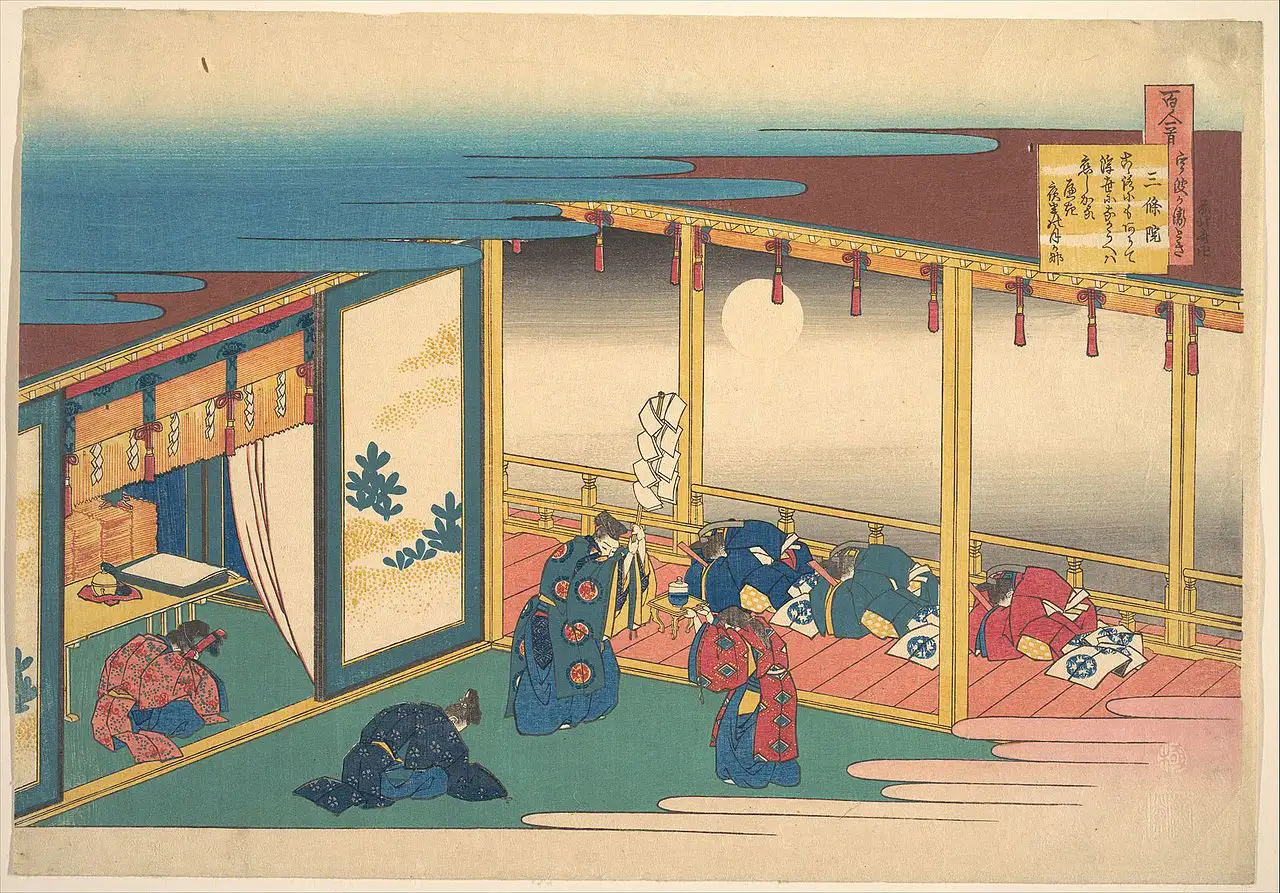
Front of the Card
Back of the Card
Japanese
English
Audio: NHK Creative Library
Read by LibriVox volunteer Larry Wilson.
Audio courtesy of LibriVox
三条院
心にも
あらで憂き世に
ながらへば
恋しかるべき
夜半の月かな
こひしかる
へきよはの
つきかな

こころに


- Poem 68
- 心にも
あらで憂き世に
ながらへば
恋しかるべき 夜半の月かな
Author: Retired Emperor Sanjō (976–1017)
Source: Go Shūi Wakashū, Miscellaneous
- English Verse Translation
- If in this troubled world of ours I still must linger on, My only friend shall be the moon,
Which on my sadness shone, When other friends were gone.
— William N. Porter, 1909
- Modern Translation
- If I live on in this painful world without purpose, I am sure I will come to miss this night and its lonely moon.
- Commentary
- Retired Emperor Sanjō wrote this when Fujiwara no Michinaga was pressing him to give up the throne. Losing his sight to an eye disease, he was in deep despair. He seems to have thought he would one day miss this time when he could still see the moon. About a month later, he decided to step down.
- About the Poet
- Sanjō was the second son of Emperor Reizei and took the throne at 36, but reigned only five years. During that time the palace burned twice and he suffered an illness that left him blind. After stepping down he became a monk and died the next year.
- Poem Illustration
-
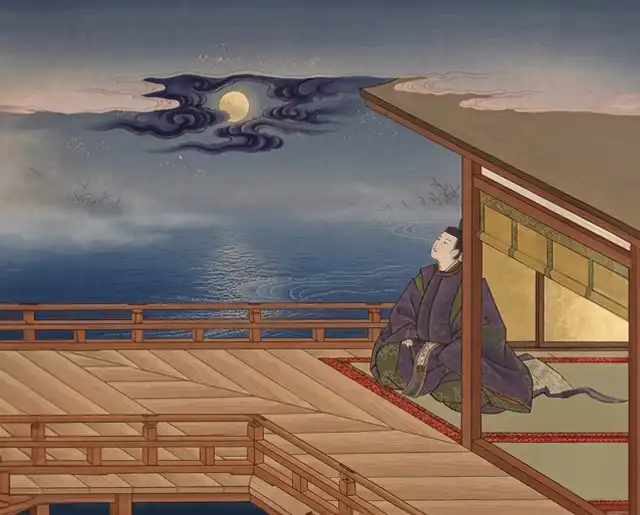
This image is based on an illustration from William N. Porter's A Hundred Verses from Old Japan, his 1909 English translation of the Hyakunin Isshu published in England, colorized and reworked using Adobe Firefly (generative AI).
- Retired Emperor Sanjō: A Short Timeline
-
- 976
- Born as a son of Emperor Reizei
- 986
- Becomes crown prince
- 1011
- Becomes emperor at age 36
- 1014
- Suffers from an eye disease
- 1016
- Hands the throne to Emperor Go-Ichijō
- 1017
- Becomes a monk and dies
- Retired Emperor Sanjō's Family Tree
-
While Emperor Sanjō was crown prince, Seishi (Sukeko) entered the court as his consort, and he loved her dearly. But Fujiwara no Michinaga brought his own daughter Kenshi (Kiyoko) into the court and made her empress (chūgū). In response, Emperor Sanjō raised Seishi to empress (kōgō) as well, and this caused friction with Michinaga. In the end Michinaga pressed the emperor to give up the throne, and the emperor stepped down on the condition that his own son, Atsuakira, be made crown prince.
But after Emperor Sanjō died, Michinaga put silent pressure on Prince Atsuakira, for example by not handing over the Tsubokiri sword, which was given to the crown prince. As a result, Prince Atsuakira himself asked to give up his place as crown prince.
Prince Atsuakira never inherited the throne, but Princess Yoshiko, the daughter of Emperor Sanjō and Kenshi, became the empress of Emperor Go-Suzaku and gave birth to Emperor Go-Sanjō, so Emperor Sanjō's bloodline carried on.
- Appendix
-
- A Poem Wishing to Gaze at the Moon to His Heart's Content
-
Retired Emperor Sanjō was so unwell that he did not know whether he would live until next autumn. So he wrote the next poem, wishing at least to take a good look at tonight's moon.
In Japanese
秋にまた 逢はむ逢はじも 知らぬ身は
こよひばかりの 月をだにみむ akinimata ahamuahajimo shiranumiha
koyohibakarino tsukiodanimimu Shika Wakashū, Retired Emperor SanjōIn English
Since I do not know whether I will see another autumn, let me at least gaze at tonight's moon to my heart's content.
- The Treatments Retired Emperor Sanjō Received
- According to the historical tale Ōkagami, as his eyesight grew worse, Retired Emperor Sanjō tried many treatments. A doctor told him to pour cold water over his hair during the coldest weeks of winter, so he poured icy water over his head, and he is also said to have taken kin'ekitan, a medicine said to bring long life. Kin'ekitan contained sulfur and mercury, which are harmful to the body, and it is thought to have made his eye disease even worse.
- Ukiyo-e by Katsushika Hokusai
-
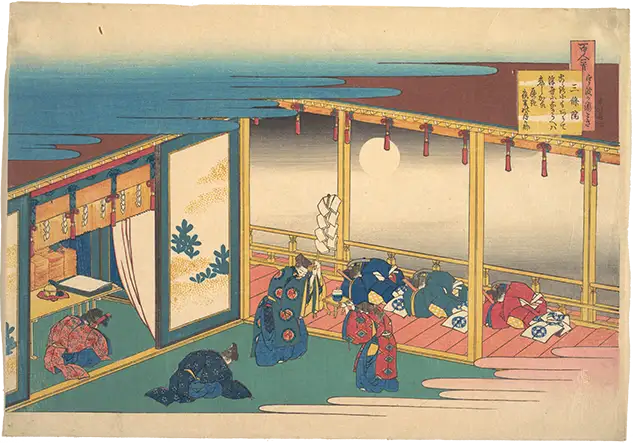
Katsushika Hokusai, CC0, via Wikimedia Commons This print is from One Hundred Poems Explained by the Nurse (Hyakunin Isshu Uba ga Etoki) by Katsushika Hokusai, an ukiyo-e artist of the Edo period. The idea of the series is a nurse explaining the Hyakunin Isshu poems with easy-to-understand pictures.
Emperor Sanjō was pressed to give up the throne because of his eye disease. We do not know what Shinto ceremony the picture shows. Perhaps it is a purification rite to pray for the recovery of his eyes.
Timeline of Emperor Sanjō
(Click to open or close.)Emperor Sanjō is born
He was born as the second son of Emperor Reizei. His mother was Chōshi, the eldest daughter of Fujiwara no Kaneie. His personal name (imina) was Okisada.
His mother, Chōshi, dies
His mother, Chōshi, died when he was 7.
Becomes crown prince
Emperor Kazan, the 65th emperor, became a monk. With the backing of his grandfather, Fujiwara no Kaneie, Sanjō became crown prince.
Kaneie's third daughter, Suishi, enters the court
Kaneie's third daughter, Suishi, entered the court as his consort. But she died young in 1004.
Seishi becomes the crown prince's consort
Seishi, the daughter of Fujiwara no Naritoki, entered the court.
Prince Atsuakira is born
His son with Fujiwara no Seishi, Prince Atsuakira, was born.
Fujiwara no Michitaka's second daughter, Genshi, enters the court
Fujiwara no Michitaka's second daughter, Genshi, entered the court. But she died young in 1002.
Takes the throne as the 67th emperor
At 36 he finally took the throne.
Michinaga's second daughter, Kenshi, enters the court
Because Michinaga made Kenshi empress (chūgū), Emperor Sanjō made Seishi empress (kōgō).
With two empresses at once, friction with Michinaga arose.Princess Yoshiko is born
His daughter with Kenshi, Princess Yoshiko, was born.
Eye disease; the palace burns
In his diary, the Shōyūki, Fujiwara no Sanesuke wrote of Emperor Sanjō's condition: "One eye cannot see, one ear cannot hear."
Before long, Fujiwara no Michinaga began pressing him again and again to give up the throne because of his eye disease.The palace burns
The palace was hit by fire again.
Gives up the throne
Emperor Sanjō gave up the throne on the condition that his son, Prince Atsuakira, be made crown prince, and passed it to Emperor Go-Ichijō.
Fujiwara no Michimasa's affair with Sanjō's daughter, Princess Masako, is discovered
Fujiwara no Michimasa's secret affair with Sanjō's daughter, Princess Masako, who had been the Ise priestess, was discovered.
Retired Emperor Sanjō forbade Michimasa to come to court.Retired Emperor Sanjō dies
In despair over his eye disease, the burning of the palace, his conflict with Michinaga, and Michimasa's affair with his daughter Princess Masako, he became a monk in the fourth month and died the next month, at 42.
Prince Atsuakira gives up his place as crown prince
After Retired Emperor Sanjō died, Prince Atsuakira gave up his place as crown prince in the eighth month of 1017.
He was given the title Koichijō-in and treated as an honorary retired emperor.