Front of the Card
Back of the Card
Japanese
English
Audio: NHK Creative Library
Read by LibriVox volunteer Larry Wilson.
Audio courtesy of LibriVox
源兼昌
淡路島
かよふ千鳥の
鳴く声に
幾夜寝覚めぬ
須磨の関守
いくよねさ
めぬすまの
せきもり

あわぢ


- Poem 78
- 淡路島
かよふ千鳥の
鳴く声に
幾夜寝覚めぬ 須磨の関守
Author: Minamoto no Kanemasa (dates unknown)
Source: Kin'yō Wakashū, Winter
- English Verse Translation
- Between Awaji and the shore The birds scream in their flight Full oft they've made the Suma
Guard Toss through a sleepless night, Until the morning light.
— William N. Porter, 1909
- Modern Translation
- The cry of the plovers flying between Awaji Island — how many nights have I lain awake listening to them at the Suma Barrier?
- Commentary
- The Kin'yō Wakashū says this was written on the theme "plovers on the barrier road." Suma is where Hikaru Genji withdrew into exile in The Tale of Genji. There Genji hears plovers and writes of sleeping alone, and this poem is thought to draw on that scene.
- About the Poet
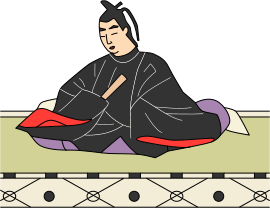
- Minamoto no Kanemasa was a descendant of Emperor Uda but stayed at a low rank. He made his name as a poet and wrote for the Eikyū Hyakushu, a set of a hundred poems ordered by Emperor Toba.
- Poem Illustration
-
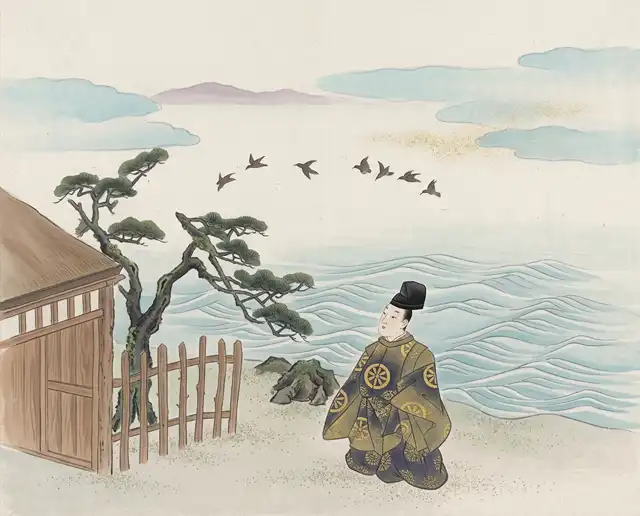
This image is based on an illustration from William N. Porter's A Hundred Verses from Old Japan, his 1909 English translation of the Hyakunin Isshu published in England, colorized and reworked using Adobe Firefly (generative AI).
- Minamoto no Kanemasa: A Short Timeline
-
- 1100
- Takes part in the poetry contest at the home of Lord Kuninobu
- 1116
- Becomes one of the poets of the Eikyū Hundred-Poem Sequence
- 1118
- Takes part in the poetry contest at the home of Palace Minister Tadamichi
- c. 1128
- Takes part in the Sumiyoshi Poetry Contest
- Minamoto no Kanemasa's Family Tree
-
Minamoto no Kanemasa was a descendant of the Uda Genji, the Minamoto line founded by Emperor Uda.
His father, Minamoto no 俊輔 (reading of the name unknown), served as Assistant Governor of Mino.
Kanemasa's final post and rank were Junior Secretary of the Empress's Household and Junior Fifth Rank, Lower Grade.
- Appendix
-
- The Cry of the Plover
- This recording was not made at Suma. It is the cry of a shore bird.
- Hikaru Genji's Poem
- In this poem, Hikaru Genji hears the plovers crying at Suma and writes of the loneliness of sleeping alone.
In Japanese
友千鳥 諸声になく 暁は
ひとり寝覚めの 床も頼もし tomochidori morokoeninaku akatsukiha
hitorinezameno tokomotanomoshi The Tale of Genji, Hikaru GenjiIn English
At dawn, when the flock of plovers cries together with me,
even the bed where I wake up alone feels less lonely."Naku" means both "(birds) cry" and "(people) weep."
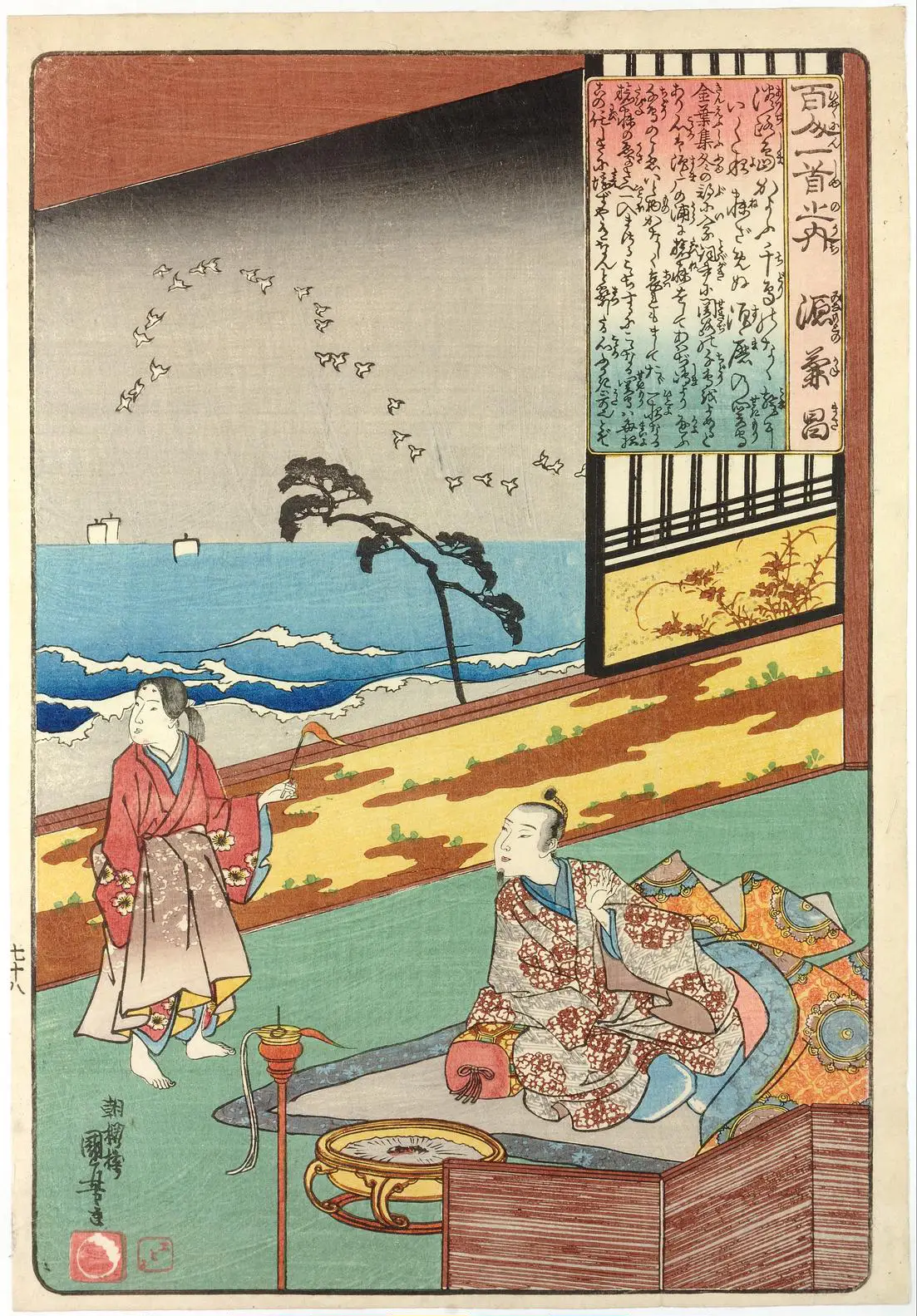
- Utagawa Kuniyoshi's Hyakunin Isshu no Uchi
-
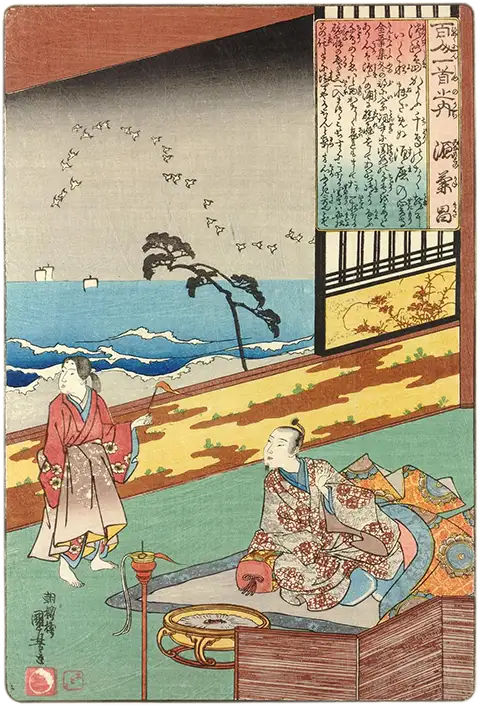
British Museum, Public domain, via Wikimedia Commons An ukiyo-e print on the Hyakunin Isshu by Utagawa Kuniyoshi, an ukiyo-e artist of the Edo period. Matching the world of the poem, it shows plovers flying over the seashore.