


Local Government System (Chihō Kansei, 地方官制)
Under the ritsuryō system — the legal and administrative code that governed Japan from the late 7th century — the central government in Heiankyō (Kyoto) deployed offices and officials throughout the country to govern the provinces. The system centred on the kokushi (provincial governors) dispatched to each province, supported by gunji (district officials) and special agencies, forming a nationwide administrative structure.
Provincial Governors (Kokushi, 国司)
The kokushi followed the four-tier official structure (shitōkan, 四等官). This same four-tier hierarchy — chief, deputy, controller, and recorder — applied to every government office under the ritsuryō system, with each office using its own specific kanji for the titles.
| Tier | Provincial title | Duties |
| Kami (長官, Chief) | 守 | Supreme authority over ceremonies, administration, justice, and military affairs. |
| Suke (次官, Deputy) | 介 | Assists the chief. |
| Jō (判官, Controller) | 大掾 > 少掾 | Review of official documents. |
| Sakan (主典, Recorder) | 目 | Drafting and recording official documents. |
Provincial Grades
Each province was graded according to its productive capacity as Taikoku (大国, Major), Jōkoku (上国, Upper), Chūkoku (中国, Middle), or Gekoku (下国, Lower).
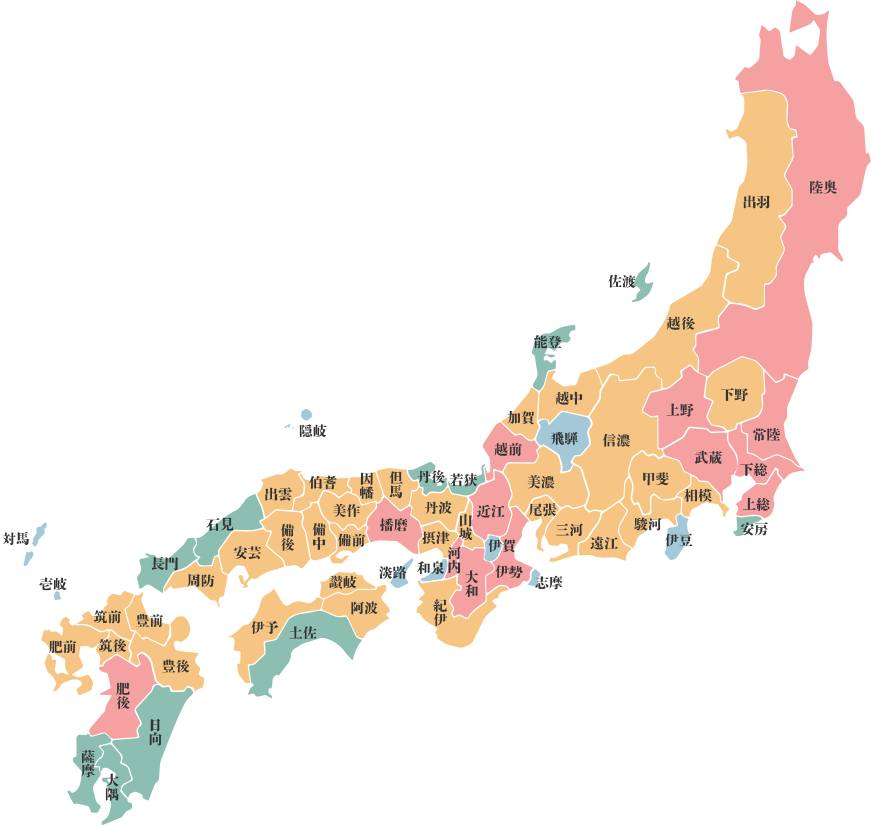
Court Ranks and Provincial Offices
Each official held a court rank (位階, ikai), a numbered grade that determined their place in the imperial hierarchy. Ranks ran from 1st (highest) to 8th (lowest), and each rank was divided into Senior (正, shō) and Junior (従, ju), then further into Upper (上) and Lower (下) — giving 30 grades in total. The office an official could be appointed to depended on their rank, and the requirements also varied by the grade of the province.
| Court Rank | Major Province | Upper Province | Middle Province | Lower Province | |
| Jr. 5th | Upper | 守 | |||
| Jr. 5th | Lower | 守 | |||
| Sr. 6th | Upper | ||||
| Sr. 6th | Lower | 介 | 守 | ||
| Jr. 6th | Upper | 介 | |||
| Jr. 6th | Lower | 守 | |||
| Sr. 7th | Upper | ||||
| Sr. 7th | Lower | 大掾 | |||
| Jr. 7th | Upper | 少掾 | 掾 | ||
| Jr. 7th | Lower | ||||
| Sr. 8th | Upper | 掾 | |||
| Sr. 8th | Lower | ||||
| Jr. 8th | Upper | 大目 | |||
| Jr. 8th | Lower | 少目 | 目 | ||
| Daishōi (大初位, Sr. Initial) | Upper | ||||
| Daishōi (大初位, Sr. Initial) | Lower | 目 | |||
| Shōshōi (少初位, Jr. Initial) | Upper | 目 | |||
| Shōshōi (少初位, Jr. Initial) | Lower | ||||
Trivia
Provincial governors (kokushi) were originally expected to travel to their assigned province and personally carry out its administration. In the Heian period, however, some governors began to remain in the capital without traveling to their post, leaving local administration to a deputy instead. This practice of a governor remaining in the capital is called yōnin (遥任), and the deputy who carried out local administration in the governor's place is called mokudai (目代).
- Yōnin (遥任): The practice of a provincial governor remaining in the capital instead of traveling to his assigned province.
- Mokudai (目代): A deputy who carried out local administration in place of a governor serving under yōnin. Where no mokudai was appointed, officials who did travel to the post — such as the suke (介, deputy), jō (掾, controller), or sakan (目, secretary) — took on the administrative duties instead.
District Officials (Gunji, 郡司)
Under the Taihō Codes, each province was divided into the three-level administrative hierarchy of province, district (gun), and village (ri; later gō). The gunji worked under the kokushi to handle the administration, tax collection, and minor judicial matters of the district (roughly equivalent to a modern county). Positions were filled by locally influential figures with knowledge of the area, held for life, and in practice often passed down hereditarily.
Offices Overseeing Local Administration
| Agency | Description |
| Azechishi (按察使) | A ryōge no kan (令外官) established to oversee the provincial governors (kokushi). Created in the Nara period, the Azechishi investigated whether governors were properly carrying out their duties and inspected the conditions and daily lives of the local population. Posts were initially established throughout the provinces, but appointments gradually ceased, and by the Heian period the office came to be limited mainly to provinces such as Mutsu and Dewa. In time, senior officials such as dainagon (Upper Counselors) increasingly held the post concurrently, and its practical role of overseeing the provinces in person was lost. Meanwhile, in the Heian period the Kageyushi was established to audit the handover of provincial governorships, taking over part of the function of supervising local administration. The Azechi Dainagon who appears in The Tale of Genji was a Dainagon who held the post of Azechishi concurrently. |
| Kageyushi (勘解由使) | A special inspector established in the early Heian period by Emperor Kanmu to oversee the handover of provincial offices when governors changed. Outgoing governors were required to submit a geyuijō (解由状, a formal transfer-of-office document) to the incoming governor, and the Kageyushi verified these records to prevent corruption. The Kageyushi was a ryōge no kan (令外官) — an office not stipulated in the original ritsuryō codes but established by imperial decree as the need arose. |
Agencies Governing Specific Regions
| Agency | Description |
| Dazaifu (大宰府) | The government headquarters for Kyushu, located in Chikuzen Province. Because Kyushu was both distant from the capital and closest to the Korean Peninsula and China, it served as Japan's front line for foreign affairs, coastal defence, and international trade. The Dazaifu also supervised the kokushi of all Kyushu provinces, functioning as a regional government in its own right — so much so that it was nicknamed Tō no Mikado (遠の朝廷), "the far court." Like the central ministries, it followed the four-tier shitōkan structure, though with its own titles: the sōchi (帥, chief) was typically a high-ranking noble who remained in the capital, leaving the dainī (大弐, deputy) as the actual administrator on the ground. |