


Security and Police Offices
In the Heian capital, separate offices were responsible for guarding the palace, inspecting officials, and maintaining public order in the city. The Rokuefu guarded the palace, the Danjōdai oversaw officials, and the Kebiishi handled police and judicial functions in the capital.
The Six Guards (Rokuefu, 六衛府)
The Rokuefu was the collective name for the six palace guard agencies — each of the three guard offices (Konoefu, Emonfu, and Hyōefu) was divided into a Left and Right branch. By the early Heian period, this six-agency system of palace security was firmly established. Their duties included escorting the emperor, guarding palace gates, and patrolling the palace grounds.
The palace was organized as two nested enclosures: the Dairi (the emperor's private residential compound) sat at the center, surrounded by the larger Daidairi (the greater palace complex containing government offices and ceremonial halls). Each guard agency was assigned a specific zone, as shown in the diagram below:
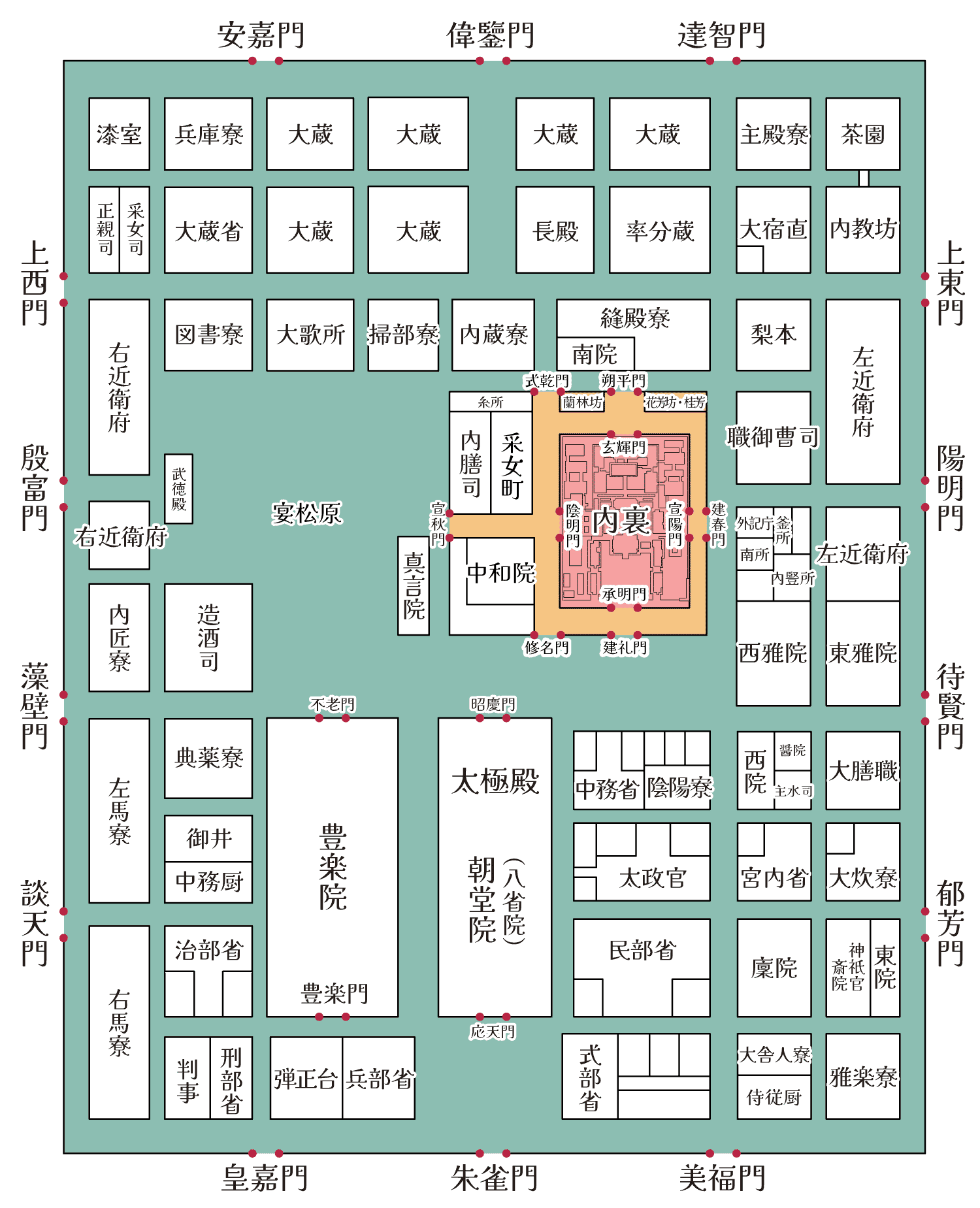
Konoefu (近衛府) — Imperial Bodyguard
Established in the Nara period, the Konoefu was a ryōgenokan (an office created outside the ritsuryō legal codes). It had a Left division (Sakonoefu) and a Right division (Ukonoefu). The guards patrolled inside the Dairi and escorted the emperor during imperial processions.
Emonfu (衛門府) — Palace Gate Guard
The Emonfu patrolled the Daidairi and escorted the emperor during imperial processions. It had a Left division (Saemonfu) and a Right division (Uemonfu).
Hyōefu (兵衛府) — Dairi Perimeter Guard
The Hyōefu guarded the perimeter around the Dairi and escorted the emperor and crown prince during processions. It had a Left division (Sahyōefu) and a Right division (Uhyōefu).
Danjōdai (弾正台) — Inspector General's Office
The Danjōdai was responsible for investigating misconduct among officials and enforcing public morals and order within the capital. After the Kebiishi was established, the Danjōdai's role was absorbed by that office, and it became largely ceremonial.
Kebiishi (検非違使) — Capital Police
The Kebiishi was a ryōgenokan (an office created outside the ritsuryō legal codes), established during the reign of Emperor Saga to maintain public order in the capital. Over time it absorbed functions previously handled by the Gyōbushō (Ministry of Justice), the Danjōdai, and the Kyōshiki (Capital Office), and also took on judicial responsibilities. Officials from the Emonfu were frequently appointed to the Kebiishi.
The Kebiishi's field operatives included a group known as the hōmen (放免). Composed mainly of former criminals, their familiarity with the underworld made them well suited for tracking down suspects, making arrests, and conducting interrogations.
Trivia
In the Yamato court, the guards (eji) who defended the palace gates carried a quiver called a yugi (靫) on their backs, and this guard duty came to be known as yugei (靫負).
Under the ritsuryō system, the Emonfu, which was responsible for guarding the palace gates, inherited this tradition and was also known as the "Yugei no Tsukasa."
The Tale of Genji features characters known as the "Yugei no Myōbu" and the "Yugei no Jō." The Yugei no Myōbu is thought to have been a woman from a family associated with the Emonfu, who held the title of Myōbu, a designation used for women of Fifth Rank or higher and for wives of officials of Fifth Rank or higher. The Yugei no Jō refers to a Jō, a third-ranking official, in the Emonfu.