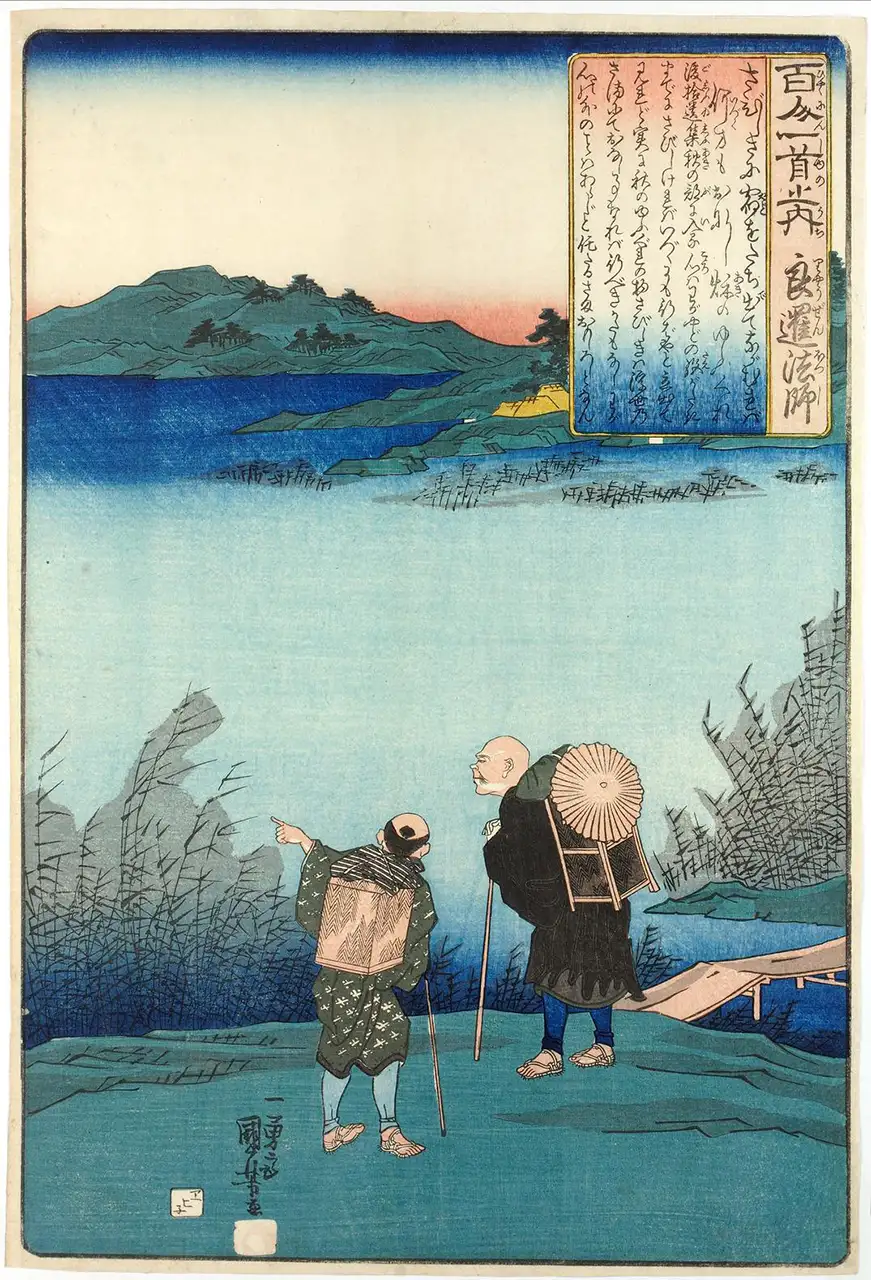
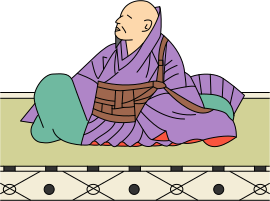
Front of the Card
Back of the Card
Japanese
English
Audio: NHK Creative Library
Read by LibriVox volunteer Larry Wilson.
Audio courtesy of LibriVox
良暹法師
さびしさに
宿を立ち出でて
ながむれば
いづくも同じ
秋の夕暮
いつくもお
なしあきの
ゆふくれ

さ


- Poem 70
- さびしさに
宿を立ち出でて
ながむれば
いづくも同じ 秋の夕暮
Author: Priest Ryōzen (dates unknown)
Source: Go Shūi Wakashū, Autumn
- English Verse Translation
- The prospect from my cottage shows No other hut in sight; The solitude depresses me, Like
deepening twilight On a chill autumn night.
— William N. Porter, 1909
- Modern Translation
- Feeling lonely, I stepped outside to gaze at the view — and everywhere I looked, it was the same twilight of autumn.
- Commentary
- The Shika Wakashū says this was written when Ryōzen, a monk of Mount Hiei, began living in Ōhara, a quiet place with few people. Lonely, he went out of his hut, only to find beauty in the empty autumn dusk. After this poem, ending a waka with "autumn dusk" became popular.
- About the Poet
- Ryōzen was a monk of Enryaku-ji on Mount Hiei and head of Gion Shrine (now Yasaka Shrine). He is said to have later lived quietly in Ōhara.
- Poem Illustration
-
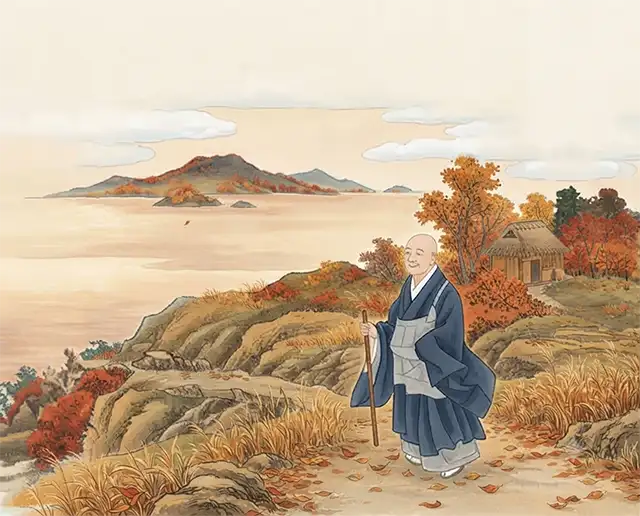
This image is based on an illustration from William N. Porter's A Hundred Verses from Old Japan, his 1909 English translation of the Hyakunin Isshu published in England, colorized and reworked using Adobe Firefly (generative AI).
- Priest Ryōzen: A Short Timeline
-
- 1038
- Takes part in poetry contests, including one at the home of Acting Upper Counselor Morofusa
- Date of death unknown
- One theory says he died around the Kōhei era (1058–1065)
- Notes
-
- As a monk of Mount Hiei, served as head of Gion Shrine
- Said to have lived quietly in Ōhara and spent his last years at Urin-in Temple
- Appendix
-
- The Three Evening Poems (Sanseki no Uta)
- The following three poems in the Shin Kokin Wakashū, each ending with "aki no yūgure" (autumn dusk), are praised as the "Three Evening Poems."
Jakuren
In Japanese
さびしさは その色としも なかりけり
まき立つ山の 秋の夕暮れ sabishisaha sonoirotoshimo nakarikeri
makitatsuyamano akinoyuugure Shin Kokin Wakashū, JakurenIn English
Loneliness does not come from any one color (such as the color of autumn leaves). I feel it in the (colorless) autumn dusk on a mountain where evergreens (maki) stand.
Saigyō
In Japanese
心なき 身にもあはれは 知られけり
鴫立つ沢の 秋の夕暮れ kokoronaki minimoahareha shirarekeri
shigitatsusawano akinoyuugure Shin Kokin Wakashū, SaigyōIn English
Even I, who gave up feeling when I became a monk, am deeply moved by the stillness of autumn dusk over the marsh after a snipe (shigi) has flown up.
Fujiwara no Sadaie
In Japanese
見渡せば 花も紅葉もなかりけり
浦の苫屋の 秋の夕暮れ miwataseba hanamomomijimonakarikeri
uranotomayano akinoyuugure Shin Kokin Wakashū, Fujiwara no SadaieIn English
Looking around, I see neither blossoms nor autumn leaves. All that meets my eyes is the autumn dusk on the shore, with only rough huts thatched with rushes (toma).
- Utagawa Kuniyoshi's Hyakunin Isshu no Uchi
-
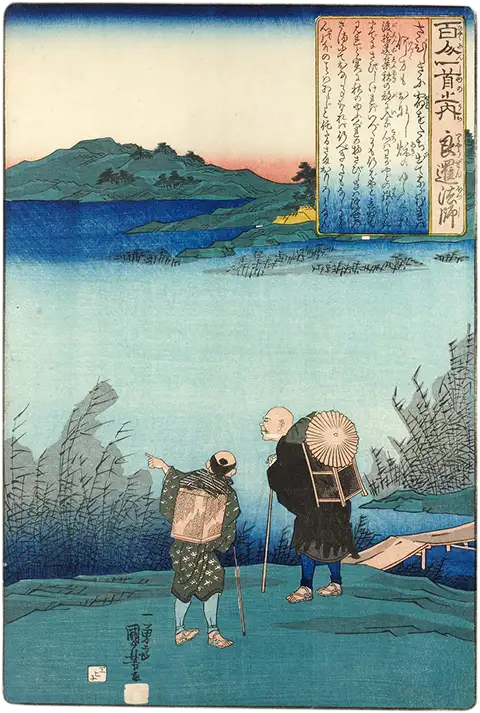
British Museum, Public domain, via Wikimedia Commons This ukiyo-e print is by Utagawa Kuniyoshi, an artist of the Edo period.
It shows a scene to go with the Hyakunin Isshu poem.