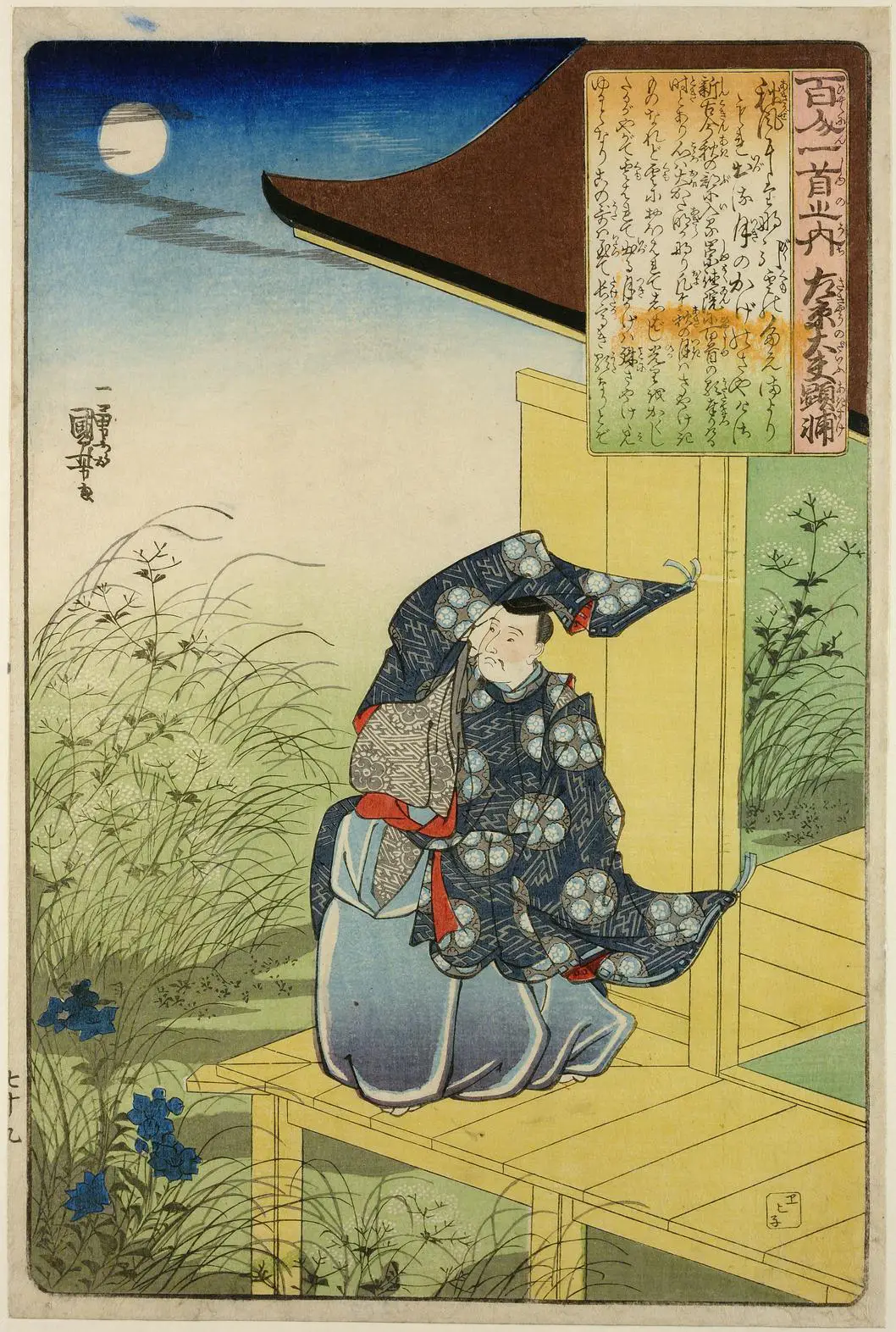
Front of the Card
Back of the Card
Japanese
English
Audio: NHK Creative Library
Read by LibriVox volunteer Larry Wilson.
Audio courtesy of LibriVox
左京大夫顕輔
秋風に
たなびく雲の
たえ間より
もれいづる月の
影のさやけさ
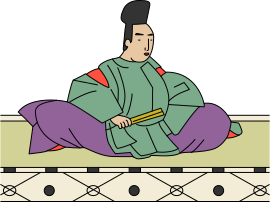
もれいつる
つきのかけ
のさやけさ

あきか


- Poem 79
- 秋風に
たなびく雲の
たえ間より
もれいづる月の 影のさやけさ
Author: Master of the Left Capital Akisuke (1090–1155)
Source: Shin Kokin Wakashū, Autumn
- English Verse Translation
- See how the wind of autumn drives The clouds to left and right, While in between the moon
peeps out, Dispersing with her light The darkness of the night.
— William N. Porter, 1909
- Modern Translation
- Through the gaps in the clouds trailing in the autumn wind, the moonlight filters through, so clear and still.
- Commentary
- The Shin Kokin Wakashū says this was one of a hundred poems presented to Retired Emperor Sutoku for the Kyūan Hyakushu.
- About the Poet
- Fujiwara no Akisuke was a famous poet of the late Heian period, son of Fujiwara no Akisue, founder of the Rokujō poetry family. Sutoku had him compile the Shika Wakashū. His son Kiyosuke helped, yet none of Kiyosuke's poems were included, which is said to show tension between them. Akisuke reached the high rank of Senior Third Rank.
- Poem Illustration
-
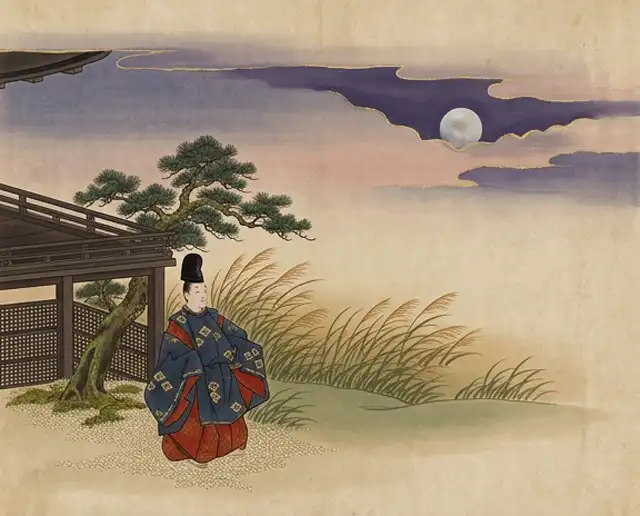
This image is based on an illustration from William N. Porter's A Hundred Verses from Old Japan, his 1909 English translation of the Hyakunin Isshu published in England, colorized and reworked using Adobe Firefly (generative AI).
- Fujiwara no Akisuke: A Short Timeline
-
- 1090
- Born as a son of Fujiwara no Akisue
- 1100
- Becomes an official in Retired Emperor Shirakawa's office
- 1137
- Given Junior Third Rank
- 1151
- Presents the Shika Wakashū, which he compiled at Retired Emperor Sutoku's order
- 1155
- Dies
- Fujiwara no Akisuke's Family Tree
-
Fujiwara no Akisuke was the second head of the Rokujō family (Rokujō Tōke), a leading family of poets founded by his father, Fujiwara no Akisue. The name "Rokujō Tōke" comes from Akisue's home at Rokujō Karasuma in Kyoto.
Akisuke was chosen by Retired Emperor Sutoku to compile the Shika Wakashū. He had his son, Fujiwara no Kiyosuke, help with the work, but it is said that Kiyosuke's opinions were hardly ever accepted, and that father and son did not get along. Even so, in the year of his death, Akisuke gave Kiyosuke the portrait of Hitomaro used in the Hitomaro eigu ceremony, which was the sign of the family's main heir.
At the end of the Heian period, the Rokujō family, which valued traditional poetry, and the Mikohidari family, which pushed for new styles, competed to lead the poetry world. The Rokujō family was at its height in the time of Akisuke and Kiyosuke, but after that it produced fewer and fewer poets, and the Mikohidari family flourished instead.
Akisuke also took a poet-monk, Kenshō, as his adopted son (yūshi). Kenshō left many commentaries on waka and books on poetry.
- Appendix
-
- A Poem About a Lover
- This poem is in the Kin'yō Wakashū.
In Japanese
逢ふと見て うつつの甲斐は なけれども
はかなき夢ぞ 命なりける afutomite utsutsunokaiha nakeredomo
hakanakiyumezo inochinarikeru Kin'yō Wakashū, Fujiwara no AkisukeIn English
Even if I meet my love in a dream, nothing changes in real life;
yet that fleeting dream is my very life. - A Poem About the Moon on the Water
- Akisuke seems to have seen the moon reflected on the water at the foot of tall reeds and compared it to himself, stuck in a low position without promotion. This poem is in the Shika Wakashū.
In Japanese
難波江の 蘆間に宿る 月みれば
我が身ひとつも 沈まざりけり naniwaeno ashimaniyadoru tsukimireba
wagamihitotsumo shizumazarikeri Shika Wakashū, Fujiwara no AkisukeIn English
Looking at the moon reflected on the water between the reeds of Naniwa Bay,
I realized I am not the only one sunk low. - A Poem Like the "Spring Is Dawn" Scene of The Pillow Book
- This poem reads like a waka version of the scene at the start of The Pillow Book (Makura no Sōshi): "In spring, it is the dawn. The sky above the mountains slowly grows light, and thin purple clouds trail across it." It is in Akisuke's personal collection, the Akisuke-shū.
In Japanese
月影に たづねきつれば ほととぎす
鳴く山の端に 横雲わたる tsukikageni tazunekitsureba hototogisu
nakuyamanohani yokogumowataru Akisuke-shūIn English
When I came looking by the light of the moon,
clouds were trailing sideways along the ridge where the hototogisu (cuckoo) sang. - A Poem Borrowing from "Aki no ta no..."
- Akisuke wrote a poem using honkadori (borrowing from an older poem) on Emperor Tenji's poem.
This poem, too, is about moonlight leaking through.In Japanese
秋の田に 庵さす賤の 苫をあらみ
月とともにや もり明すらん akinotani iosasushizuno tomaoarami
tsukitotomoniya moriakasuran Shin Kokin Wakashū, Fujiwara no AkisukeIn English
The farmer who builds a hut by the autumn rice field has a roof of coarsely woven rush mats,
so he will spend the night until dawn with the moonlight shining in. - Utagawa Kuniyoshi's Hyakunin Isshu no Uchi
-
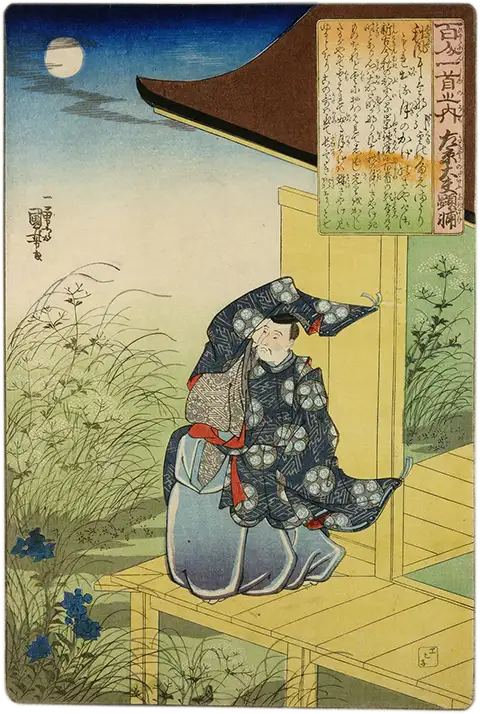
British Museum, Public domain, via Wikimedia Commons An ukiyo-e print by Utagawa Kuniyoshi, an ukiyo-e artist of the Edo period.
It shows a scene that matches the Hyakunin Isshu poem. - The Hitomaro Eigu Ceremony
- A ceremony started by Fujiwara no Akisue, founder of the Rokujō family, to honor Kakinomoto no Hitomaro, the "saint of poetry." A portrait of Hitomaro was hung and poems were offered to it, so that poets would take Hitomaro's poems as their model and work hard at waka. In the Rokujō family, inheriting the portrait of Hitomaro was the sign of the main heir.