


Front of the Card
Back of the Card
Japanese
English
Audio: NHK Creative Library
Read by LibriVox volunteer Larry Wilson.
Audio courtesy of LibriVox
藤原清輔朝臣
長らへば
またこのごろや
しのばれむ
憂しと見し世ぞ
今は恋しき
うしとみし
よそいまは
こひしき

ながら


- Poem 84
- 長らへば
またこのごろや
しのばれむ
憂しと見し世ぞ 今は恋しき
Author: Fujiwara no Kiyosuke Ason (1104–1177)
Source: Shin Kokin Wakashū, Miscellaneous
- English Verse Translation
- Time was when I despised my youth, As boyhood only can; What would I give for boyhood now,
When finishing life's span An old decrepid man!
— William N. Porter, 1909
- Modern Translation
- If I live on long enough, perhaps even these painful days will become dear to me, as something I once longed to leave behind.
- Commentary
- The Kiyosuke Shū says this was sent to the Sanjō Palace Minister while he was still a Middle Captain, thought to be Fujiwara no Kinnori. One theory says Kiyosuke wrote it to cheer him up, as he had been stuck at that rank for years.
- About the Poet
- Fujiwara no Kiyosuke was the son of Fujiwara no Akisuke, compiler of the Shika Wakashū, but because of tension between them, none of Kiyosuke's poems were included. Later, Emperor Nijō had him compile the Shoku Shika Wakashū, but the emperor died just before it was presented, and it was never made official.
- Poem Illustration
-
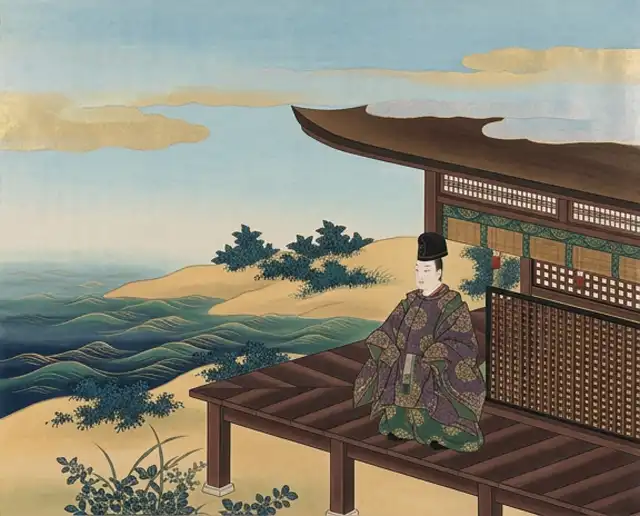
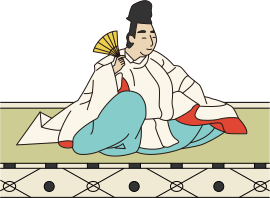
This image is based on an illustration from William N. Porter's A Hundred Verses from Old Japan, his 1909 English translation of the Hyakunin Isshu published in England, colorized and reworked using Adobe Firefly (generative AI).
- Fujiwara no Kiyosuke: A Short Timeline
-
- 1104
- Born as a son of Fujiwara no Akisuke
- 1124–1144
- Writes the Ōgishō, a book on poetry
- 1144
- Helps his father compile the Shika Wakashū
- 1155
- Receives the Hitomaro portrait ceremony from his father and becomes head of the Rokujō poetry family
- 1160s
- Compiles the Shoku Shika Wakashū, but it does not become an imperial anthology because Emperor Nijō dies
- 1177
- Dies
- Fujiwara no Kiyosuke's Family Tree
-
Fujiwara no Kiyosuke was the third head of the Rokujō family (Rokujō Tōke), a family of poets founded by Fujiwara no Akisue. The name "Rokujō Tōke" comes from Akisue's home at Rokujō Karasuma in Kyoto.
Fujiwara no Akisuke (Master of the Left Capital Akisuke) was Kiyosuke's father, but the two did not get along. When Akisuke compiled the Shika Wakashū, it is said that the opinions of Kiyosuke, who helped him, were hardly ever accepted, and so father and son are said to have been at odds. Even so, in the year of Akisuke's death, Kiyosuke received from him the portrait of Hitomaro used in the Hitomaro eigu ceremony, which was the sign of the family's main heir.
At the end of the Heian period, the Rokujō family, which valued traditional poetry, and the Mikohidari family, which pushed for new styles, competed to lead the poetry world. The Rokujō family was at its height in the time of Akisuke and Kiyosuke, but after that it gradually declined. The Mikohidari family, on the other hand, kept producing strong poets and led the poetry world for a long time.
Kiyosuke's Hyakunin Isshu poem was sent to his cousin, Fujiwara no Kinnori.
- Appendix
-
- Fukuro Zōshi
- The Fukuro Zōshi is a book on poetry by Fujiwara no Kiyosuke. It describes the manners of poetry gatherings, advice on composing poems, stories about famous poets, and more.
- Ōgishō
- The Ōgishō is a three-volume book on poetry by Fujiwara no Kiyosuke. It covers the uses and history of waka, notes on about 260 poems from the Man'yōshū to the Goshūi Wakashū, the rikugi (six styles of expression in waka), honkadori (borrowing from an older poem), pillow words (makurakotoba), poetic vocabulary, and more.