


Court Ranks (位階, ikai) and
the Eight Hereditary Titles (八色の姓, Yakusa no Kabane)
In the Heian court, rank was everything. Every official was assigned a rank called ikai (court rank), which determined their position, authority, and career prospects.
Under the kani-sōtō system — which determined eligibility for office based on rank — court rank functioned as the primary measure of an official’s standing and opportunities for advancement.
This page explains the structure of court ranks and the Eight Hereditary Titles (Yakusa no Kabane), which formed the foundation of that system.
For the table showing the correspondence between offices and court ranks (kani-sōtō-hyō), see the Central Government Structure (Two Offices, Eight Ministries) page.
Court Rank (位階, ikai)
Court rank defined each official’s position within the bureaucratic hierarchy. There were a total of 30 ranks, and the upper 14 — from Shō-ichii (Senior First Rank) down to Jū-gonoi-ge (Junior Fifth Rank, Lower Grade) — constituted the aristocracy.
Eligibility for office was strictly determined by rank, and promotion opened the way to more prestigious positions.
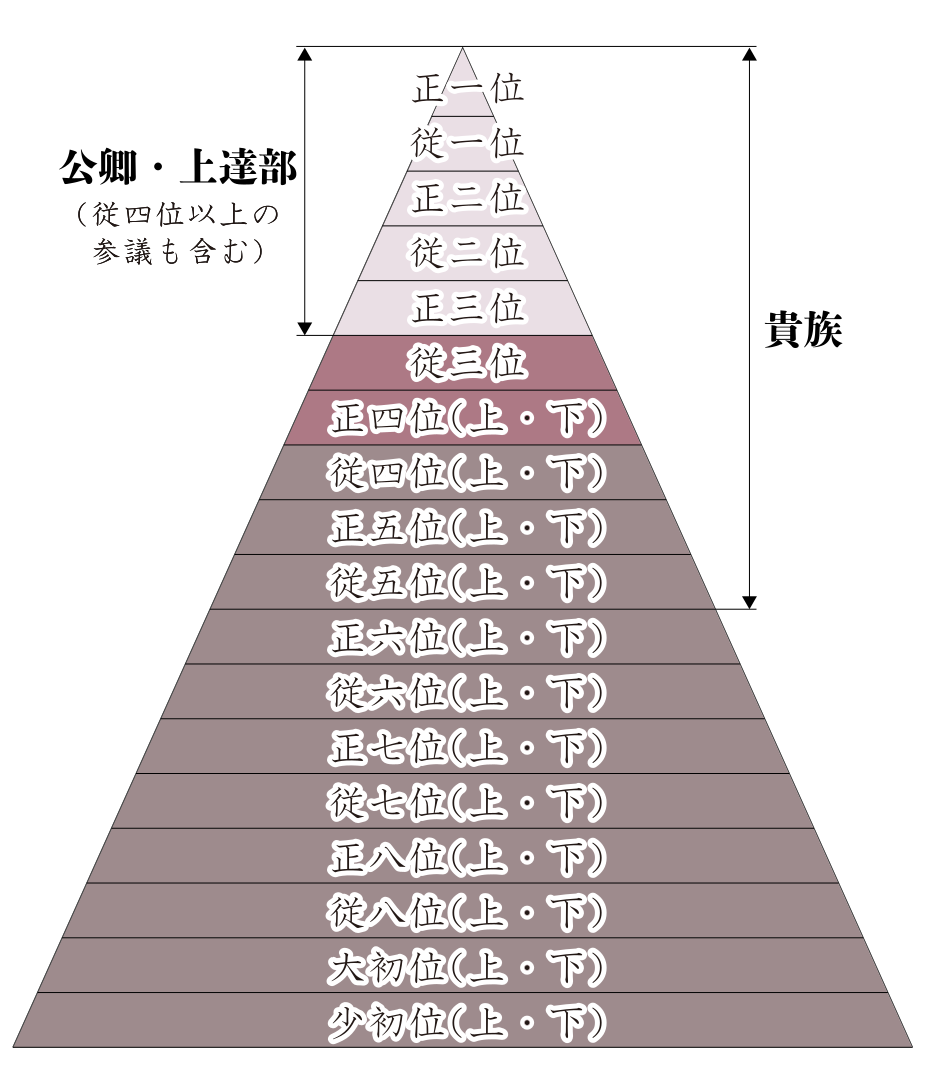
However, an unequal system known as On'i no Sei (the Hereditary Privilege System) gave children of high-ranking officials a significant advantage, making upward mobility across generations difficult. The gap between the Fifth and Sixth Rank was especially large, with income differences exceeding four times.
The Hereditary Privilege System (蔭位の制, On'i no Sei)
Under the On'i no Sei, if a father or grandfather held a rank between First and Fifth, their children were granted a relatively high rank upon coming of age (around 21) and could begin their careers at that level.
The table below shows the ranks granted to children and grandchildren based on the father's rank. By contrast, those outside this system — even those who had completed advanced studies — generally started at Senior Eighth Rank and could not receive their first promotion until age 25 or later.
| Father's rank | Child's starting rank | Grandchild's starting rank |
| First Rank | Junior Fifth Rank, Lower Grade | Senior Sixth Rank, Upper Grade |
| Second or Third Rank | Sixth–Seventh Rank | |
| Fourth Rank | Seventh–Eighth Rank | |
The Foundation of Court Rank: The Eight Hereditary Titles (八色の姓, Yakusa no Kabane)
In the Heian period, holding a court rank appropriate to one's office was essential. A person’s initial rank was largely determined by their Yakusa no Kabane — the Eight Hereditary Titles.
These titles were established by Emperor Tenmu to shift political power away from regional clan leaders and centralize it under the imperial court. Before this reform, clans had adopted their own kabane in an unstructured and inconsistent manner.
The new system reorganized these titles into eight ranks based on proximity to the imperial family.
The table below lists the Eight Hereditary Titles in order of precedence.
| Title (kabane) | Description |
| 真人 (Mahito) | The highest title, granted to those closest to the imperial family. |
| 朝臣 (Ason) | The title associated with the Heian aristocracy, borne by major clans such as the Fujiwara, Minamoto, Taira, and Sugawara. |
| 宿禰 (Sukune) | Granted to long-established and influential clans such as the Ōtomo and Ki families. |
| 忌寸 (Imiki) | Often granted to clans of immigrant origin who brought advanced knowledge and skills from the continent. |
| 道師 (Michino-shi) | A title that was rarely, if ever, conferred in practice. |
| 臣 (Omi) | Clans of the former omi class who did not qualify for the Ason title. |
| 連 (Muraji) | Clans of the former muraji class who did not qualify for the Sukune title. |
| 稲置 (Inagi) | Local administrative leaders such as the kuni no miyatsuko. |
These titles came to indicate a clan’s hereditary status (kakaku), effectively determining how far its members could rise within the court hierarchy.
For the table of corresponding ranks and offices (kani-sōtō-hyō) and an explanation of the four-tier office structure (shitōkan), see the Central Government Structure (Two Offices, Eight Ministries) page.