


Central Government Structure: The Two Offices and Eight Ministries (Nikan-Hasshō)
Imagine a system of government in which religious authority and political power stood side by side under the emperor. This was the structure of the Heian court.
This system was known as 二官八省 — the "Two Offices and Eight Ministries."
Beneath the emperor were two parallel institutions: the 神祇官 (Office of Shinto), responsible for state religious rites, and the 太政官 (Grand Council of State), which directed national governance. Eight ministries operated under the authority of the Dajōkan.
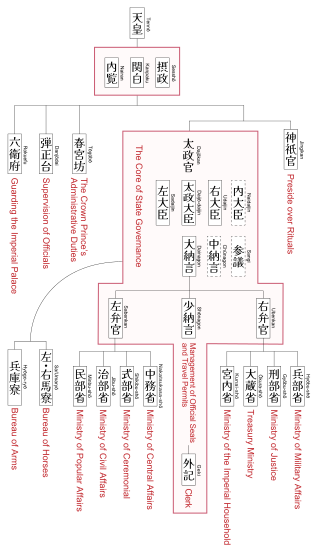
The Two Offices (Nikan)
Jingikan (神祇官) — Office of Shinto
The Jingikan oversaw state religious ceremonies and supervised Shinto priests throughout the country. In the formal ritsuryō system, it stood alongside the Dajōkan as an institution parallel under the emperor. In practice, however, the Dajōkan exercised far greater political influence.
Dajōkan (太政官) — Grand Council of State
The Dajōkan was the central governing body of the Heian state. Unlike modern systems based on the separation of powers, it concentrated executive, legislative, and judicial authority in a single institution.
Its senior officials — including the daijō-daijin, sadaijin, udaijin, as well as senior and middle counselors (dainagon, chūnagon) and councillors (sangi) — met in a policy council known as jin no sadame, or Kugyō Kaigi, to discuss a wide range of matters relating to government and administration. Opinions reached in council were compiled into a document called the sadamebumi, which was submitted to the emperor for his approval.
The Shōnagon originally served as a close aide to the emperor. However, after the establishment of the Kurōdodokoro (Chamberlain's Office) by Emperor Saga in 810, many of these functions were transferred to the chamberlains. The Shōnagon thereafter focused mainly on administrative duties such as managing imperial seals and post-horse bells (ekirei).
The Left and Right Benkan bureaus functioned as the administrative core of the Dajōkan, transmitting decisions to the eight ministries in the form of concrete orders. In addition, extra-statutory offices (ryōgenokan) such as the Naidaijin (Minister of the Interior) played important roles in governance. Titles such as Jun-daijin (Acting Minister) were also used to grant ministerial-level status to individuals outside the standard hierarchy.
In the Heian court, power was organized with remarkable precision. Every official position was tied to rank, and each rank determined the offices a person could hold.
At the center of this system stood the Dajōkan, supported by a clearly defined internal hierarchy.
The table below illustrates its four-tier structure.
Government offices were organized into four functional levels: leadership (kami), deputies (suke), administrators (jō), and record-keepers (sakan).
| Tier | Posts |
| Kami (Chief) |
太政大臣 (Chancellor) >
左大臣 (Minister of the Left) > 右大臣 (Minister of the Right) > 内大臣 (Minister of the Interior) |
| Suke (Deputy) |
大納言 (Upper Counselor) >
中納言 (Middle Counselor) > 参議 (Councillor) |
| Jō (Controller) | 少納言 · 左弁・右弁 (Senior > Middle > Junior) |
| Sakan (Recorder) | 外記 (Senior/Junior) · 左史・右史 (Senior/Junior) |
The Daijō-daijin was often left unfilled (sokketsukan) (sokketsukan) — it was left unfilled when no suitable candidate existed, and the empty post caused no problem as it was essentially an honorary role. Titles prefixed with gon (acting) indicate appointments beyond the standard quota.
Structure of the Dajōkan and Its Sub-Organisations
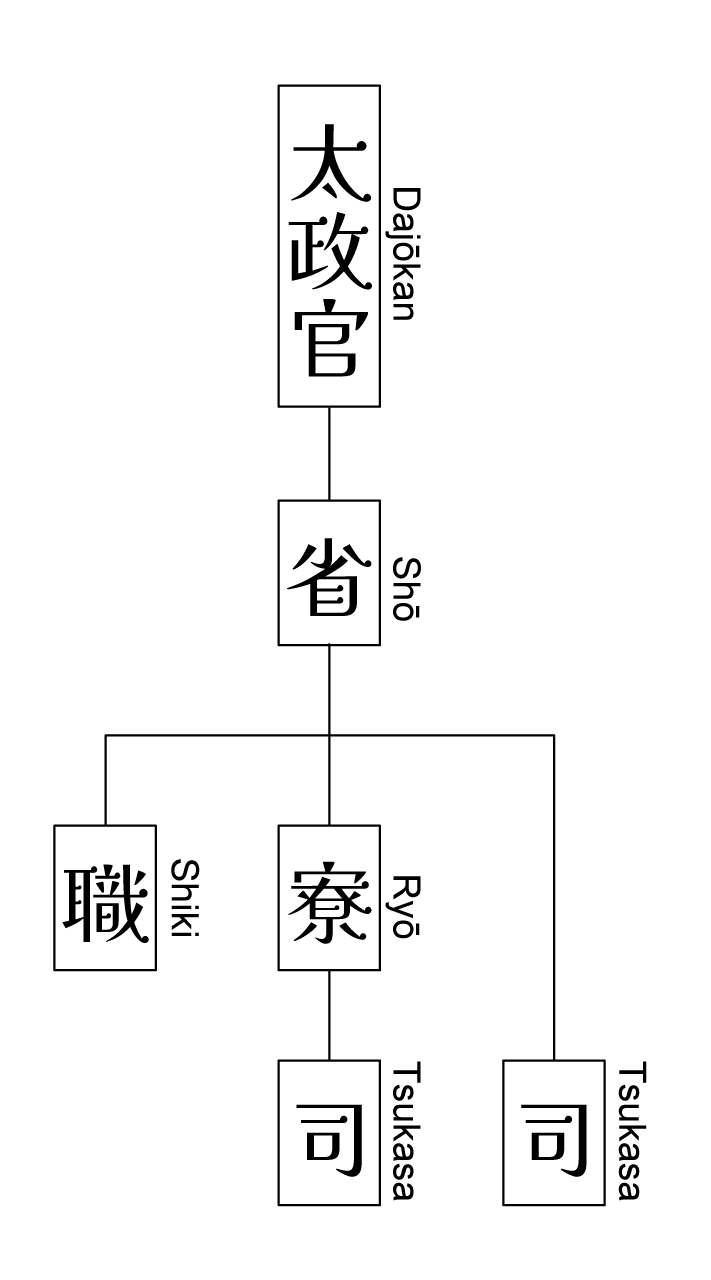
The Dajōkan was the supreme governing body of the state, overseeing all shō (ministries) and combining functions comparable to a modern cabinet, legislature, and supreme court.
A shō (省) can be understood as a ministry.
Below the ministries were several layers of subordinate organisations. A shiki (職) was relatively large and high-ranking, while a ryō (寮) was smaller in scale.
In the Heian period, important shiki included the Chūgū-shiki (serving the empress) and the Kyō-shiki (responsible for administration and judicial matters in the capital).
A tsukasa (司) was the smallest administrative unit, responsible for highly specialised practical tasks. Most tsukasa operated under a ryō, although some units close to the emperor functioned independently under a ministry.
In addition to this basic "ministry → bureau → office" structure, there also existed a category known as gen (監). These were independent agencies, often related to military, diplomatic, or guard functions, and ranked between shiki and ryō.
Many of these organisations disappeared during the early Heian period. For example, the Tonerigen was absorbed into the Ōtoneri-ryō, while the Udoneri-gen came under the control of the Nakatsukasa-shō.
The title gen survived mainly in regional administration, particularly in the Dazaifu, where officials were known as Daigen (大監) and Shōgen (少監).
Regency Power: Sesshō, Kampaku, and Nairan
These three positions stood above the Nikan-Hasshō system and effectively controlled the entire administration of the state.
| Title | Description |
| 摂政 Regent |
Governed on behalf of the emperor when the emperor was a minor. Held full authority over the government and directed the entire Nikan-Hasshō system. |
| 関白 Chief Advisor to the Emperor |
Served as the chief advisor to an adult emperor. In practice, the Kampaku exercised power comparable to the Sesshō and effectively controlled the administration. |
| 内覧 | Reviewed official documents and imperial edicts before they reached the emperor. By controlling the flow of information, the Nairan could exert significant influence over political decision-making. |
The Eight Ministries (Hasshō)
Nakatsukasa-shō (中務省) — Ministry of Central Affairs
The Nakatsukasa-shō was the most important of the eight ministries, positioned closest to the emperor.
It handled core state affairs, including the drafting of imperial edicts and the management of official appointments. Because of its proximity to the emperor, it played a central role in coordinating government administration.
| Office | Function |
| Taikōtaigō-gū-shiki (太皇太后宮職) | Served the empress dowager (grandmother generation) and managed her household affairs. |
| Kōtaigō-gū-shiki (皇太后宮職) | Served the empress dowager (mother generation) and managed her household. |
| Kōgō-gū-shiki (皇后宮職) | Served the empress (the emperor's principal consort). |
| Chūgū-shiki (中宮職) | Served the chūgū (the emperor's principal consort, distinct title). |
| Ōtoneri-ryō (大舎人寮) | Responsible for palace security and ceremonial duties; guards joined imperial processions. |
| Zusho-ryō (図書寮) | Managed books and Buddhist images; also collected and stored texts, produced sutra copies, and made paper and ink. |
| Kura-ryō (内蔵寮) | Managed the emperor's private assets — the "imperial treasury," receiving offerings and managing their disbursement. |
| Nuidono-ryō (縫殿寮) | Made imperial garments and managed the personnel of female palace officials. |
| Onmyō-ryō (陰陽寮) | Handled astronomy, calendrical calculations, and divination — determining auspicious dates and times. |
| Takumi-ryō (内匠寮) | Made palace utensils and ceremonial objects, and decorated buildings. |
Shikibu-shō (式部省) — Ministry of Ceremonial
Managed the Daigaku-ryō (Imperial University) and handled the personnel evaluation and appointment of civil officials. Also administered the Sanni-ryō (Bureau of Supernumerary Officials).
| Office | Function |
| Daigaku-ryō (大学寮) | The national university; trained officials for government service. |
| Sanni-ryō (散位寮) | Maintained lists of officials who held court rank but had no current post. Dispatched personnel to other offices on request. A uniquely Japanese institution with no equivalent in the Tang system; absorbed into the Shikibu-shō in 896. |
Daigaku-ryō Curriculum
The Daigaku-ryō offered four specialist courses: Kidendō (Chinese history and literature), Myōgyōdō (Confucian classics), Myōhōdō (law), and Sandō (mathematics). In the Heian period, Kidendō became the dominant course.
Kidendō (紀伝道) — Ranks
| Rank | Definition |
| Monjō-hakase (文章博士) | Lecturer in Kidendō (Chinese poetry and history) |
| Monjō-tokugōshō (文章得業生) | Two outstanding students selected from the monjō-shō |
| Monjō-shō (文章生) | Students who passed further examinations from the gimonjō-shō |
| Gimonjō-shō (擬文章生) | Candidates who passed the ryō-shi entrance examination |
Myōgyōdō (明経道) — Ranks
| Rank | Definition |
| Myōgyō-hakase (明経博士) | One lecturer in Confucian classics; the post was hereditary in the Nakahara and Kiyohara clans |
| Jokyō (助教) | Two assistant lecturers |
| Chokkyō (直講) | Two supporting instructors |
| Myōgyō-tokugōshō (明経得業生) | Two outstanding students selected from myōgyō-shō |
| Myōgyō-shō (明経生) | Students of the Confucian classics course |
Myōhōdō (明法道) — Ranks
| Rank | Definition |
| Myōhō-hakase (明法博士) | Two law lecturers |
| Myōhō-tokugōshō (明法得業生) | Two outstanding students selected from myōhō-shō |
| Myōhō-shō (明法生) | Law students |
Sandō (算道) — Ranks
| Rank | Definition |
| San-hakase (算博士) | Two mathematics lecturers |
| San-tokugōshō (算得業生) | Two outstanding students selected from san-shō |
| San-shō (算生) | Mathematics students |
Ondō (音道)
Ondō was not an independent course but a foundational skills subject for students of the Daigaku-ryō (especially those in Kidendō and Myōgyōdō).
| Rank | Definition |
| On-hakase (音博士) | Two instructors teaching Chinese pronunciation at the Daigaku-ryō |
| On-shō (音生) | Students learning Chinese pronunciation at the Daigaku-ryō |
Shodō (書道)
Shodō was not an independent course but a foundational skills subject for students of the Daigaku-ryō (especially those in Kidendō and Myōgyōdō).
| Rank | Definition |
| Sho-hakase (書博士) | Two instructors teaching calligraphy at the Daigaku-ryō |
| Sho-shō (書生) | Students learning calligraphy at the Daigaku-ryō |
Jibu-shō (治部省) — Ministry of Civil Affairs
Broadly responsible for court ceremonies, foreign diplomacy, and the administration of Buddhist and Shinto clergy. Its sub-offices included:
| Office | Function |
| Uta-ryō / Gagaku-ryō (雅楽寮) | Court music, dance, and related education. |
| Genba-ryō (玄蕃寮) | Administered Buddhist clergy and received foreign envoys. The Kōrokan guest houses in Kyoto, Osaka, and Fukuoka hosted envoys from Silla and Balhae. |
| Shoryō-ryō (諸陵寮) | Managed imperial mausoleums and conducted imperial funeral rites. Elevated from a smaller office (shoryō-shi) to a full bureau during Emperor Saga's reign. |
Minbu-shō (民部省) — Ministry of Popular Affairs
Controlled the nation's finances and household registers — combining the functions of a modern ministry of finance and ministry of internal affairs. A common misconception: it was the Minbu-shō, not the Ōkura-shō, that collected taxes. The Ōkura-shō was the guardian of the treasury.
| Office | Function |
| Kazue-ryō (主計寮) | Compiled the national budget and calculated tax revenues — deciding how taxes (especially chō, local specialties delivered to the capital) would be collected and allocated. |
| Chikara-ryō (主税寮) | Managed so (rice stored in provincial granaries) and audited local finances. The famous Shōsōin repository at Tōdaiji in Nara is similar in construction to the provincial shōsō granaries, though it was a temple storehouse rather than a government one. |
Hyōbu-shō (兵部省) — Ministry of Military Affairs
The supreme headquarters for military and national defence — the equivalent of a modern Ministry of Defence. It also managed the Hayato, warriors from southern Kyushu, who served as palace guards and performed traditional dances; maintained the fire-and-smoke signal network (tobhi) for rapid communication; and oversaw state horse-breeding pastures (maki).
| Office | Function |
| Hayato-shi (隼人司) | Administered and commanded the Hayato warriors from the Ōsumi and Satsuma peninsulas of southern Kyushu. |
Gyōbu-shō (刑部省) — Ministry of Justice
The supreme judicial organ, determining the severity of crimes according to the penal codes (ritsuryō) and overseeing the execution of sentences. The five types of punishment were:
- Chi (笞)
- Light flogging: Beaten with a thin bamboo whip on the back or buttocks; 10–50 strokes in five gradations.
- Jō (杖)
- Heavy flogging: Beaten with a thicker rod; 60–100 strokes in five gradations.
- Zu (徒)
- Penal servitude: Forced labour at a government office for 1–3 years.
- Ru (流)
- Exile: Forced relocation to a distant province; three gradations based on distance (near, middle, far).
- Shi (死)
- Death: The ultimate penalty; two forms: strangulation (kō) and decapitation (zan).
| Office | Function |
| Shūgoku-shi (囚獄司) | Managed the prison facilities (gokusha) — the equivalent of a modern correctional institution. |
For serious cases or legally complex disputes, the Dajōkan issued the final verdict after reviewing the Gyōbu-shō's findings. From the mid-Heian period, as the Kebiishi (capital police) took over arrests, trials, and prison management, the Gyōbu-shō and its prison office became increasingly hollow.
Ōkura-shō (大蔵省) — Treasury Ministry
Managed the chō (tribute goods such as cloth and regional specialty products), along with gold, silver, and coinage submitted from the provinces via the Minbu-shō and other channels — in effect, the office that managed the court's "treasury." Besides inspecting the quality and quantity of submitted goods before storing them, it was also responsible for minting coinage and maintaining the accuracy of weights and measures.
| Office | Function |
| Oribe-no-Tsukasa (織部司) | Not merely a storage operation — this office created value by producing premium textiles such as brocade and damask from the yarns and cloth received as tax, using the finest craftsmanship of the day. |
Kunai-shō (宮内省) — Ministry of the Imperial Household
The core agency for running the imperial court, managing everything from the emperor's food, clothing, and shelter to medical care and palace maintenance.
| Office | Function |
| Daizen-shiki (大膳職) | Prepared large-scale ceremonial banquets. |
| Naizen-shi (内膳司) | Prepared the emperor's daily meals and managed food safety (including tasting). |
| Ōi-ryō (大炊寮) | Managed and supplied rice and grains for cooking. |
| Miki-no-Tsukasa (造酒司) | Brewed sake, vinegar, porridge, and other fermented foods for court use. |
| Moitori-no-Tsukasa (主水司) | Managed drinking water, ice and ice cellars, and ritual water supplies. |
| Moku-ryō (木工寮) | Constructed and repaired palace buildings; produced wooden furniture and utensils. |
| Tonomori-ryō (主殿寮) | Managed palace cleaning, lighting, firewood and charcoal, and bathing. |
| Kamon-ryō (掃部寮) | Managed tatami mats and blinds; set up and cleaned ceremony venues. |
| Ten'yaku-ryō (典薬寮) | Provided medical care, procured medicines, and trained physicians and acupuncturists. |
| Uneme-no-Tsukasa (采女司) | Administered and educated the uneme — serving women submitted from the provinces to attend the empress. |
Major Bureaus Outside the Eight Ministries
While the Nikan-Hasshō was the administrative backbone, some agencies dealing with military power and ceremonial arms were placed directly under the Dajōkan rather than any of the eight ministries.
Maryō (馬寮) — Bureau of Horses
An independent, high-autonomy organization directly under the Dajōkan, not subordinate to any ministry. Managed the breeding, training, and equipment of official horses, and oversaw horse pastures throughout the country. Divided into Left (Samaryō) and Right (Umaryō) bureaus.
Hyōgo-ryō (兵庫寮) — Bureau of Arms
Likewise directly under the Dajōkan, not subordinate to any ministry. Maintained and managed weapons and ceremonial arms (gijō).
Rank Correspondence Table (Kani-Sōtō-Hyō)
The table below shows the correspondence between court offices and ranks within the Nikan-Hasshō system. Offices were assigned according to a person's court rank under the kani-sōtō-sei (rank-office correspondence system), making rank the critical factor for any official's career.
| 位階 | 二官 | 八省 | |||
| Rank | 神祇官 | 太政官 | 中務省 | 式部省 / 治部省 / 民部省 / 兵部省 / 大蔵省 / 宮内省 |
刑部省 |
| Sr. 1st (正一位) |
太政大臣 | ||||
| Jr. 1st (従一位) |
|||||
| Sr. 2nd (正二位) |
左大臣 右大臣 内大臣 |
||||
| Jr. 2nd (従二位) |
|||||
| Sr. 3rd (正三位) |
大納言 | ||||
| Jr. 3rd (従三位) |
中納言 権中納言 |
||||
| Sr. 4th Upper (正四位上) |
伯 | 卿 | |||
| Sr. 4th Lower (正四位下) |
参議 / 宰相 | 卿 | 卿 | ||
| Jr. 4th Upper (従四位上) |
大弁 | ||||
| Jr. 4th Lower (従四位下) |
|||||
| Sr. 5th Upper (正五位上) |
左中弁 右中弁 |
大輔 | |||
| Sr. 5th Lower (正五位下) |
左少弁 右少弁 |
大輔 | 大輔 | 大判事 | |
| Jr. 5th Upper (従五位上) |
少輔 | ||||
| Jr. 5th Lower (従五位下) |
大副 | 少納言 侍従 大監物 |
少輔 | 少輔 | |
| Sr. 6th Upper (正六位上) |
少副 | 左弁大史 右弁大史 大内記 |
|||
| Sr. 6th Lower (正六位下) |
少祐 | 大丞 | 大丞 | 大丞 | 中判事 |
| Jr. 6th Upper (従六位上) |
大祐 | 少丞 | 中監物 | 少丞 | 少丞 |
| Jr. 6th Lower (従六位下) |
少判事 | ||||
| Sr. 7th Upper (正七位上) |
大外記 | 左弁少史 右弁少史 大録 |
中内記 | 大録 | 大録 |
| Sr. 7th Lower (正七位下) |
少監物 | 大主鈴 判事大属 |
|||
| Jr. 7th Upper (従七位上) |
少外記 | ||||
| Jr. 7th Lower (従七位下) |
大典鑰 | 大解部 | |||
| Sr. 8th Upper (正八位上) |
少録 | 少内記 少主鈴 |
少録 | 少録 | |
| Sr. 8th Lower (正八位下) |
大史 | 判事少属 | 中解部 | ||
| Jr. 8th Upper (従八位上) |
少史 | 少典鑰 | |||
| Jr. 8th Lower (従八位下) |
Shō-kaibu (少解部) | ||||
| Daishōi Upper/Lower (大初位上下) |
|||||
| Shōshōi Upper/Lower (少初位上下) |
|||||
Officials of Fifth Rank and above were considered nobility (kizoku). Those of Third Rank and above, plus the sangi, were called kugyō or kandachime (senior courtiers). Those of Sixth Rank and below were not nobility and were called jigebito. For further details on the rank system and the Eight Hereditary Titles, see Court Ranks and the Eight Hereditary Titles.
Note: The Four-Tier Office Structure (Shitōkan)
Virtually every government office had four tiers of officials: kami (chief), suke (deputy), jō (controller), and sakan (recorder) — comparable to a modern organisation's president, general manager, section manager, and team leader.
There were exceptions. In the Dazaifu (the regional government of Kyushu) and the Konoefu (imperial guard), the third-tier (jō) post was called gen rather than jō. Likewise, the fourth-tier (sakan) had distinctive names in these offices — daiten and shōten in the Dazaifu, and shōsō in the Konoefu — reflecting the specialised military and diplomatic traditions of those organisations.
| Office type | 長官 (Chief) |
次官 (Deputy) |
判官 (Controller) |
主典 (Recorder) |
| 神祇官 (Department of Shinto) |
伯 | 大副 > 少副 | 大祐 > 少祐 | 大史 > 少史 |
| 省 (Ministry) |
卿 | 大輔 > 少輔 | 大丞 > 少丞 | 大録 > 少録 |
| 職 (Office) |
大夫 | 亮 | 大進 > 少進 | 大属 > 少属 |
| 寮 (Bureau) |
頭 | 助 | 大允 > 少允 | 大属 > 少属 |
Note: Shishō (史生) — Junior Scribes
Below the four-tier managerial officials were shishō (史生), lower-ranking officials who actually drafted official documents and handled clerical work — comparable to modern administrative staff or secretaries. Largely invisible in the historical record, they were the people who kept the mountains of paperwork moving in Heian bureaucracy. They appear occasionally in historical fiction as minor but practically indispensable officials.