


The Inner Palace (Kōkyū, 後宮)
The kōkyū was the section of the palace where the emperor's consorts and ladies-in-waiting lived and supported the emperor's daily life. It included the residential halls of the consorts and the administrative offices (the Twelve Offices of the Inner Palace, kōkyū-jūnishi) staffed by female officials.
Imperial Consorts
| Title | Description |
| Nyōgo (女御) |
One of the emperor's consorts; ranked just below the chūgū or kōgō (empress). Usually the daughter of a powerful noble. Often called by the name of her residential hall — for example, Kokiden-no-nyōgo, who appears in The Tale of Genji. Some nyōgo went on to become empress (chūgū or kōgō). |
| Kōi (更衣) |
A consort ranked below the nyōgo. Generally from a family of lower standing, but could wield great influence if she enjoyed the emperor's deep affection. |
| Miyasudokoro (御息所) |
Originally referred to a place where the emperor rested; the term later came to denote a woman who served in the emperor's bedchamber. |
| Mikushigedono (御匣殿) |
Originally a female official in charge of clothing and sewing. From around the mid-tenth century, some who held this post also served close to the emperor and, at times, enjoyed his favor. |
The term nyōgo first appears in the Nihon Kōki (815), in an official document setting out clothing regulations by rank and status. The term kōi first appears in the Shoku Nihon Kōki (842), in a record noting that a woman raised from no court rank to Junior Fifth Rank had been made a kōi of the retired Emperor Saga. From the mid-Heian period on, women bearing the title kōi grew increasingly rare, and some scholars hold that the rank had already begun to decline by around the reign of Emperor En'yū. The Tale of Genji opens with the line "In a certain reign there was a lady not of the highest rank, among the many nyōgo and kōi in attendance upon the emperor…," but this is not thought to depict the inner palace of Murasaki Shikibu's own time; rather, the tale is understood to be set against the backdrop of an earlier era.
The Nyōbō (Ladies-in-Waiting) of the Inner Palace
The daily lives of the consorts were directly supported by women known as nyōbō (ladies-in-waiting) and nyokan (female officials). The term nyōbō covered not only female officials belonging to the court's government offices, but also women who served in the household organizations of the consorts. Their duties went beyond attending to their mistress's person — they also handled the drafting and relaying of documents, ceremonial duties, clothing, food, and more.
| Title | Description |
| Nyōbō (女房) |
Women who served close to a noble person — such as the emperor or empress — in the palace or an aristocratic household, handling practical tasks, documentation, and daily assistance. The term could also denote a group of women serving a particular master, as when the emperor's nyōbō and the empress's nyōbō each formed their own distinct organization. |
| Kami no Nyōbō (上の女房) |
Ladies-in-waiting who served the emperor directly. As opposed to the Miya no Nyōbō, who served the consorts, this term denotes ladies-in-waiting on the emperor's side. |
| Miya no Nyōbō (宮の女房) |
Women who served mainly the empress directly. As opposed to the Kami no Nyōbō, who served the emperor directly, this term denotes ladies-in-waiting on the empress's side. |
| Nyōbō Sanyaku (女房三役) Three Key Posts |
In the mid-Heian period, the Senji (宣旨), Mikushigedono-bettō (御匣殿別当), and Naishi (内侍) held the senior roles within the empress's ladies-in-waiting organization, and the nyōbō organization gradually took shape around these posts. |
| Senji (宣旨) |
A senior lady-in-waiting who stood at the very top of the nyōbō community, conveying and relaying the wishes of the emperor or consorts to others, and bringing the nyōbō together. |
| Mikushigedono-bettō (御匣殿別当) |
The mikushigedono was the place in the inner palace where female officials in charge of clothing and sewing worked. The woman who oversaw this office was called the Mikushigedono-bettō, or informally just Mikushigedono. |
| Menowarawa (女童) |
Girls aged 15 or younger from mid- to low-ranking aristocratic families, who performed a variety of miscellaneous chores. |
Bō (房) means a private chamber. In the palace and in aristocratic households, women were given living quarters partitioned off with standing screens and curtains and lived in close attendance on their mistress or master; such women were called nyōbō.
Location of the Inner Palace
The inner palace where these women lived spread across the northern part of the dairi (imperial residence). There stood a cluster of residential halls known collectively as the Shichiden-Gosha (Seven Halls and Five Chambers), each of which served as a residence for the consorts and a place where serving women came and went. The "Kokiden," "Reikeiden," "Kiritsubo," and "Fujitsubo" that appear in The Tale of Genji were among these halls.
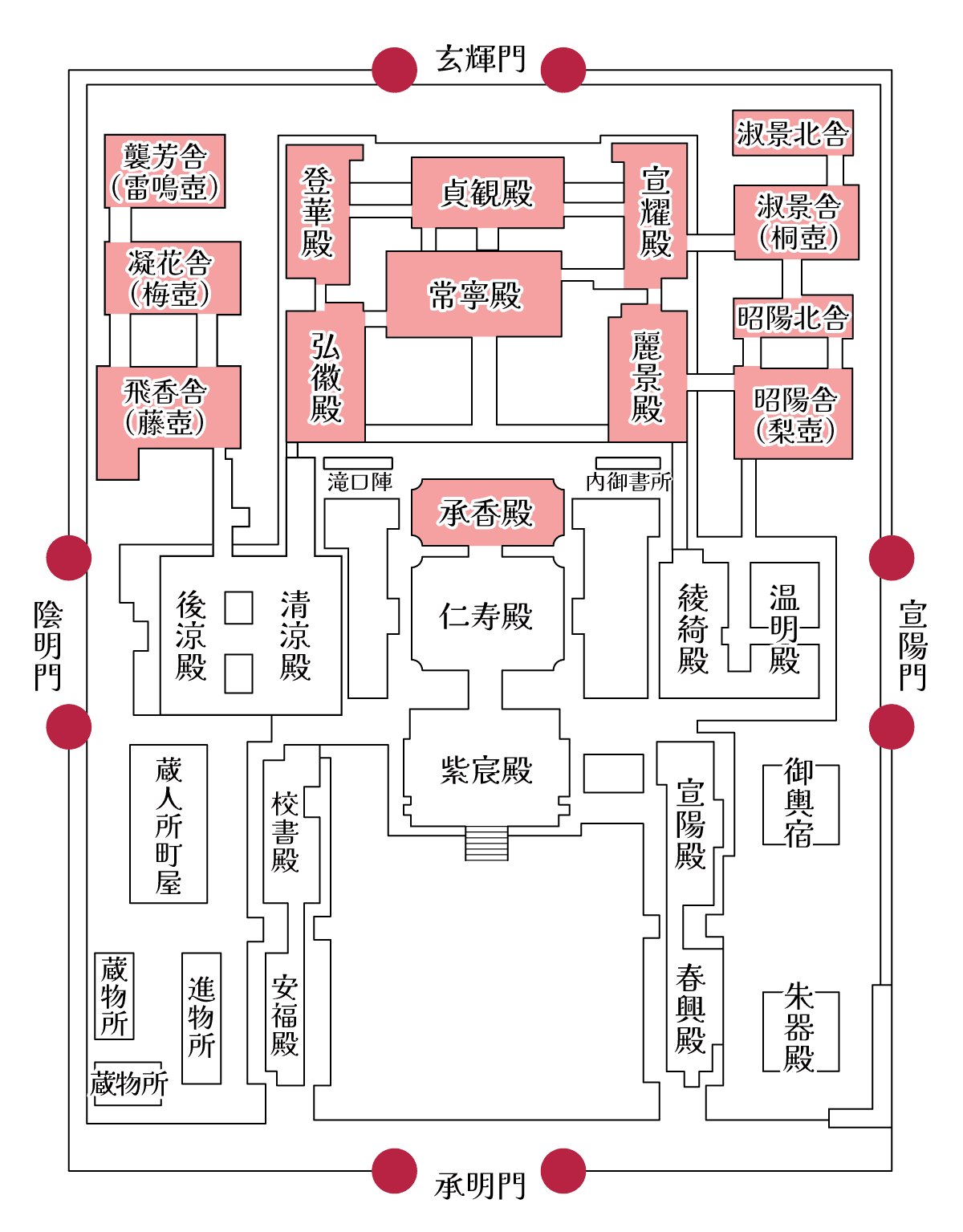
Click the image above to enlarge.
登華殿・弘徽殿・貞観殿・常寧殿・
承香殿・
麗景殿・宣耀殿.
襲芳舎(雷鳴壺)・凝花舎(梅壺)・
飛香舎(藤壺)・淑景舎(桐壺)・昭陽舎(梨壺).
The Twelve Offices of the Inner Palace (Kōkyū-jūnishi)
The vast inner palace was run by the kōkyū-jūnishi (Twelve Offices of the Inner Palace). Specialist offices covered every aspect of palace life — from the consorts' food, medicine, and clothing to the management of gate keys and cleaning.
However, from the mid-Heian period onward, the rise of the Kurōdo-dokoro (Imperial Secretariat) caused the practical work of the other eleven offices to gradually decline until they became merely nominal. As a result, the Naishi no Tsukasa became the effective centre of the female official organisation in the inner palace.
| Name | Function |
| Naishi no Tsukasa (内侍司) |
Conveyed reports and petitions to the throne, relayed imperial commands, and oversaw inner palace ceremonial protocol. |
| Kura no Tsukasa (蔵司) |
Managed important items including the imperial seal (shinji), gate passes (kankei), and the clothing of the emperor and empress. |
| Fumi no Tsukasa (書司) |
Managed books and writing supplies such as paper, ink, and brushes. |
| Kusuri no Tsukasa (薬司) |
Managed medicines and oversaw the administration of medicine to the emperor, including poison-tasting. |
| Tsuwamono no Tsukasa (兵司) |
Managed ceremonial weapons and armour used in rites and ceremonies (not combat weapons, as the inner palace was a living space). |
| Mikado no Tsukasa (闈司) |
Managed the keys to the inner palace gates. |
| Tonomori no Tsukasa (殿司) |
Managed palanquins and their canopies, lighting, charcoal, and bathing supplies for palace life. |
| Kanimori no Tsukasa (掃司) |
Maintained palace facilities, set up furnishings, and managed cleaning. |
| Moitori no Tsukasa (水司) |
Managed the supply of drinking water and light refreshments such as rice porridge. |
| Kashiwade no Tsukasa (膳司) |
Managed the preparation, service, and poison-tasting of the emperor's meals. |
| Miki no Tsukasa (酒司) |
Managed the brewing of sake and the care of sake vessels. |
| Nui no Tsukasa (縫司) |
Managed the sewing of garments and the making of braided cords. |
The Naishi no Tsukasa (Bureau of Handmaids)
Among the Twelve Offices of the Inner Palace, it was the Naishi no Tsukasa that grew particularly important during the Heian period. While the other eleven offices gradually became hollow institutions, the Naishi no Tsukasa continued to carry out the duties performed in close attendance on the emperor, such as conveying memorials and relaying his commands.
| Tier | Office | Duties |
| Kami (長官, Chief) |
Naishi no Kami (尚侍) |
Served as a close attendant to the emperor in a secretarial capacity. Under the ritsuryō system, two posts were ranked as equivalent to Junior Fifth Rank, though the rank was later raised to Junior Third Rank. The post could be largely honorary, and its holder sometimes received the emperor's favor. |
| Suke (次官, Deputy) |
Naishi no Suke (典侍) |
Assisted the Naishi no Kami. Under the ritsuryō system, four posts were ranked as equivalent to Junior Sixth Rank, though the rank was later raised to Junior Fourth Rank. Besides being an inner-palace official post, by the mid-Heian period it was also sometimes granted to honor the emperor's wet nurse. |
| Jō (判官, Controller) |
Naishi no Jō (掌侍) |
Under the ritsuryō system, four posts were ranked as equivalent to Junior Seventh Rank, though the rank was later raised to Junior Fifth Rank. This post became the core of the court's clerical administration. |
| Lower-ranking female officials | Nyoju (女孺) |
Assigned to miscellaneous duties. Under the ritsuryō system, one hundred posts were ranked as equivalent to Shōshōi (少初位). |
Nyoju were assigned not only to the Naishi no Tsukasa but to the other offices as well, though the Naishi no Tsukasa had the largest number of them.
Offices Other Than the Naishi no Tsukasa
In the Heian period, new offices such as the Kurōdo-dokoro (Imperial Secretariat) were created, and male officials came to take on an increasing share of the work carried out in the palace. At the same time, part of the work originally handled by the Twelve Offices of the Inner Palace came to be carried out instead by the Kurōdo-dokoro, other offices, and the Naishi no Tsukasa itself.
In this way, the system of the Twelve Offices of the Inner Palace laid down by the ritsuryō codes gradually changed over the course of the Heian period. By around the tenth century, it had become difficult for most of the Twelve Offices to continue their original duties, and their functions gradually passed to other organisations.
The Naishi no Tsukasa, however, kept its role of serving close to the emperor and conveying memorials and relaying his commands. In this way, the Twelve Offices of the Inner Palace established under the ritsuryō system are thought to have transformed, by the Heian period, not into their original form but into a new organisation of female officials centred on the Naishi no Tsukasa.
Lower-Ranking Female Officials Who Supported the Inner Palace
| Title | Description |
| Ujime (氏女) |
Women presented to the court by powerful clans of the Kinai region (the provinces around the capital) to serve as female officials, primarily assigned to lower-ranking posts such as nyoju. |
| Uneme (采女) |
Women presented to the court by powerful regional clans to serve as female officials, attending to the emperor's personal needs and serving his meals. Some went on to become nyoju, others worked in offices such as the Moitori no Tsukasa (水司) or Kashiwade no Tsukasa (膳司), while others served as tokusen in offices such as the Mizushidokoro (御厨子所). |
| Tokusen (得選) |
Women selected from among the uneme to handle meals and other duties in offices such as the Mizushidokoro (御厨子所). |
| Hisumashi (樋洗) |
Female officials responsible for cleaning the palace's lavatories. |