


The Imperial Family (Kōzoku)
In the imperial court of Japan, members of the imperial family stood apart from ordinary officials. Rather than being part of the standard court rank system, they belonged to a separate framework known as kōzoku (the imperial family).
This hierarchy extended from the emperor at the top down through retired and cloistered emperors, imperial princes and princesses, and more distant members of the imperial line.
Blood Relations and Status within the Imperial Family
The diagram below shows blood relations centered on the emperor.
Click a red
marker to see an explanation of that status.
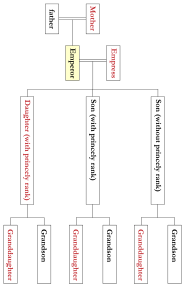
Click a red marker in the diagram to see an explanation here.
Within the imperial family, centered on the emperor, there were statuses such as Jōkō and Hōō, Shinnō and Naishinnō, and Ō and Joō.
Shinnō and Naishinnō also held a rank system unique to the imperial family called hon’i (品位), divided into four grades from Ippon (一品) to Shihon (四品). Ō and Joō, by contrast, generally belonged to the same rank system as ordinary subjects, receiving regular court ranks such as Shō-ichii (正一位) or Ju-ichii (従一位).
There was a substantial difference in status and treatment between Shinnō/Naishinnō and Ō/Joō.
Titles and Statuses of the Imperial Family
| Title | Description |
| Jōkō (上皇) | An abbreviated form of Daijō-Tennō (Retired Emperor). From the late Heian period onward, retired emperors often exercised real political power through insei (cloistered rule). |
| Jun-Daijō-Tennō (准太上天皇) |
A status equivalent to that of a Retired Emperor, granted in exceptional circumstances.
For example, Prince Atsumichi — the first son of Emperor Sanjō — received this title after being pressured by Fujiwara no Michinaga to renounce his position as Crown Prince. It was an extremely rare honor used as a political compromise to avoid a succession dispute. Notably, in his later years Hikaru Genji, the protagonist of The Tale of Genji, holds this rank, portrayed as a status symbolizing the effective pinnacle of his power. |
| Chiten no Kimi (治天の君) | During the insei period, this term referred to the retired (or cloistered) emperor who, as head of the imperial house, held real power over succession and governance. |
| Taikō-Taigō (太皇太后) | A title given to an empress from a previous generation, typically the emperor’s grandmother. |
| Kōtaigō (皇太后) | The title of an empress dowager — either the widow of a previous emperor or the birth mother of the reigning emperor. |
| Kokumo / Kokubo (国母) | A respectful title for the emperor’s birth mother. |
| Hōō (法皇) | A retired emperor who has taken Buddhist vows. An abbreviated form of Daijō-Hōō. |
| In (院) | Originally referred to the residence of a retired emperor, cloistered emperor, or high-ranking imperial woman. From the late Heian period onward, it also came to be used as an honorific title for the retired emperor himself. |
| Nyōin (女院) | A title and status granted to high-ranking imperial women — such as empresses, empress dowagers, and imperial princesses — often accompanied by independent financial resources and estates (in-ryō). |
| Tennō (天皇) | The sovereign ruler of Japan. |
| Shinnō (親王) | An imperial prince who has been formally granted princely status (shinnō-senge). |
| Naishinnō (内親王) | An imperial princess who has been formally granted princely status. |
| Ō (王) | A male member of the imperial family below the rank of shinnō, generally referring to more distant descendants of the imperial line (from the third generation onward). |
| Joō (女王) | A female member of the imperial family below the rank of naishinnō, generally referring to more distant descendants of the imperial line (from the third generation onward). |
| Wakamiya (若宮) | A title for a young imperial prince, often used for one considered a potential future heir. |
| Tōgū (東宮) / Haruno Miya (春宮) | The Crown Prince. Tōgū was the formal title, while Haruno Miya was a more poetic or refined expression. |
| Mōke no Kimi (儲けの君) | Another term for the Crown Prince. |
| Chūgū (中宮) | Originally an alternative title for the empress. From the mid-Heian period onward, it became a separate consort rank distinct from kōgō, allowing the emperor to have two empress-ranked consorts simultaneously. It referred to one of the emperor’s principal consorts. |
| Kōgō (皇后) | The formal empress under the ritsuryō system. Originally the sole legitimate wife of the emperor, but later coexisted with the chūgū. |
| Kisaki-gane (后がね) | A woman considered a prospective empress or chūgū, either before entering the imperial court or prior to formal elevation. |
| Saigū (斎宮) | An unmarried imperial princess appointed to serve the deity of the Grand Shrine of Ise as the emperor’s representative. Her service typically ended upon the death of the reigning emperor. |
| Saiin (斎院) | An unmarried imperial princess appointed to serve at the Kamo Shrines (Kamigamo and Shimogamo) as the emperor’s representative. Her service typically ended upon the death of the reigning emperor. |
Shinseki-kōka (臣籍降下) — Transition to Subject Status
As the imperial family expanded over generations, a system developed in which male members beyond a certain generation were granted surnames such as Minamoto or Taira and reclassified as subjects. This was known as shinseki-kōka (also called shisei-kōka).
Those who underwent shinseki-kōka relinquished their imperial status and entered the aristocratic hierarchy of the court. Beginning with the many sons of Emperor Saga, who were granted the surname Minamoto, much of the Minamoto and Taira clans originated in this way. Many of the poets featured in the Hyakunin Isshu were also descendants of imperial family members who had undergone shinseki-kōka.
Insei (院政) — Government by Retired Emperors
In the late Heian period, some emperors abdicated at a relatively young age and continued to rule from behind the scenes as retired emperors. This system, in which they exercised power as chiten no kimi, was known as insei.
This system is generally considered to have been established by Retired Emperor Shirakawa in 1086, and it also served as a means of countering the power of the Fujiwara clan, which had long dominated court politics through the regency system.
During the insei period, the "in" (the residence or palace of the retired emperor) became the de facto center of political power. With both a reigning emperor and a retired emperor existing simultaneously, it became unclear which held greater authority: the inzen (retired emperor's decree) or the senji (emperor's decree). These tensions eventually contributed to armed conflicts such as the Hōgen Rebellion (1156).