Front of the Card
Back of the Card
Japanese
English
Audio: NHK Creative Library
Read by LibriVox volunteer Larry Wilson.
Audio courtesy of LibriVox
伊勢
難波潟
みじかき葦の
ふしのまも
逢はでこの世を
過ぐしてよとや
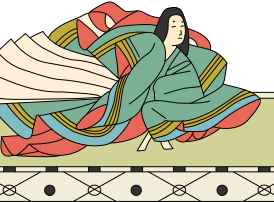
あはてこの
よをすくし
てよとや

なにはが


- Poem 19
- 難波潟
みじかき葦の
ふしのまも
逢はでこの世を 過ぐしてよとや
Author: Ise (c. 872–c. 938)
Source: Shin Kokin Wakashū, Love
- English Verse Translation
- Short as the joints of bamboo reeds That grow beside the sea On pebble beach at Naniwa,
I hope the time may be, When thou 'rt away from me.
— William N. Porter, 1909
- Modern Translation
- In this short life, even as brief as a joint of reed at Naniwa Bay, must I pass through this world without ever meeting you?
- Commentary
- The Ise Shū says this was written in autumn when someone said something unpleasant. It is said to show Ise's mixed feelings when her former lover, Fujiwara no Nakahira, left her.
- About the Poet
- Ise was a leading poet of the Kokin Wakashū period, and her life was full of love affairs. After parting from Nakahira she had a son with Emperor Uda, and later a daughter, Nakatsukasa, with Uda's son Prince Atsuyoshi. Nakatsukasa also became a famous poet.
- Poem Illustration
-
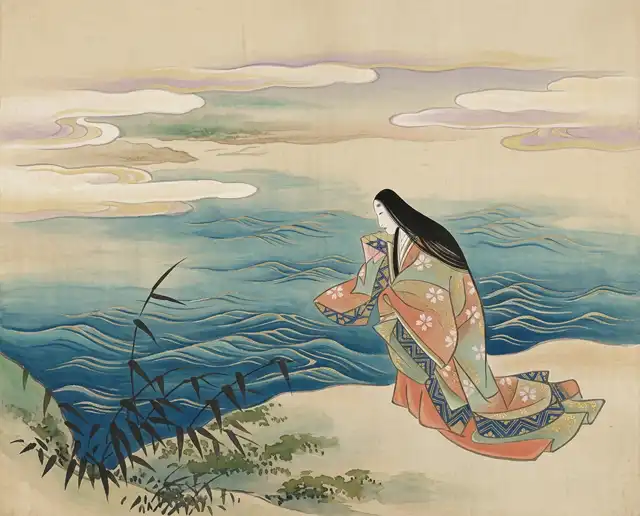
This image is based on an illustration from William N. Porter's A Hundred Verses from Old Japan, his 1909 English translation of the Hyakunin Isshu published in England, colorized and reworked using Adobe Firefly (generative AI).
- Ise: A Short Timeline
-
- c. 872
- Born as a daughter of Fujiwara no Tsugukage
- 890s
- Serves Onshi, empress of Emperor Uda, as a lady-in-waiting
- c. 912
- Gives birth to Nakatsukasa, her daughter with Prince Atsuyoshi
- c. 938
- Dies
- Notes
-
- Her name comes from Ise Province, where her father served as governor
- Counted as one of the Thirty-Six Immortal Poets
- Ise's Family Tree
-
Many people courted Ise. She had a son with Emperor Uda, the husband of Onshi, whom she served, and she came to be called "Ise no Miyasudokoro" (Lady Ise, mother of an imperial child). But the boy died young.
Later, with Prince Atsuyoshi, the husband of Onshi's daughter, she had a daughter, the poet Nakatsukasa. Mother and daughter are both counted among the Thirty-Six Immortal Poets.
- Appendix
-
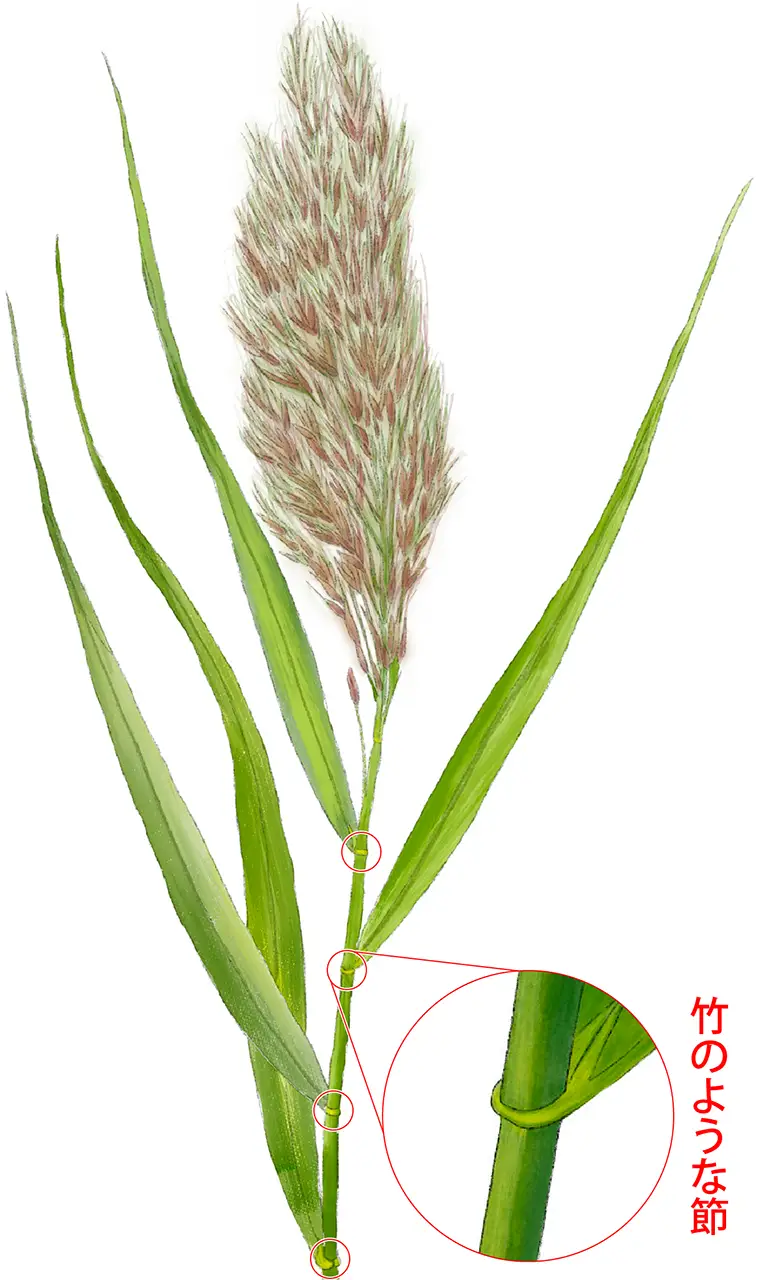
- What Is "Ashi no Fushi"?
-
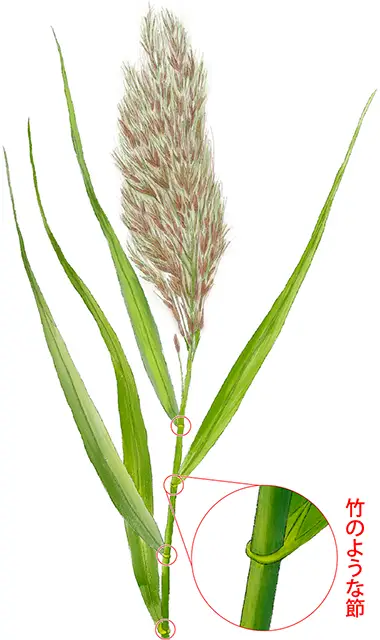
Ashi (also called yoshi) is the common reed, a plant of the grass family that grows by the water. Its stem is thin and has joints (fushi) like bamboo.
It sprouts in late April and grows very fast until about June, and its stem can reach 3 m.
Its underground stems spread sideways, so it grows in large clumps.Fushi no ma, "the space between the joints," is used as an image of something very short.
Naniwa was famous for its reeds and appears in many poems.When you look at a real reed, the space between the joints does not seem short. One theory says that the phrase stands for "a short time" because a reed grows so quickly, adding joint after joint to its stem.
- A Poem Ise Wrote About Lost Love
-
Ise had once been passionately in love with Fujiwara no Nakahira, but at some point their love grew cold. Sunk in loneliness, as if she had lost her place at court, Ise decided to go to the province of Yamato (now Nara Prefecture), where her father, Fujiwara no Tsugukage, was serving as governor. She wrote the next poem as she left the glittering capital to travel alone, still unable to let go of her feelings.
In Japanese
三輪の山 いかに待ち見む 年経とも
尋ぬる人も あらじと思へば
miwanoyama ikanimachimimu toshifutomo
tazunuruhitomo arajitoomoheba Ise-shū, IseIn English
How shall I wait for you at Mount Miwa?
I think that no one will come to visit me, however many years go by. - A Poem Ise Wrote When She Gave Up Her House
- Ise is said to have written the next poem, with a touch of humor, when she gave up the house she had long lived in. Se ni is thought to be a kakekotoba (a word with two meanings): se ni, "into shallows," and zeni, "money." Another theory says fuchi is also a kakekotoba: fuchi, "a deep pool," and 扶持 (fuchi), meaning a living or wages, a word known today in the phrase kuibuchi, "one's living."
In Japanese
あすか川 ふちにもあらぬ わが宿も
せにかはりゆく ものにぞありける asukagawa fuchinimoaranu wagayadomo
senikahariyuku mononizoarikeru Kokin Wakashū, IseIn English
Just as the deep pools of the Asuka River turn into shallows, my house, too, is turning into money to live on.
- A Poem Quoted in "Utsusemi" in The Tale of Genji
- The next poem is in Ise-shū, Ise's personal poetry collection.
It also became famous because Murasaki Shikibu quoted it in "Utsusemi," the third chapter of The Tale of Genji. Comparing herself, her heart left empty by lost love, to the empty shell of a cicada, the poet expresses her loneliness.
In Japanese
空蝉の 羽におく露の 木隠れて
しのびしのびに 濡るる袖かな utsusemino haneniokutsuyuno kogakurete
shinobishinobini nururusodekana Ise-shū, IseIn English
Just as the morning dew on the wings of a cicada's shell is hidden in the shade of the leaves, my sleeves, too, are secretly wet with tears of a hidden love.
- Ukiyo-e by Katsushika Hokusai
-
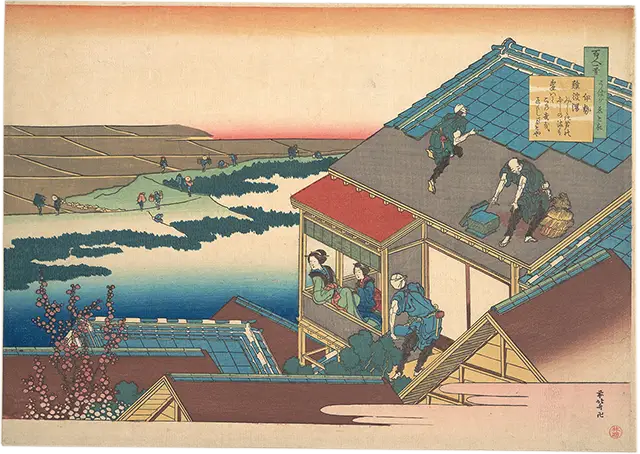
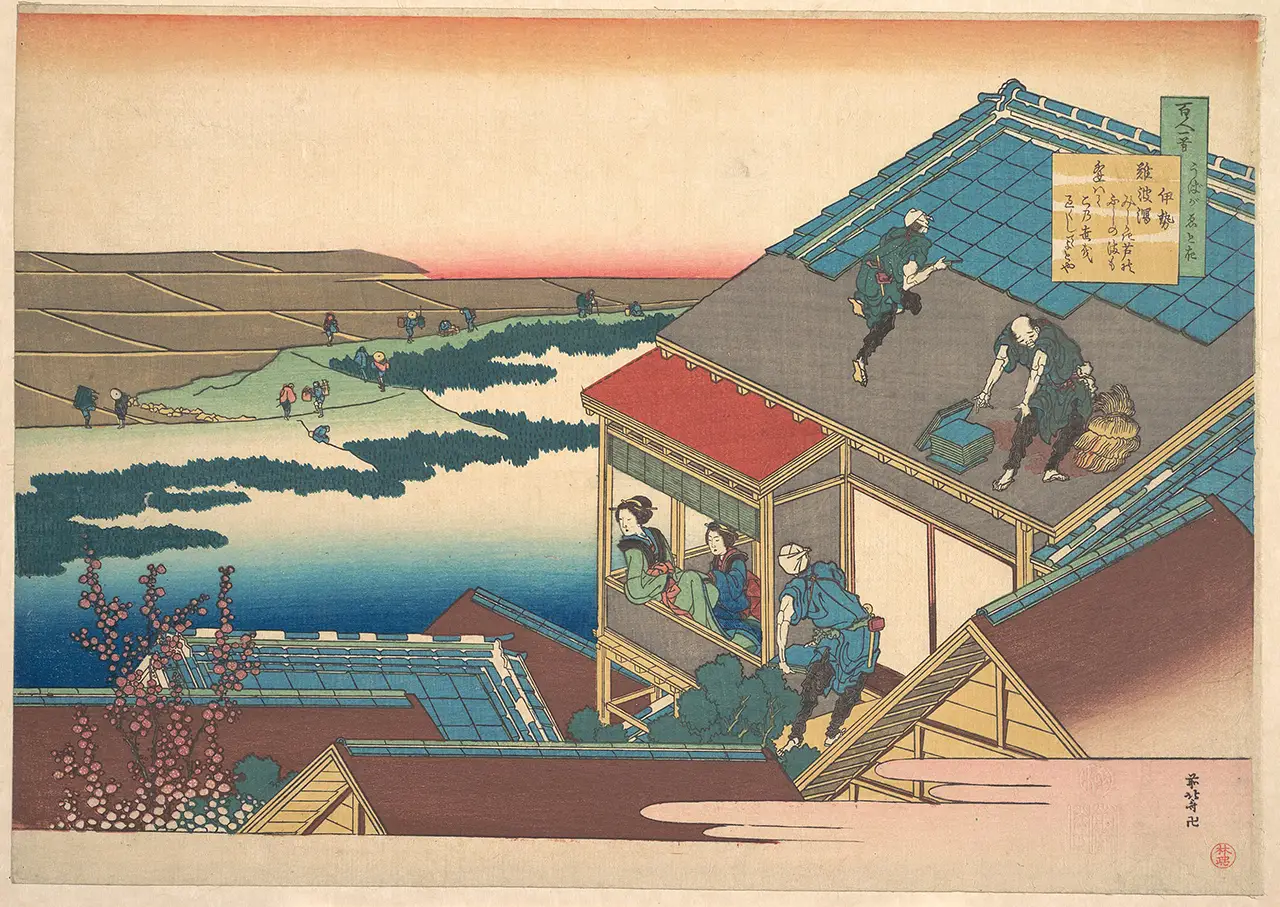
Katsushika Hokusai, CC0, via Wikimedia Commons This print is from One Hundred Poems Explained by the Nurse (Hyakunin Isshu Uba ga Etoki) by Katsushika Hokusai, an ukiyo-e artist of the Edo period. The idea of the series is a nurse explaining the Hyakunin Isshu poems with easy-to-understand pictures. It shows a woman viewing plum blossoms against the scenery of Naniwa Bay. Could this woman be Ise? The workers laying new roof tiles also seem to express the feelings of a woman putting a lid on memories she cannot forget.
Timeline of Ise
(Click to open or close.)Born the daughter of Fujiwara no Tsugukage, Governor of Ise
Begins serving Fujiwara no Onshi, a consort of Emperor Uda
She falls in love with Onshi's younger brother, Fujiwara no Nakahira, but they later part. Heartbroken, she goes to stay in the province of Yamato, where her father is serving. After returning to the capital, she becomes known for her romances with Onshi's elder brother, Fujiwara no Tokihira, and with Taira no Sadafun, a famous lover of women.
Gives birth to a son of Emperor Uda
Emperor Uda steps down and becomes retired emperor
Retired Emperor Uda becomes a monk (cloistered emperor)
The Kokin Wakashū is completed
Twenty-two of Ise's poems are included in the Kokin Wakashū, the most of any woman poet.
Fujiwara no Onshi dies
After that, Ise serves Onshi's daughter, Princess Kinshi. Princess Kinshi later becomes the wife of her half-brother, Prince Atsuyoshi.
Gives birth to Nakatsukasa, the child of Prince Atsuyoshi, Emperor Uda's fourth son
In the same year, Princess Kinshi dies.
Prince Atsuyoshi dies
Cloistered Emperor Uda dies
After the death of Cloistered Emperor Uda, Ise retires to Kosobe in the province of Settsu (now Takatsuki City).
Ise dies