Front of the Card
Back of the Card
Japanese
English
Audio: NHK Creative Library
Read by LibriVox volunteer Larry Wilson.
Audio courtesy of LibriVox
貞信公
小倉山
峰のもみぢ葉
心あらば
今ひとたびの
みゆき待たなむ
いまひとた
ひのみゆき
またなむ

おぐ


- Poem 26
- 小倉山
峰のもみぢ葉
心あらば
今ひとたびの みゆき待たなむ
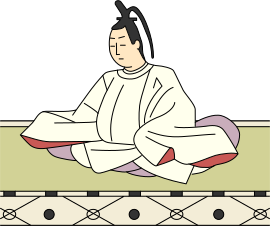
Author: Teishin-kō (880–949)
Source: Shūi Wakashū, Autumn Miscellany
- English Verse Translation
- The maples of Mount Ogura, If they could understand, Would keep their brilliant leaves, until
The Ruler of this land Pass with his royal band.
— William N. Porter, 1909
- Modern Translation
- O maple leaves of Ogura Mountain, if you have a heart — hold on a little longer, until the emperor's visit.
- Commentary
- Retired Emperor Uda was so moved by the autumn leaves of Mount Ogura that he said he wanted his son, Emperor Daigo, to see them too. Teishin-kō, who was with him, wrote this poem. It conveys the wish of father and son to share the sight.
- About the Poet
- Fujiwara no Tadahira, youngest son of Fujiwara no Mototsune, served as regent and chief adviser and helped build the Fujiwara clan's power. He was gentle by nature and stayed friends with Sugawara no Michizane, whom his brother Tokihira had exiled. He was named Teishin-kō after death, and was Kentoku-kō's grandfather.
- Poem Illustration
-
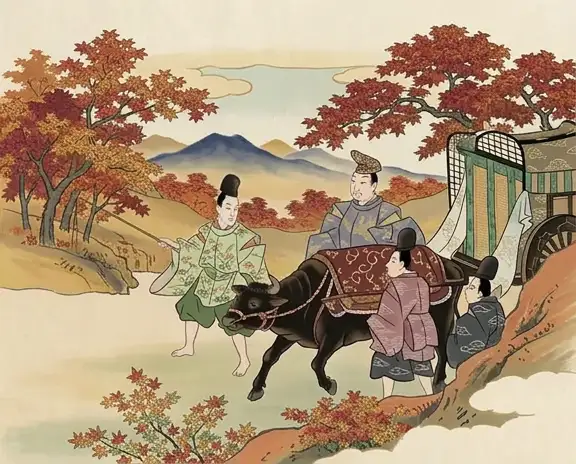
This image is based on an illustration from William N. Porter's A Hundred Verses from Old Japan, his 1909 English translation of the Hyakunin Isshu published in England, colorized and reworked using Adobe Firefly (generative AI).
- Fujiwara no Tadahira (Teishin-kō): A Short Timeline
-
- 880
- Born as a son of Fujiwara no Mototsune
- 909
- Becomes head of the Fujiwara clan after his elder brother Tokihira dies
- 914
- Becomes Minister of the Right
- 924
- Becomes Minister of the Left
- 927
- Completes the Engishiki, a book of government rules
- 930
- Becomes Regent (Sesshō)
- 932
- Given Junior First Rank
- 936
- Becomes Chancellor of the Realm
- 941
- Becomes Kampaku (chief adviser to the emperor)
- 949
- Dies; later given Senior First Rank
- Teishin-kō's Family Tree
-
Teishin-kō (Fujiwara no Tadahira) was born into the Northern House of the Fujiwara. Fujiwara no Michinaga was his great-grandson.
When his elder brother, the Minister of the Left Fujiwara no Tokihira, died at 39, Tadahira came to lead the government. He also completed the Engi Kyakushiki (detailed rules for carrying out the law codes), which Tokihira had been compiling on Emperor Daigo's orders.
In the reign of Emperor Suzaku, Tadahira served as Regent and Kampaku (chief adviser). But the reign was far from peaceful: large revolts such as those of Fujiwara no Sumitomo and Taira no Masakado broke out one after another, and order in the provinces broke down badly.
His elder brother Tokihira is infamous for bringing down Sugawara no Michizane, but Tadahira, by contrast, is known as a gentle man. He kept in touch with Michizane even after Michizane was sent away, and stories of his kind nature have come down to us.
Tokihira's sudden death was said to be Michizane's curse, and Tokihira's son Yasutada is said to have lived in fear of Michizane's vengeful spirit. After Tokihira died, the main line of the Northern House of the Fujiwara passed to Tadahira, and his sons flourished: Saneyori as the Ononomiya line and Morosuke as the Kujō line.
- Appendix
-
- Cherry Blossoms That Bloomed in Ink-Black
- The next poem is a poem of mourning written by Kamitsukeno no Mineo, a friend of the Chancellor Fujiwara no Mototsune, when Mototsune died. Bokusen-ji Temple in Fushimi Ward, Kyoto, takes its name from this poem. There is a strange legend that, after this poem was written, the cherry tree there bloomed in sumizome color (a pale gray, like ink), as if sharing the sorrow. Today the temple is a little-known spot for cherry blossoms. The name "Sumizome" is used not only for the temple but also for the nearby town and station, and the story is still lovingly told.
In Japanese
深草の 野辺の桜し 心あらば
今年ばかりは 墨染めに咲け fukakusano nobenosakurashi kokoroaraba
kotoshibakariha sumizomenisake Kokin Wakashū, Kamitsukeno no MineoIn English
O cherry trees in the fields of Fukakusa, if you have a heart,
just this year, bloom in the gray of mourning. - Sadaie's Poem on the Autumn Leaves of Mount Ogura
-
Fujiwara no Sadaie also wrote about the autumn leaves of Mount Ogura. He wrote the next poem at his Ogura mountain villa, where he is thought to have compiled the Hyakunin Isshu.
Because of this poem, the villa also came to be called the Shigure-tei, "the Pavilion of Autumn Showers." The autumn leaves of Mount Ogura that Sadaie must have gazed at still charm many people today.In Japanese
小倉山 しぐるるころの 朝な朝な
昨日はうすき 四方のもみぢ葉 ogurayama shigururukorono asanaasana
kinouhausuki shihounomomijiba Shūi Gusō (Sadaie's own collection), Fujiwara no SadaieIn English
In the season of autumn showers on Mount Ogura, the autumn leaves all around grow deeper day by day, and each morning I notice that yesterday's colors were paler than today's.
- Ogura-an (Sweet Bean Paste)
-
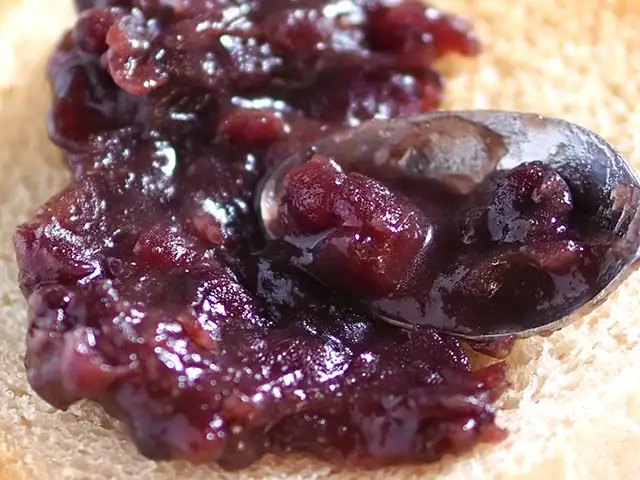
Ogura-an is a sweet bean paste made by mixing smooth bean paste with dainagon azuki (large red beans) simmered in sugar. Its name is said to come from an interesting chain of ideas. First, "Ogura" comes from Mount Ogura, famous for its autumn leaves, as in Teishin-kō's poem. Next, autumn leaves and deer have long been loved as a tasteful pair, as in Sarumaru Dayū's Hyakunin Isshu poem. The spotted pattern on a deer's back is called kanoko moyō ("fawn pattern"), and it calls to mind grains of sweet simmered beans, that is, dainagon azuki. Mixed into smooth bean paste, these beans make ogura-an. Mount Ogura → autumn leaves → deer → the fawn pattern → large red beans → ogura-an: this is said to be where the name comes from.
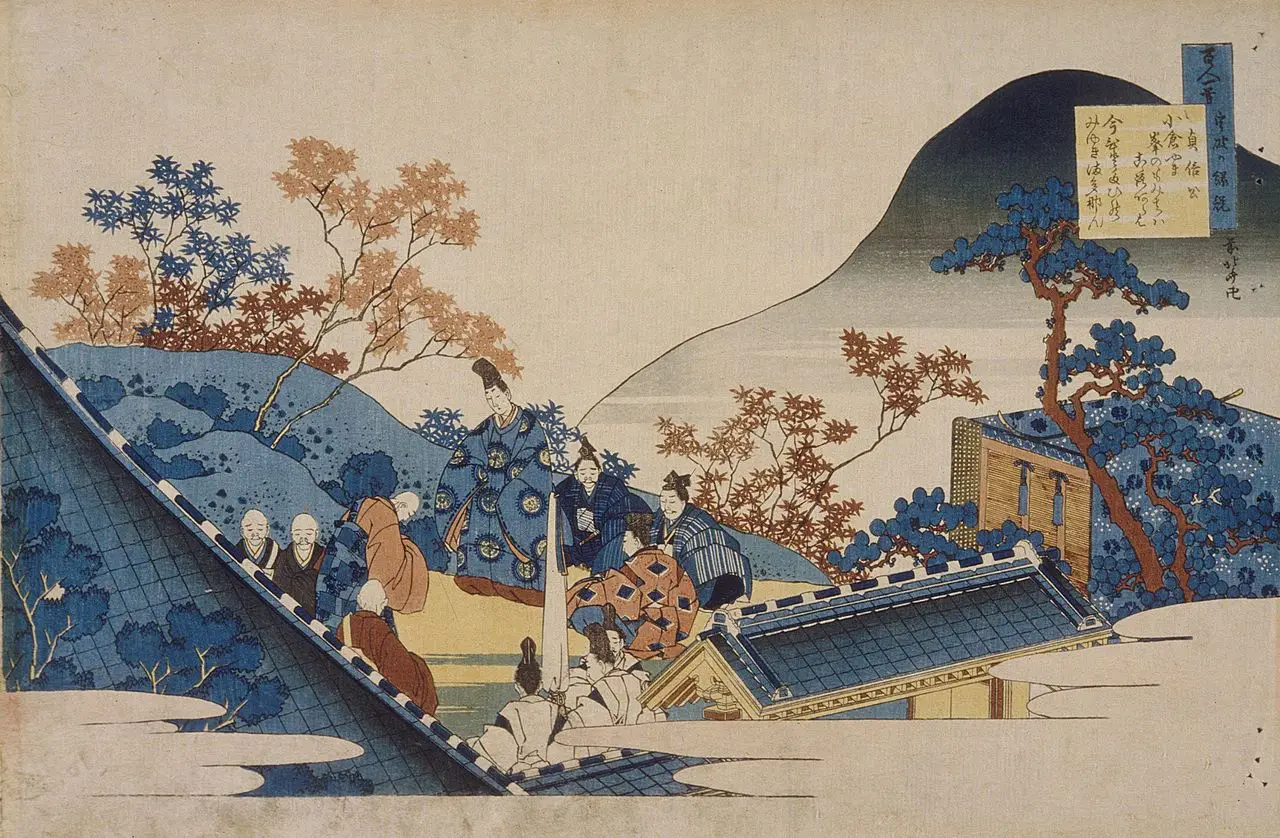
- Ukiyo-e by Katsushika Hokusai
-
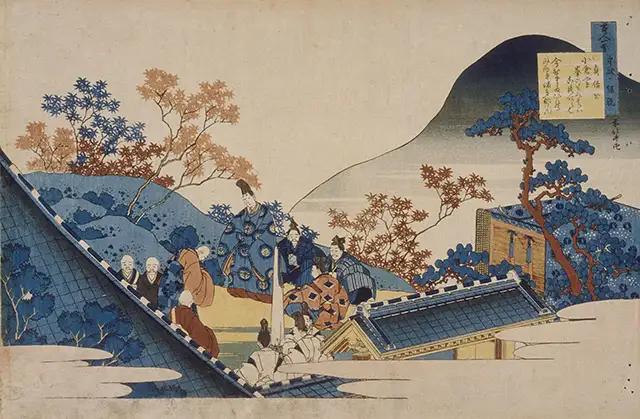
Los Angeles County Museum of Art, Public domain, via Wikimedia Commons This print is from One Hundred Poems Explained by the Nurse (Hyakunin Isshu Uba ga Etoki) by Katsushika Hokusai, an ukiyo-e artist of the Edo period. The idea of the series is a nurse explaining the Hyakunin Isshu poems with easy-to-understand pictures.
This picture shows what happens after the poem. In the poem, Retired Emperor Uda wishes to show the beautiful autumn leaves of Mount Ogura to his son, Emperor Daigo, and the picture shows Emperor Daigo actually coming to see them. On the right is a pine tree (matsu), which is said to carry the meaning that the autumn leaves' waiting (matsu) was worth it.