Front of the Card
Back of the Card
Japanese
English
Audio: NHK Creative Library
Read by LibriVox volunteer Larry Wilson.
Audio courtesy of LibriVox
菅家
このたびは
幣もとりあへず
手向山
もみぢのにしき
神のまにまに
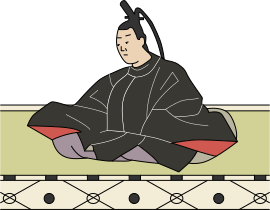
もみちのに
しきかみの
まにまに

この


- Poem 24
- このたびは
幣もとりあへず
手向山
もみぢのにしき 神のまにまに
Author: Kanke (845–903)
Source: Kokin Wakashū, Travel
- English Verse Translation
- I bring no prayers on coloured silk To deck thy shrine to-day, But take instead these maple leaves,
That grow at Tamuké; Finer than silk are they.
— William N. Porter, 1909
- Modern Translation
- This time, setting out in haste, I could not bring any offerings. O god of Mount Tamuke, please accept instead this brocade of autumn leaves, as you will.
- Commentary
- This poem was written on a journey of Retired Emperor Uda. People then offered nusa, strips of paper or cloth, to the gods of the road. Michizane had none with him, so on the spot he offered the beautiful autumn leaves instead.
- About the Poet
- Sugawara no Michizane was a gifted writer of waka and Chinese poems from childhood. From a family of scholars, he rose unusually high, to Minister of the Right. Seen as a threat by the Fujiwara, he was falsely accused by Fujiwara no Tokihira and sent to Dazaifu, where he lived in hardship and died two years later.
- Poem Illustration
-
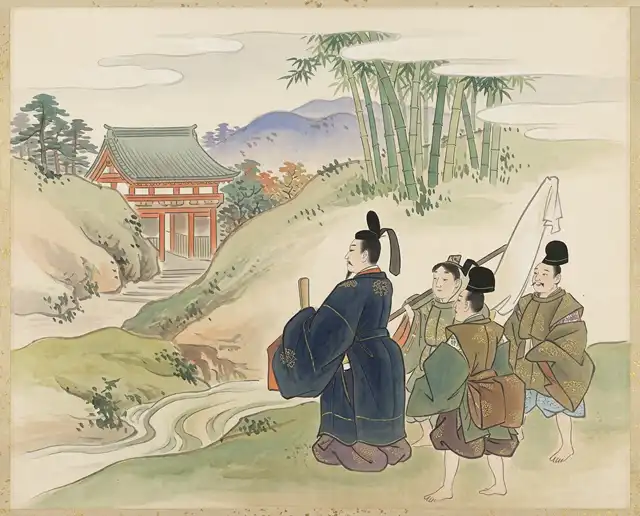
This image is based on an illustration from William N. Porter's A Hundred Verses from Old Japan, his 1909 English translation of the Hyakunin Isshu published in England, colorized and reworked using Adobe Firefly (generative AI).
- Sugawara no Michizane (Kanke): A Short Timeline
-
- 845
- Born
- 862
- Becomes a student of literature at the court university
- 877
- Becomes Professor of Literature
- 886
- Becomes governor of Sanuki Province
- 893
- Becomes Councillor (Sangi) and Major Controller of the Left
- 894
- Named envoy to Tang China, but advises ending the missions
- 899
- Becomes Minister of the Right
- 901
- Sent away from the capital to Dazaifu in Kyushu
- 903
- Dies at Dazaifu
- 923
- Given back the post of Minister of the Right and given Senior Second Rank after death
- 993
- Given Senior First Rank and Minister of the Left after death, and later Chancellor of the Realm
- Kanke's Family Tree
-
Sugawara no Michizane was given important posts by Emperor Uda and rose unusually high for a scholar, becoming Minister of the Right in the reign of Emperor Daigo.
Ruishi, the daughter of Michizane's father Koreyoshi, entered the court of Emperor Kōkō, and Michizane made his own daughter Enshi a consort of Emperor Uda and his daughter Yasuko the wife of Uda's son, Prince Tokiyo. But false accusations by the Minister of the Left, Fujiwara no Tokihira, led to the Shōtai Incident, and Michizane was sent away to Dazaifu.
When Michizane was sent to Dazaifu, his son Sugawara no Takami was also punished and sent away as Assistant Governor of Tosa. Prince Tokiyo, too, was caught up and became a monk, and his son Minamoto no Hideakira had an unhappy childhood. Many others were punished as well.
By the way, among Michizane's descendants is Sugawara no Takasue's Daughter, famous as the author of the Sarashina Diary.
- Appendix
-
- The Roots of the Sugawara Family:
From the Haji Clan to a "House of Learning" -
The history of the Sugawara family began when Michizane's great-grandfather, Furuhito, changed the family name to Sugawara. Originally the family was called Haji. Since the Kofun period, they had been an officially recognized group of craftsmen in charge of emperors' funerals and the building of huge burial mounds (kofun), and they also made haniwa clay figures. It was a family of fine lineage, given Sukune, the third of the "Eight Titles" (Yakusa no Kabane) set up by Emperor Tenmu.
In the Nara period, however, the spread of Buddhism changed funeral customs, and the work of building burial mounds no longer fit the times. To help the family survive, Furuhito decided to turn it from a family of craftsmen into a class of scholars specializing in learning. In 781, he asked to change the family name to Sugawara, after the place where they lived, and to be raised to the higher title of Ason.
It was Michizane's grandfather, Kiyotomo, who turned Furuhito's bold decision into a firm position. Kiyotomo was one of the elite who sailed on the same mission to Tang China as Saichō and Kūkai and took in the advanced government systems and learning of the Tang. After returning, he rose to Head of the Daigakuryō (the court university) and finally reached Junior Third Rank, the first Sugawara to join the top court nobles. At his home he also opened a private school called the Kanke Rōka, which produced many elite officials of the time.
Michizane's father, Koreyoshi, was given the honor of being a jitō, a scholar who taught the emperor in person. Seeing the remarkable gifts Michizane showed from an early age, he gave him a thorough elite education that sharpened his powers of expression and logical thinking, rather than simply stuffing him with knowledge.
In this way, in only four generations, the family changed dramatically from the Haji, craftsmen who built burial mounds, to the Sugawara, who moved the nation with words, and it gave the world Michizane, a genius without equal.
- A Poem Priest Sosei Wrote
in Response to Michizane's - The next poem was written by Priest Sosei, influenced by Michizane's Hyakunin Isshu poem. Sosei's dates are not known, but he lived at the same time as Sugawara no Michizane and, like Michizane, seems to have gone with Retired Emperor Uda on his journeys and written poems.
In Japanese
手向けには つづりの袖も 切るべきに
もみぢに飽ける 神や返さむ tamukeniha tsuzurinosodemo kirubekini
momijiniakeru kamiyakaesamu Kokin Wakashū, Priest SoseiIn English
I ought to cut even the sleeve of my shabby robe to offer to the gods, but the gods, who have had their fill of these beautiful autumn leaves, would probably send it back.
- Michizane's Poem to the Plum Tree
- In the next poem, Michizane, about to be sent away to Dazaifu, calls out to the plum tree in his garden.
According to the "Flying Plum" legend, the plum tree missed him so much that it flew all the way to Dazaifu in a single night.In Japanese
東風吹かば 匂ひおこせよ 梅の花
主なしとて 春な忘るな kochifukaba nihohiokoseyo umenohana
arujinashitote harunawasuruna Shūi Wakashū, Sugawara no MichizaneIn English
When the east wind blows in spring, send me your fragrance, plum blossoms.
Even though your master is gone, do not forget the spring. - A Poem by Minamoto no Shitagō Remembering Michizane
- In the next poem, Minamoto no Shitagō, a poet of the mid-Heian period, remembers Michizane, who was sent away to Dazaifu, drawing on the Flying Plum legend.
In Japanese
梅は飛び 桜は枯れぬ 菅原や
深くぞ頼む 神の誓いを umehatobi sakurahakarenu sugaharaya
fukakuzotanomu kaminochikaio Genpei Jōsuiki, Minamoto no ShitagōIn English
The plum tree, loved by its master, flew all the way to Tsukushi, but the cherry tree in the same garden was forgotten and withered. Such is the power of deep faith in the gods.
- A Poem in Which Michizane, Now a Criminal,
Declared His Innocence - Sent away to Dazaifu for a crime he had not committed, Michizane wrote a poem declaring his innocence.
In Japanese
海ならず たたへる水の 底までに
清き心は 月ぞ照らさむ uminarazu tataherumizuno sokomadeni
kiyokikokoroha tsukizoterasamu Shin Kokin Wakashū, Sugawara no MichizaneIn English
The moon, which shines not only on the sea but down to the very bottom of the deepest waters, will surely make my pure heart clear to all.
- A Poem to the Wife He Left in the Capital
- The next poem is said to have been sent by Michizane, after he was sent away to Dazaifu, to the wife he had left in the capital.
In Japanese
君が住む 宿の梢を ゆくゆくと
隠るるまでも 返り見しはや kimigasumu yadonokozueo yukuyukuto
kakururumademo kaerimishihaya Ōkagami, Sugawara no MichizaneIn English
As I went on my way, I kept looking back at the treetops of the house where you live, until they were hidden from sight.
- The Mystery of a Criminal Made
Acting Governor-General of Dazaifu -
When Sugawara no Michizane was sent away to Dazaifu, he was given the post of Dazai no Gon no Sochi, Acting Governor-General of Dazaifu. In practice this was the real head of Dazaifu, a high position that only top court nobles could hold. But it was given only to save his honor; in reality he was being banished as a criminal.
He had to pay his own travel costs to Dazaifu, and he had to take many attendants befitting his high rank, all at his own expense. What is more, the post came with no salary despite its high rank, so he fell into hardship. In these harsh conditions, Michizane died only two years after moving to Dazaifu.
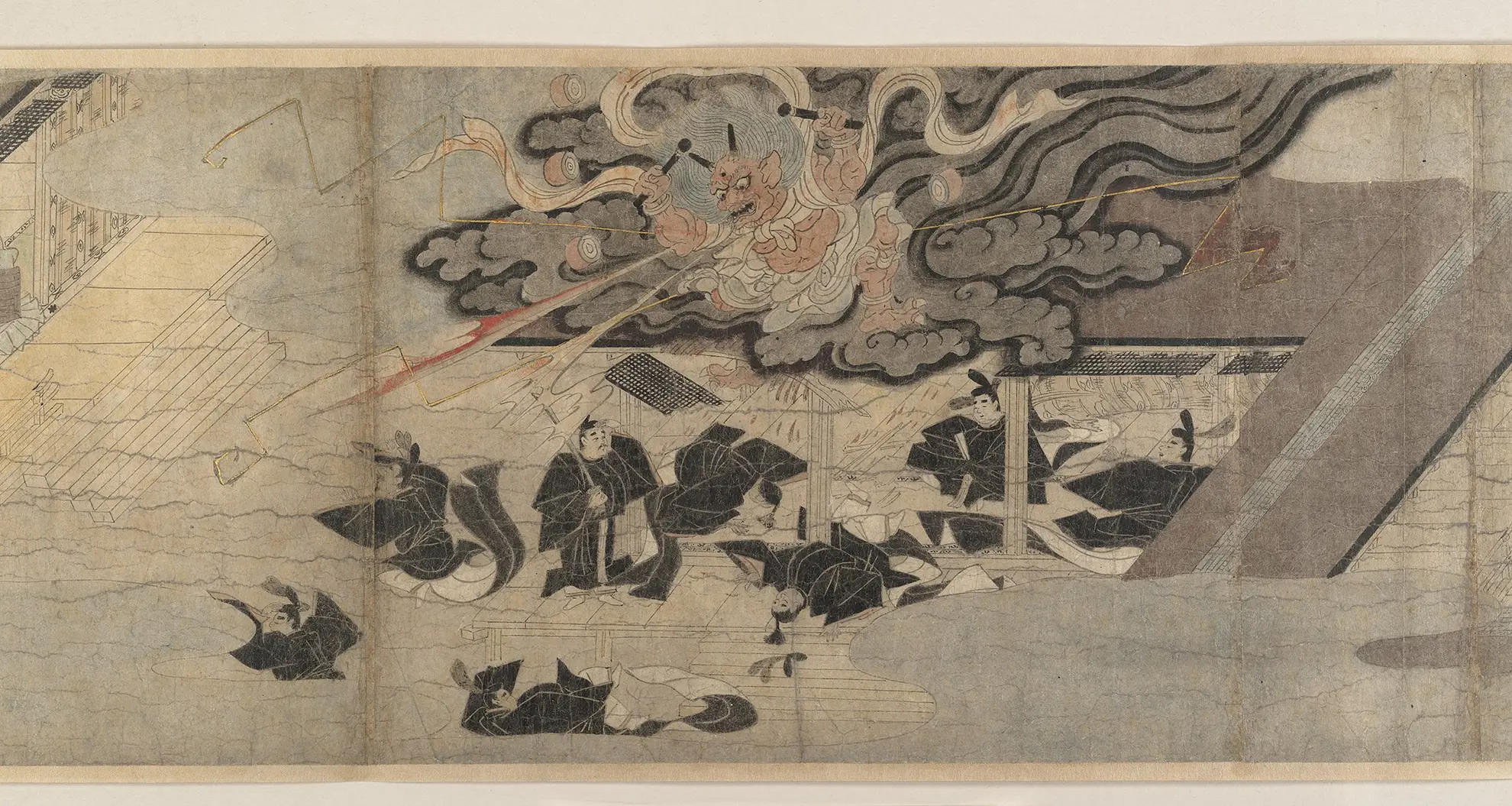
- The Kitano Tenjin Engi Picture Scroll
-
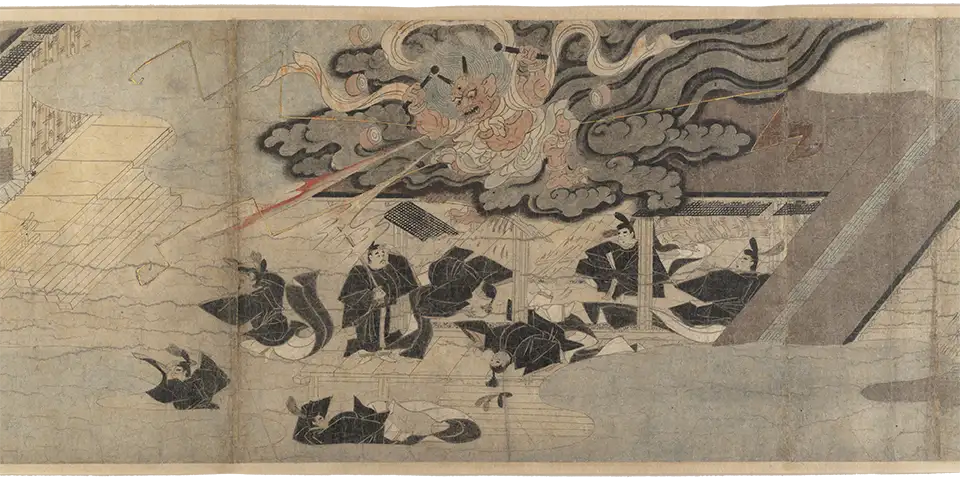
Metropolitan Museum of Art, Public domain, via Wikimedia Commons After Sugawara no Michizane died with his grievances unresolved at Dazaifu, lightning struck the Seiryōden hall of the imperial palace, killing the Upper Counselor Fujiwara no Kiyotsura and Taira no Mareyo, Middle Controller of the Right and Head of the Treasury. Three months later, even Emperor Daigo, who had banished Michizane, died. Seeing this chain of disasters, the nobles trembled in fear, saying, "This must be a curse from Michizane's vengeful spirit." To calm his anger, they built Kitano Tenmangū Shrine and worshipped his spirit with great care. In time, Michizane, who had shown the overwhelming power of lightning, also came to be worshipped as a "god of thunder." Because of these legends, Sugawara no Michizane is still spoken of today, along with Taira no Masakado and Retired Emperor Sutoku, as one of the "Three Great Vengeful Spirits of Japan."
- Gakumon no Michi, "The Road of Learning"
-
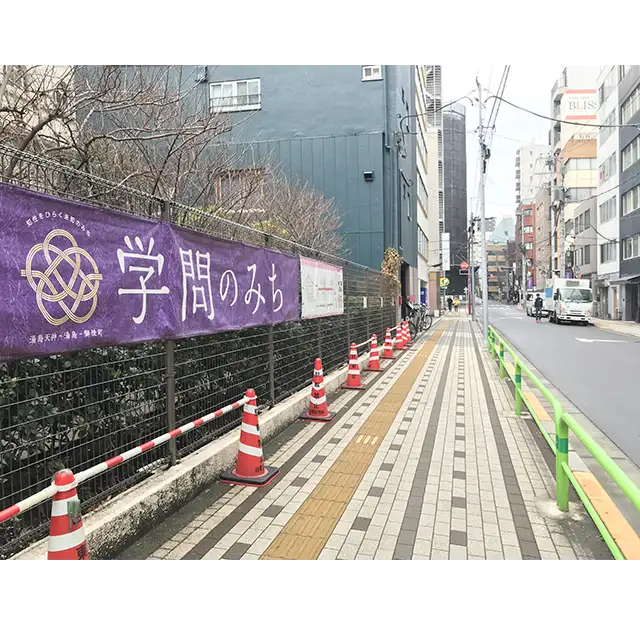
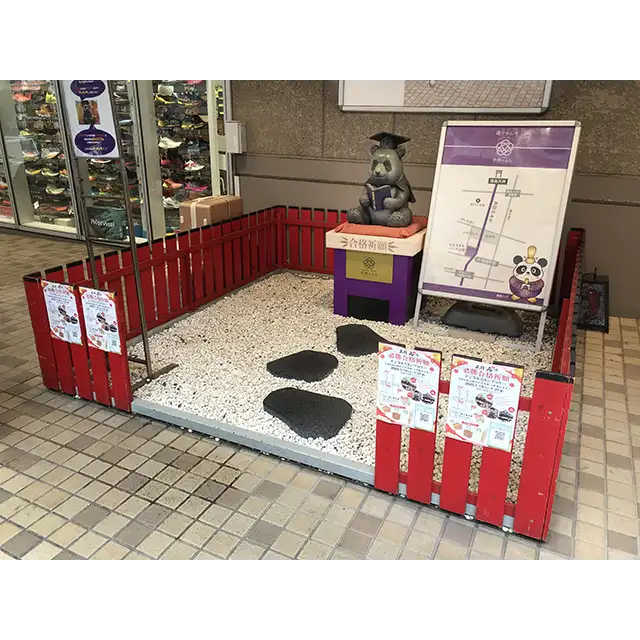
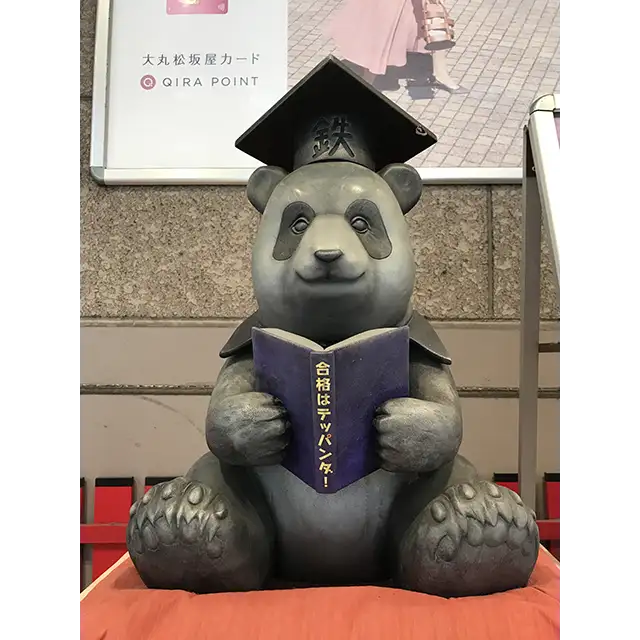
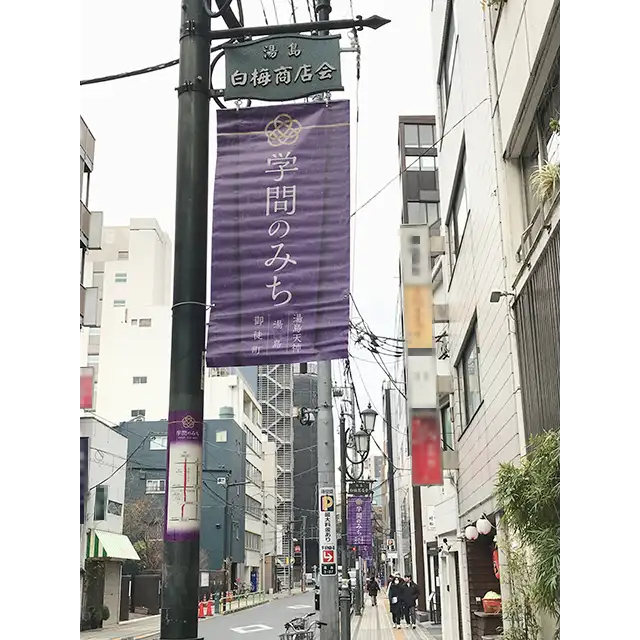
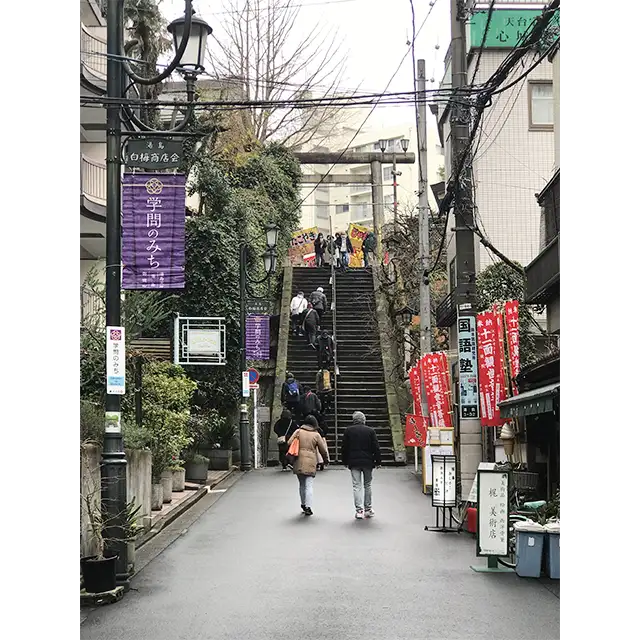
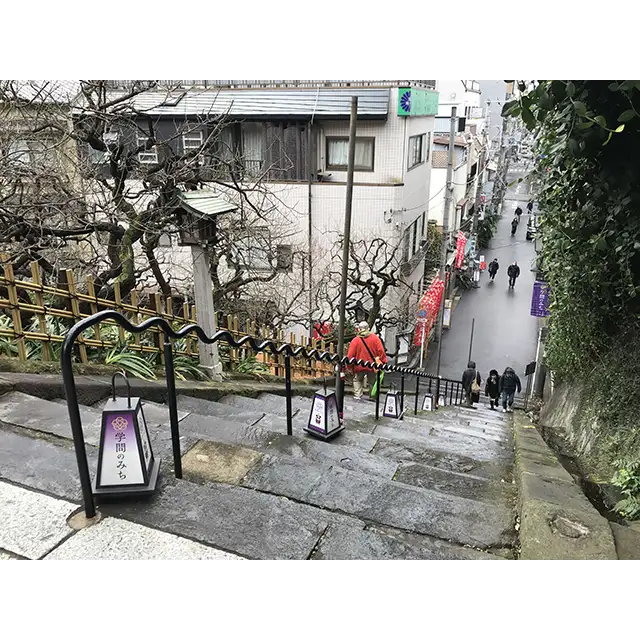
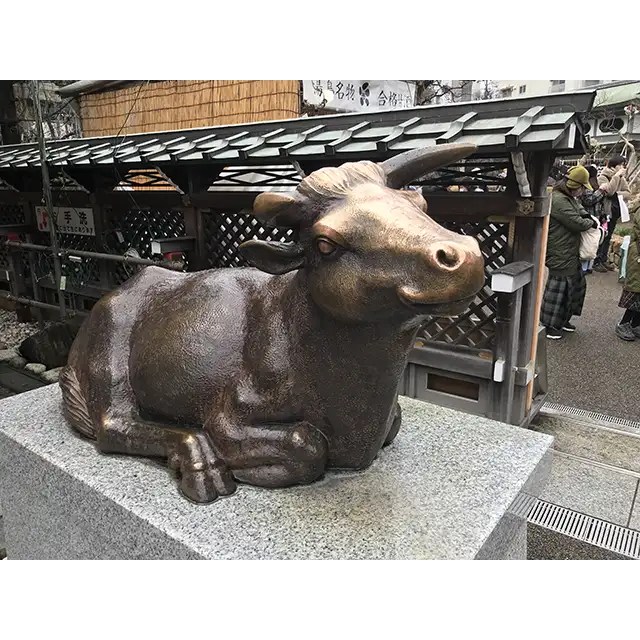
Gakumon no Michi, "The Road of Learning" (Bunkyō City, Tokyo), is a straight street about 700 meters long between Yushima Tenmangū Shrine, which honors Sugawara no Michizane as the god of learning, and Naka-Okachimachi Station on the Tokyo Metro. At Okachimachi Panda Square near JR Okachimachi Station stands an iron panda statue called "Teppanda," and the white gravel and black stepping stones made a panda pattern.
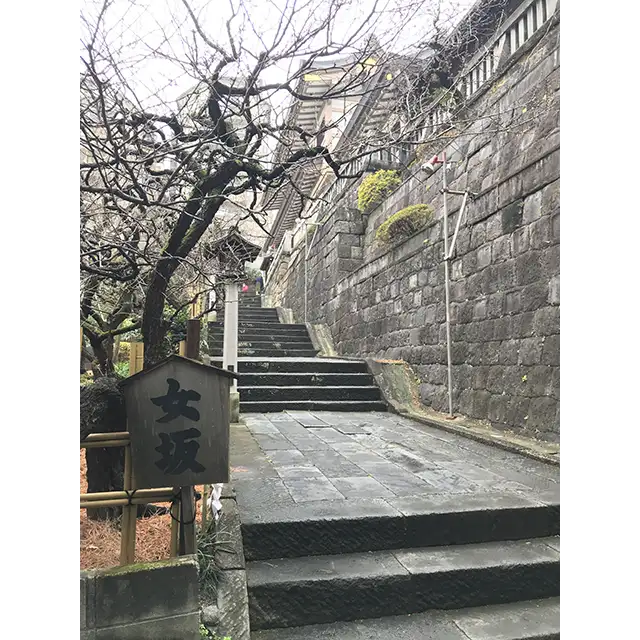
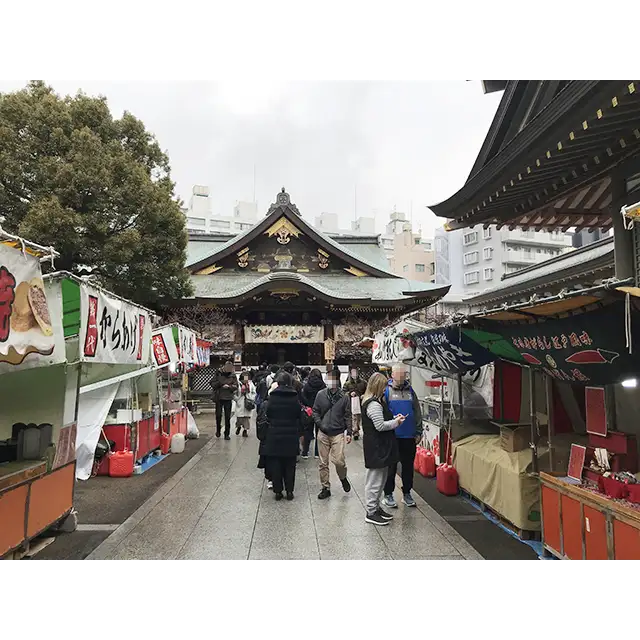
As you get closer to Yushima Tenmangū, the atmosphere becomes old-fashioned and nostalgic, and a steep stone stairway of 38 steps called Tenjin Ishizaka (Tenjin Otoko-zaka) appears. If you don't like steep slopes, you can take the gentler Onna-zaka steps, though it is a little farther. At the top of the stairs you can see the worship hall.
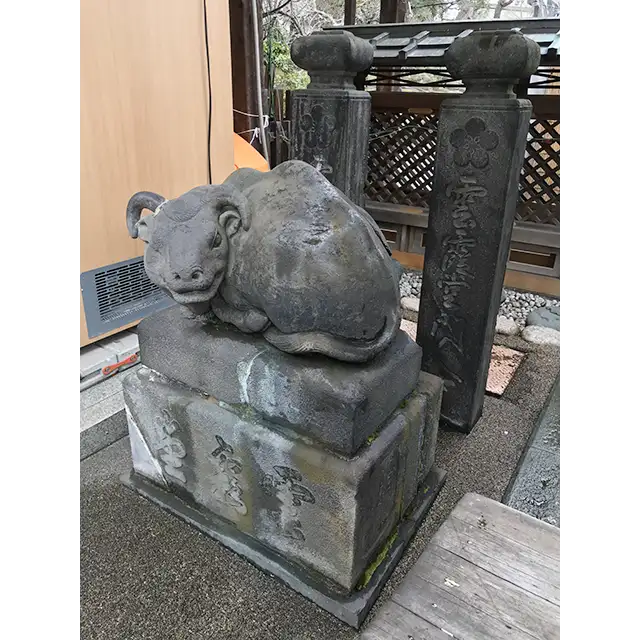
Near the purification fountain sit two lying oxen, one large and one small, and people hoping for blessings were waiting in line to stroke the large one. At this shrine to Michizane, the god of learning, so many people stroke the ox's head that it shines brightly.
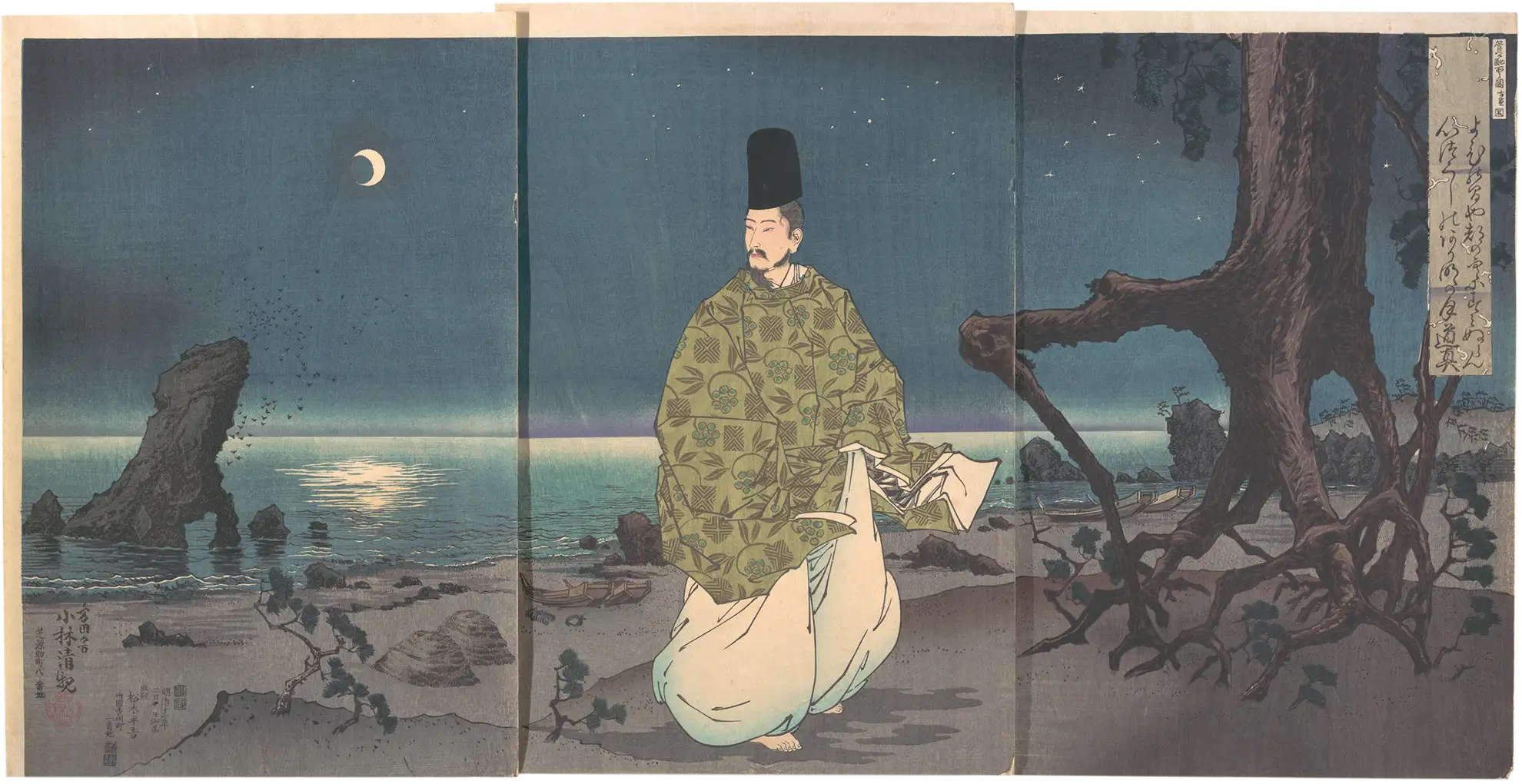
(January 25, 2025) - Kankō Haisho no Zu (Michizane in Exile)
-
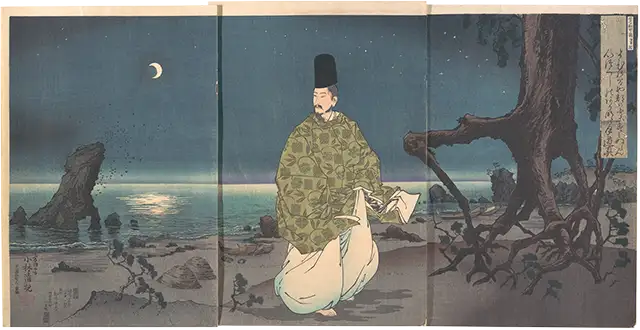
Metropolitan Museum of Art, Public domain This is Kankō Haisho no Zu by Kobayashi Kiyochika, an ukiyo-e artist of the Meiji period. Haisho means a place of exile.
- Ukiyo-e by Katsushika Hokusai
-
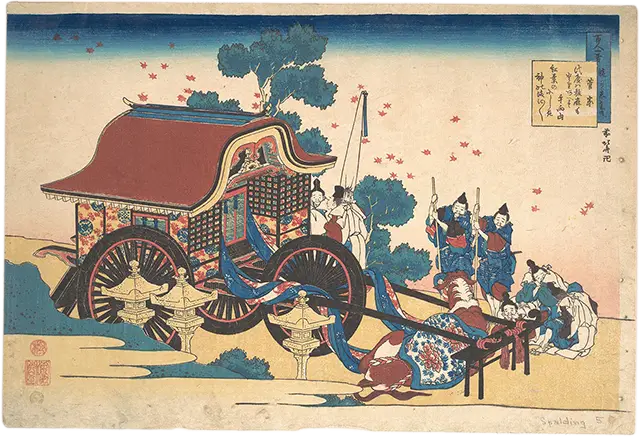
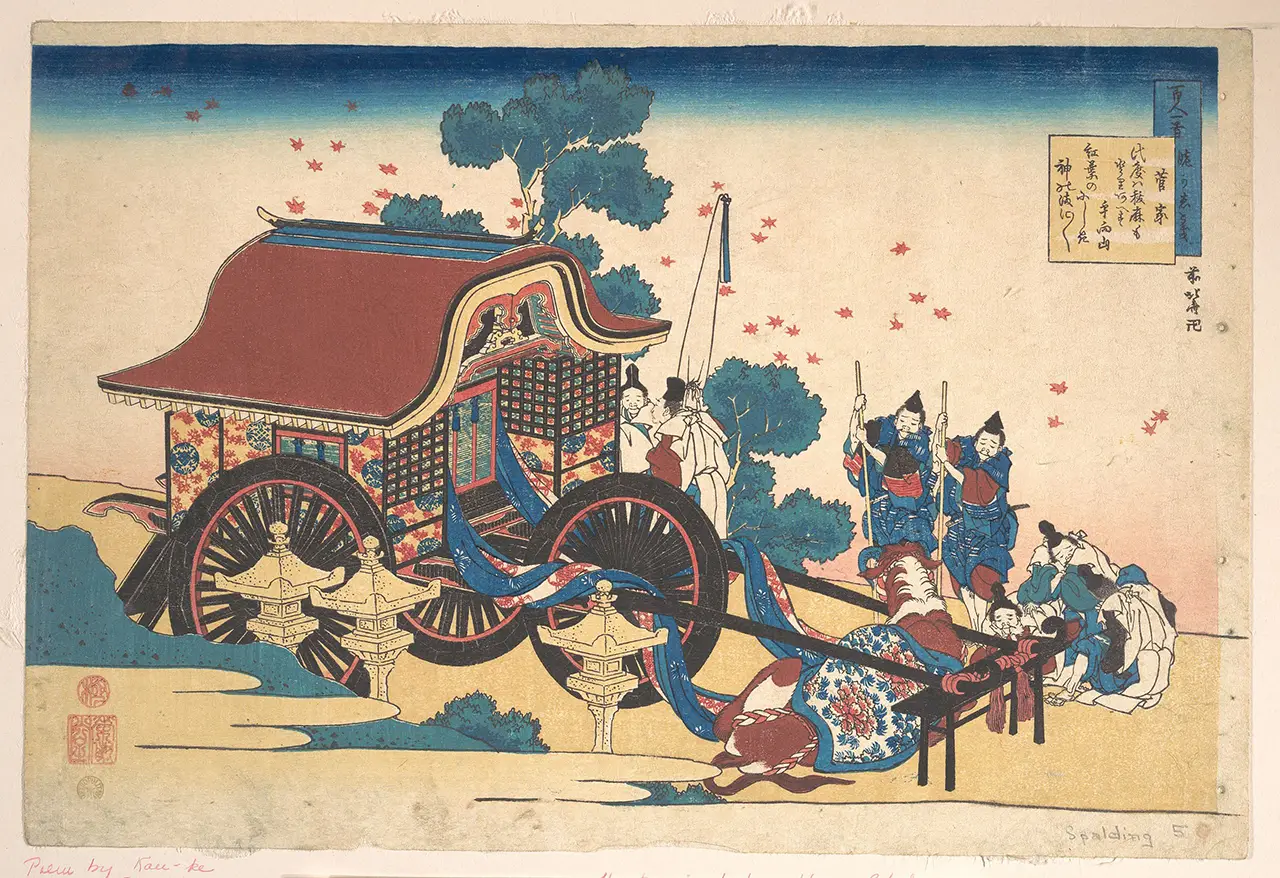
Katsushika Hokusai, CC0, via Wikimedia Commons This print is from One Hundred Poems Explained by the Nurse (Hyakunin Isshu Uba ga Etoki) by Katsushika Hokusai, an ukiyo-e artist of the Edo period. The idea of the series is a nurse explaining the Hyakunin Isshu poems with easy-to-understand pictures.
It shows an ox lying in the road, people watching over the ox that will not move, and someone telling the person inside the ox carriage why it has stopped. As Michizane was dying at Dazaifu, he left word to "bury me where the ox stops." It is said that when his body was carried on an ox carriage, the ox lay down on the way and would not move, so Michizane was buried there. Today Dazaifu Tenmangū Shrine stands on that spot.
- Utagawa Kuniyoshi's Hyakunin Isshu no Uchi
-
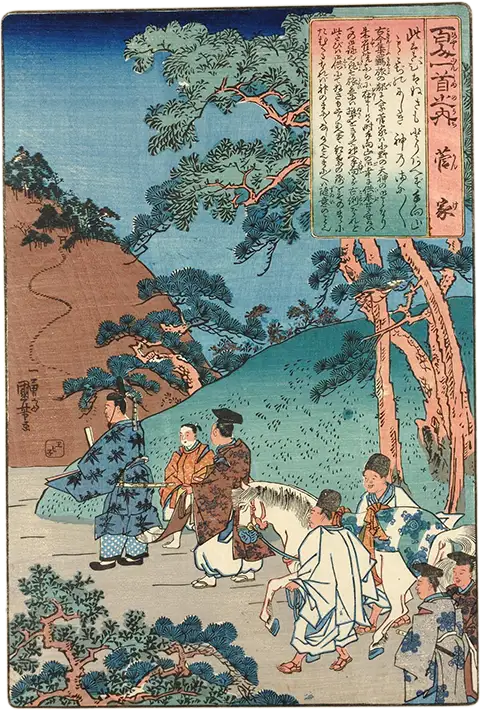
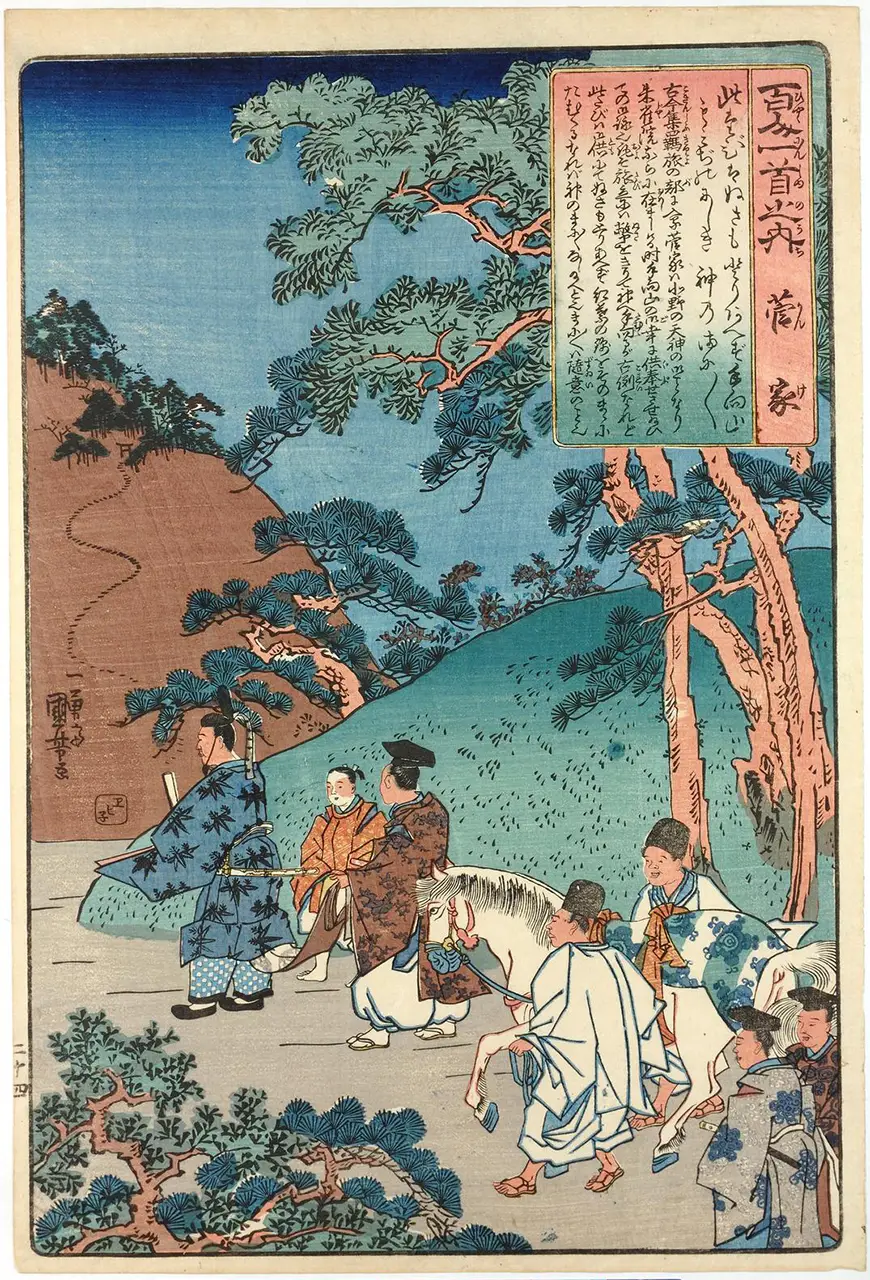
British Museum, Public domain, via Wikimedia Commons This ukiyo-e is by Utagawa Kuniyoshi, an artist of the Edo period.
It shows a scene that matches the poem in the Hyakunin Isshu.Kanke's Hyakunin Isshu poem was written during Retired Emperor Uda's journey to the Miyataki detached palace in Yoshino. Looking at the print, it seems to show just the moment in the poem when he is about to offer beautiful autumn leaves to the gods.
Look around, though, and there are only pine trees; the autumn leaves themselves are nowhere to be seen. By drawing a scene full of pines, Kuniyoshi may have wanted to show the rising excitement of the attendants, eagerly waiting for Kanke's offering to the gods to begin.
Timeline of Sugawara no Michizane
(Click to open or close.)Sugawara no Michizane is born
Born the third son of Sugawara no Koreyoshi.
He studied hard from childhood and wrote a Chinese poem at 11.Becomes a student of literature (monjōshō)
He became a student of literature.
Becomes an advanced student of literature (monjō tokugōshō)
He became an advanced student of literature, a place given to only two of the students.
Passes the hōryakushi exam
He passed the hōryakushi, the examination for government officials, and was given Senior Sixth Rank, Upper Grade.
Becomes Junior Assistant Minister of Ceremonies and Professor of Literature
He became Professor of Literature (monjō hakase), the highest post for a scholar.
Leaves those posts and becomes Governor of Sanuki
The Akō Dispute (a political conflict) breaks out
To ask Fujiwara no Mototsune to assist him, Emperor Uda had Tachibana no Hiromi write an edict saying, "Let the duties of akō be your duties." But Mototsune claimed that akō was only an honorary title with no real duties, stopped working, and brought the government to a standstill. This political conflict, called the Akō Dispute, was settled by Sugawara no Michizane.
Becomes Head Chamberlain
Advises ending the missions to Tang China
Fujiwara no Tokihira arranged for Michizane to be named chief envoy to Tang China to keep him away from politics, but Michizane advised ending the missions, because Tang China was in a state of civil war.
Becomes Minister of the Right
He became Minister of the Right, the second-highest post in the Council of State after the Minister of the Left, Fujiwara no Tokihira.
Receives a letter from Miyoshi no Kiyoyuki
Michizane received a letter from Miyoshi no Kiyoyuki, a Professor of Literature, telling him to know his limits and retire, but he would not listen.
The Shōtai Incident
Fujiwara no Tokihira falsely accused Michizane of plotting to remove Emperor Daigo and put his son-in-law, Prince Tokiyo, on the throne, and Michizane was sent away to Dazaifu as Acting Governor-General (Dazai no Gon no Sochi).
Dies of illness
Living in poverty, he fell ill and died at Dazaifu.
- The Roots of the Sugawara Family: