Front of the Card
Back of the Card
Japanese
English
Audio: NHK Creative Library
Read by LibriVox volunteer Larry Wilson.
Audio courtesy of LibriVox
素性法師
今こむと
いひしばかりに
長月の
有明の月を
待ち出でつるかな
ありあけの
つきをまち
いてつるかな

いまこ


- Poem 21
- 今こむと
いひしばかりに
長月の
有明の月を 待ち出でつるかな
Author: Priest Sosei (dates unknown)
Source: Kokin Wakashū, Love
- English Verse Translation
- The moon that shone the whole night through This autumn morn I see, As here I wait thy well-known step,
For thou didst promise me— "I'll surely come to thee."
— William N. Porter, 1909
- Modern Translation
- Just because you said "I will come right away" — I waited all night for you, watching the moon of the long autumn month until it set at dawn.
- Commentary
- The poem is in a woman's voice. Nagatsuki is the ninth lunar month, late autumn. Did she wait one night, or for months? Readings differ, but Fujiwara no Sadaie read it as "autumn ended while I waited month after month." It conveys her growing longing and the loneliness of passing autumn.
- About the Poet
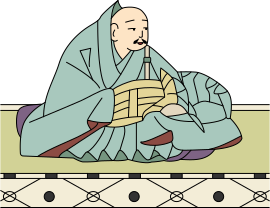
- Priest Sosei was a great-grandson of Emperor Kanmu and the son of Henjō. His father became a monk when Emperor Ninmyō died, and Sosei, perhaps following him, also became a monk while young. He remained active at court poetry gatherings.
- Poem Illustration
-
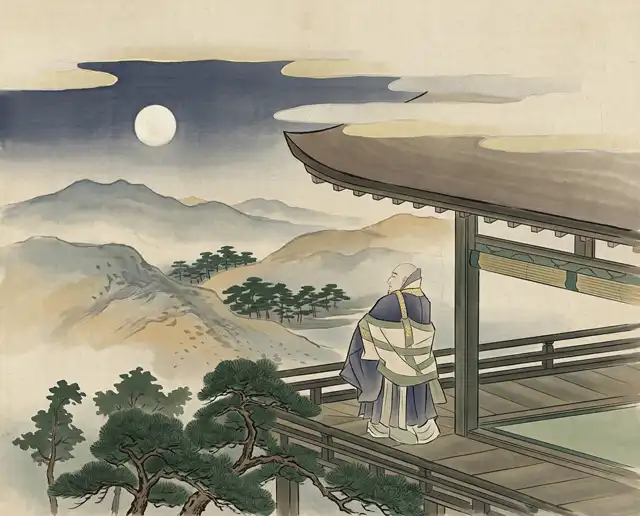
This image is based on an illustration from William N. Porter's A Hundred Verses from Old Japan, his 1909 English translation of the Hyakunin Isshu published in England, colorized and reworked using Adobe Firefly (generative AI).
- Priest Sosei: A Short Timeline
-
- 896
- Becomes a Provisional Vinaya Master (a monk's rank)
- Notes
-
- Dates of birth and death unknown
- Rose to officer of the Left Palace Guards, then became a monk
- Lived at Urin-in Temple
- Later moved to Ryōin-in Temple at Isonokami in Yamato Province
- Counted as one of the Thirty-Six Immortal Poets
- Priest Sosei's Family Tree
-
Priest Sosei was a great-grandson of Emperor Kanmu. His father, High Priest Henjō, took over the care of Urin-in from Prince Tsuneyasu, the seventh son of Emperor Ninmyō.
After Henjō died, Sosei is said to have moved to Urin-in and held gatherings there for waka and Chinese poetry.
By the way, the historical tale Ōkagami begins with two old men sharing memories at the Bodai-kō of Urin-in, a Buddhist service where the Lotus Sutra was explained.
- Appendix
-
- The Poem Sosei Built On
-
Sosei's poem "Ima komu to..." is thought to be based on the next poem.
It is by his father, High Priest Henjō.In Japanese
今こむと いひて別れし 朝より
思ひくらしの 音をのみぞ鳴く imakomuto ihitewakareshi ashitayori
omohikurashino neonomizonaku Kokin Wakashū, High Priest HenjōIn English
Ever since the morning we parted, when you said, "I'll come soon,"
I have done nothing but cry, like a higurashi cicada. - Sosei's Poem of "Crimson Tears"
-
The next poem of mourning was written at the funeral procession of Fujiwara no Yoshifusa, a leading court noble of the early Heian period. During his life, Yoshifusa had a country house at Shirakawa (now Sakyō Ward, Kyoto), called Shirakawa-dono. Through that area flowed a river called the Shirakawa, "White River."
The name is said to come from its white river sand.In waka, the tears shed in deep grief are sometimes called 紅涙 (kōrui), "crimson tears," red like blood.
In this poem, the "White River" with its white sand is turned red by tears of sorrow.In Japanese
血の涙 落ちてぞたぎつ 白川は
君が世までの 名にこそありけれ chinonamida ochitezotagitsu shirakawaha
kimigayomadeno nanikosoarikere Kokin Wakashū, Priest SoseiIn English
Crimson tears have fallen, and the river, dyed deep red, seethes as if trembling with grief. The name "White River" belonged only to the days when you were alive.
- The Ariake Moon and the Phases of the Moon
-
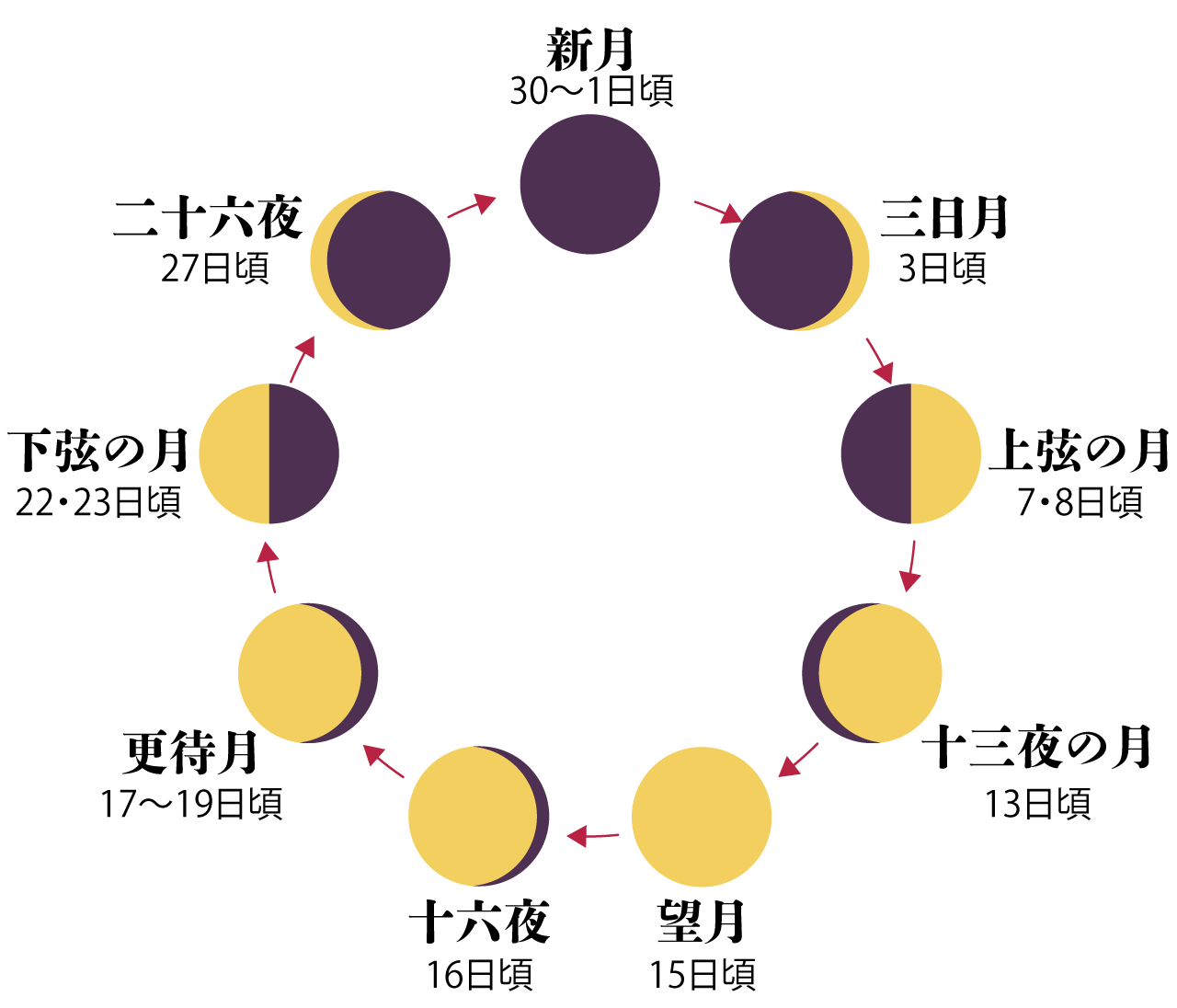
The ariake no tsuki is the moon that is still in the sky after dawn. From about the 15th to the 29th day of the lunar month, the moon can be seen in the early-morning sky.
In the Heian period, only privileged people could have calendars. So for ordinary people, the changing shape of the moon probably served as a kind of natural calendar.
Phase Moonrise Moonset New moon 6:00 18:00 First quarter 12:00 24:00 Full moon 18:00 6:00 Last quarter 24:00 12:00 - Ukiyo-e by Katsushika Hokusai
-
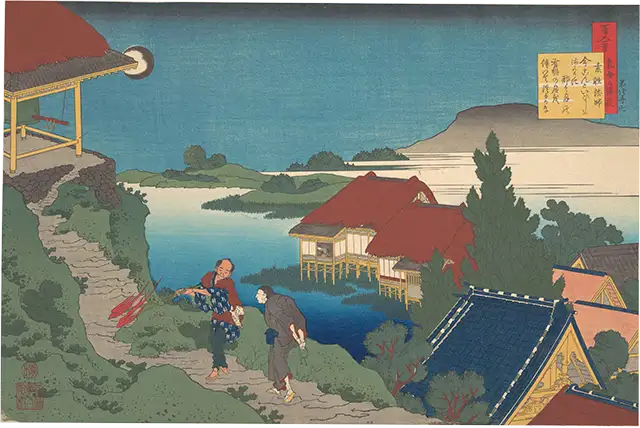
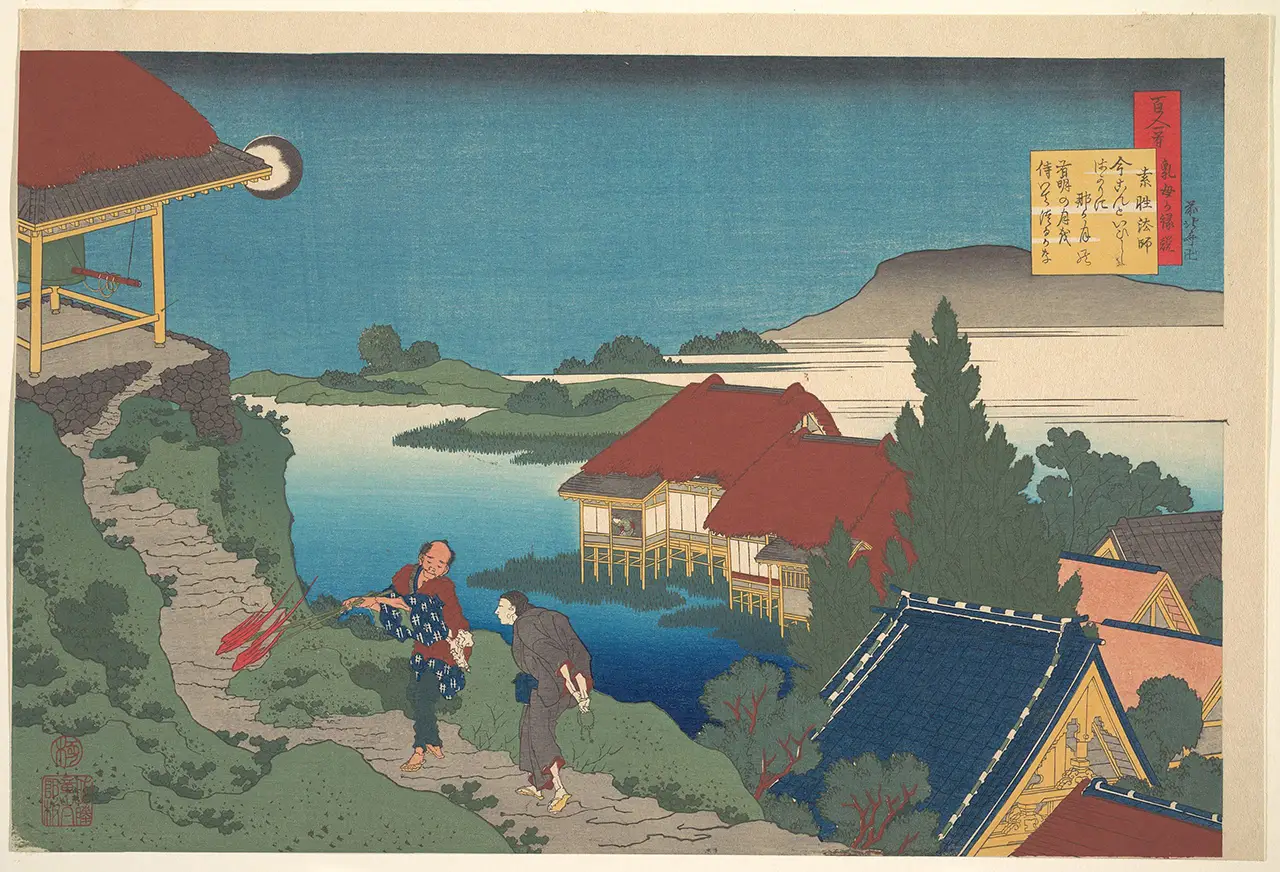
Katsushika Hokusai, CC0, via Wikimedia Commons This print is from One Hundred Poems Explained by the Nurse (Hyakunin Isshu Uba ga Etoki) by Katsushika Hokusai, an ukiyo-e artist of the Edo period. A moon that looks like an eclipse, an old man heading toward a temple bell, and a woman seen in a house at the back. It is a mysterious picture.
- Utagawa Kuniyoshi's Hyakunin Isshu no Uchi
-
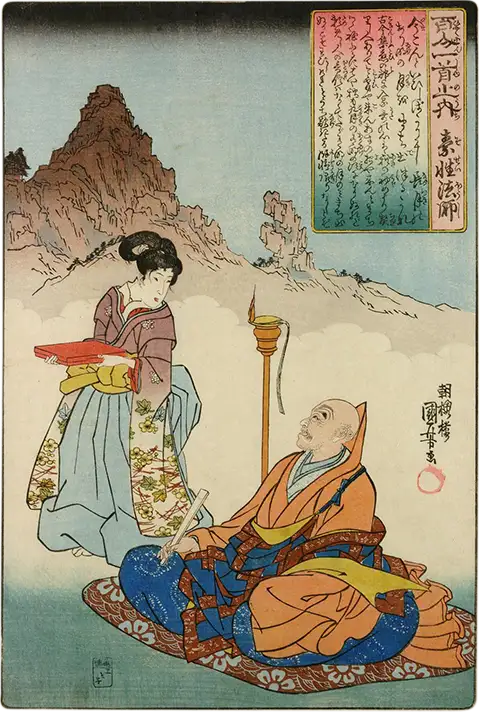
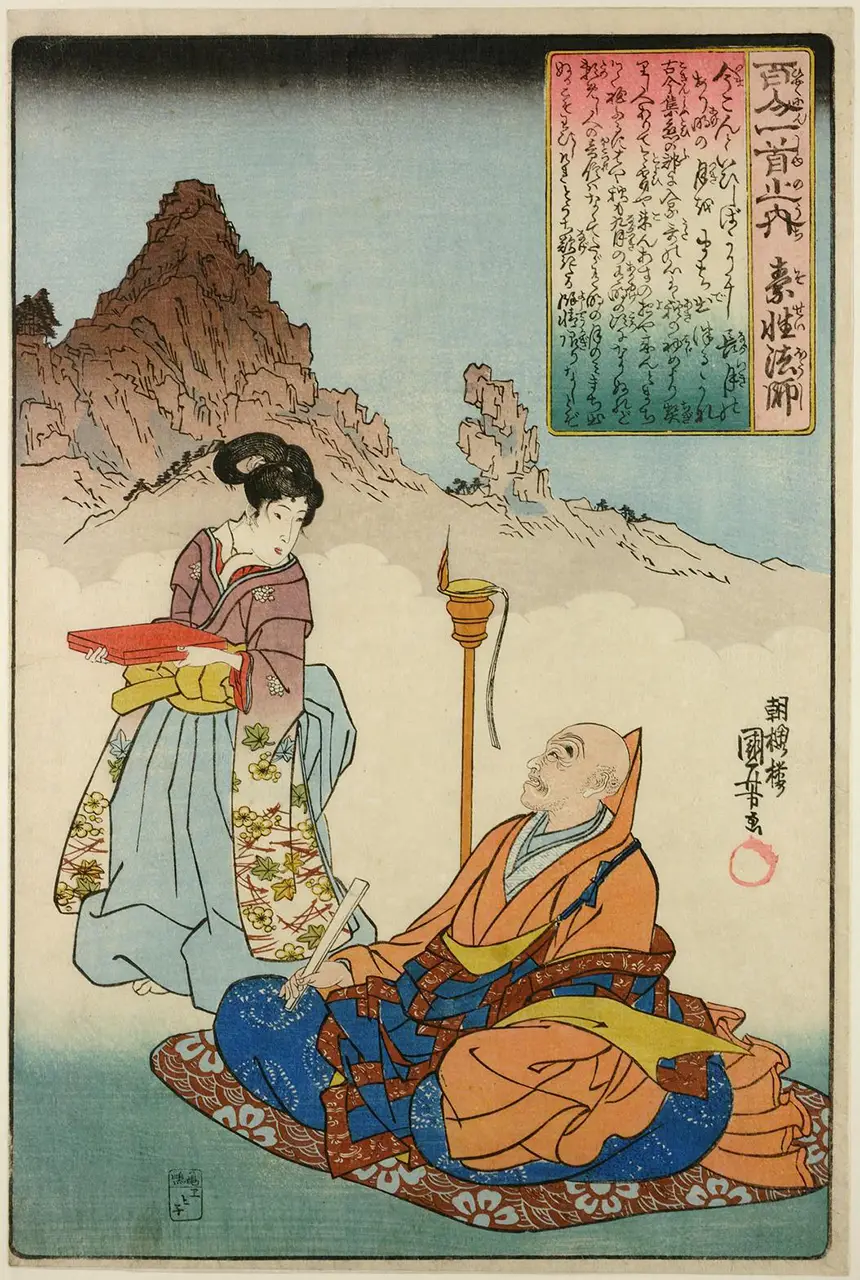
British Museum, Public domain, via Wikimedia Commons This ukiyo-e is by Utagawa Kuniyoshi, an artist of the Edo period.
It shows a scene that matches the poem in the Hyakunin Isshu.The poem is thought to have been written by Sosei taking the part of a woman. In this picture, however, the monk also seems to be looking back on the days of his youth, when he could not meet the woman he loved.
A woman is drawn in the picture, but she looks much younger than the monk. So rather than a present lover, she may be a woman the monk is picturing as he looks back on the distant past. The steep mountains in the background seem to stand for the distance that keeps them apart, however much they long to meet.