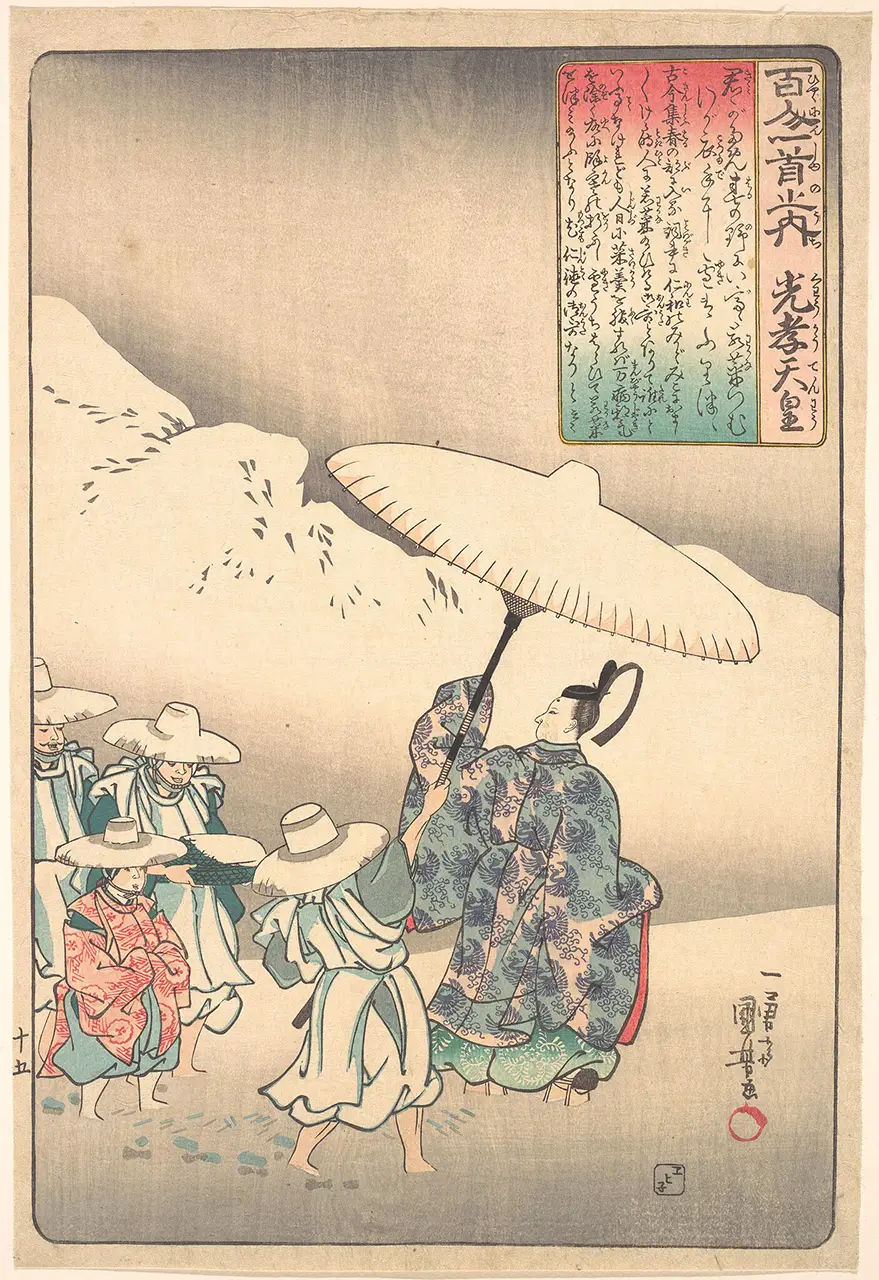
Front of the Card
Back of the Card
Japanese
English
Audio: NHK Creative Library
Read by LibriVox volunteer Larry Wilson.
Audio courtesy of LibriVox
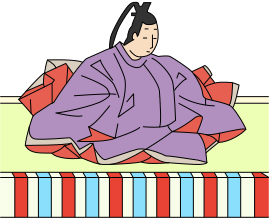
光孝天皇
君がため
春の野に出でて
若菜つむ
わが衣手に
雪は降りつつ
わかころも
てにゆきは
ふりつつ

きみがためは


- Poem 15
- 君がため
春の野に出でて
若菜つむ
わが衣手に 雪は降りつつ
Author: Emperor Kōkō (830–887)
Source: Kokin Wakashū, Spring
- English Verse Translation
- Mother, for thy sake I have been Where the wakana grow, To bring thee back some fresh green leaves
And see—my koromo Is sprinkled with the snow!
— William N. Porter, 1909
- Modern Translation
- Going out into the spring fields to pick young greens for you — the snow falls on my sleeves.
- Commentary
- The Kokin Wakashū says the future Emperor Kōkō, while still a prince, sent this poem with a gift of young spring greens.
- About the Poet
- After Yōzei was removed by Fujiwara no Mototsune, Kōkō became emperor at 55 on Mototsune's recommendation. He died after only three years, and Mototsune held the real power. A history of the time calls him humble, gentle, kind, and generous, and that gentle nature shows in his poem.
- Poem Illustration
-
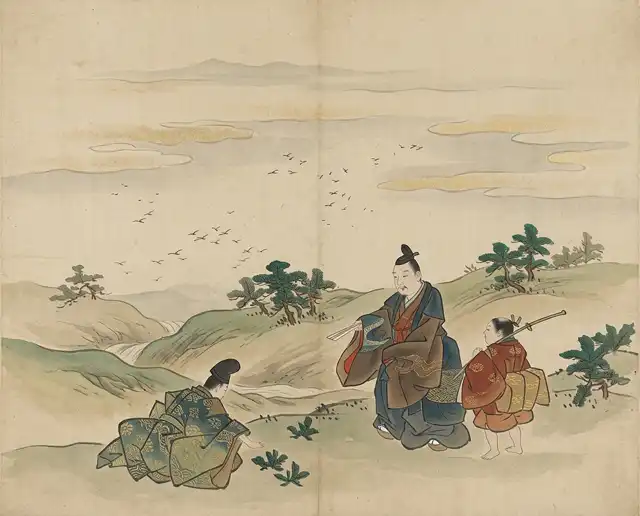
This image is based on an illustration from William N. Porter's A Hundred Verses from Old Japan, his 1909 English translation of the Hyakunin Isshu published in England, colorized and reworked using Adobe Firefly (generative AI).
- Emperor Kōkō: A Short Timeline
-
- 830
- Born as a son of Emperor Ninmyō
- 843
- Holds his coming-of-age ceremony
- 882
- Given First Rank for princes (Ippon)
- 884
- Becomes emperor at age 55, put forward by Fujiwara no Mototsune
- 887
- Dies
- Emperor Kōkō's Family Tree
-
Emperor Kōkō became emperor at the age of 55, after Retired Emperor Yōzei gave up the throne. Kōkō expected that when he himself stepped down, Prince Sadayasu, Emperor Yōzei's younger brother, would become the next emperor, so he had his own children leave the imperial family and become subjects.
However, the Kampaku (chief adviser to the emperor), Fujiwara no Mototsune, put Kōkō's seventh son, Prince Sadami, on the throne as Emperor Uda.
- Appendix
-
- A Poem Based on Kōkō's, in The Tales of Yamato
- This poem appears in The Tales of Yamato (Yamato Monogatari) and is thought to be based on Emperor Kōkō's Hyakunin Isshu poem. In the story, Lieutenant Yoshimine (later High Priest Henjō) stops at a run-down house to get out of the rain and meets a beautiful woman there. The next day, she picks greens from the garden and cooks them for him. The poem shows her touching feelings: though she is poor, she does all she can to welcome her guest.
In Japanese
君がため 衣のすそを ぬらしつつ
春の野にいで つめる若菜ぞ kimigatame koromonosusoo nurashitsutsu
harunononiide tsumeruwakanazo The Tales of YamatoIn English
These are young greens I went out to the spring fields to pick for you, getting the hem of my robe wet.
- A Poem Sad That Snow Keeps Him
from Picking Young Greens -
In this poem, Yamabe no Akahito had been looking forward to picking young greens, and he is disappointed that the snow keeps falling.
In Japanese
明日よりは 春菜摘まむと 標めし野に
昨日も今日も 雪は降りつつ asuyoriha harunatsumamuto shimeshinoni
kinoumokyoumo yukihafuritsutsu Man'yōshū, Yamabe no AkahitoIn English
I marked a field so I could pick spring greens from tomorrow on, but yesterday and today, the snow keeps falling.
- Utagawa Kuniyoshi's Hyakunin Isshu no Uchi
-
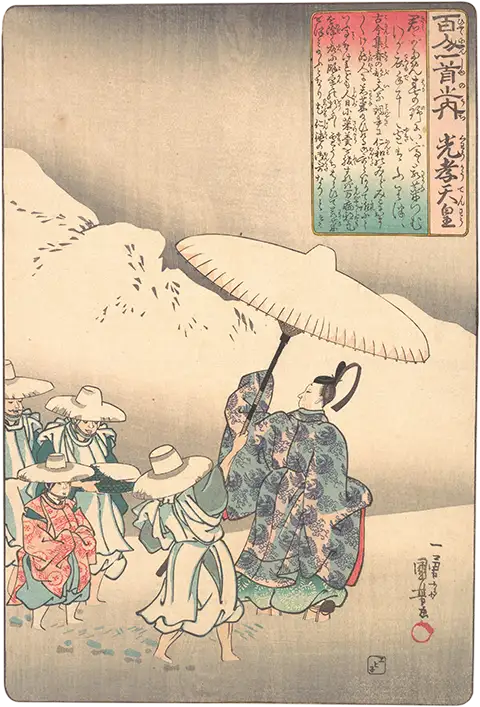
Utagawa Kuniyoshi, CC0, via Wikimedia Commons This ukiyo-e is by Utagawa Kuniyoshi, an artist of the Edo period.
It shows a scene that matches the poem in the Hyakunin Isshu.According to the headnote in the Kokin Wakashū, Emperor Kōkō wrote his Hyakunin Isshu poem while he was still Prince Tokiyasu.
Even as a prince, he was a member of the imperial family, so he may really have gone out with a long line of attendants, as in this print.