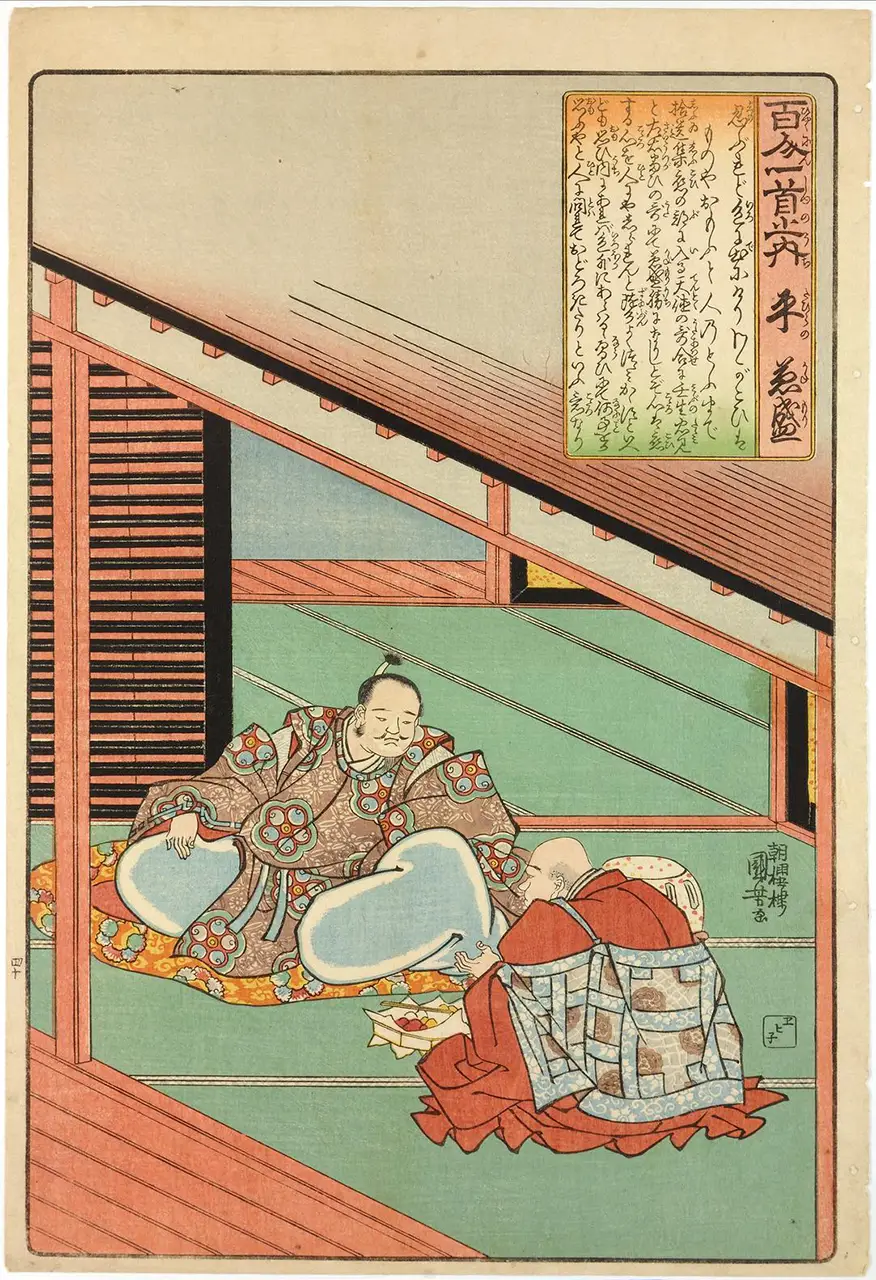
Front of the Card
Back of the Card
Japanese
English
Audio: NHK Creative Library
Read by LibriVox volunteer Larry Wilson.
Audio courtesy of LibriVox
平兼盛
忍ぶれど
色に出でにけり
我が恋は
物や思ふと
人の問ふまで
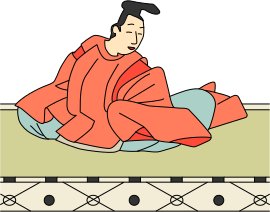
ものやおも
ふとひとの
とふまて

しの


- Poem 40
- 忍ぶれど
色に出でにけり
我が恋は
物や思ふと 人の問ふまで
Author: Taira no Kanemori (dates unknown–991)
Source: Shūi Wakashū, Love
- English Verse Translation
- Alas! the blush upon my cheek, Conceal it as I may, Proclaims to all that I'm in love,
Till people smile and say— "Where are thy thoughts to-day?"
— William N. Porter, 1909
- Modern Translation
- Though I tried to keep it secret, my love showed itself on my face — to the point where people asked if something was on my mind.
- Commentary
- Written for the Tentoku palace poetry contest (960) on the theme "love not yet met," it was in a close match with Mibu no Tadami's poem. It is said to have won because Emperor Murakami was heard softly reciting its opening, "shinoburedo."
- About the Poet
- Taira no Kanemori was a great-great-grandson of Emperor Kōkō but became a commoner with the name Taira. He is not of the same branch as Taira no Kiyomori. Some say he was the father of Akazome Emon, but this is not certain.
- Poem Illustration
-
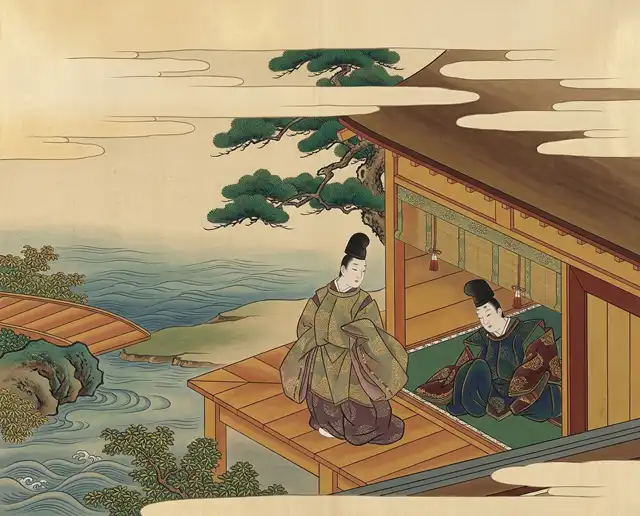
This image is based on an illustration from William N. Porter's A Hundred Verses from Old Japan, his 1909 English translation of the Hyakunin Isshu published in England, colorized and reworked using Adobe Firefly (generative AI).
- Taira no Kanemori: A Short Timeline
-
- 946
- Given Junior Fifth Rank, Lower Grade
- 950
- Leaves the imperial family and is given the family name Taira
- 960
- Competes against Mibu no Tadami at the Palace Poetry Contest of the Tentoku Era
- 979
- Becomes governor of Suruga Province
- 991
- Dies
- Notes
-
- Counted as one of the Thirty-Six Immortal Poets
- Taira no Kanemori's Family Tree
-
According to the Sonpi Bunmyaku, a collection of family trees, Taira no Kanemori was a great-great-grandson of Emperor Kōkō. In 950 he was given the family name Taira no Ason and left the imperial family to become a subject.
At the Palace Poetry Contest of 960 (the 4th year of Tentoku), Kanemori competed against Mibu no Tadami. It was a close match, but Kanemori was judged the winner because Emperor Murakami had been softly reciting his poem, "Shinoburedo...."
Akazome Emon is said to be the daughter of Akazome Tokimochi, her mother's second husband. But it is also said that her mother was already pregnant when she remarried, so Kanemori may have been Akazome Emon's real father.
- Appendix
-
- Utagawa Kuniyoshi's Hyakunin Isshu no Uchi
-
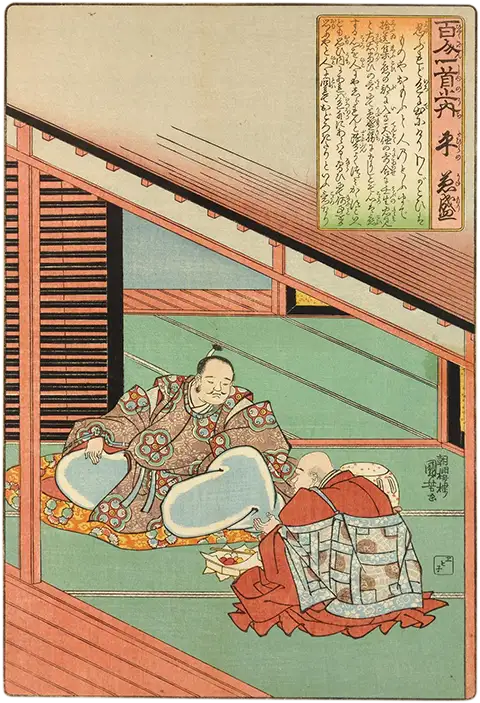
British Museum, Public domain, via Wikimedia Commons This ukiyo-e print is by Utagawa Kuniyoshi, an artist of the Edo period.
It shows a scene to go with the Hyakunin Isshu poem.At first glance, the picture does not seem to match the poem. Why did Kuniyoshi draw an everyday moment, relaxing with a monk over Japanese sweets, for a sad poem about hidden love? We can only guess.
Perhaps Kanemori, just as in his poem, is hiding a burning love deep in his heart and trying hard to look calm so that no one will notice. But the person facing him is a monk, who has risen above worldly troubles.
"Lord Kanemori, is something on your mind...?"
At this question from someone who seems to see right through him, his hand reaching for the sweets suddenly stops. Perhaps a quiet battle of minds is taking place.