Front of the Card
Back of the Card
Japanese
English
Audio: NHK Creative Library
Read by LibriVox volunteer Larry Wilson.
Audio courtesy of LibriVox
赤染衛門
やすらはで
寝なましものを
小夜更けて
かたぶくまでの
月を見しかな
かたふくま
てのつきを
みしかな

やす


- Poem 59
- やすらはで
寝なましものを
小夜更けて
かたぶくまでの 月を見しかな
Author: Akazome Emon (c. 956–c. 1041)
Source: Go Shūi Wakashū, Love
- English Verse Translation
- Waiting and hoping for thy step, Sleepless in bed I lie, All through the night, until the
moon, Leaving her post on high, Slips sideways down the sky.
— William N. Porter, 1909
- Modern Translation
- I waited and waited without sleep, watching the moon sink slowly toward the horizon in the deepening night. How I regret it.
- Commentary
- The Go Shūi Wakashū says Fujiwara no Michitaka was courting one of Akazome Emon's sisters. One night he promised to come but never did, so Akazome Emon wrote this poem for her sister, gently showing her displeasure.
- About the Poet
- Akazome Emon's name comes from her father's post in the Right Gate Guards (Uemon). She served Tomoko, wife of Fujiwara no Michinaga, and then Tomoko's daughter Akiko, empress of Emperor Ichijō, knowing Murasaki Shikibu and Izumi Shikibu there. She is known as the author of the main part of A Tale of Flowering Fortunes.
- Poem Illustration
-

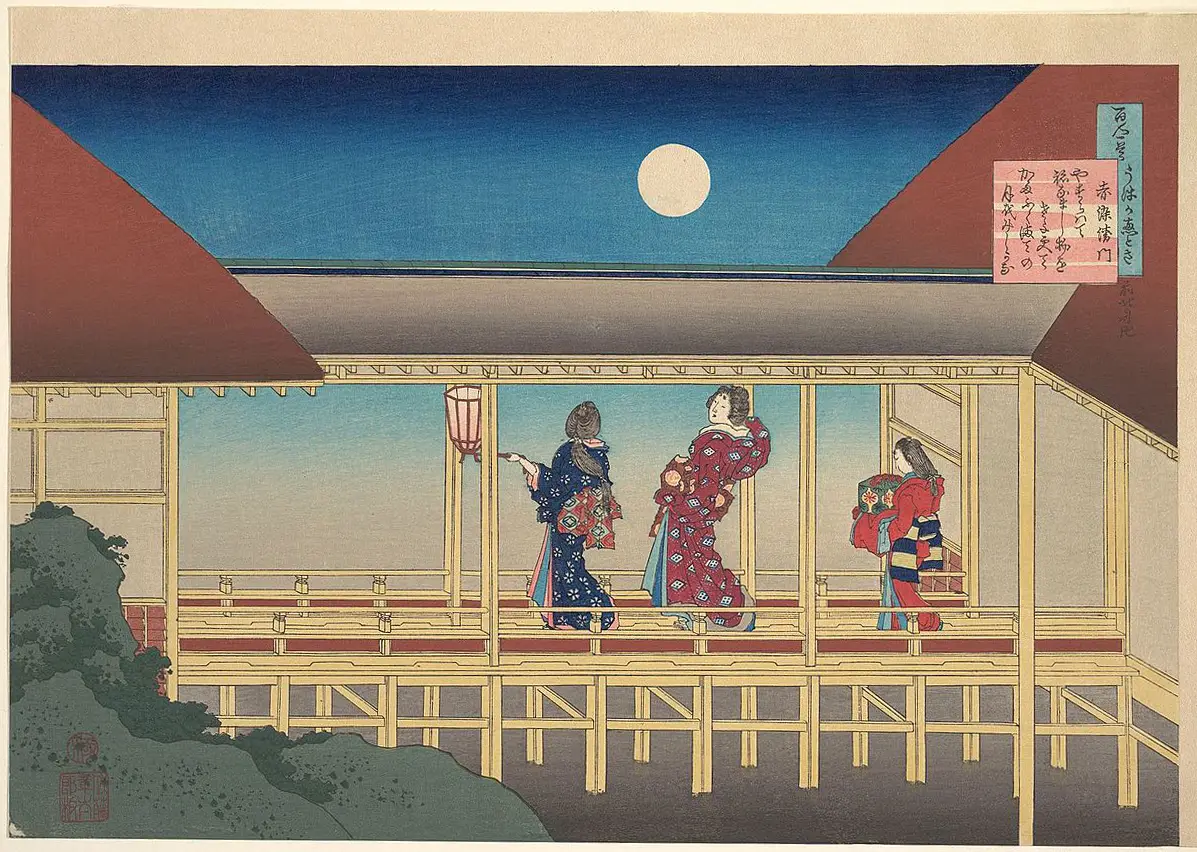
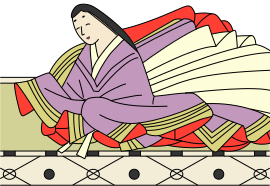
This image is based on an illustration from William N. Porter's A Hundred Verses from Old Japan, his 1909 English translation of the Hyakunin Isshu published in England, colorized and reworked using Adobe Firefly (generative AI).
- Akazome Emon: A Short Timeline
-
- c. 956
- Born
- c. 976
- Marries Ōe no Masahira
- 1001
- Goes with her husband to Owari Province
- 1012
- Her husband Masahira dies
- 1035
- Takes part in the poetry contest held by Kampaku and Minister of the Left Yorimichi
- 1041
- Takes part in the poetry contest held by Seishi, consort of the Kokiden
- c. 1041
- Dies
- Notes
-
- Served in the household of Minamoto no Masanobu
- Served Akiko, empress of Emperor Ichijō
- Akazome Emon's Family Tree
-
Akazome Emon was the daughter of Akazome Tokimochi (his post: junior officer of the Right Gate Guards, Uemon no jō). But there is a story that Taira no Kanemori went to court to claim her as his own child and lost, and one theory says her real father was Taira no Kanemori.
Her name comes from her father, Tokimochi, who served in the Right Gate Guards (Uemon-fu).
Her husband was Ōe no Masahira, a Professor of Literature (monjō hakase).
Acting Middle Counselor Masafusa was Akazome Emon's great-grandson.
- Family Tree of the Ōe Clan
-
- Appendix
-
- A Poem About Autumn Leaves Brought Back from Hatsuse
- Akazome Emon wrote this poem about autumn leaves she brought back as a souvenir from a pilgrimage to Hatsuse (Hase-dera Temple).
In Japanese
つとにとて 折りし紅葉は 枯れにけり
嵐のいたく 吹しまぎれに tsutonitote orishimomijiha karenikeri
arashinoitaku fukishimagireni Akazome Emon-shūIn English
The autumn leaves I broke off to bring home as a souvenir (tsuto) have withered, while the storm was blowing so hard.
- A Poem Praying for Her Son Takachika's Recovery
- Akazome Emon offered this poem at Sumiyoshi Taisha Shrine when her son Takachika was seriously ill and near death. Takachika was then Governor of Izumi, and Akazome Emon is said to have hurried there from Kyoto.
In Japanese
代はらむと 祈る命は 惜しからで
さても別れむ ことぞ悲しき kawaramuto inoruinochiha oshikarade
satemowakaremu kotozokanashiki Shika Wakashū, Akazome EmonIn English
I do not mind giving my own life to take his place, but if my prayer is answered, it is sad that I must part from my son.
- Poems Exchanged with Her Husband, Ōe no Masahira
- When Akazome Emon had a baby, the nurse they hired did not have much milk, and Akazome Emon and her husband, Ōe no Masahira, exchanged the following poems about it.
- Poem by Her Husband, Ōe no Masahira
-
In Japanese
果なくも 思ひけるかな 乳もなくて
博士の家の 乳母せむとは hakanakumo omohikerukana chimonakute
hakasenoieno ubasemutoha Go Shūi Wakashū, Ōe no MasahiraIn English
What a foolish idea, to be the nurse in a scholar's house with no milk!
Ōe no Masahira makes a pun (kakekotoba) on chi (milk) and chi (knowledge): besides having little milk, he hints, "How dare she try to work in a scholar's house with no learning!" Masahira was one of the most learned men of his day, but he may have been a little proud of it.
- Akazome Emon's Poem
-
In Japanese
さもあらばあれ 大和心し 賢こくば
細乳につけて あらすばかりぞ samoarabaare yamatogokoroshi kashikokuba
hodojinitsukete arasubakarizo Go Shūi Wakashū, Akazome EmonIn English
Never mind that. If she has a good Yamato-gokoro, let her stay, even with little milk.
Yamato-gokoro means a graceful, gentle heart.
Akazome Emon defends the nurse as a person with an honest heart. - Ukiyo-e by Katsushika Hokusai
-
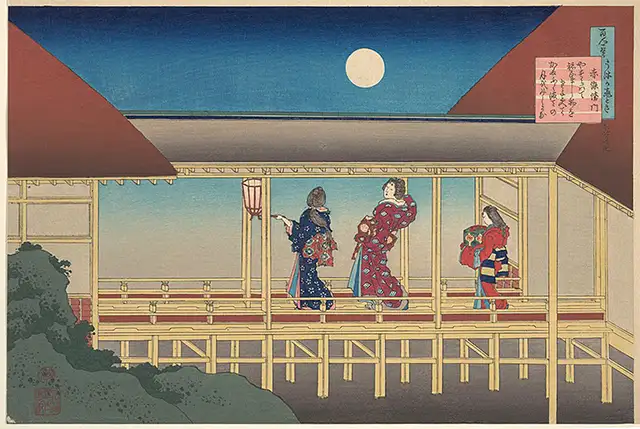
Katsushika Hokusai, CC0, via Wikimedia Commons This print is from One Hundred Poems Explained by the Nurse (Hyakunin Isshu Uba ga Etoki) by Katsushika Hokusai, an ukiyo-e artist of the Edo period. The idea of the series is a nurse explaining the Hyakunin Isshu poems with easy-to-understand pictures. The picture is said to show women of the pleasure quarters. The woman in the middle seems to twist her body restlessly. Perhaps, like the poet, she is waiting for her lover.
- Ukiyo-e by Tsukioka Yoshitoshi
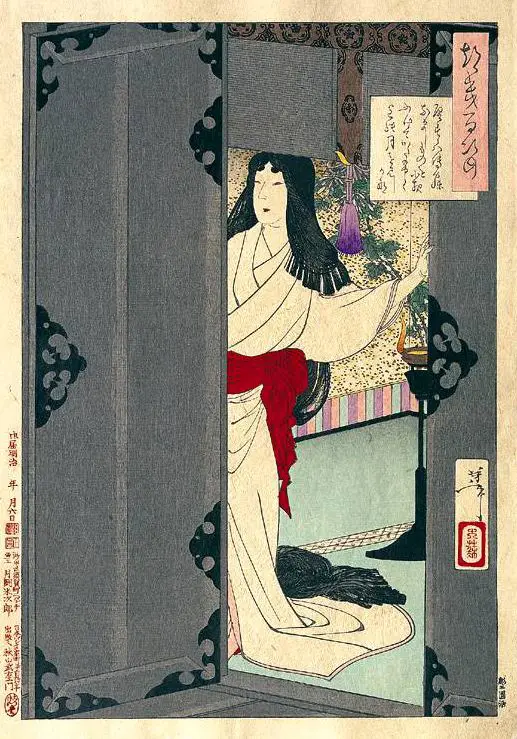
-
Yoshitoshi, Public domain, via Wikimedia Commons Tsukioka Yoshitoshi was an ukiyo-e artist active from the end of the Edo period to the middle of the Meiji period. Akazome Emon also appears in his One Hundred Aspects of the Moon (Tsuki Hyakushi), a series of scenes connected with the moon.