


Front of the Card
Back of the Card
Japanese
English
Audio: NHK Creative Library
Read by LibriVox volunteer Larry Wilson.
Audio courtesy of LibriVox
儀同三司母
忘れじの
ゆく末までは
かたければ
今日を限りの
命ともがな
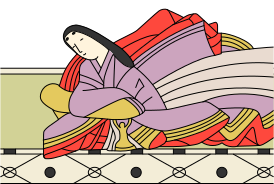
けふをかき
りのいのち
ともかな

わすれ


- Poem 54
- 忘れじの
ゆく末までは
かたければ
今日を限りの 命ともがな
Author: Mother of the Honorary Grand Minister (dates unknown–996)
Source: Shin Kokin Wakashū, Love
- English Verse Translation
- How difficult it is for men Not to forget the past! I fear my husband's love for me Is
disappearing fast; This day must be my last.
— William N. Porter, 1909
- Modern Translation
- The promise that you would never forget me — that is too much to ask forever. I only wish my life would end today, while the vow still holds.
- Commentary
- Written when her future husband, Fujiwara no Michitaka, first began visiting her. It shows her at the height of happiness.
- About the Poet
- Takashina no Takako was a noblewoman with a rare gift for Chinese poetry. She married Fujiwara no Michitaka and had a son, Korechika, and a daughter, Teishi, who became Emperor Ichijō's empress. When Michitaka died at 43, her sons were exiled for shooting arrows at Retired Emperor Kazan, and Teishi became a nun. Takako died worrying for her family.
- Poem Illustration
-
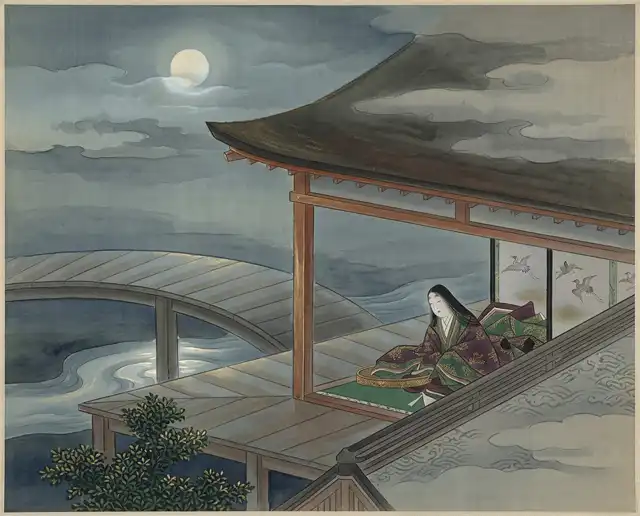
This image is based on an illustration from William N. Porter's A Hundred Verses from Old Japan, his 1909 English translation of the Hyakunin Isshu published in England, colorized and reworked using Adobe Firefly (generative AI).
- Mother of the Honorary Grand Minister: A Short Timeline
-
- 990
- Her husband, Fujiwara no Michitaka, becomes Kampaku, and her daughter Teishi becomes empress
- 995
- Her husband Michitaka dies
- 996
- Her sons Korechika and Takaie are sent away from the capital in the Chōtoku Incident; she dies the same year
- The Naka-no-Kanpaku Family
-
The family founded by Takako's husband was called the "Naka-no-Kanpaku family" (the "middle Kampaku" family). The name is said to come from the fact that Michitaka served as Kampaku in between, after his father Fujiwara no Kaneie and before Fujiwara no Michinaga brought regency politics (sekkan seiji) to its height. Michitaka held power for a while, but he favored his own relatives too much and lost the support of the other nobles. His son Korechika angered the nobles even more, and the family fell. Michinaga, on the other hand, was good at getting along in the world; he made one daughter after another an empress and built a firm base of power. Michinaga wrote this poem:この世をば 我が世とぞ思ふ 望月の
欠けたることも なしと思へば
1018, Fujiwara no Michinaga (from the Shōyūki)("This world, I feel, is truly mine, for like the full moon, it lacks nothing.") He composed it at a party on the night when the third of his daughters became an empress. It has often been seen as a poem of a powerful man's pride, but recent studies suggest a new reading: "this world" (kono yo) means "this night," the daughters who became empresses are compared to the full moon, and the moon is also linked to the sake cups the nobles were holding. All his daughters had become empresses, and none of the nobles who shared cups with him was missing (kaketaru), so let us all support my daughters together. In this reading, the poem shows a father's love for his daughters.
- Appendix
-
- A Mother's Poem for Her Exiled Son
- Takako's son Korechika lost his position in the Chōtoku Incident and was exiled to Dazaifu, far from the capital. She was not allowed to see her son. The "crane in the night" in this poem comes from a line of Chinese poetry by Bai Juyi: "The crane at night, thinking of its young, cries in its cage." It pictures a crane in its nest at night thinking of its chick, and joins it with a mother's love and worry for a son who lives far away. She died without ever seeing Korechika again.
In Japanese
夜の鶴 都のうちに 籠められて
子を恋ひつつも 鳴き明かすかな yorunotsuru miyakonouchini komerarete
kookohitsutsumo nakiakasukana Shika Wakashū, Mother of the Honorary Grand MinisterIn English
Like the crane that cries in its nest, thinking of its young, I am shut up in the capital and cry all night long, missing my son.
- A Poem Ending with "Inochi to mo gana"
- This poem by Izumi Shikibu is in the Go Shūi Wakashū.
It was written to someone who kept promising to come "tonight, tonight," but never came.
It also ends with "inochi to mo gana" (I wish my life would end), but this one is a tragic poem.In Japanese
今宵さへ あらばかくこそ 思ほえめ
今日暮れぬまの 命ともがな koyoisahe arabakakukoso omohoeme
kyoukurenumano inochitomogana Go Shūi Wakashū, Izumi ShikibuIn English
If I live through tonight only to feel this pain again,
I wish my life would end before this day is over. - Gidō Sanshi (Honorary Grand Minister)
- Gidō sanshi is another name for a minister ranked just below the Chancellor of the Realm and the Ministers of the Left and Right. Fujiwara no Korechika was given this rank of honorary minister and called himself Gidō Sanshi. For the ranks and offices of the Heian period, see this page.
- Fujiwara no Michitaka
-
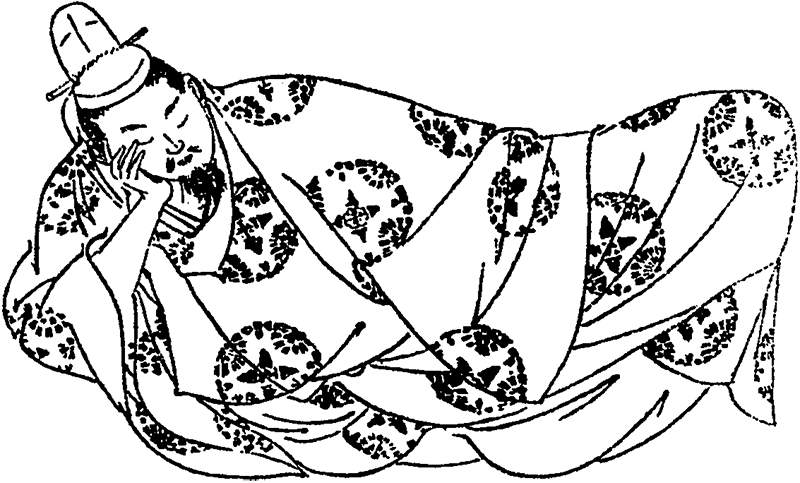 A court noble of the mid-Heian period. He was the eldest son of Fujiwara no Kaneie and the husband of the Mother of the Honorary Grand Minister. After his father died, he became Kampaku (chief adviser) and led the court, but only five years later he fell ill and died. It is thought that drinking too much may have given him diabetes (insui no yamai, "the drinking-water illness").
- The Chōtoku Incident
- After Fujiwara no Michitaka died and Fujiwara no Michinaga was given the right to review state papers (nairan), a political incident called the Chōtoku Incident took place. Fujiwara no Korechika wrongly believed that Retired Emperor Kazan had stolen his lover, and talked to his younger brother, Fujiwara no Takaie. Takaie and his servants attacked the retired emperor's party and shot an arrow through his sleeve. Because of this, Korechika and Takaie were sent away from the capital, and the Naka-no-Kanpaku family (Fujiwara no Michitaka's family) fell from power.
- The Death Poem of Her Daughter Teishi
- Takako's daughter Teishi, who became Emperor Ichijō's empress, died young after giving birth to her third child. Feeling that her death was near, she left a death poem.