


Front of the Card
Back of the Card
Japanese
English
Audio: NHK Creative Library
Read by LibriVox volunteer Larry Wilson.
Audio courtesy of LibriVox
伊勢大輔
いにしへの
奈良の都の
八重桜
けふ九重に
匂ひぬるかな
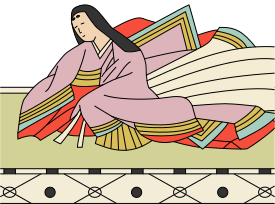
けふここの
へににほひ
ぬるかな

いに


- Poem 61
- いにしへの
奈良の都の
八重桜
けふ九重に 匂ひぬるかな
Author: Ise no Taifu (c. 989–death year unknown)
Source: Shika Wakashū, Spring
- English Verse Translation
- The double cherry trees, which grew At Nara in past days, Now beautify this Palace, and Their
blossoms all ablaze Perfume the royal ways.
— William N. Porter, 1909
- Modern Translation
- The ancient eightfold cherry blossoms of Nara — today they bloom gloriously in the ninefold imperial palace.
- Commentary
- When a branch of double cherry blossoms was sent to court from Kōfuku-ji in Nara, Ise no Taifu was suddenly asked to receive it, and Fujiwara no Michinaga told her to make a poem. She linked the blossoms to the glory of Emperor Ichijō's reign, pairing "long ago" with "today" and "eightfold" with "ninefold" (the palace). The whole court was amazed.
- About the Poet
- Ise no Taifu was the granddaughter of Ōnakatomi no Yoshinobu. Her name comes from her father's post at Ise Shrine. She served Empress Akiko and knew Izumi Shikibu and Murasaki Shikibu.
- Poem Illustration
-
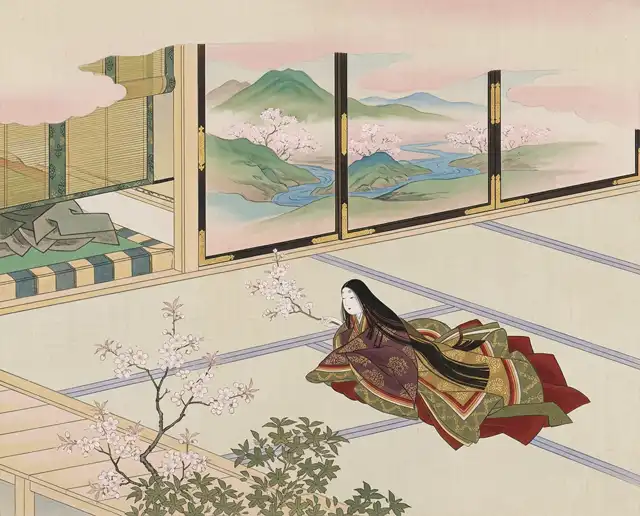
This image is based on an illustration from William N. Porter's A Hundred Verses from Old Japan, his 1909 English translation of the Hyakunin Isshu published in England, colorized and reworked using Adobe Firefly (generative AI).
- Ise no Taifu: A Short Timeline
-
- c. 989
- Born
- c. 1008
- Serves Empress Akiko
- 1032
- Takes part in the Chrysanthemum Contest held by Jōtōmon-in (Akiko)
- 1049
- Takes part in a palace poetry contest
- 1056
- Takes part in the Empress's Spring and Autumn Poetry Contest
- 1060
- Known to be still alive around this time
- Notes
-
- In her later years, helped raise the future Emperor Shirakawa
- Ise no Taifu's Family Tree
-
The Nakatomi family led Shinto rites and ceremonies, and produced many poets. Yorimoto, Yoshinobu, Sukechika, and Ise no Taifu are well known as poets. Nakatomi no Kamatari was given the family name Fujiwara and became the founder of the Fujiwara clan, which later flourished as the regents' family (sekkanke).
- Appendix
-
- Where the Word "Onara" Comes From
- There are several theories about where the Japanese word onara (a fart) comes from. The best known is that it comes from the verb narasu (to make a sound). A more unusual theory says it comes from Ise no Taifu's Hyakunin Isshu poem, which mentions nioi and "the double cherry blossoms of the old capital of Nara." Nioi in the poem is usually taken to mean "blooming beautifully," but it can also be read as "smelling." So "Nara" became the source of a smell, and with the polite prefix o it turned into onara.
- The Nara Double Cherry
-
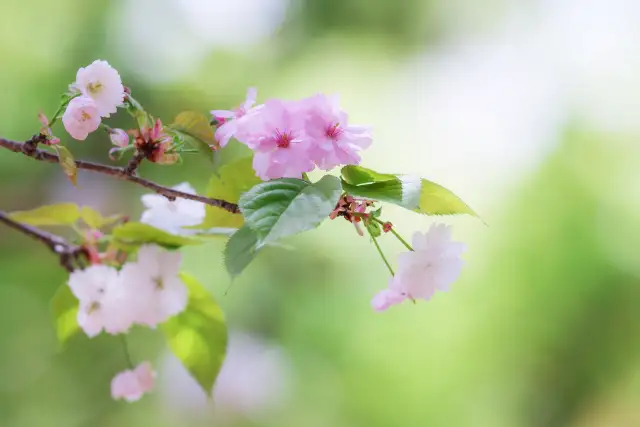
The cherry in Ise no Taifu's poem is said to be the variety called Nara no Yaezakura (Nara double cherry). This is not a general name for double cherries growing in Nara, but one particular variety. It is a double-flowered form of the kasumizakura cherry and has small flowers for a double cherry.
It is the official flower of Nara Prefecture and of Nara City.
- Akiko's Answer
- Akiko, the empress of Emperor Ichijō whom Ise no Taifu served, answered her poem "Inishie no Nara no miyako no yaezakura..." with the following poem.
In Japanese
九重に 匂ふを見れば 桜がり
重ねてきたる 春かとぞ思ふ kokonoeni niofuomireba sakuragari
kasanetekitaru harukatozoomofu Ise no Taifu-shū, AkikoIn English
Seeing the (late-blooming) double cherries in full bloom in the palace, I feel as if I have come cherry-blossom viewing. It seems as though spring has come again.
- Poems Exchanged with Izumi Shikibu
- When Ise no Taifu and Izumi Shikibu served Akiko together as ladies-in-waiting, they seem to have been good friends, and the following exchange of poems remains. These poems were written when the two first met.
- Izumi Shikibu's Poem
-
In Japanese
思はむと 思ひし人と 思ひしに
思ひしごとも 思ほゆるかな omohamuto omohishihitoto omohishini
omohishigotomo omohoyurukana Izumi Shikibu Diary, Izumi ShikibuIn English
I thought you were someone who would care for me,
and it is just as I thought. - Ise no Taifu's Poem
-
In Japanese
君をわれ 思はざりせば われをきみ
思はむとしも 思はましやは kimioware omohazariseba wareokimi
omohamutoshimo omohamashiyaha Izumi Shikibu Diary, Ise no TaifuIn English
If I had not cared for you,
you would not have cared for me either. - Poems Exchanged with Minamoto no Tsunenobu
- This is the story of a poem of thanks that Ise no Taifu sent to Minamoto no Tsunenobu when he visited her while she was ill. The two were more than 20 years apart in age, and Tsunenobu, given a poem as beautiful as white dew (a treasure) by Ise no Taifu, the finest poet of the day, is said to have been so moved that he wrote a poem in reply.
- Ise no Taifu's Poem
-
In Japanese
うれしさは 忘れやはする 忍ぶ草
しのぶるものを 秋の夕暮 ureshisaha wasureyahasuru shinobugusa
shinoburumonoo akinoyuugure Shin Kokin Wakashū, Ise no TaifuIn English
How could I forget my joy? Like the shinobu fern,
I fondly think (shinobu) of you this autumn evening. - Minamoto no Tsunenobu's Poem
-
In Japanese
秋風の おとせざりせば 白露の
軒のしのぶに かからましやは akikazeno otosezariseba shiratsuyuno
nokinoshinobuni kakaramashiyaha Shin Kokin Wakashū, Minamoto no TsunenobuIn English
If the autumn wind had not come calling,
would white dew have settled on the shinobu fern under the eaves? - A Poem About the Hototogisu
- For Heian nobles, hearing the first call of the hototogisu (lesser cuckoo), which announced the coming of summer, was something especially elegant.
Ise no Taifu wrote this poem at a poetry contest held by Princess Yūshi.
In Japanese
聞きつとも 聞かずともなく 時鳥
心まどはす さ夜のひと声 kikitsutomo kikazutomonaku hototogisu
kokoromadohasu sayonohitokoe Go Shūi Wakashū, Ise no TaifuIn English
I cannot tell whether I heard it or not. O hototogisu, your single call in the night leaves my heart confused.
- A Poem About the House Her Lover Left
-
The headnote in the Ise no Taifu-shū, where this poem appears, says it was written on the fifth day of the fifth month, the year after she left the place where she had lived for years and moved elsewhere. It probably expresses this feeling: the lover she lived with left on this very day a year ago, and though the irises (ayame) in the garden bloom just as they did last year, her present home no longer feels like the home she shared with him.

In Japanese
けふも今日 あやめもあやめ
変らぬに
宿こそありし
宿とおぼえぬ kefumokefu ayamemoayame karanuni
yadokosoarishi yadotooboenu Ise no Taifu-shū, Ise no TaifuIn English
Today is the fifth day of the fifth month, the same as last year, and the irises bloom just as before, but this house does not feel at all like the home I once had.
- Linked Verse with Fujiwara no Michinobu
- The next poem is a linked verse (renga) by Ise no Taifu and Fujiwara no Michinobu.
When Michinobu was passing the rooms of Akiko, Emperor Ichijō's empress, holding yamabuki (kerria) flowers, the ladies-in-waiting begged him to compose a poem. So Michinobu wrote the upper verse, and Ise no Taifu wrote the lower verse.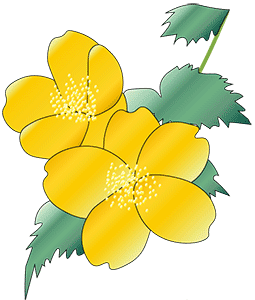
In Japanese
くちなしに ちしほやちしほ
染めてけり
こはえも言はぬ
花の色かな kuchinashini chishihoyachishiho sometekeri
kohaemoihanu hananoirokana Toshiyori ZuinōIn English
I, who hold feelings I cannot speak, like the kuchinashi (gardenia, "no mouth"),
carry these yamabuki flowers, dyed again and again in gardenia yellow.
What a color, too lovely for words!Yamabuki has yellow flowers. The fruit of the kuchinashi (gardenia) is used as a dye and gives a yellow color. "Kuchinashi" also means "no mouth."
- Utagawa Kuniyoshi's Hyakunin Isshu no Uchi
-
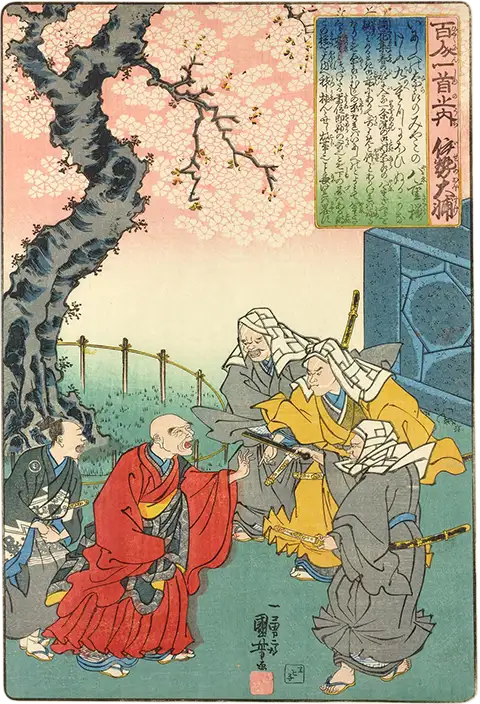
British Museum, Public domain, via Wikimedia Commons This ukiyo-e print is by Utagawa Kuniyoshi, an artist of the Edo period.
The Shasekishū, a Kamakura-period collection of Buddhist tales, tells this story. Empress Akiko wanted to bring the famous double cherry tree in front of the Tōendō hall to the Heian palace. The head (bettō) of Kōfuku-ji ordered his men to dig up and move the tree, but a monk objected: "How can we give away such a famous cherry tree? Please stop."
When Akiko heard of the commotion and learned how much the tree was treasured, she praised their care and sent "flower guards" (hanamori). Afterward, Kōfuku-ji presented a branch of the cherry tree to the Heian palace.