Front of the Card
Back of the Card
Japanese
English
Audio: NHK Creative Library
Read by LibriVox volunteer Larry Wilson.
Audio courtesy of LibriVox
和泉式部
あらざらむ
この世のほかの
思ひ出に
いまひとたびの
逢ふこともがな
いまひとた
ひのあふこ
ともかな

あらざ


- Poem 56
- あらざらむ
この世のほかの
思ひ出に
いまひとたびの 逢ふこともがな
Author: Izumi Shikibu (c. 976–death year unknown)
Source: Go Shūi Wakashū, Love
- English Verse Translation
- My life is drawing to a close, I cannot longer stay, A pleasant memory of thee I fain would
take away; So visit me, I pray.
— William N. Porter, 1909
- Modern Translation
- I may not be long for this world. As a memory to take beyond — let me meet you just one more time.
- Commentary
- The Go Shūi Wakashū says Izumi Shikibu sent this to someone while she was ill, so it is read as a poem to a lover from her sickbed. But since the men she loved tended to die young, some read it as a last message to a lover who was himself near death.
- About the Poet
- After having Koshikibu no Naishi with Tachibana no Michisada, Izumi Shikibu became known for her affairs with Prince Tametaka and Prince Atsumichi, sons of Emperor Reizei. Murasaki Shikibu wrote that she was loose in love but a gifted writer whose every word had charm.
- Poem Illustration
-
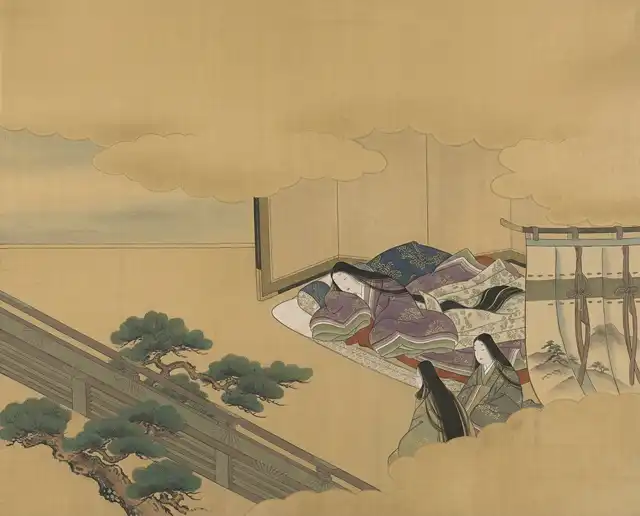
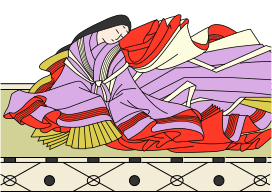
This image is based on an illustration from William N. Porter's A Hundred Verses from Old Japan, his 1909 English translation of the Hyakunin Isshu published in England, colorized and reworked using Adobe Firefly (generative AI).
- Izumi Shikibu: A Short Timeline
-
- c. 976
- Born
- c. 996
- Marries Tachibana no Michisada; later gives birth to Koshikibu no Naishi
- 1002
- Her lover, Prince Tametaka, dies
- 1003
- Her love affair with Prince Atsumichi begins (The Izumi Shikibu Diary)
- 1007
- Prince Atsumichi dies
- c. 1009
- Serves Empress Akiko as a lady-in-waiting
- Unknown
- Marries again, to Fujiwara no Yasumasa
- 1025
- Her daughter Koshikibu no Naishi dies
- Izumi Shikibu's Family Tree
-
Izumi Shikibu's name comes from her first husband, Tachibana no Michisada, who was Governor of Izumi (Izumi no kami), and from her father's post as a secretary of the Ministry of Ceremonial (Shikibu no jō).
Her father was Ōe no Masamune, born into a family of scholars. Her deep learning seems to owe much to his teaching.
With her first husband, Tachibana no Michisada, she had Koshikibu no Naishi, but her daughter died young, in her twenties. Izumi Shikibu also left poems of mourning (aishōka) for her daughter.
Her love with her second husband, Fujiwara no Yasumasa, is the subject of a famous legend that became one of the floats of the Gion Festival. It is introduced further down this page. Please take a look.
- Family Tree of the Princes Izumi Shikibu Loved
-
- Appendix
-
- A Poem by Inpumon'in no Taifu Borrowing from This Poem
- The Attendant to Empress Inpu (Inpumon'in no Taifu) wrote the next poem, borrowing from Izumi Shikibu's Hyakunin Isshu poem (honkadori).
In Japanese
いかにせむ 今ひとたびの 逢ふことを
夢にだに見て 寝覚めずもがな ikanisemu imahitotabino oukotoo
yumenidanimite nezamezumogana Shin Chokusen Wakashū, Attendant to Empress InpuIn English
What shall I do? I want to meet you once more, even if only in a dream, and never wake from that sleep.
- A Poem for Her Daughter Who Died Young
- Izumi Shikibu's daughter, Koshikibu no Naishi, died in her twenties after giving birth.
The Izumi Shikibu-shū contains many poems of mourning (aishōka) for her daughter. Here is one of them.In Japanese
とどめおきて 誰をあはれと 思ふらむ
子はまさるなり 子はまさりけり todomeokite tareoahareto omofuramu
kohamasarunari kohamasarikeri Izumi Shikibu-shūIn English
Leaving her child and her mother behind in this world, whom is she thinking of now? Surely her love for her child is stronger, for I, too, am thinking of my child.
- A Poem About the Summer Heat
- The Heian capital, surrounded by mountains, has merciless summer heat.
Izumi Shikibu wrote lightly about the heat, using the cicada's song and the cicada's wings as images.
In Japanese
声聞けば 暑さぞまさる 蝉の羽の
薄き衣は 身に着たれども koekikeba atsusazomasaru seminohano
usukikoromoha minikitaredomo Izumi Shikibu-shūIn English
When I hear the cicadas sing, I feel even hotter,
though I am wearing a robe as thin as a cicada's wings. - A Poem Mourning Prince Tametaka
- In this poem Izumi Shikibu grieves for Prince Tametaka after his death.
It expresses how crushed she felt by the sound of the night wind and the loneliness of no longer having his warmth beside her.In Japanese
寝覚する 身を吹き通す 風の音を
昔は袖の よそに聞きけん nezamesuru miofukitoosu kazenoneo
mukashihasodeno yosonikikiken Shin Kokin Wakashū, Izumi ShikibuIn English
The sound of the wind that blows right through me as I lie awake: in the old days (when I was with Prince Tametaka), I must have heard it as something that had nothing to do with me.
- A Poem Mourning Prince Atsumichi
- In this poem Izumi Shikibu grieves for Prince Atsumichi after his death. The yobukodori ("calling bird") is the cuckoo.
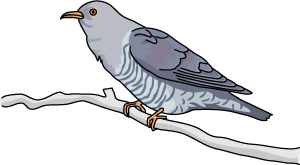
In Japanese
鳴けや鳴け
わが諸声に 呼子鳥
呼ばば答へて 帰り来ばかり nakeyanake wagamorogoeni yobukodori
yobabakotahete kaerikubakari Izumi Shikibu ZokushūIn English
Cry, cry on, calling bird, together with my weeping,
until he answers your call and comes back to me. - A Poem Seeing Fireflies as Her Soul
-
Izumi Shikibu wrote this poem when, troubled by her relationship with her husband, she visited Kifune Shrine at Kurama in Kyoto and saw fireflies flying over the Mitarashi Stream. She seems to have been so worn out that she felt her soul had left her body, but afterwards she and her husband got back together. Because of this, Kifune Shrine is said to have become known as a shrine for bringing couples together.

In Japanese
物思へば 沢の蛍も 我が身より
あくがれ出づる 魂かとぞ見る monoomoheba sahanohotarumo wagamiyori
akugareizuru tamakatozomiru Go Shūi Wakashū, Izumi ShikibuIn English
As I sit lost in thought, even the fireflies over the stream
look to me like my soul, wandering out of my body. - A Poem Seeking Salvation
- Izumi Shikibu lived freely for love, but at the price of much suffering. She also wrote poems seeking salvation.

In Japanese
暗きより 暗き道にぞ 入りぬべき
はるかに照らせ 山の端の月 kurakiyori kurakimichinizo irinubeki
harukaniterase yamanohanotsuki Shūi Wakashū, Izumi ShikibuIn English
From a dark path I am about to enter a path darker still.
Light the way I should go from far away,
O moon on the mountain's edge. - A Poem Comparing Love to a Color
- Izumi Shikibu loved many times and went through painful partings.
Her way of comparing love to a color, lightly and simply, shows her special sensitivity.In Japanese
世の中に 恋てふ色は なけれども
深く身にしむ ものにぞありける yononakani koitefuiroha nakeredomo
fukakuminishimu mononizoarikeru Go Shūi Wakashū, Izumi ShikibuIn English
There is no color in this world called "love," yet love soaks deep into the body like a dye.
- A Sensual Poem of "Tangled Hair"
- Like Horikawa, attendant to Empress Taiken, Izumi Shikibu also wrote a poem on the theme of "tangled hair."
In Japanese
黒髪の 乱れも知らず うち伏せば
まづかきやりし 人ぞ恋しき kurokamino midaremoshirazu uchifuseba
mazukakiyarishi hitozokoishiki Go Shūi Wakashū, Izumi ShikibuIn English
Lying down, troubled, not even caring that my black hair is tangled, I long for the one who used to brush it aside for me.
- Poems Exchanged with Ise no Taifu
- When Izumi Shikibu and Ise no Taifu served Akiko together as ladies-in-waiting, they seem to have been good friends, and the following exchange of poems remains. These poems were written when the two first met.
- Izumi Shikibu's Poem
-
In Japanese
思はむと 思ひし人と 思ひしに
思ひしごとも 思ほゆるかな omohamuto omohishihitoto omohishini
omohishigotomo omohoyurukana Izumi Shikibu Diary, Izumi ShikibuIn English
I thought you were someone who would care for me,
and it is just as I thought. - Ise no Taifu's Poem
-
In Japanese
君をわれ 思はざりせば われをきみ
思はむとしも 思はましやは kimioware omohazariseba wareokimi
omohamutoshimo omohamashiyaha Izumi Shikibu Diary, Ise no TaifuIn English
If I had not cared for you,
you would not have cared for me either. - The Izumi Shikibu Diary
- A diary written by Izumi Shikibu. She is deep in grief over the sudden death of her lover, Prince Tametaka (the third son of Emperor Reizei), and in despair after her father has cut her off because of her love with a man so far above her. The story begins when a branch of tachibana (mandarin orange) flowers arrives for her from Prince Atsumichi (the Sochi no Miya). It tells, from a third-person point of view and in the style of a poem-tale, how the two exchange poems and grow closer.
- A Love Legend That Became a Gion Festival Float
-
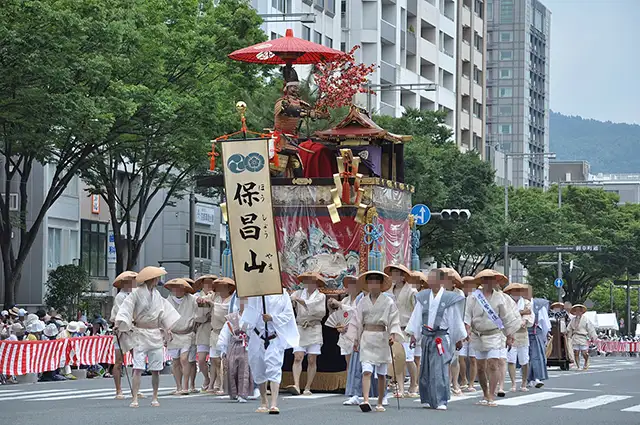
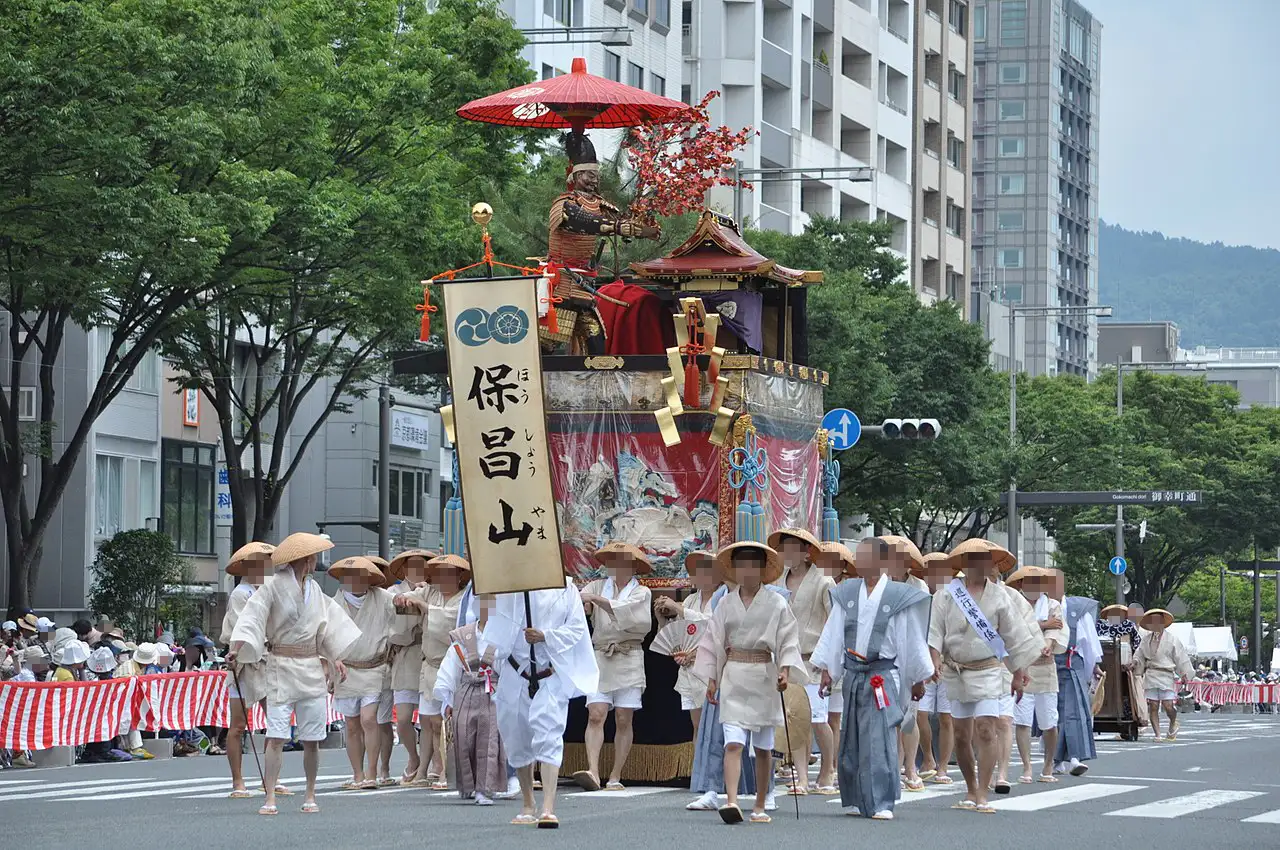
江戸村のとくぞう (Edomura no Tokuzō), CC BY-SA 4.0 <https://creativecommons.org/licenses/by-sa/4.0>, via Wikimedia Commons
(The image has been edited so that people cannot be identified.)When Fujiwara no Yasumasa asked Izumi Shikibu to marry him, she tested how serious he was by asking him to bring her a branch of the plum tree at the Shishinden, the palace's main hall. Yasumasa slipped into the Shishinden at night and, at the risk of being shot by the guards, managed to steal a branch of plum blossoms, and Izumi Shikibu accepted his proposal.
In honor of this legend, a float called "Hōshōyama" parades in the Gion Festival. If you look at the figure of Yasumasa on the float, you can see that he holds a fine branch of plum blossoms. The float's charms are said to be popular with people hoping for a good match.
- Seishin-in, a Temple Connected with Izumi Shikibu
-
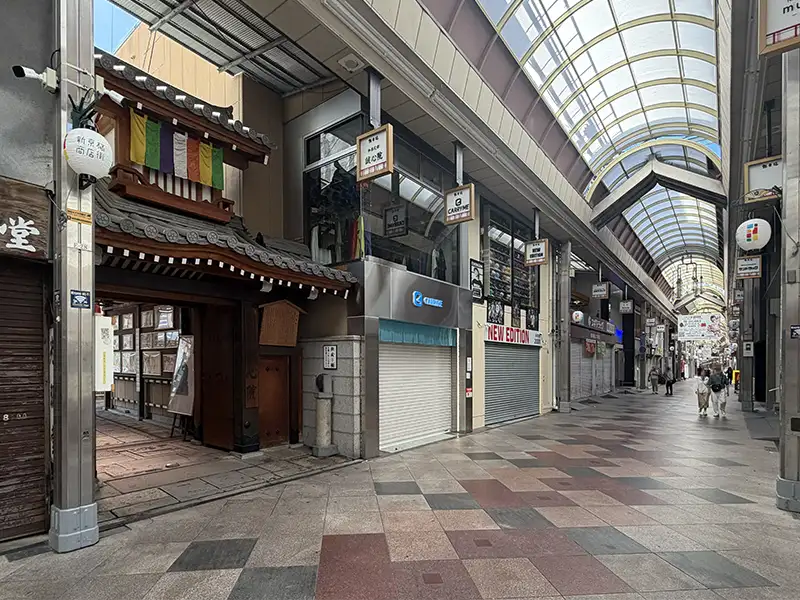
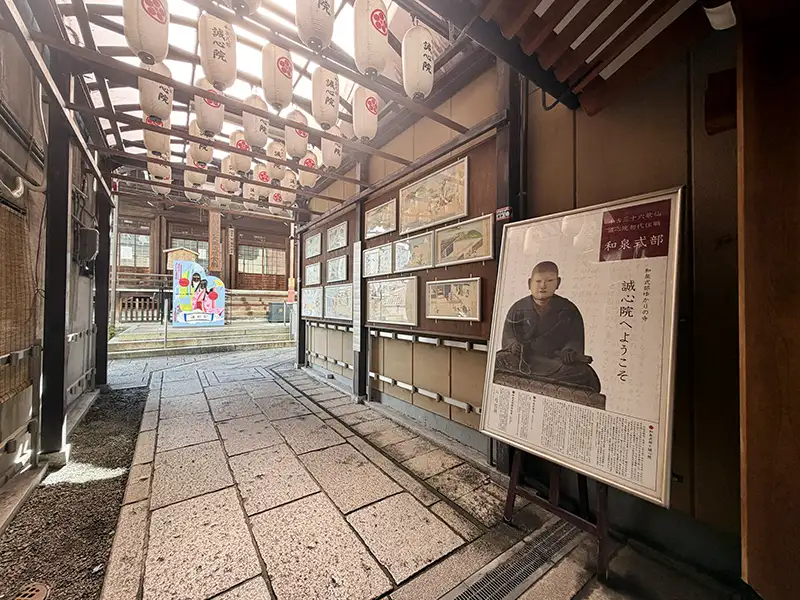
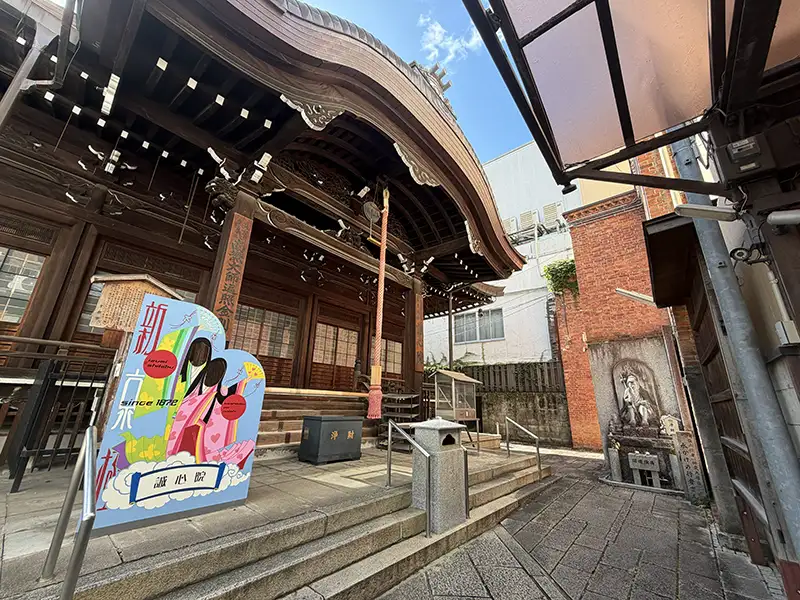
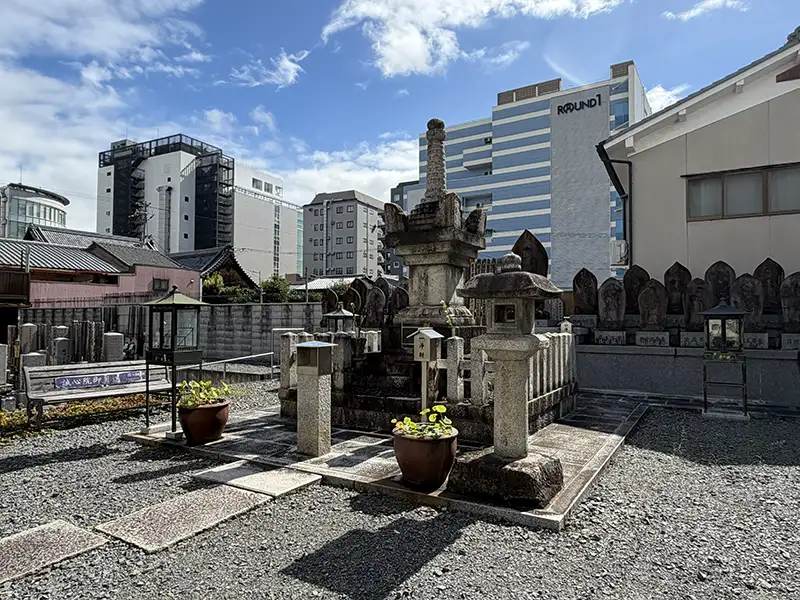
A temple connected with Izumi Shikibu, inside the arcade of the Shinkyōgoku shopping street in Nakagyō Ward, Kyoto. According to the temple, it began in 1027 when Kampaku Fujiwara no Michinaga gave Izumi Shikibu, who served his daughter Jōtōmon-in, a small hermitage inside the Tōhoku-in of Hōjō-ji. It was first in another place, but after several moves it was moved to its present site in Shinkyōgoku on the orders of Toyotomi Hideyoshi. The grounds have a stone pagoda (hōkyōintō) said to be Izumi Shikibu's grave and a stone carved with her poem, and the hall holds the main image, Amida Buddha, along with statues of Izumi Shikibu and Fujiwara no Michinaga. In the middle of a busy shopping district, the history of a Heian poet lives on quietly.
(Photos taken August 8, 2026)
- Izumi Shikibu Park
-
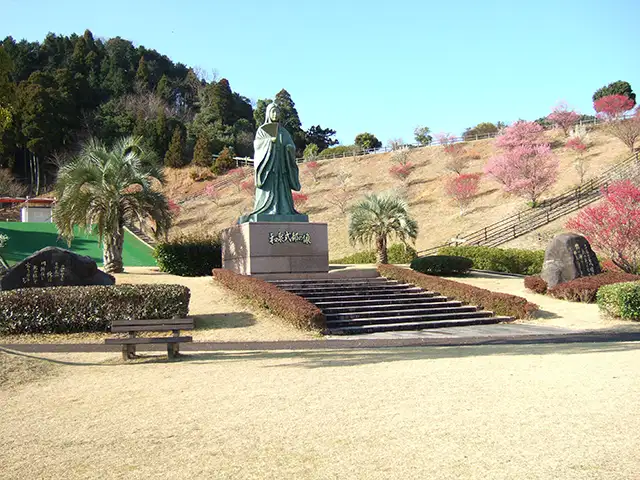
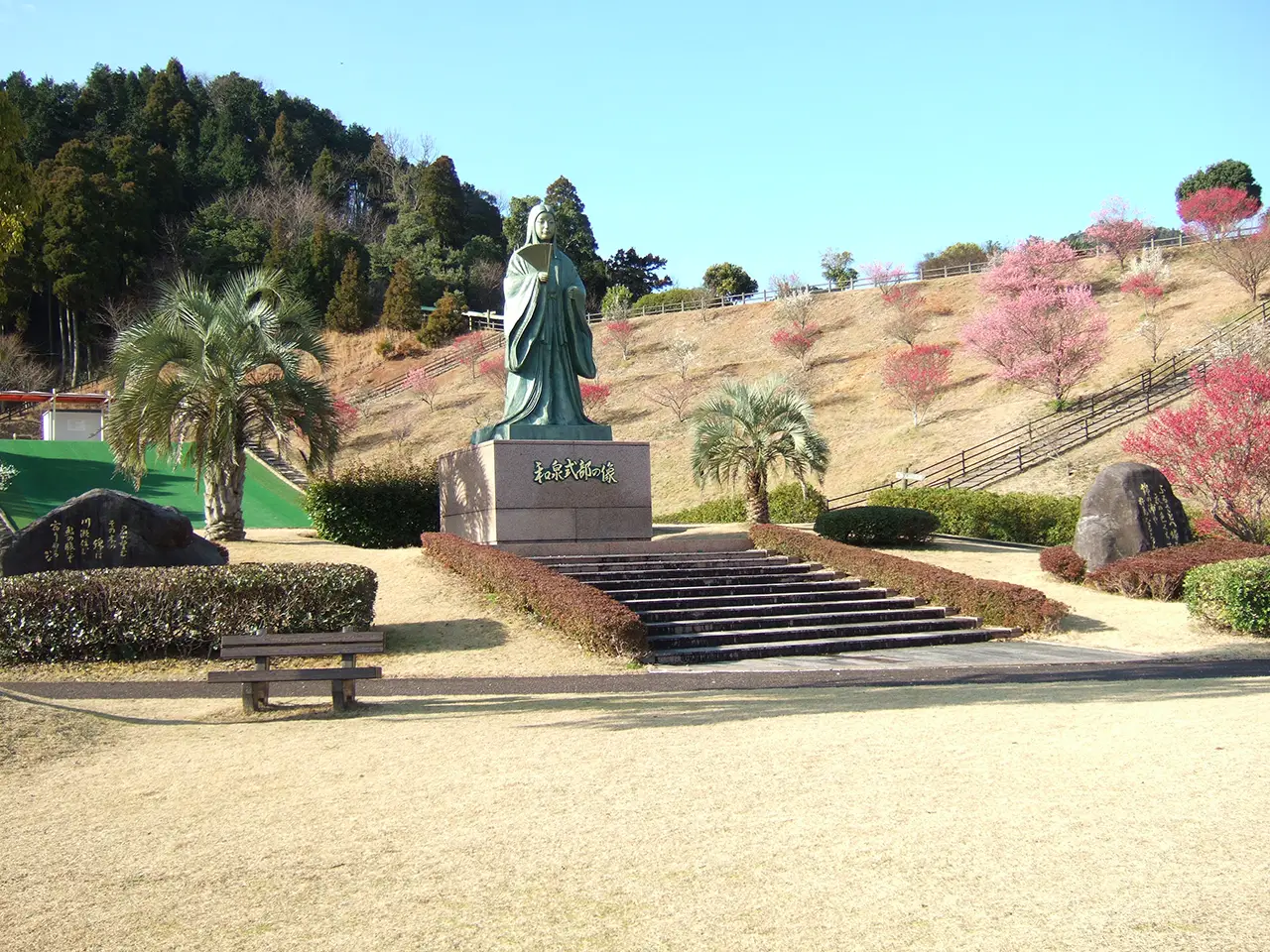
Photo: Saga Prefecture Tourism Federation A park in Shiota-chō, Ureshino City, Saga Prefecture. It stands on a small hill overlooking the Ariake Sea. Because Izumi Shikibu is said to have been born here and lived here until she was nine, a 5-meter bronze statue of her and a stone carved with her poem stand in the park. It also has an artificial-grass slope for grass skiing, an "athletic forest," and other facilities.
See it on the map - Utagawa Kuniyoshi's Hyakunin Isshu no Uchi
-
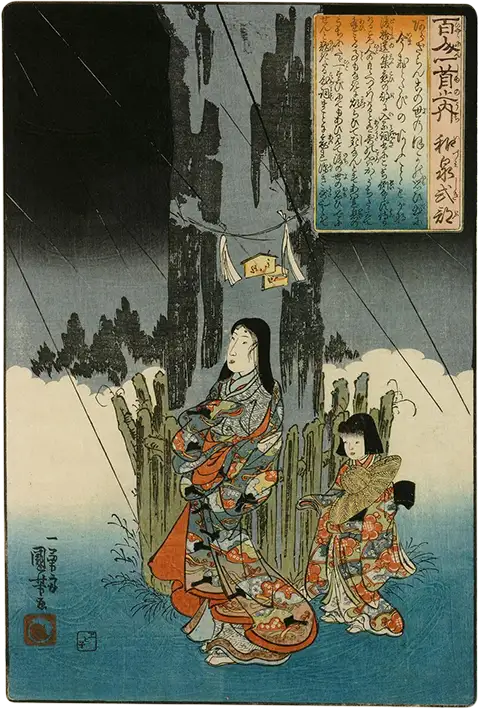
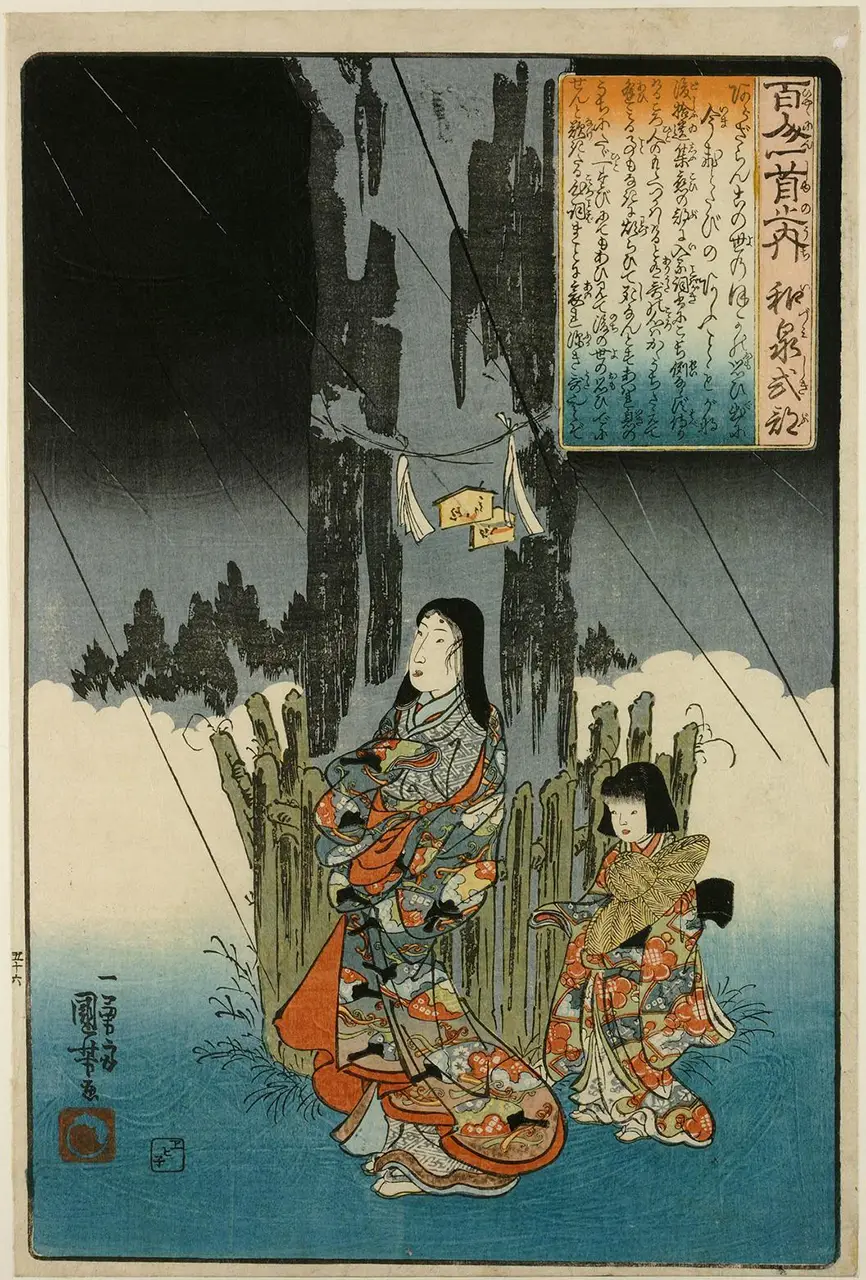
British Museum, Public domain, via Wikimedia Commons This ukiyo-e print is by Utagawa Kuniyoshi, an artist of the Edo period.
It shows a scene to go with the Hyakunin Isshu poem.
Could the mother and child sheltering from the rain be Izumi Shikibu and the young Koshikibu no Naishi?