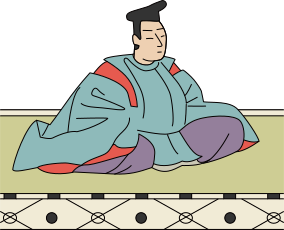
Front of the Card
Back of the Card
Japanese
English
Audio: NHK Creative Library
Read by LibriVox volunteer Larry Wilson.
Audio courtesy of LibriVox
大江千里
月みれば
ちぢにものこそ
悲しけれ
わが身一つの
秋にはあらねど
わかみひと
つのあきに
はあらねと

つき


- Poem 23
- 月みれば
ちぢにものこそ
悲しけれ
わが身一つの 秋にはあらねど
Author: Ōe no Chisato (c. 850–c. 905)
Source: Kokin Wakashū, Autumn
- English Verse Translation
- This night the cheerless autumn moon Doth all my mind enthrall; But others also have their griefs,
For autumn on us all Hath cast her gloomy pall.
— William N. Porter, 1909
- Modern Translation
- When I look at the moon, a thousand thoughts rise up and fill me with sadness. Yet this autumn is not mine alone.
- Commentary
- The poem is based on a passage from "Swallow Tower," a poem by the Chinese poet Bai Juyi. It pairs "a thousand" (chiji ni, "in a thousand ways") with "one" ("I alone"), using a Chinese poetry technique in a waka.
- About the Poet
- Ōe no Chisato came from a family of scholars. Learned in Chinese classics, he was also a fine waka poet. In 897 he gave Emperor Uda the Kudai Waka, waka based on lines of Chinese poems. He seems to stand for the age's shift from Chinese poetry to waka. He never rose above a low rank.
- Poem Illustration
-
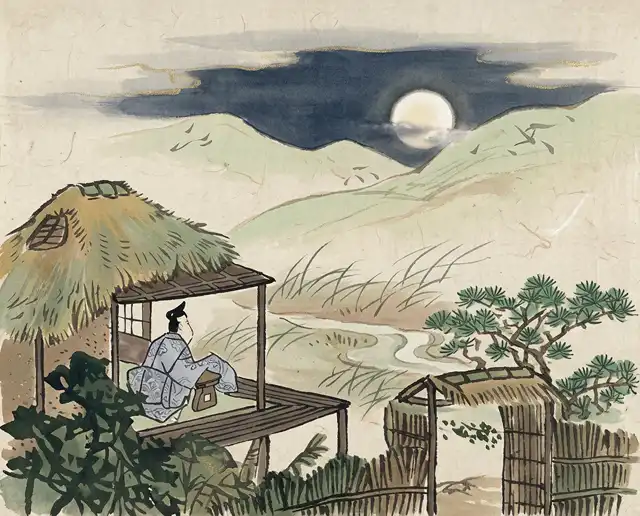
This image is based on an illustration from William N. Porter's A Hundred Verses from Old Japan, his 1909 English translation of the Hyakunin Isshu published in England, colorized and reworked using Adobe Firefly (generative AI).
- Ōe no Chisato: A Short Timeline
-
- c. 850
- Born
- 883
- Becomes a senior secretary of Bitchū Province
- 897
- Presents his Kudai Waka (waka based on lines of Chinese poems) at Emperor Uda's order
- 901
- Becomes a junior secretary in the Ministry of Central Affairs
- 903
- Becomes a senior secretary in the Ministry of Military Affairs
- c. 905
- Dies
- Ōe no Chisato's Family Tree
-
According to the Sonpi Bunmyaku and the Ōe-shi Keizu (family records), the ancestor of the Ōe clan was Emperor Heizei. But this is said to have been the Ōe family's attempt to make their line look nobler, and it may be wrong. In the time of Ōe no Otondo, the way the name was written was changed from 大枝 to 大江. The new characters are said to carry the wish that the family would prosper for a long time, like a great river (江).
Like the Sugawara clan, the Ōe clan produced many scholars, and the two were spoken of together as the Kanke (the Sugawara house) and the Gōke (the Ōe house). Ōe no Chisato, too, was a Confucian scholar who studied at the Daigakuryō, the court university.
- Appendix
-
- "The Swallow Tower" from Collected Works of Bai Juyi
- Ōe no Chisato wrote his Hyakunin Isshu poem based on this Chinese poem. "The Swallow Tower" (Enshirō) is a sad poem about a woman named Panpan, who was loved by her husband Zhang Shangshu. After he died, she lived alone in the Swallow Tower, thinking of him and staying faithful to him.
In Chinese (read in Japanese)
燕子楼 中霜月夜
秋来只為一人 長 Collected Works of Bai Juyi, Volume 15, "The Swallow Tower," Bai JuyiIn English
In the Swallow Tower, the moon is clear and cold as frost.
The autumn night is long for me alone. - The Poem of the Hazy Moon
-
In The Tale of Genji, there is a scene in which the lady Oborozukiyo murmurs, "Nothing compares to a hazy moonlit night." It comes from the next poem,
which Ōe no Chisato wrote based on a poem in Collected Works of Bai Juyi.
In Japanese
照りもせず 曇りも果てぬ 春の夜の
朧月夜にしくものぞなき terimosezu kumorimohatenu harunoyono
oborozukiyonishikumonozonaki Shin Kokin Wakashū, Ōe no ChisatoIn English
Neither shining bright nor fully clouded,
nothing compares to the beauty of a hazy moonlit night in spring. - Kamo no Chōmei's Honkadori
- In the next poem, Kamo no Chōmei borrowed from Ōe no Chisato's poem "Tsuki mireba..." (a technique called honkadori). It was written on the theme "Wind in the Pines Before the Moon."
Kamo no Chōmei wrote An Account of My Hut (Hōjōki) and studied waka under Priest Shun'e.In Japanese
ながむれば 千々にもの思ふ 月にまた
わが身ひとつの 峰の松風 nagamureba chijinimonoomofu tsukinimata
wagamihitotsuno minenomatsukaze Shin Kokin Wakashū, Kamo no ChōmeiIn English
As I gaze at the moon that fills me with a thousand thoughts, the lonely wind in the pines on the peak blows, as if for me alone.
- A Poem Contrasting "One" and "a Thousand"
- The next poem, by Fujiwara no Toshiyuki, uses the contrasting numbers "one" and "a thousand," just like Ōe no Chisato's poem. With this paired contrast, Chisato vividly expresses his inner feelings, while Toshiyuki expresses the wonder of nature.
In Japanese
白露の 色は一つを いかにして
秋の木の葉を 千々に染むらむ shiratsuyuno irohahitotsuo ikanishite
akinokonohao chijinisomuramu Kokin Wakashū, Fujiwara no ToshiyukiIn English
White dew has only one color, so how does it dye the autumn leaves in a thousand colors?
- Bai Juyi
- A Chinese poet of the mid-Tang dynasty, also known as Bai Letian. His easy-to-understand words and flowing style were popular in Japan too, and many people in the Heian period loved to read Collected Works of Bai Juyi. It is quoted in The Tale of Genji and The Pillow Book, and it had a great influence on Heian literature. Many of Bai Juyi's poems are also included in Wakan Rōeishū, a collection of Japanese and Chinese poems for reciting, compiled by Fujiwara no Kintō.
- Prince Abo
-
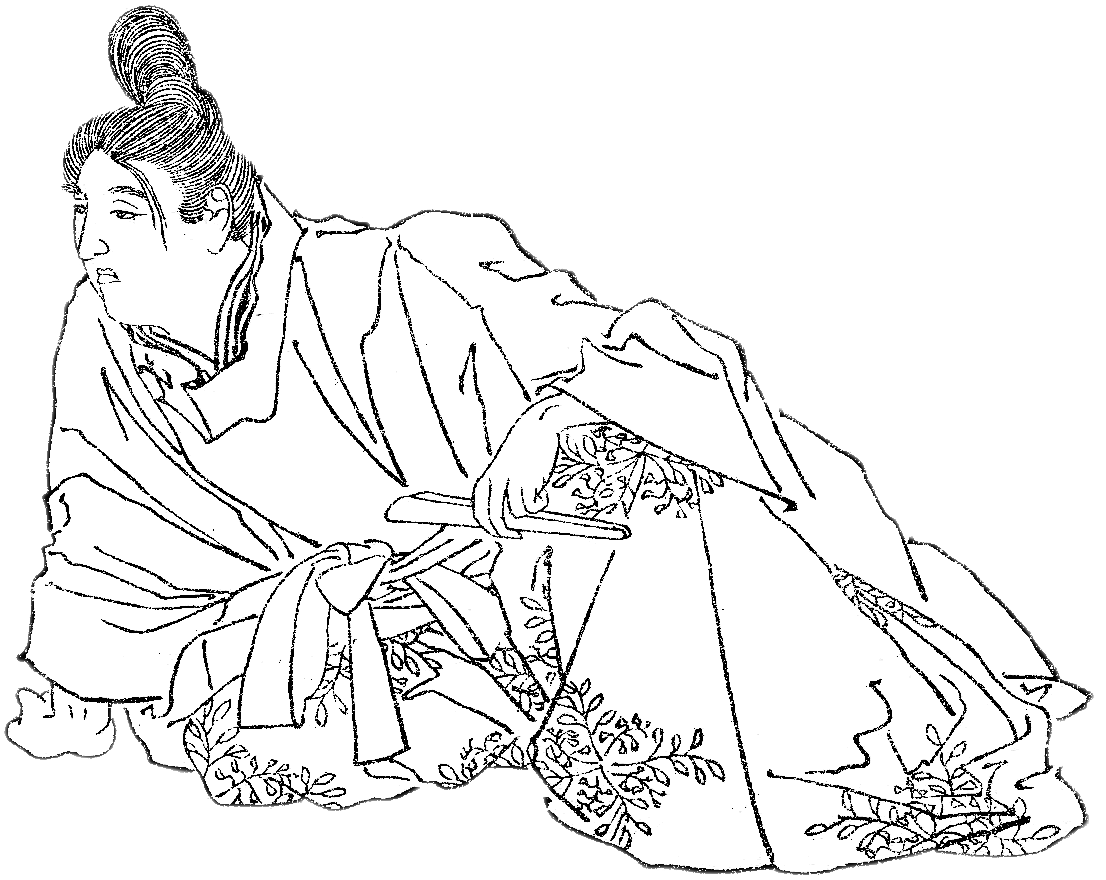
The first son of Emperor Heizei, and the father of Ariwara no Yukihira and Ariwara no Narihira.
He is also said to be the real grandfather of Ōe no Chisato.
- The Kusuko Incident
-
An incident in which Retired Emperor Heizei, who had stepped down, was urged on by Fujiwara no Kusuko to take back power and clashed with his younger brother, Emperor Saga.
In recent years it is also called the "Retired Emperor Heizei Incident."
Because of this incident, Heizei's first son, Prince Abo, was also punished and sent away to Dazaifu in Kyushu as its acting governor-general.
Later, Prince Abo asked the emperor to let his sons leave the imperial family and become subjects, and Yukihira and Narihira were given the family name Ariwara.
It is also said that this incident led to Ōe no Otondo being adopted by Ōe no Motonushi. - Utagawa Kuniyoshi's Hyakunin Isshu no Uchi
-
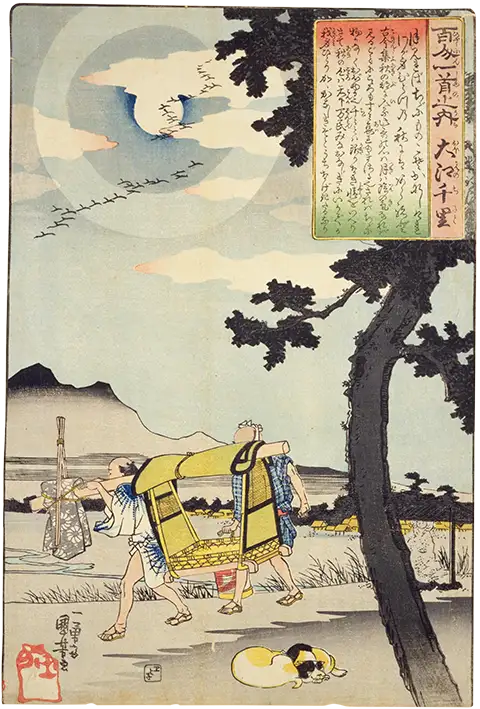
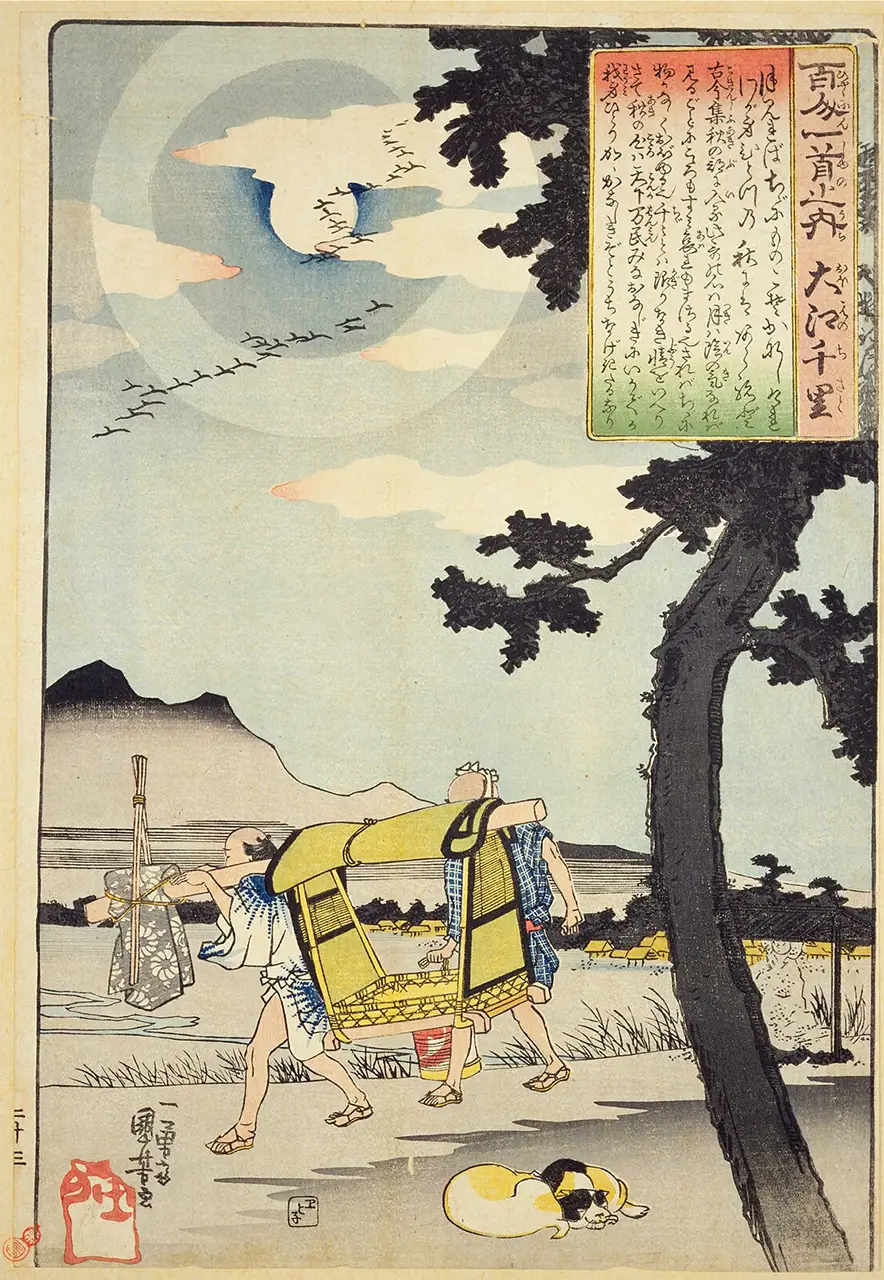
National Diet Library, Public domain, via Wikimedia Commons This ukiyo-e is by Utagawa Kuniyoshi, an artist of the Edo period.
It shows a scene that matches the poem in the Hyakunin Isshu.There were no palanquins like the one in this picture in the Heian period, so Kuniyoshi probably imagined Ōe no Chisato's poem in a setting from his own time, the Edo period.
The palanquin is empty, so perhaps the bearers are walking home at night after dropping off their passenger. The bearer at the back looks up at the moon and may be reciting Ōe no Chisato's poem to himself.