Front of the Card
Back of the Card
Japanese
English
Audio: NHK Creative Library
Read by LibriVox volunteer Larry Wilson.
Audio courtesy of LibriVox
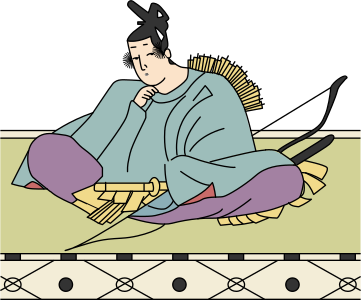
在原業平朝臣
ちはやぶる
神代もきかず
竜田川
から紅に
水くくるとは
からくれな
ゐにみつく
くるとは

ちは


- Poem 17
- ちはやぶる
神代もきかず
竜田川
から紅に 水くくるとは
Author: Ariwara no Narihira Ason (825–880)
Source: Kokin Wakashū, Autumn
- English Verse Translation
- All red with leaves Tatsuta's stream So softly purls along, The everlasting Gods themselves,
Who judge 'twixt right and wrong, Ne'er heard so sweet a song.
— William N. Porter, 1909
- Modern Translation
- Even the ancient gods never heard of this — the Tatsuta River, dyeing its waters a deep crimson with fallen maple leaves.
- Commentary
- The Kokin Wakashū says this was written about a painted screen showing autumn leaves flowing down the Tatsuta River, at the invitation of Fujiwara no Takaiko. She and Narihira had once been lovers, but she had become a consort of Emperor Seiwa, far above him. He is thought to have hidden in this poem the love he could no longer speak.
- About the Poet
- Ariwara no Narihira was a son of Prince Abo (a son of Emperor Heizei) but became a commoner. Free-spirited and a gifted poet, he is believed to be the hero of The Tales of Ise.
- Poem Illustration
-
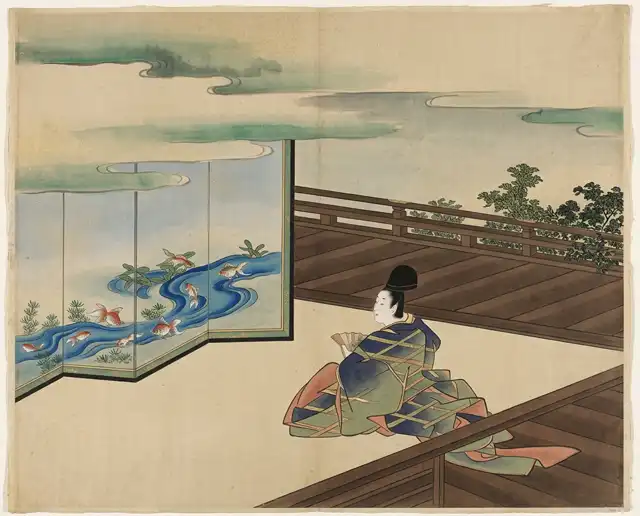
This image is based on an illustration from William N. Porter's A Hundred Verses from Old Japan, his 1909 English translation of the Hyakunin Isshu published in England, colorized and reworked using Adobe Firefly (generative AI).
- Ariwara no Narihira: A Short Timeline
-
- 825
- Born as a son of Prince Abo
- 826
- Given the family name Ariwara
- 841
- Becomes an officer of the Right Palace Guards
- 849
- Given Junior Fifth Rank, Lower Grade
- 865
- Becomes Head of the Right Stables
- 877
- Given Junior Fourth Rank, Upper Grade, and becomes Acting Middle Captain of the Right Palace Guards
- 879
- Becomes Head Chamberlain (Kurōdo no Tō)
- 880
- Dies
- Notes
-
- Counted as one of the Six Immortal Poets
- Counted as one of the Thirty-Six Immortal Poets
- Ariwara no Narihira's Family Tree
-
Ariwara no Narihira was born the fifth son of Prince Abo, a son of Emperor Heizei. His mother was Princess Ito, a daughter of Emperor Kanmu, so both his father and his mother came from the imperial family.
Prince Abo, however, was caught up in the Kusuko Incident and sent away to Dazaifu in Kyushu as its acting governor-general, which took him far from the throne. Later he asked the court to let his children leave the imperial family and become subjects. In 826, Narihira, together with his elder half-brother Yukihira and others, left the imperial family and was given the family name "Ariwara no Ason."
The Tales of Ise describes a deep love between Narihira and Fujiwara no Takaiko, who was later called the "Nijō Empress." When it was decided that Takaiko would enter the palace as a consort of Emperor Seiwa, the two tried to run away together. But on the way, Takaiko's elder brothers caught up with them and took her back.
After that, women who remind readers of Takaiko appear again and again in The Tales of Ise, in stories of love and parting with Narihira.
- Appendix
-
- Tatsuta-age
 Tatsuta-age is Japanese fried chicken marinated in soy sauce, which turns its surface red when fried. Its name is said to come from this poem, which describes autumn leaves floating on the Tatsuta River.
- Prince Abo
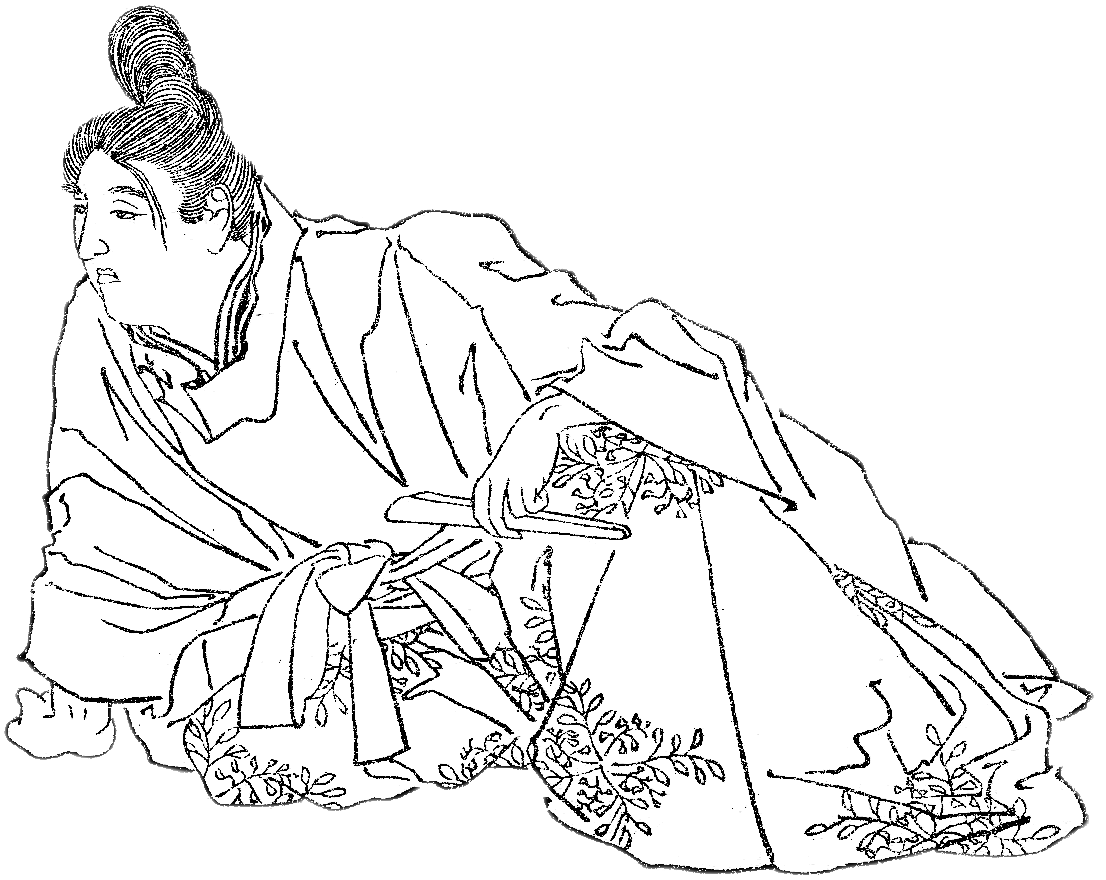 The first son of Emperor Heizei, and the father of Ariwara no Yukihira and Ariwara no Narihira.
He is also said to be the real grandfather of Ōe no Chisato.- Why Narihira Left the Imperial Family
- After stepping down, Retired Emperor Heizei, urged on by Fujiwara no Kusuko, tried to take back power and clashed with his younger brother, Emperor Saga. Because of this "Retired Emperor Heizei Incident" (also called the "Kusuko Incident"), Heizei's first son, Prince Abo, was also punished and sent away to Dazaifu as its acting governor-general. Later, Prince Abo asked the emperor to let his sons leave the imperial family and become subjects, and Yukihira and Narihira were given the family name "Ariwara."
- The Six Poetic Sages (Rokkasen)
-
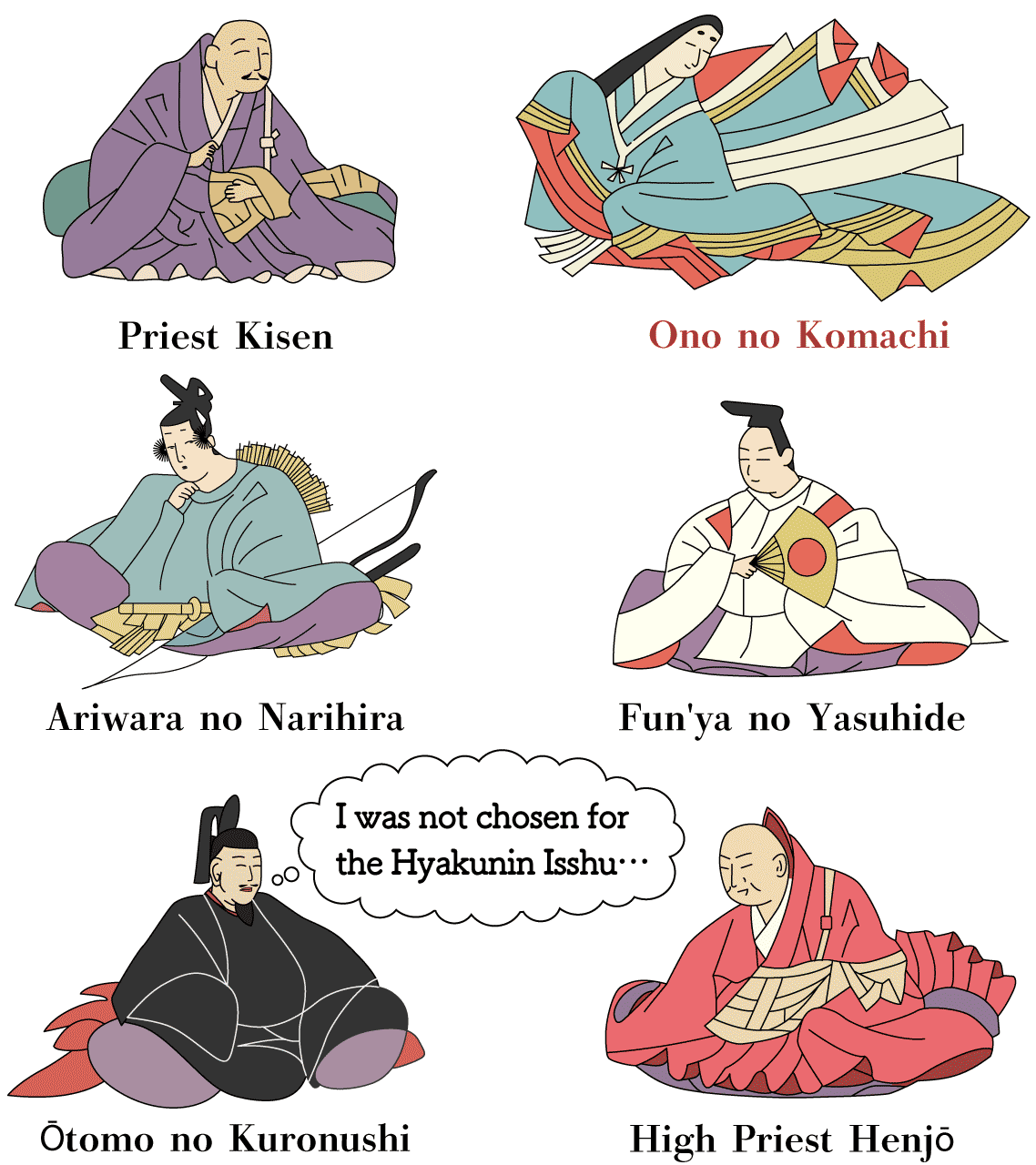
Click a poet to go to their poem page. When the Kokin Wakashū was compiled, these six poets, including Ariwara no Narihira, were very famous poets of the generation before. In the Japanese preface to the Kokin Wakashū, Ki no Tsurayuki picked them out as "people whose names were known in recent times" and judged their poetry. His judgments were quite harsh, but the six later came to be called the Rokkasen, the Six Poetic Sages, and were highly praised as great poets.
See Ki no Tsurayuki's judgments of the six poets.
One of the Six Poetic Sages, Ōtomo no Kuronushi, has no poem in the Hyakunin Isshu, while the other five were all chosen.
- Narihira, the Hero of The Tales of Ise
- The Tales of Ise is a collection of poem-tales, mostly about love, made in the early Heian period. Each story begins "Long ago, there was a man." Because of this opening line, the hero is called Mukashi-otoko, "the man of long ago." Of the roughly 200 poems he writes in the work, as many as 34 are known to be by Ariwara no Narihira, so Narihira is thought to be the model for the hero.
- Poems Beginning "Chihayaburu"
-
The next two poems are an exchange in The Tales of Ise between the hero (Ariwara no Narihira) and a lady-in-waiting at the shrine of the Ise Priestess who had fallen in love with him.
- The Lady-in-Waiting's Poem
-
In Japanese
ちはやぶる 神の斎垣も 越えぬべし
大宮人の 見まくほしさに chihayaburu kaminoikakimo koenubeshi
oomiyabitono mimakuhoshisani The Tales of IseIn English
I feel I could even cross the sacred fence of the gods,
just to catch a glimpse of you, a man of the court. - Ariwara no Narihira's Poem
-
In Japanese
恋しくは 来ても見よかし ちはやぶる
神のいさむる 道ならなくに kohishikuha kitemomiyokashi chihayaburu
kaminoisamuru michinaranakuni The Tales of IseIn English
If you miss me, come and see me.
This is not a path the gods forbid. - A Poem from "The Journey East" in The Tales of Ise
-
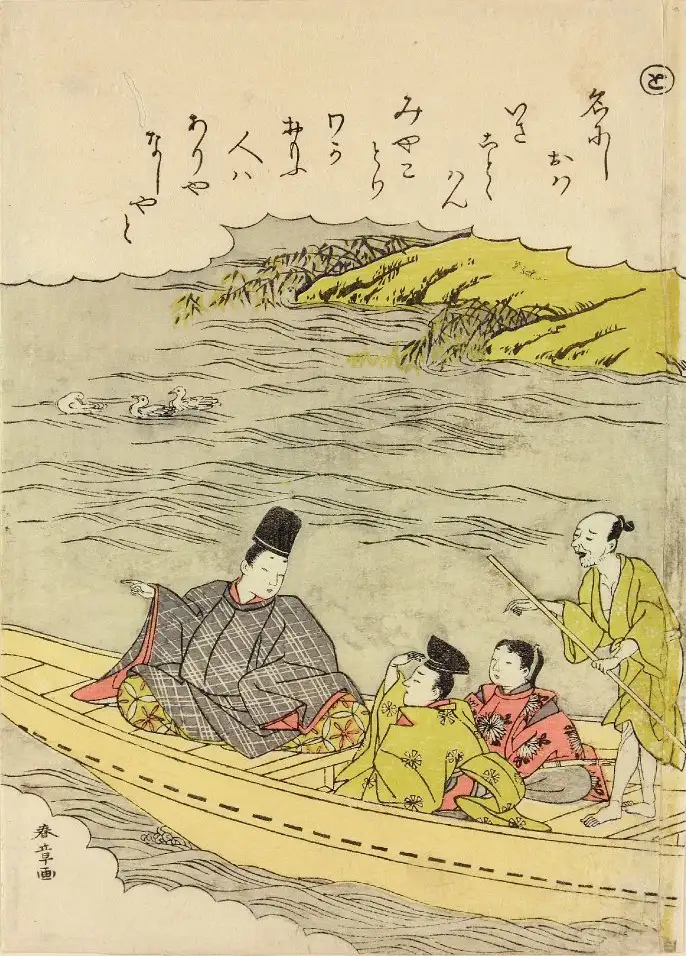
The next poem appears in "The Journey East" (Azuma Kudari) in The Tales of Ise. On a journey to the eastern provinces, at the Sumida River between the provinces of Musashi and Shimōsa, the hero learns that the birds he sees are called miyakodori, "birds of the capital," and writes this poem thinking of the woman he loves, whom he left in the capital.
In Japanese
名にし負はば いざ言問はむ 都鳥
nanishiohaba izakototohamu miyakodori
わが思ふ人は ありやなしやと
wagaomofuhitoha ariyanashiyato The Tales of Ise, Ariwara no Narihira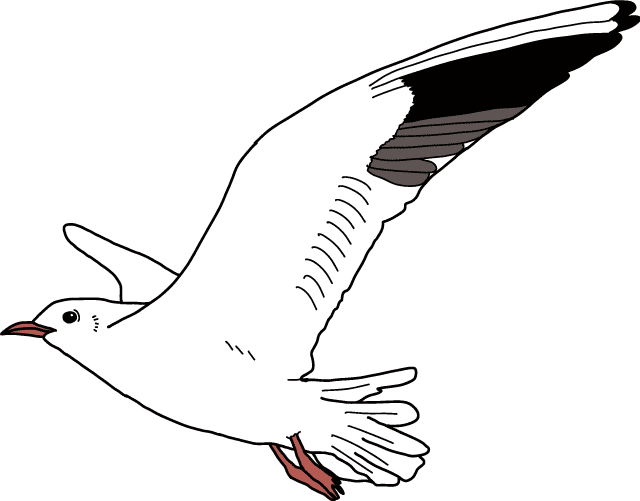
In English
Bird of the capital,
if you are true to your name, tell me:
is the one I love in the capital
still well, or not?The miyakodori is the black-headed gull. Today it is known as the official bird of Tokyo.
- Kototoi Dango and Kototoi Monaka
-
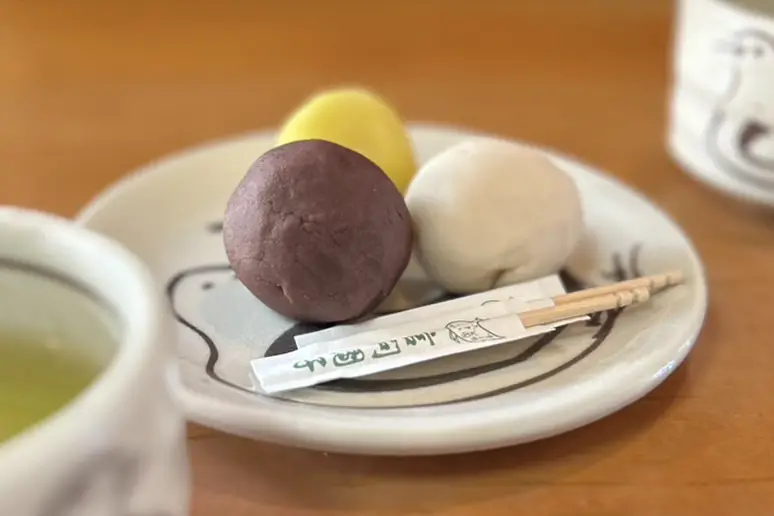
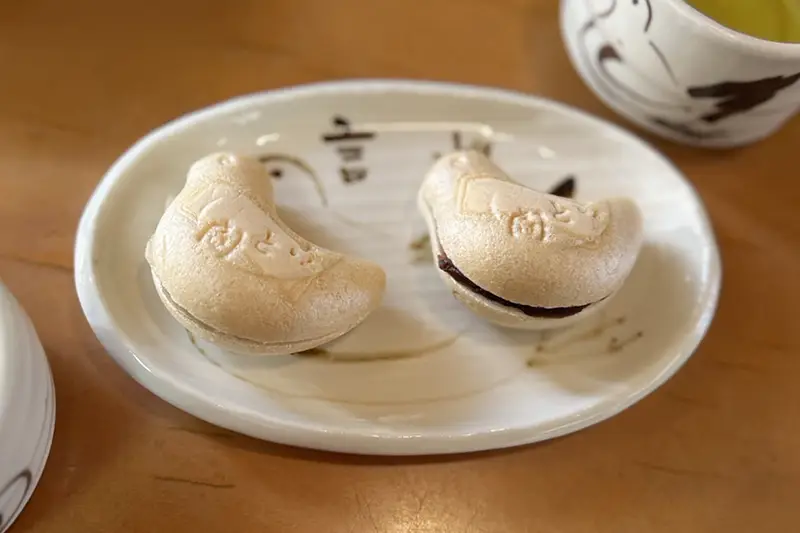
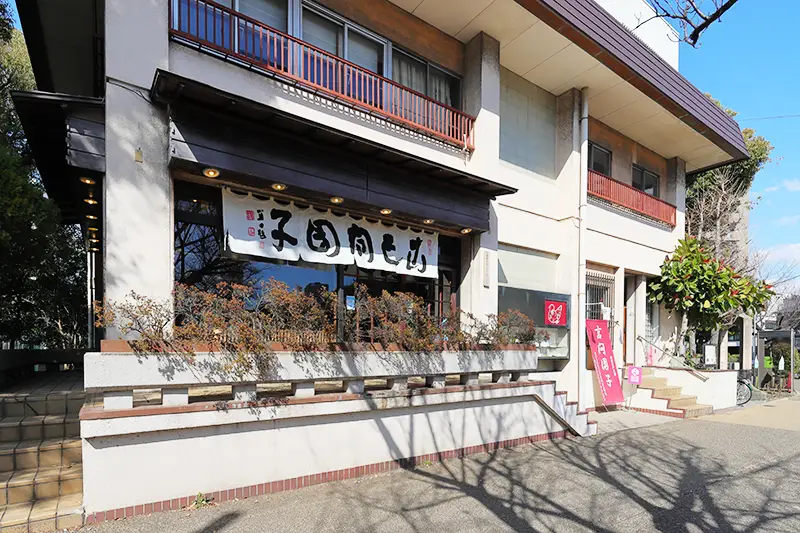
Kototoi Dango, named after Narihira's poem "Na ni shi owaba iza koto towamu miyakodori...," was created at the end of the Edo period.
At Mukōjima Kototoi Dango, a long-established shop in Mukōjima on the banks of the Sumida River, these dumplings, served without skewers, have been made in the same place since the shop opened.
The round dumplings come in three colors, white, yellow, and black. Because they are not put together on one skewer, you can enjoy the flavor of each one. Kototoi Monaka, a wafer sweet shaped like a miyakodori, is also recommended: it looks lovely and has the same gentle sweetness as the dumplings.
Both are carefully made from selected Japanese ingredients and have been loved by many people across the ages.
In the shop, you can take your time and enjoy these sweets with fragrant tea.
March 20, 2025
- Kototoi Bridge
-
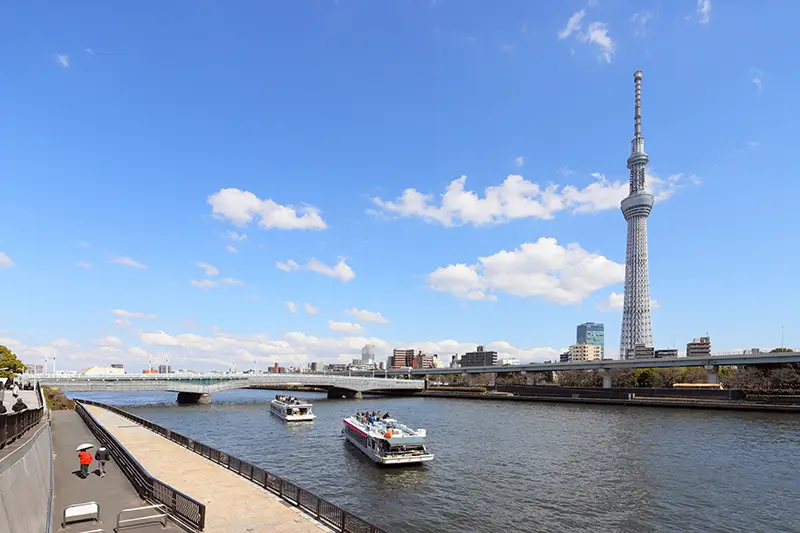
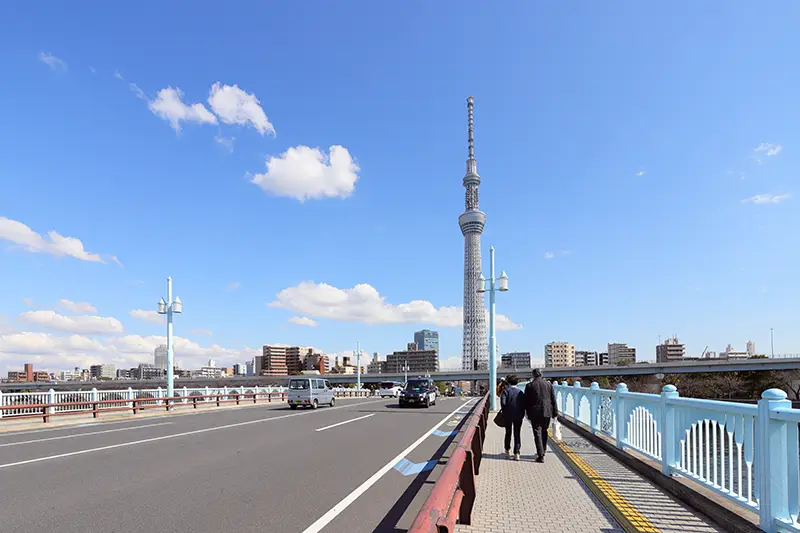
Kototoi Bridge crosses the Sumida River. Its name is said to come from Narihira's poem. As I looked out over the river from the bridge, black-headed gulls were flying gracefully.
The story goes that when Narihira first saw these birds, he did not know their name and asked the ferryman. The ferryman told him they were called miyakodori, "birds of the capital." Hearing the name reminded Narihira of the woman he loved, whom he had left in the capital, and he wrote the poem "Na ni shi owaba iza koto towamu miyakodori waga omou hito wa ari ya nashi ya to."
March 20, 2025
- Another Poem from "The Journey East" in The Tales of Ise
-
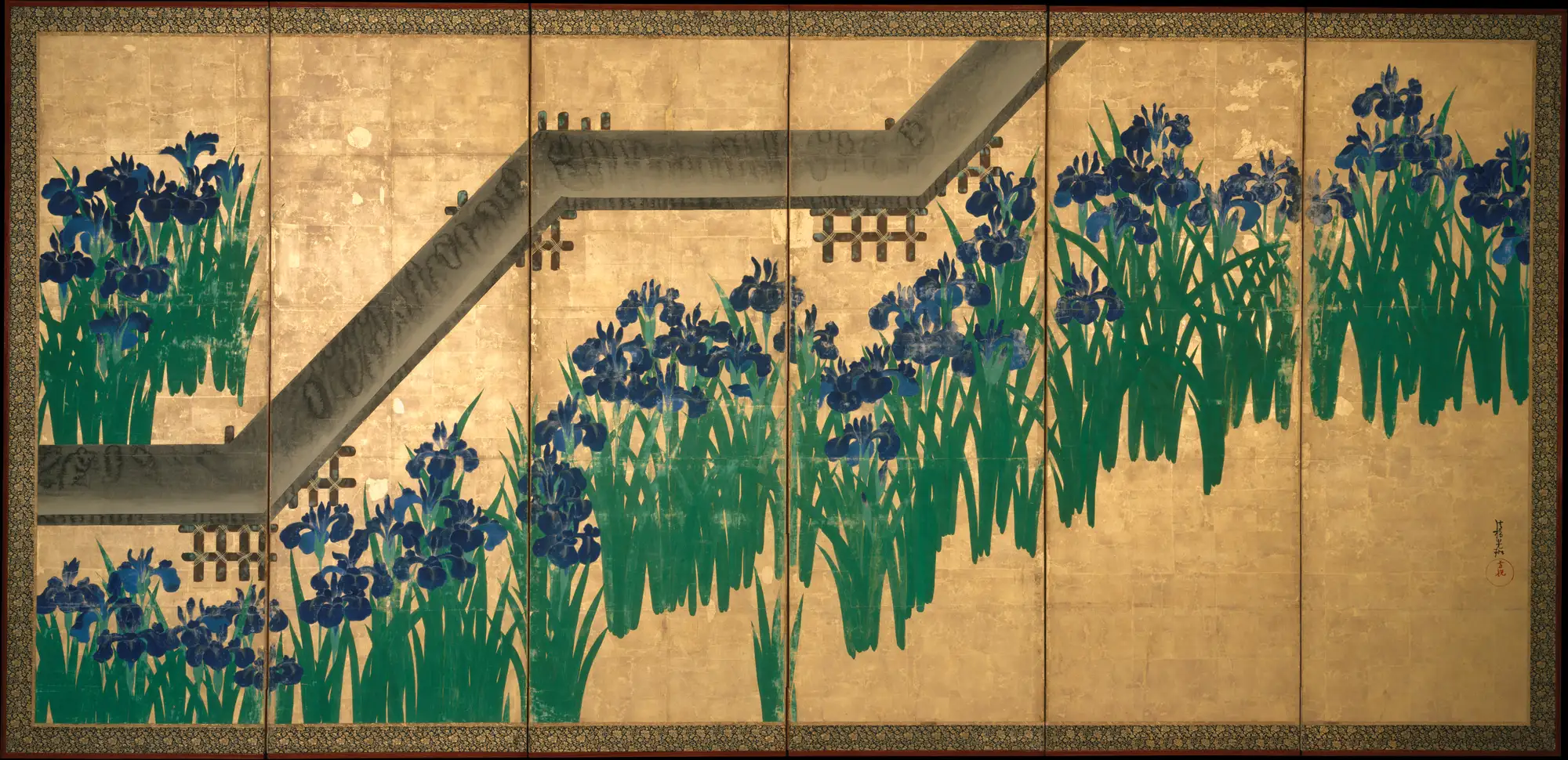
The next poem also appears in "The Journey East" in The Tales of Ise. On his journey to the eastern provinces, the hero saw kakitsubata (rabbit-ear irises) blooming at Yatsuhashi in the province of Mikawa and wrote this poem. The word tsuma in the poem is a kakekotoba (a word with two meanings): 妻, "wife," and 褄, "the hem of a robe." The poem also places the five sounds "ka-ki-tsu-ha-ta" at the start of its five lines. This technique is called oriku.
In Japanese
唐衣 着つつなれにし つましあれば
karakoromo kitsutsunarenishi tsumashiareba
はるばる来ぬる 旅をしぞ思ふ
harubarukinuru tabioshizoomofu The Tales of Ise, Ariwara no NarihiraIn English
Like a Chinese robe I have worn so long it feels part of me, I have a dear wife I left in the capital, so I feel deeply how far I have come on this journey.
- Ukiyo-e by Katsukawa Shunshō
-
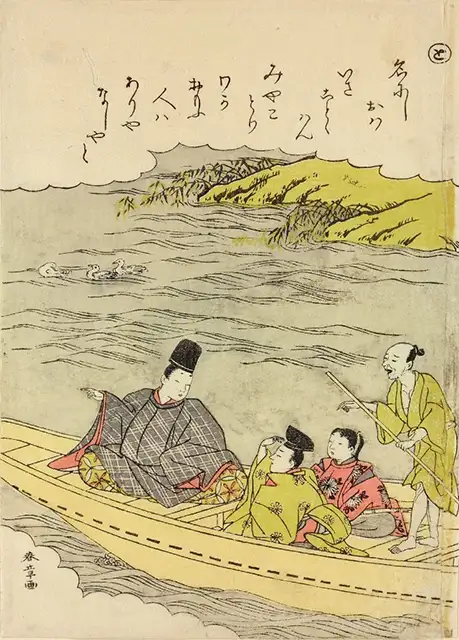
Katsukawa Shunshō, Public domain, via Wikimedia Commons This ukiyo-e shows Ariwara no Narihira writing the poem "Na ni shi owaba iza koto towamu...." Later, a nearby dumpling shop began selling Kototoi Dango, named after the poem. They became popular, and it is said that this is why the nearby bridge came to be called Kototoi Bridge, and the street Kototoi Street.
The birds floating on the river in the upper left of the print are miyakodori. There are several theories, but the most widely accepted one is that the miyakodori is the black-headed gull, which is now known as the official bird of Tokyo.
- Ogata Kōrin's Irises at Yatsuhashi
-
Irises at Yatsuhashi (Yatsuhashi-zu Byōbu), a folding screen by the Edo-period painter and craftsman Ogata Kōrin, takes as its subject the story of Yatsuhashi in Mikawa from "The Journey East" in The Tales of Ise.
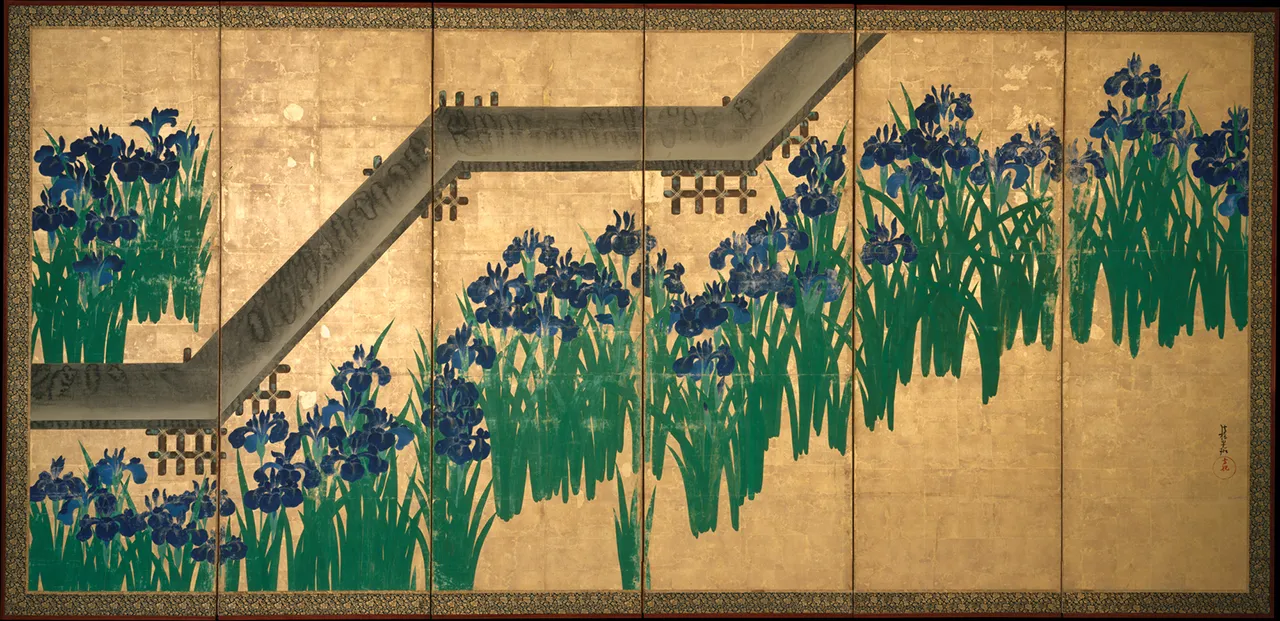
Public domain (The Metropolitan Museum of Art) - A Poem from "Nagisa-no-in" in The Tales of Ise
-
The next poem also appears in The Tales of Ise.
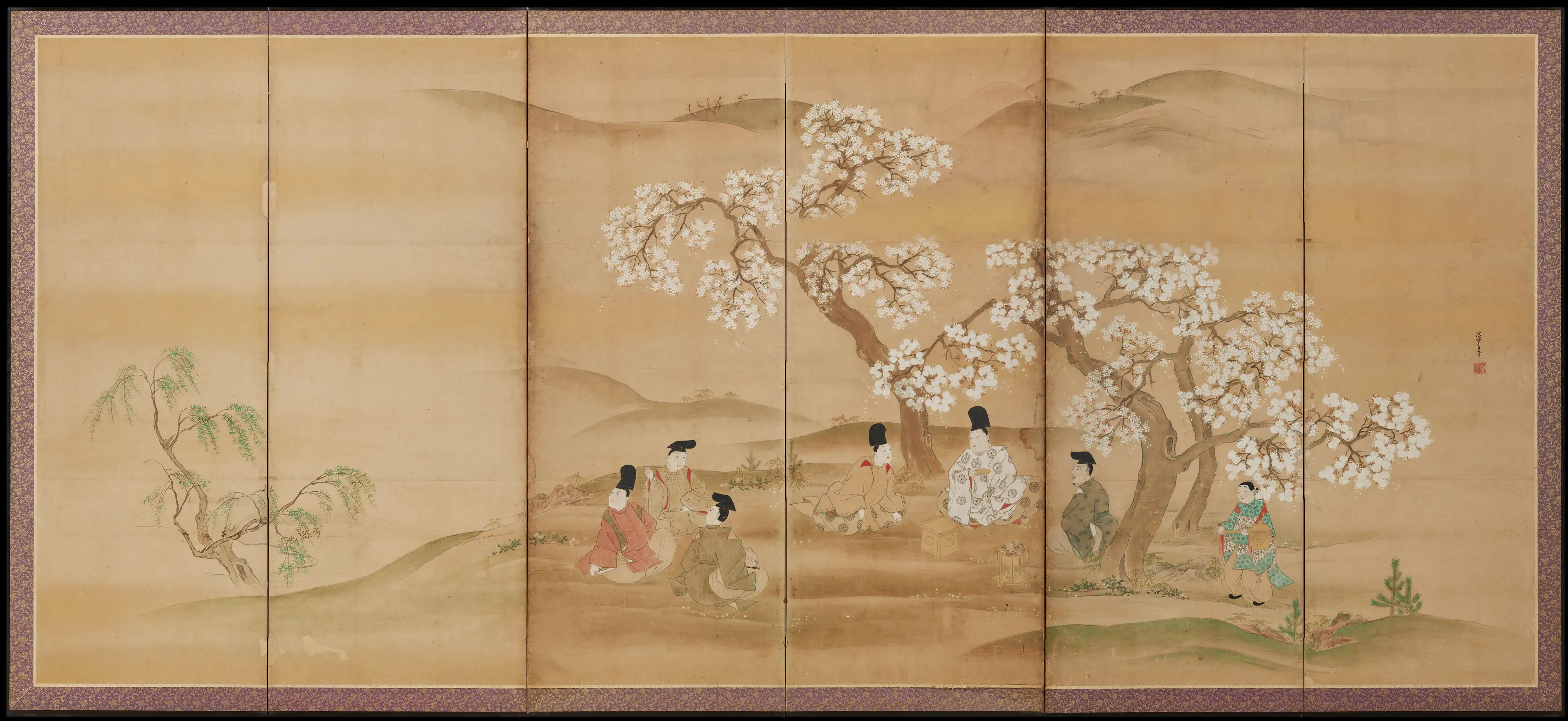
Ariwara no Narihira wrote it while viewing cherry blossoms at Nagisa-no-in, the country house of Prince Koretaka (the first son of Emperor Montoku) at Katano-ga-hara (now Hirakata City, Osaka).In Japanese
世の中に たえて桜の なかりせば
yononakani taetesakurano nakariseba
春の心は のどけからまし
harunokokoroha nodokekaramashiIn English
If there were no cherry blossoms at all in this world,
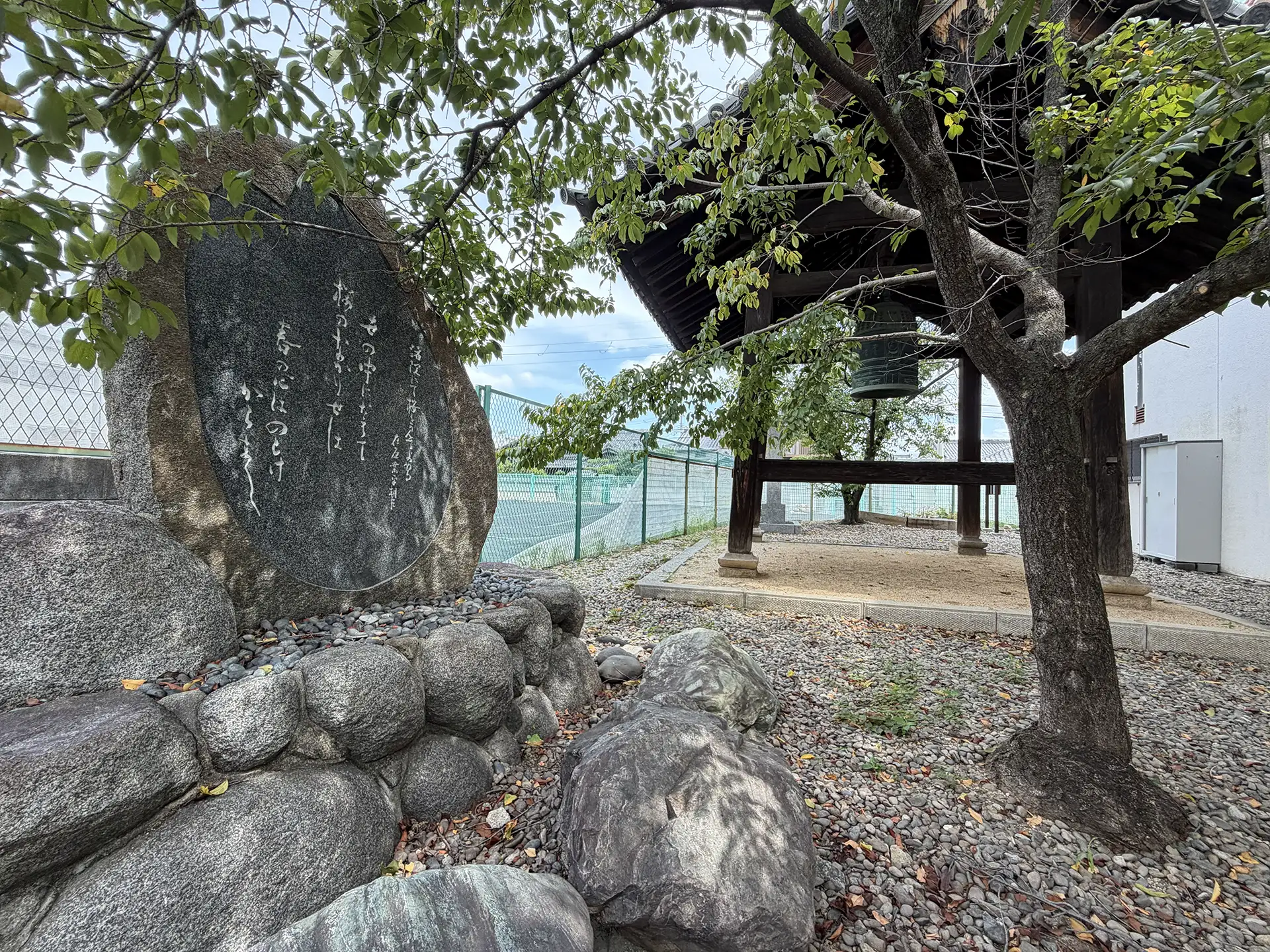
how calm people's hearts would be in spring. - The Site of Nagisa-no-in
-
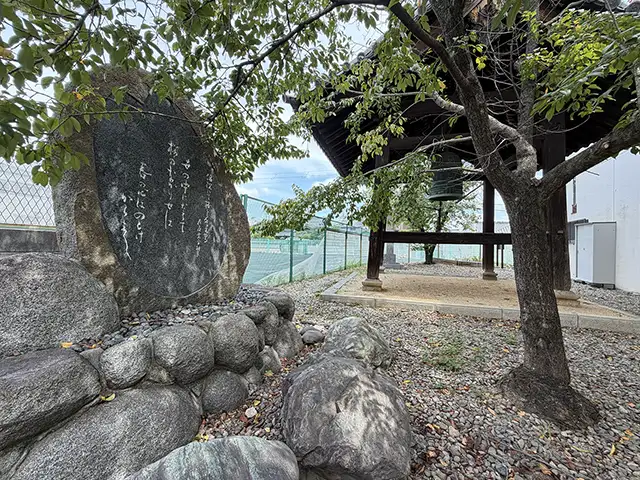
(Photo taken August 10, 2026) Nagisa-motomachi, Hirakata City, Osaka. This was the country house of Prince Koretaka, the first son of Emperor Montoku. The Tales of Ise describes Prince Koretaka, Ariwara no Narihira, and others visiting this place and enjoying the cherry blossoms. Narihira's poem "Yo no naka ni taete sakura no nakariseba haru no kokoro wa nodokekaramashi" is said to have been written at Nagisa-no-in. Today a stone monument with this poem stands at the site.
- Folding Screen of Cherry-Blossom Viewing
-
This folding screen shows a scene from "Nagisa-no-in" in The Tales of Ise. It is a work by Sumiyoshi Gukei, a painter of the early Edo period.
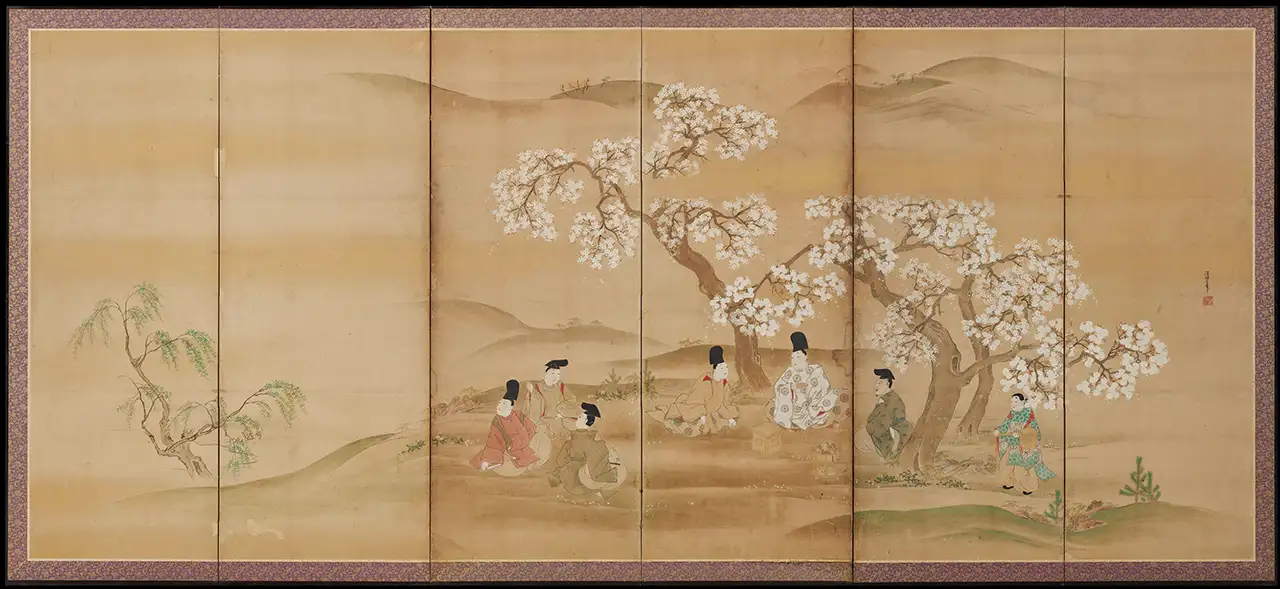
Source: ColBase (https://colbase.nich.go.jp/) - Narihira's Farewell Poem
- The next poem is the last one in The Tales of Ise. Its headnote says, "Long ago, a man fell ill and felt that he was about to die." It is Narihira's death poem, written when he fell ill and knew his end was near.
In Japanese
つひに行く 道とはかねて 聞きしかど
昨日今日とは 思はざりしを tsuhiniyuku michitohakanete kikishikado
kinoukefutoha omohazarishioIn English
I had long heard it is the road we all must take in the end,
but I never thought it would be so soon, today or tomorrow. - Ukiyo-e by Tsukioka Yoshitoshi
-
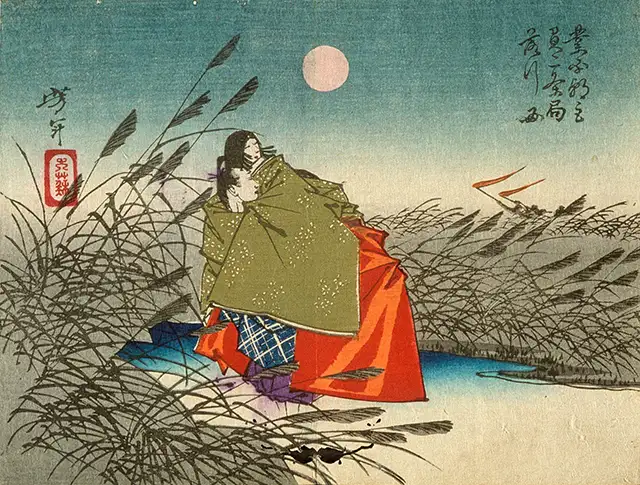
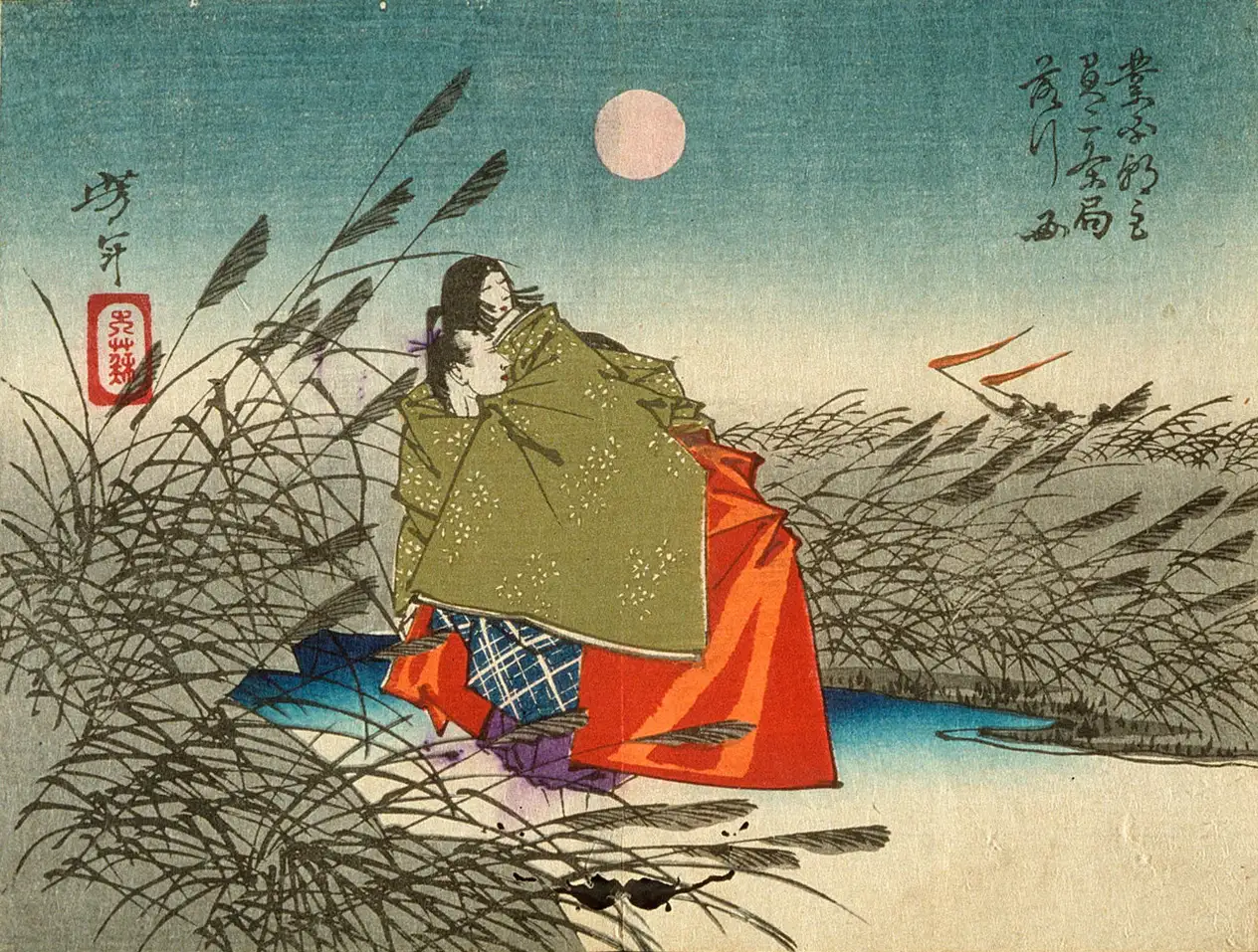
Yoshitoshi, Public domain, via Wikimedia Commons This ukiyo-e is Narihira Ason Carrying the Lady Nijō on His Back as They Flee by Tsukioka Yoshitoshi. The Tales of Ise has a scene in which Narihira runs away with the Nijō Empress (Fujiwara no Takaiko), carrying her on his back, and this print shows that scene.
- Ukiyo-e by Katsushika Hokusai
-
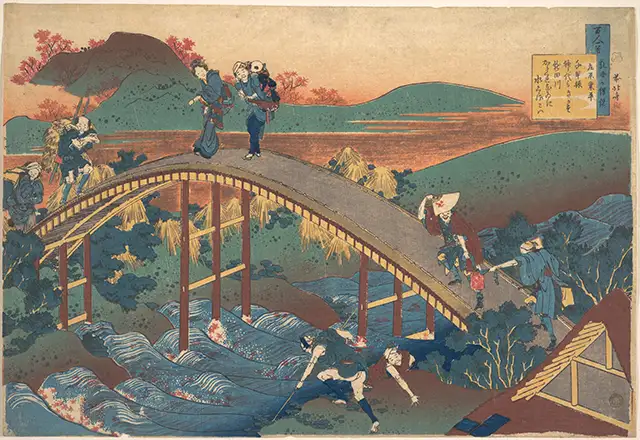
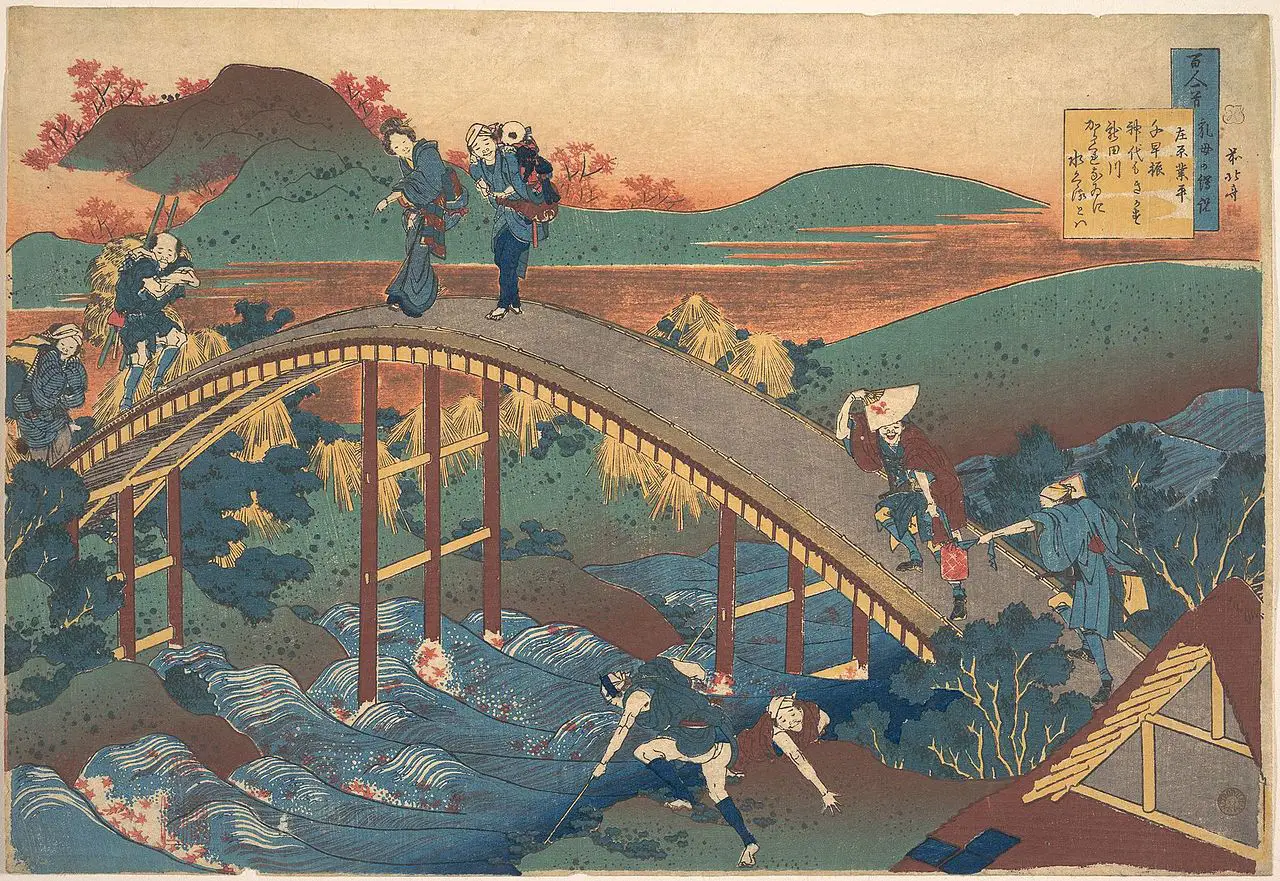
Katsushika Hokusai, CC0, via Wikimedia Commons This print is from One Hundred Poems Explained by the Nurse (Hyakunin Isshu Uba ga Etoki) by Katsushika Hokusai, an ukiyo-e artist of the Edo period. The idea of the series is a nurse explaining the Hyakunin Isshu poems with easy-to-understand pictures. You can see people on a bridge enjoying the autumn leaves floating down the Tatsuta River, and people fishing on the riverbank. The words mizu kukuru in the poem are usually taken to mean "tie-dyeing," but they are sometimes read as "flowing under the water." Looking at Hokusai's print, which reading do you think it shows?
- Utagawa Kuniyoshi's Hyakunin Isshu no Uchi
-
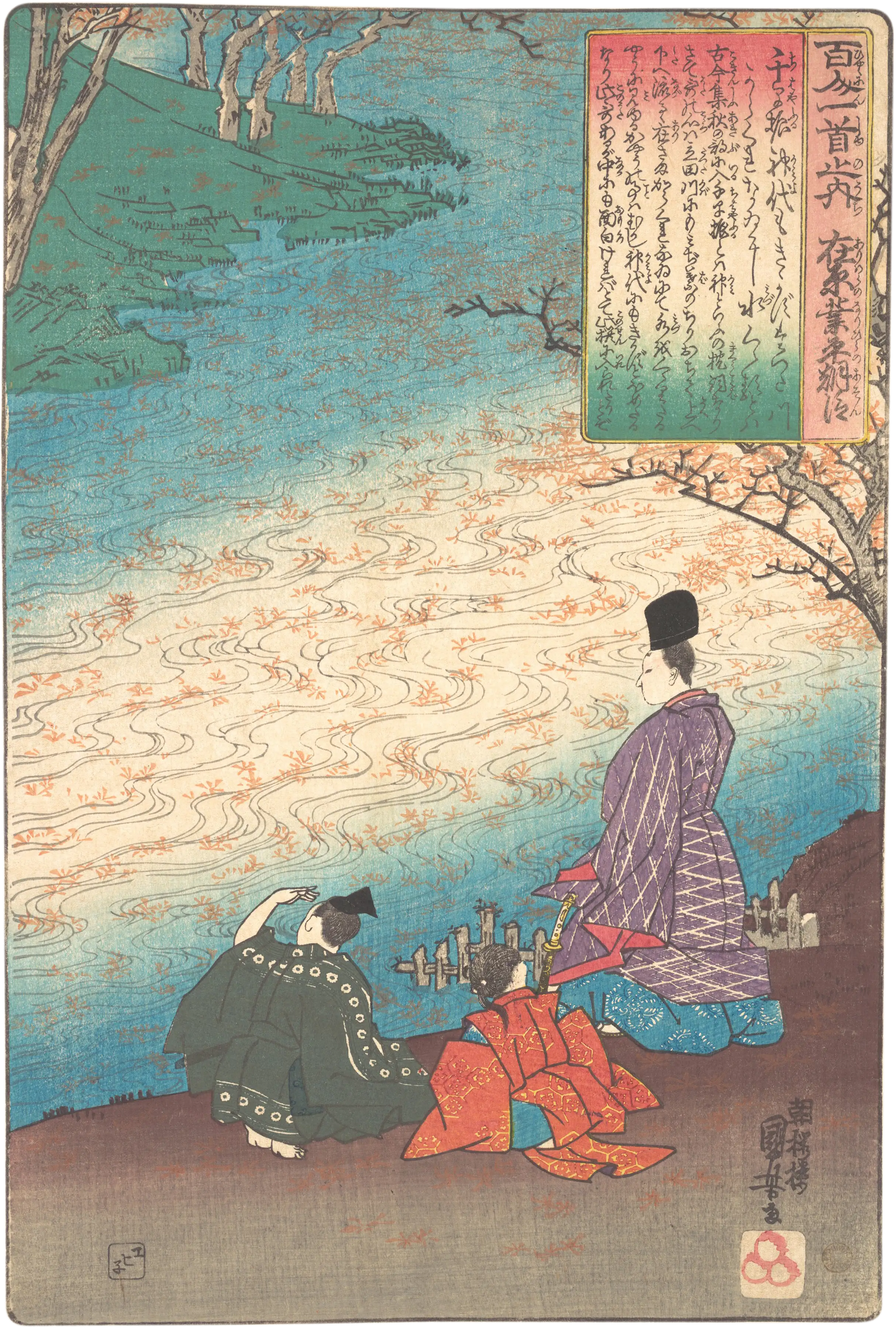
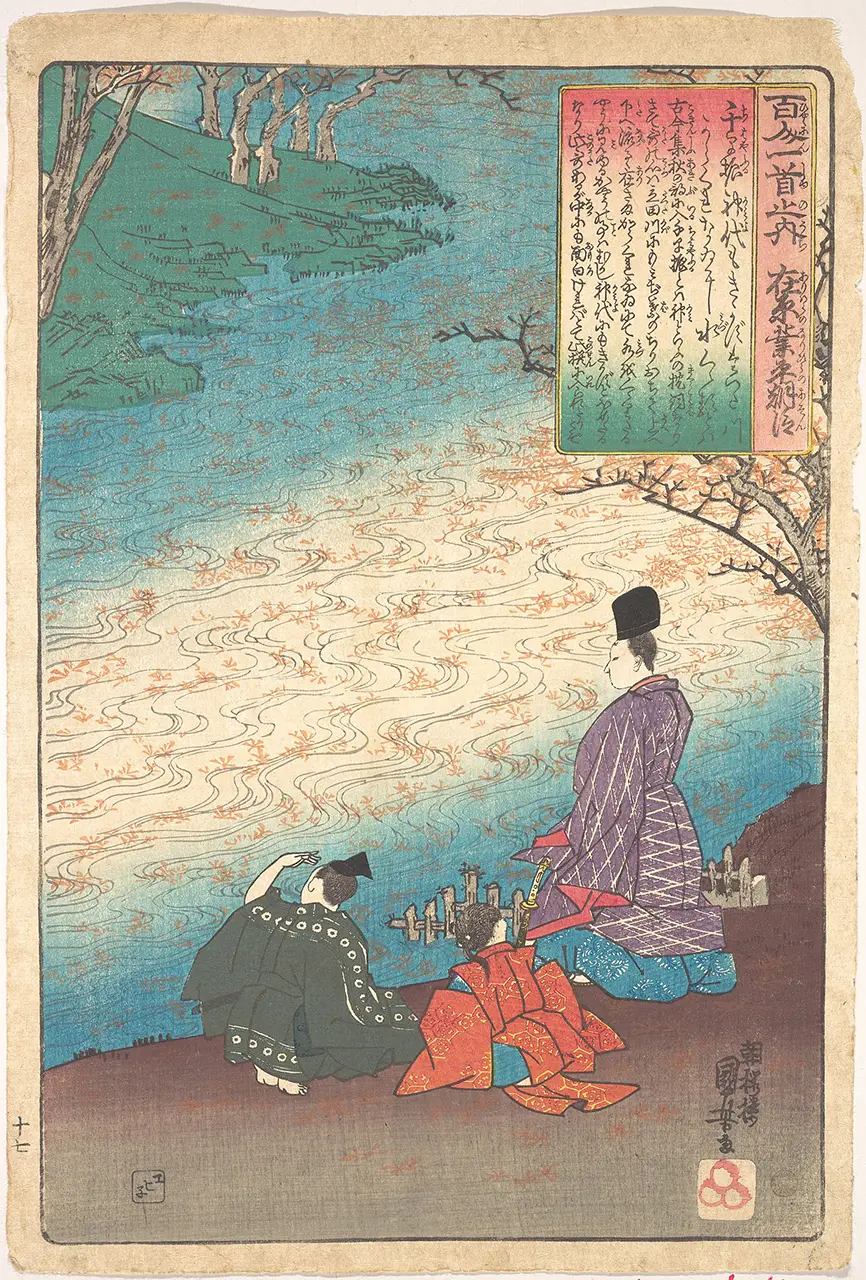
Utagawa Kuniyoshi, CC0, via Wikimedia Commons This ukiyo-e is by Utagawa Kuniyoshi, an artist of the Edo period.
It shows a scene that matches the poem in the Hyakunin Isshu.Narihira's Hyakunin Isshu poem was written while looking at a painted folding screen, but this print shows the autumn leaves spreading over the Tatsuta River as if he were really seeing them.
Perhaps Narihira has come across a scene just like the one in his poem, and is fondly remembering the day he wrote it for the screen.