Front of the Card
Back of the Card
Japanese
English
Audio: NHK Creative Library
Read by LibriVox volunteer Larry Wilson.
Audio courtesy of LibriVox
陽成院
筑波嶺の
峰より落つる
みなの川
こひぞつもりて
淵となりぬる
こひそつも
りてふちと
なりぬる

つく


- Poem 13
- 筑波嶺の
峰より落つる
みなの川
こひぞつもりて 淵となりぬる
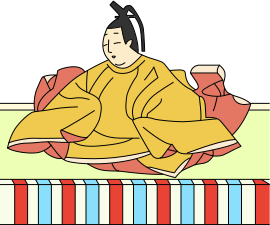
Author: Retired Emperor Yōzei (869–949)
Source: Gosen Wakashū, Love
- English Verse Translation
- The Mina stream comes tumbling down From Mount Tsukuba's height; Strong as my love,
it leaps into A pool as black as night With overwhelming might.
— William N. Porter, 1909
- Modern Translation
- Just as the streams from the peak of Tsukuba flow down to fill the deep pools of the Mina River, so my love for you has gathered deep within me.
- Commentary
- The Gosen Wakashū says this was sent to the Princess of Tsuridono. Retired Emperor Yōzei wrote it to propose to Princess Suishi, a daughter of Emperor Kōkō, and they later married. Mount Tsukuba has a "woman peak" and a "man peak," so it often appears in love poems.
- About the Poet
- Yōzei became emperor at 9 and stepped down at 17 because of mental illness. Stories of violent acts survive, but the reasons for his stepping down are debated; one says Fujiwara no Mototsune arranged it. He then lived as a retired emperor for over 60 years, the longest in history.
- Poem Illustration
-
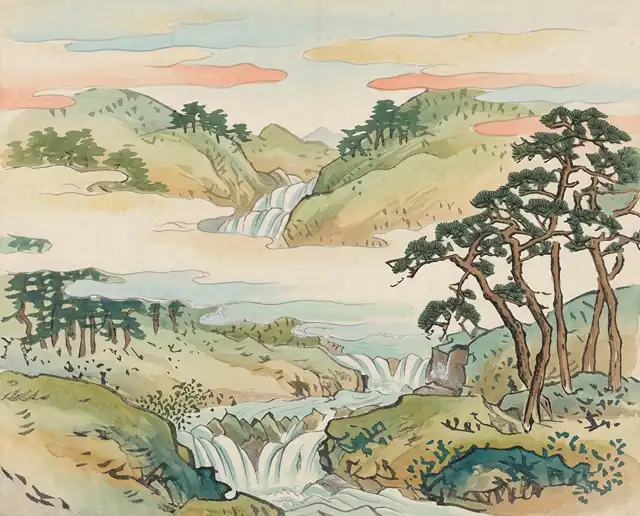
This image is based on an illustration from William N. Porter's A Hundred Verses from Old Japan, his 1909 English translation of the Hyakunin Isshu published in England, colorized and reworked using Adobe Firefly (generative AI).
- Retired Emperor Yōzei: A Short Timeline
-
- 869
- Born as a son of Emperor Seiwa
- 876
- Becomes emperor at age 9
- 880
- Fujiwara no Mototsune becomes Kampaku (chief adviser to the emperor)
- 882
- Holds his coming-of-age ceremony
- 884
- Steps down from the throne at age 17
- 949
- Dies
- Retired Emperor Yōzei's Family Tree
-
Retired Emperor Yōzei became emperor at the age of 9, but he is said to have behaved strangely. The year after his foster brother (raised by the same nurse), Minamoto no Masaru, was killed inside the palace, the regent Fujiwara no Mototsune pressed him to give up the throne. Mototsune was the elder brother of Yōzei's mother, Fujiwara no Takaiko. Although they had the same mother, Mototsune and Takaiko were rivals in a struggle for power. So the reasons given for Yōzei's stepping down may have been made up.
After leaving the throne at 17, Yōzei married Princess Suishi. He lived 65 years as a retired emperor and died at the age of 80.
His son, Prince Motoyoshi, is known for his secret love affair with Fujiwara no Hōshi, a daughter of Mototsune's son Tokihira and a consort of Emperor Uda.
- Appendix
-
- Mount Tsukuba
-
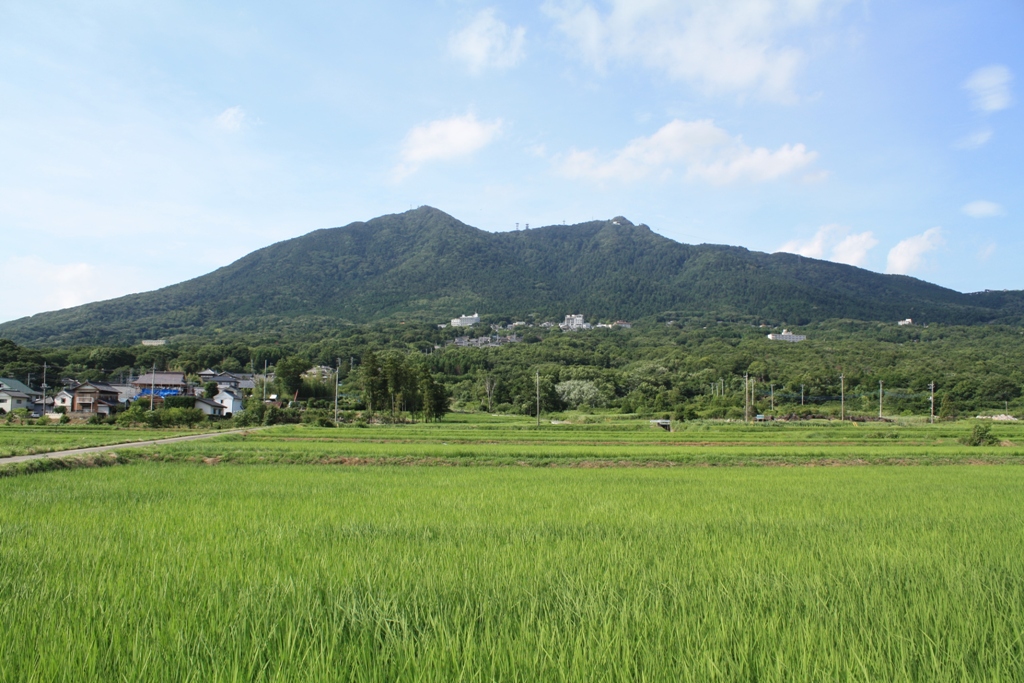
Courtesy of Tsukuba City An 877-meter mountain at the northern end of Tsukuba City, Ibaraki Prefecture. It has two peaks: Nantaisan, the "Male Peak" (871 m), on the west, and Nyotaisan, the "Female Peak" (877 m), on the east. Mount Tsukuba was known as a place for utagaki (or kagai), gatherings where unmarried young men and women sang love poems to each other and danced, and many love poems were written about it. The tradition seems to live on today: events such as hikes and treks for people looking for a marriage partner are sometimes held there.
See it on the map - The Minano River
-
Today the Minano River is written 男女川, "Male-and-Female River," but long ago it was sometimes written 水無川, "River without Water."
Mount Tsukuba was formed from magma that hardened deep underground and came to the surface over a very long time. Its rocks are full of cracks, so rainwater easily sinks into the ground, and probably little water flowed on the surface. This may be why it was written "River without Water."
We don't know how much Yōzei knew about the land around Mount Tsukuba. Still, the quiet nature of the water flowing down the mountain seems to live in his poem "Tsukubane no..."
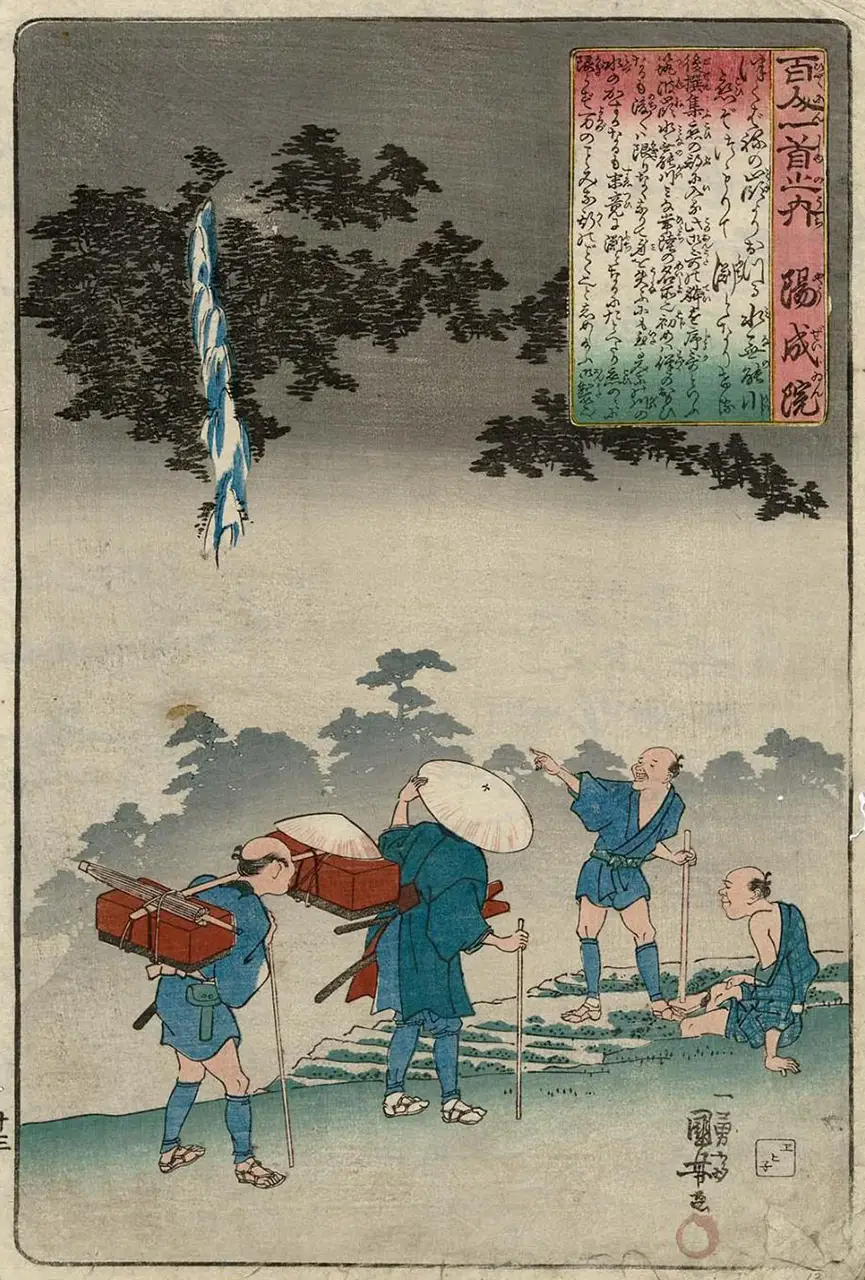
- Utagawa Kuniyoshi's Hyakunin Isshu no Uchi
-
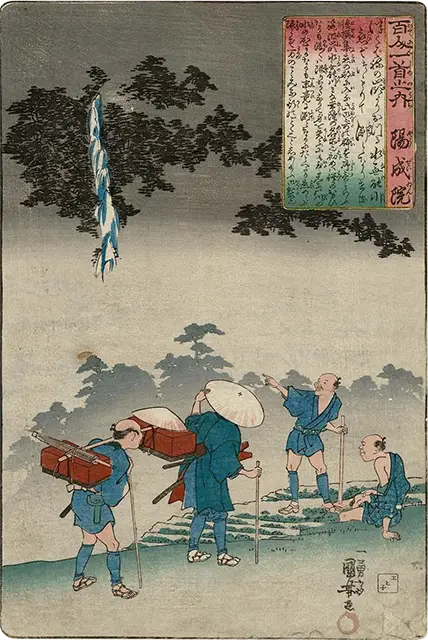
© 2024 Museum of Fine Arts Boston This ukiyo-e is by Utagawa Kuniyoshi, an artist of the Edo period.
It shows a scene that matches the poem in the Hyakunin Isshu.A group of travelers points at a waterfall on Mount Tsukuba. You can almost hear them saying, "Isn't that the Minano River from Yōzei's poem?"