


Front of the Card
Back of the Card
Japanese
English
Audio: NHK Creative Library
Read by LibriVox volunteer Larry Wilson.
Audio courtesy of LibriVox
三条右大臣
名にし負はば
逢坂山の
さねかづら
人にしられで
くるよしもがな
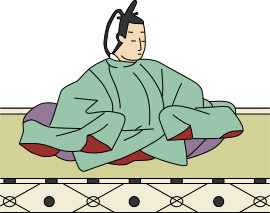
ひとにしら
れてくるよ
しもかな

なにし


- Poem 25
- 名にし負はば
逢坂山の
さねかづら
人にしられで くるよしもがな
Author: Minister of the Right of Sanjō (873–932)
Source: Gosen Wakashū, Love
- English Verse Translation
- Hear thou art as modest as The little creeping spray Upon Mount Ōsaka, which hides
Beneath the grass; then, pray, Wander with me to-day.
— William N. Porter, 1909
- Modern Translation
- If the name of Ōsaka carries its meaning — then let me secretly follow the vine I draw toward me, and come to you unseen.
Note: "Ōsaka" is both a place name and a pun on the verb *au* ("to meet"). The vine (*kazura*) reflects the wordplay of the original poem: to pull or draw the vine (*kuru*) and to come (*kuru*) to one's beloved unseen.
- Commentary
- As Minister of the Right, the poet was so high-ranking that meeting a lover was not easy, so the poem may hold his wish to meet her secretly. People often sent a poem with the object it named; he may have sent a sanekazura vine with this one.
- About the Poet
- Fujiwara no Sadakata was the father of Middle Counselor Asatada. He was called "the Minister of the Right of Sanjō" because his home was in Sanjō. A relative of the emperor by marriage, he rose to Minister of the Right and supported the poets Ki no Tsurayuki and Ōshikōchi no Mitsune.
- Poem Illustration
-
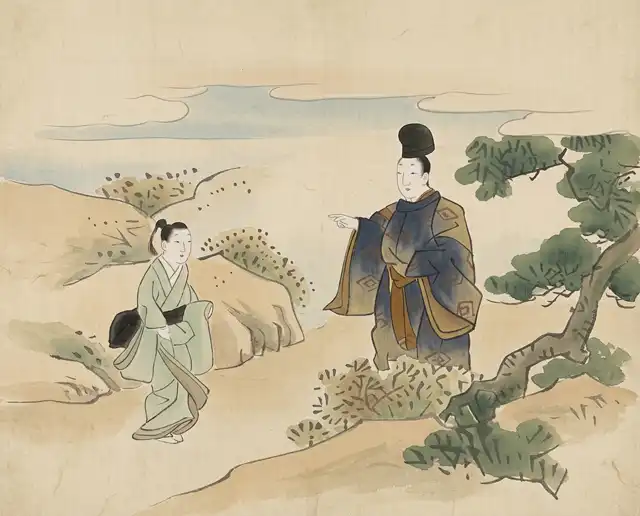
This image is based on an illustration from William N. Porter's A Hundred Verses from Old Japan, his 1909 English translation of the Hyakunin Isshu published in England, colorized and reworked using Adobe Firefly (generative AI).
- Fujiwara no Sadakata (Minister of the Right of Sanjō): A Short Timeline
-
- 873
- Born as a son of Fujiwara no Takafuji
- 892
- Becomes a palace guard (Udoneri)
- 909
- Becomes Councillor (Sangi)
- 920
- Becomes Upper Counselor
- 924
- Becomes Minister of the Right
- 926
- Given Junior Second Rank
- 932
- Dies; later given Junior First Rank
- The Minister of the Right of Sanjō's Family Tree
-
The Minister of the Right of Sanjō belonged to the Northern House of the Fujiwara and was a son of Fujiwara no Takafuji. His real name was Fujiwara no Sadakata. His elder or younger sister with the same mother, Taneko, was a consort of Emperor Uda. Sadakata is thought to have risen as high as Minister of the Right because he was a relative of Emperor Daigo through Daigo's mother.
Sadakata's fifth son, Middle Counselor Asatada, also has a poem in the Hyakunin Isshu. A famous story says that he was a big eater: the doctor told him to eat rice with hot or cold water poured over it, but he ate so much of it that it did no good.
However, in the Konjaku Monogatarishū of the late Heian period, the hero of this story was originally Fujiwara no Asahira, Sadakata's sixth son. The author of Hyakunin Isshu Yūwa, written in the late Edo period, seems to have mixed up the two men and told it as a story about the poet Middle Counselor Asatada.
Sadakata's great-grandchildren include Minamoto no Tomoko, Fujiwara no Michinaga's wife, and Fujiwara no Nobutaka, Murasaki Shikibu's husband.
He and Fujiwara no Kanesuke (Murasaki Shikibu's great-grandfather) were cousins. Both served Emperors Uda and Daigo and helped make the poetry world of the court flourish.
- Appendix
-
- A Poem That Also Begins "Na ni shi owaba"
- Here is another famous poem that begins "Na ni shi owaba."
Ariwara no Narihira wrote it in a boat on the Sumida River, and it appears in "The Journey East" in The Tales of Ise. Later, a dumpling shop on a nearby street began selling Kototoi Dango, named after this poem. The dumplings became popular, and it is said that the nearby bridge was named Kototoi Bridge and the nearby street Kototoi Street. By the way, the miyakodori is the black-headed gull, which is now known as the official bird of Tokyo.In Japanese
名にし負はば いざ言問はむ 都鳥
わが思ふ人は ありやなしやと nanishiohaba izakototohamu miyakodori
wagaomofuhitoha ariyanashiyato The Tales of Ise, Ariwara no Narihira
In English
Bird of the capital,
if you are true to your name, tell me:
is the one I love in the capital
still well, or not?