Front of the Card
Back of the Card
Japanese
English
Audio: NHK Creative Library
Read by LibriVox volunteer Larry Wilson.
Audio courtesy of LibriVox
中納言朝忠
逢ふことの
絶えてしなくは
なかなかに
人をも身をも
恨みざらまし
ひとをもみ
をもうらみ
さらまし

おうこ


- Poem 44
- 逢ふことの
絶えてしなくは
なかなかに
人をも身をも 恨みざらまし
Author: Middle Counselor Asatada (910–967)
Source: Shūi Wakashū, Love
- English Verse Translation
- To fall in love with womankind Is my unlucky fate; If only it were otherwise, I might
appreciate Some men, whom now I hate.
— William N. Porter, 1909
- Modern Translation
- If there were no meetings at all, I would not have to suffer. It is because we meet that parting brings such pain.
- Commentary
- Written for the Tentoku palace poetry contest. It can be read as "love not yet met" or as "love met, then lost." In the second reading, after a happy meeting she turned cold, and he regrets ever meeting her, yet still cannot forget their time together.
- About the Poet
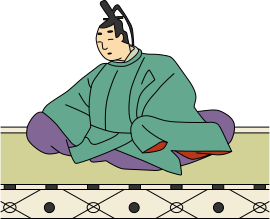
- Fujiwara no Asatada was the fifth son of Fujiwara no Sadakata, the Minister of the Right of Sanjō and rose to Middle Counselor. Besides poetry, he was a master of the shō, a wind instrument. His granddaughter Tomoko became the wife of Fujiwara no Michinaga.
- Poem Illustration
-
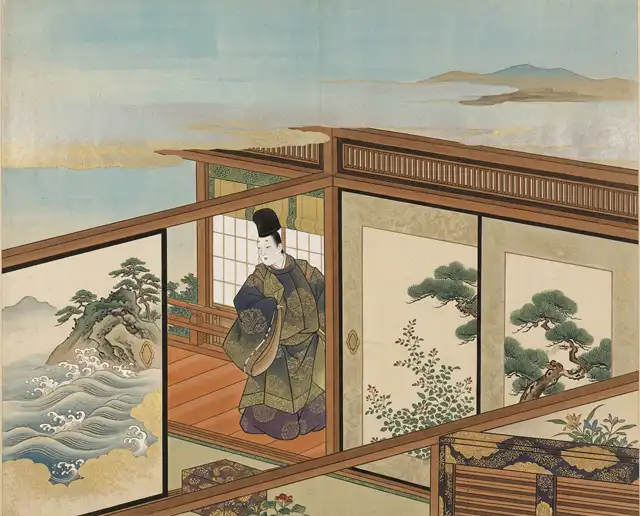
This image is based on an illustration from William N. Porter's A Hundred Verses from Old Japan, his 1909 English translation of the Hyakunin Isshu published in England, colorized and reworked using Adobe Firefly (generative AI).
- Fujiwara no Asatada: A Short Timeline
-
- 910
- Born as a son of Fujiwara no Sadakata
- 926
- Given Junior Fifth Rank, Lower Grade
- 952
- Becomes Councillor (Sangi)
- 963
- Becomes Middle Counselor
- 967
- Dies
- Notes
-
- Counted as one of the Thirty-Six Immortal Poets
- Middle Counselor Asatada's Family Tree
-
Fujiwara no Asatada was the fifth son of the Minister of the Right of Sanjō (Fujiwara no Sadakata). His granddaughter Tomoko became the principal wife of Fujiwara no Michinaga. He was one of the Thirty-Six Immortal Poets and a master of the shō.
Asatada's Hyakunin Isshu poem was written at the Palace Poetry Contest of the Tentoku Era, the same contest where the poems of Taira no Kanemori (Poem 40) and Mibu no Tadami (Poem 41) were written.
- Appendix
-
- The Shō
-
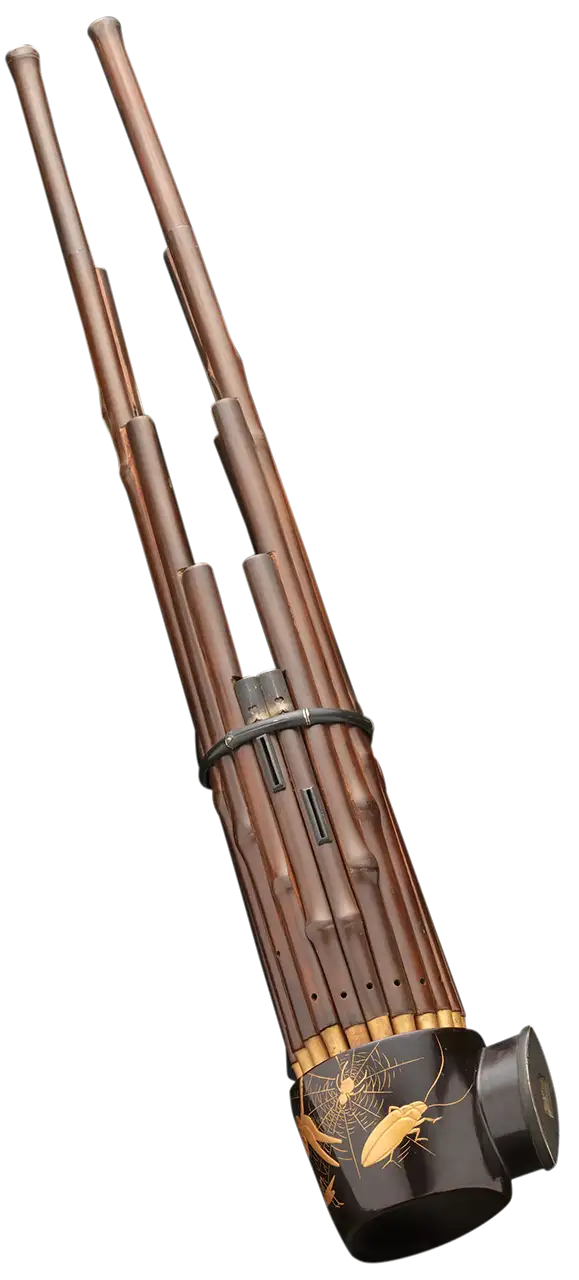
Metropolitan Museum of Art, Public domain A wind instrument used in gagaku (court music). Seventeen thin bamboo pipes are set in a circle, and the player holds it upright to play.
The shō in this photo was made in the 19th century, so it may be a little different from those of the Heian period.
Asatada was a master of the shō. Click the play button to hear its sound.
Pocket Sound (sound effects) - Utagawa Kuniyoshi's Hyakunin Isshu no Uchi
-
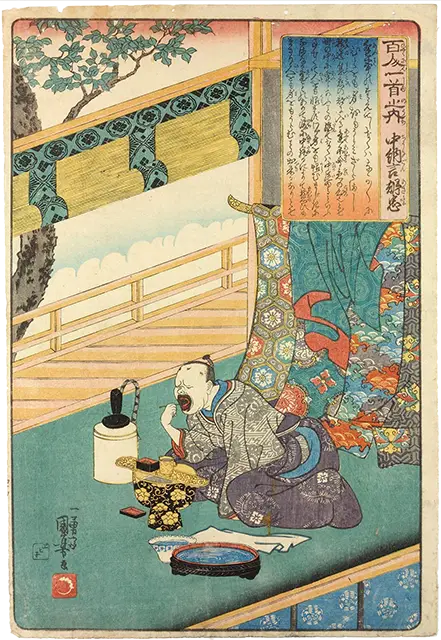
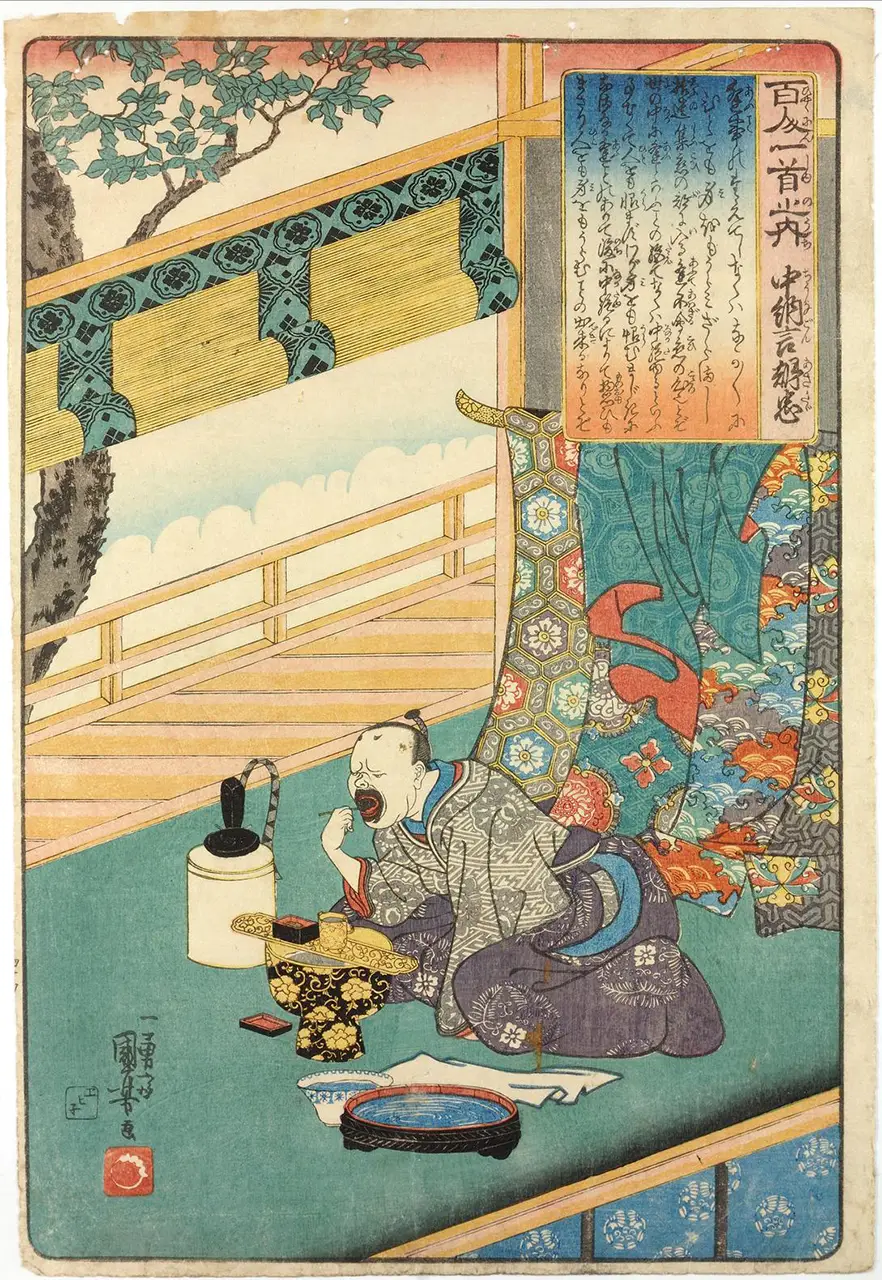
British Museum, Public domain, via Wikimedia Commons This ukiyo-e print is by Utagawa Kuniyoshi, an artist of the Edo period.
It shows a scene to go with the Hyakunin Isshu poem.
It shows someone blackening their teeth (ohaguro).
We can only wonder what Kuniyoshi meant by it.