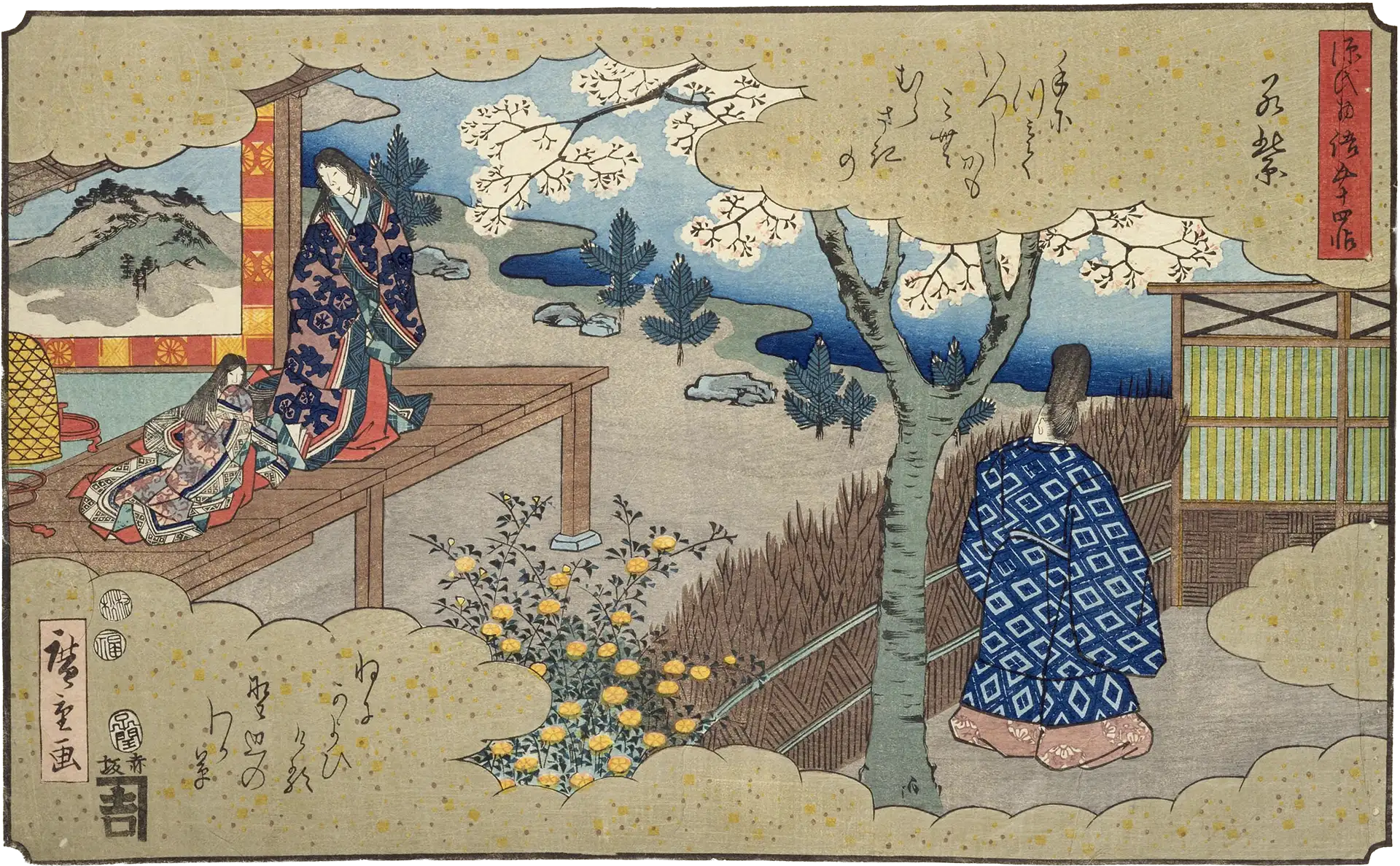
Front of the Card
Back of the Card
Japanese
English
Audio: NHK Creative Library
Read by LibriVox volunteer Larry Wilson.
Audio courtesy of LibriVox
中納言兼輔
みかの原
わきて流るる
いづみ川
いつ見きとてか
恋しかるらむ
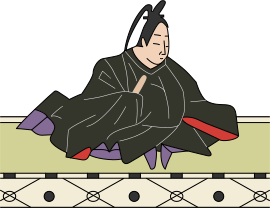
いつみきと
てかこひし
かるらむ

みかの


- Poem 27
- みかの原
わきて流るる
いづみ川
いつ見きとてか 恋しかるらむ
Author: Middle Counselor Kanesuke (877–933)
Source: Shin Kokin Wakashū, Love
- English Verse Translation
- Oh! rippling River Izumi, That flows through Mika plain, Why should the maid I saw but now
And soon shall see again Torment my love-sick brain?
— William N. Porter, 1909
- Modern Translation
- Like the Izumi River that wells up and flows through Mika Plain — when did I first see you, that I should long for you so?
- Commentary
- Loving a woman you have never met seems strange today, but Heian nobles rarely saw each other, so people did fall in love from a glimpse or from rumors. Mika Plain lies on the north bank of the Kizu River in southern Kyoto; Izumi River is the river's old name.
- About the Poet
- Fujiwara no Kanesuke was Murasaki Shikibu's great-grandfather. He supported the poets Ki no Tsurayuki and Ōshikōchi no Mitsune. Because his home stood by the bank (tsutsumi) of the Kamo River, he was called the "Tsutsumi Middle Counselor."
- Poem Illustration
-
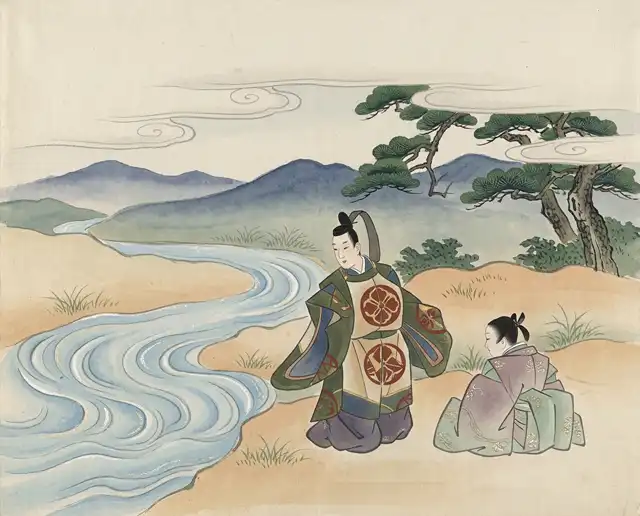
This image is based on an illustration from William N. Porter's A Hundred Verses from Old Japan, his 1909 English translation of the Hyakunin Isshu published in England, colorized and reworked using Adobe Firefly (generative AI).
- Fujiwara no Kanesuke: A Short Timeline
-
- 877
- Born
- 898
- Becomes an acting official of Sanuki Province
- 917
- Becomes Head Chamberlain (Kurōdo no Tō)
- 921
- Becomes Councillor (Sangi)
- 927
- Given Junior Third Rank and becomes Acting Middle Counselor
- 930
- Becomes Middle Counselor and Commander of the Right Gate Guards
- 933
- Dies
- Notes
-
- Counted as one of the Thirty-Six Immortal Poets
- Middle Counselor Kanesuke's Family Tree
-
Fujiwara no Kanesuke belonged to the Northern House of the Fujiwara. He had a daughter named Kuwako. When she was to enter the palace as a kōi (a lower-ranking consort) of Emperor Daigo, he sent the emperor a poem expressing his feelings for her. His great-granddaughter was Murasaki Shikibu, author of The Tale of Genji. Murasaki Shikibu's daughter was Daini no Sanmi (Fujiwara no Kataiko), and both mother and daughter have poems in the Hyakunin Isshu.
- Appendix
-
- Who Really Wrote Kanesuke's Hyakunin Isshu Poem?
- In the Shin Kokin Wakashū this poem is credited to Fujiwara no Kanesuke, but in the Kokin Wakashū it is listed as anonymous (author unknown). It is also not in Kanesuke-shū, his personal poetry collection, so one theory says Kanesuke did not actually write his Hyakunin Isshu poem.
- A Poem by Ariwara no Narihira
- Ariwara no Narihira sent a love poem to a woman whose face he had glimpsed only a little in an ox carriage.
In Japanese
見ずもあらず 見もせぬ人の 恋しくは
あやなく今日や ながめくらさむ mizumoarazu mimosenuhitono koishikuha
ayanakukefuya nagamekurasamu Kokin Wakashū, Ariwara no NarihiraIn English
I can't say I didn't see your face, nor that I saw it clearly, yet I long for you, and today I will spend the whole day lost in thought for no reason.
- A Poem by Ki no Tsurayuki
- Ki no Tsurayuki, too, sent a love poem to a woman he had seen only for a moment.
In Japanese
山桜 霞の間より ほのかにも
見てし人こそ 恋しかりけれ yamazakura kasuminomayori honokanimo
miteshihitokoso koishikarikere Kokin Wakashū, Ki no TsurayukiIn English
Like mountain cherry blossoms glimpsed faintly through the mist,
the one I saw only faintly is the one I long for. - A Nobleman Peeking Through a Fence
-
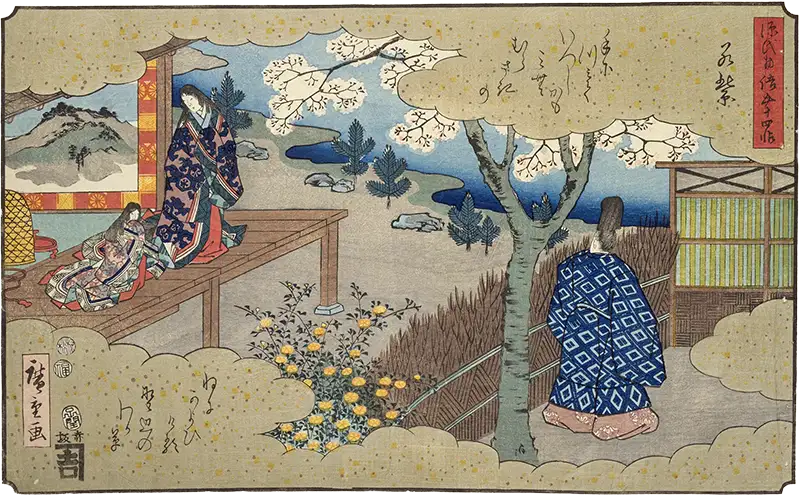
National Diet Library, Public domain, via Wikimedia Commons This ukiyo-e shows a scene from "Wakamurasaki" in The Tale of Genji. A Heian nobleman is looking at a woman on the other side of a fence.
In the Heian period, men and women could not easily meet face to face, so men fell in love by quietly peeking at women through gaps in bamboo blinds or fences.
- A Poem Written in Worry for a Daughter
Entering the Palace - Kanesuke sent the next poem to Emperor Daigo, worrying about his daughter Kuwako, who was entering the palace as a kōi (a lower-ranking consort) of the emperor.
Kanesuke's great-granddaughter Murasaki Shikibu quoted this poem many times in The Tale of Genji.In Japanese
人の親の 心は闇に あらねども
子を思ふ道に まどひぬるかな hitonooyano kokorohayamini aranedomo
kooomofumichini madohinurukana Gosen Wakashū, Fujiwara no KanesukeIn English
A parent's heart is not darkness itself,
yet on the path of caring for a child, it loses its way as if in the dark. - Tsutsumi Chūnagon
- There is a collection of short stories from the Heian period called Tsutsumi Chūnagon Monogatari (The Tales of the Tsutsumi Middle Counselor), but it has nothing to do with Fujiwara no Kanesuke, who was called "Tsutsumi Chūnagon," and no character called "Tsutsumi Chūnagon" appears in the stories. Because it is a collection of short stories, the separate stories were wrapped (tsutsumu) together so they would not come apart. It is thought that this is why it was called "the wrapped tales" and later came to be known as Tsutsumi Chūnagon Monogatari.
- Mikanohara, Kuni-no-miya, and Yamashiro Kokubun-ji
-
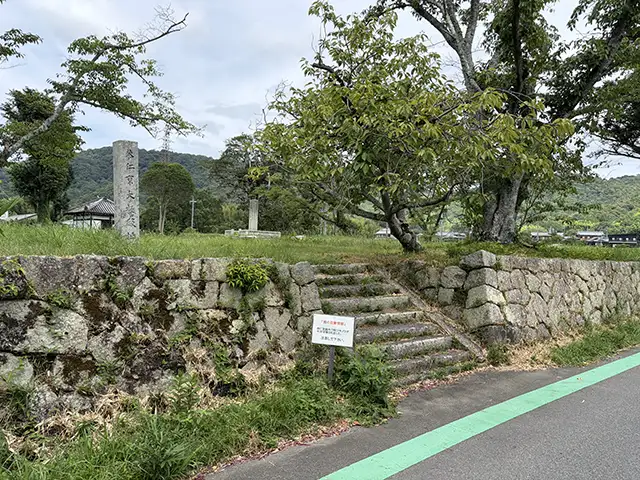
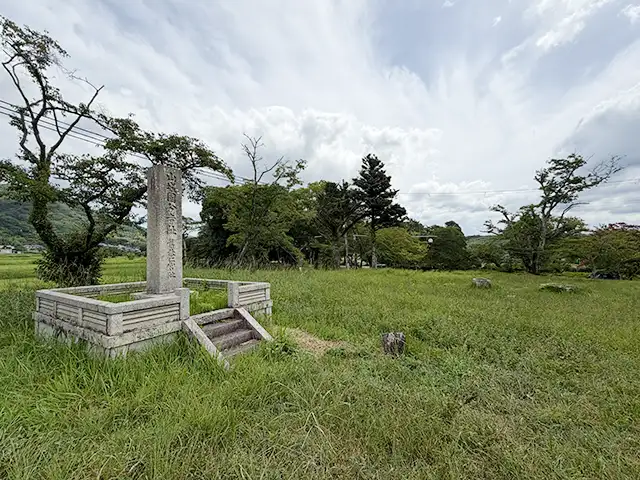
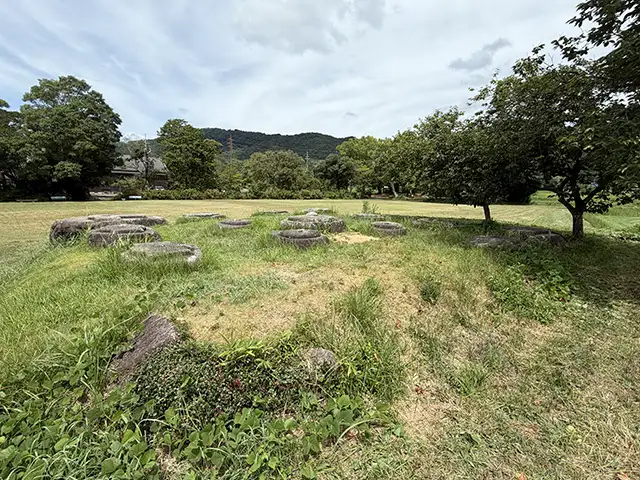
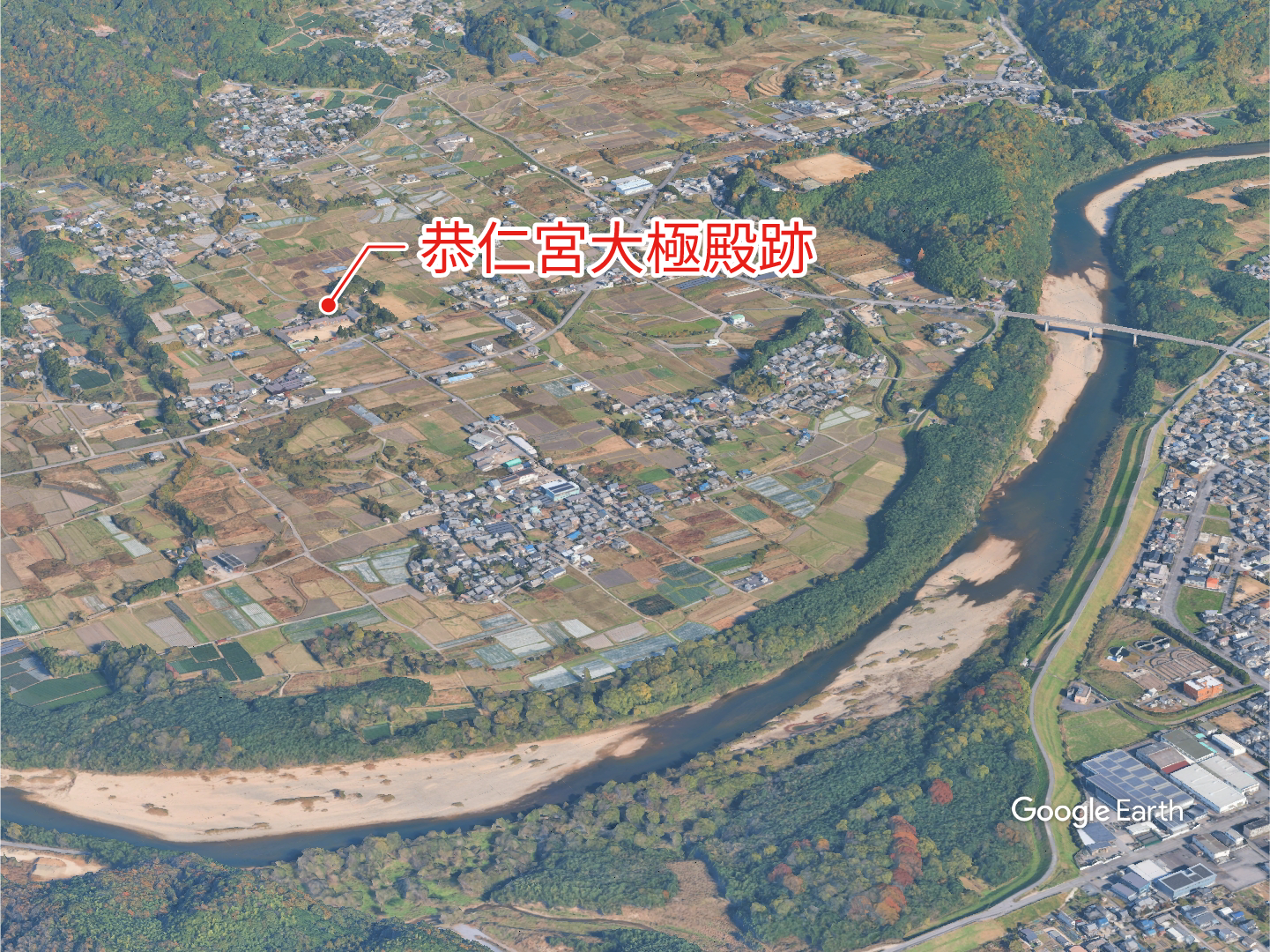
Mikanohara, the place named in the poem, is an area in what is now Kamo-chō, Kizugawa City, Kyoto Prefecture. In 740, in the Nara period, Emperor Shōmu moved the capital here and built the Kuni-no-miya palace. The palace served its purpose for only about four years, and the center of the palace site was later reborn as Yamashiro Kokubun-ji, a provincial temple.
No buildings remain today, so at first glance it looks like a wide field, but foundation stones are still left where buildings once stood. These stones, in the quiet landscape, tell us that a capital and a provincial temple once stood here.
(Photos taken August 11, 2026)