


Front of the Card
Back of the Card
Japanese
English
Audio: NHK Creative Library
Read by LibriVox volunteer Larry Wilson.
Audio courtesy of LibriVox
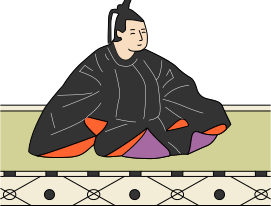
紀貫之
人はいさ
心も知らず
ふるさとは
花ぞ昔の
香に匂ひける
はなそむか
しのかにに
ほひける

ひとは


- Poem 35
- 人はいさ
心も知らず
ふるさとは
花ぞ昔の 香に匂ひける
Author: Ki no Tsurayuki (c. 868–945)
Source: Kokin Wakashū, Spring
- English Verse Translation
- The village of my youth is gone, New faces meet my gaze; But still the blossoms at thy gate,
Whose perfume scents the ways, Recall my childhood's days.
— William N. Porter, 1909
- Modern Translation
- I cannot know what is in your heart. But here in the old village, the plum blossoms still carry the same fragrance as before.
- Commentary
- The Kokin Wakashū says Ki no Tsurayuki returned after a long absence to the inn where he used to stay on visits to Hase. The innkeeper teased him: "The inn has been here all along." He picked a plum blossom nearby and wrote this poem in reply. Whether the innkeeper was a man or a woman is unknown.
- About the Poet
- Ki no Tsurayuki wrote the Japanese preface to the Kokin Wakashū and the Tosa Diary, an account of his trip home after serving as a provincial governor. Written in kana as if by a woman, the diary greatly influenced later women writers.
- Poem Illustration
-
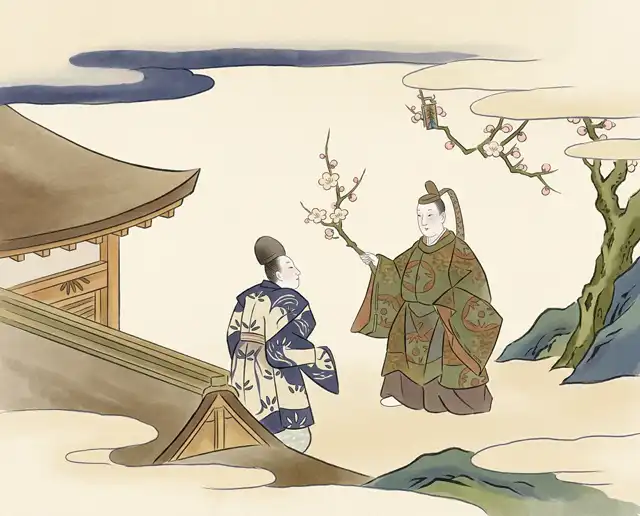
This image is based on an illustration from William N. Porter's A Hundred Verses from Old Japan, his 1909 English translation of the Hyakunin Isshu published in England, colorized and reworked using Adobe Firefly (generative AI).
- Ki no Tsurayuki: A Short Timeline
-
- c. 868
- Born
- c. 893
- Takes part in the Poetry Contest at the Home of Prince Koresada
- 905
- Compiles the Kokin Wakashū at Emperor Daigo's order
- 930
- Becomes governor of Tosa Province
- c. 935
- Returns to the capital from Tosa
Around this time, writes the Tosa Diary - 943
- Given Junior Fifth Rank, Upper Grade
- 945
- Becomes Acting Head of the Carpentry Office; dies around this time
- Notes
-
- Wrote the Japanese preface to the Kokin Wakashū
- Counted as one of the Thirty-Six Immortal Poets
- Ki no Tsurayuki's Family Tree
-
Ki no Tsurayuki is said to have come from the Ki clan, an ancient powerful family whose ancestor was Takeuchi no Sukune, a legendary statesman. In the Heian period, as the Fujiwara grew stronger, the political power of the Ki clan gradually weakened. So Tsurayuki's rank was never high.
But Tsurayuki excelled at waka, and at the order of Emperor Daigo he served as a compiler of the Kokin Wakashū together with his cousin Ki no Tomonori, Mibu no Tadamine, and Ōshikōchi no Mitsune. Tsurayuki also wrote the Kana Preface, which explains that waka expresses the human heart. Ki no Tomonori is thought to have died before the Kokin Wakashū was completed.
Tsurayuki also served in a series of provincial posts. After serving as Governor of Tosa, he wrote The Tosa Diary, an account in kana of his boat journey back to Kyoto, pretending to be a woman. The Tosa Diary is said to have had a great influence on later Japanese literature.
His final rank, Junior Fifth Rank, Upper Grade, was not high at all, but he contributed greatly to the growth of waka and kana culture.
- Appendix
-
Timeline of Ki no Tsurayuki
(Click to open or close.)Ki no Tsurayuki is born
Born the son of Ki no Mochiyuki.
Becomes a compiler of the Kokin Wakashū
At Emperor Daigo's order, he compiled and presented the Kokin Wakashū, Japan's first imperial anthology of waka, together with Ki no Tomonori, Mibu no Tadamine, and Ōshikōchi no Mitsune. Tsurayuki took the lead among them. He wrote the Kana Preface to the Kokin Wakashū and is thought to have been a driving force behind the waka boom.
Given Junior Fifth Rank, Lower Grade
He was given Junior Fifth Rank, Lower Grade, and appointed Assistant Governor of Kaga.
Becomes Governor of Tosa
and compiles the Shinsen WakaJust before leaving for the province of Tosa, he was ordered by Emperor Daigo to compile the Shinsen Waka, a selection of poems.
He finished it while in Tosa, but by the time he returned to the capital, Emperor Daigo had died, so he could not present it.Writes The Tosa Diary
He returned to the capital from Tosa and wrote The Tosa Diary about the 50-day journey home, presented as if a woman had written it in hiragana.
Ki no Tsurayuki dies
His highest rank and post were Junior Fifth Rank, Upper Grade, and Acting Head of the Carpentry Bureau.
- The Innkeeper's Reply
- The master of the house answered Ki no Tsurayuki's Hyakunin Isshu poem with this reply.
In Japanese
花だにも 同じ心に 咲くものを
植ゑけむ人の 心知らなむ hanadanimo onajikokoroni sakumonoo
uekemuhitono kokoroshiranamu Kokin Wakashū, author unknownIn English
Even the plum blossoms bloom with the same heart as before,
so please understand the heart of the one who planted them, too. - A Poem Blaming a Man for His Change of Heart
-
The next poem is in Ki no Tsurayuki's personal collection. It is said to have been written by a woman blaming Tsurayuki for his change of heart. People have long known that bush clover changes color from its lower leaves first, and the poem compares that "changing color" to a man whose feelings have changed.
In Japanese
秋萩の 下葉につけて 目に近く
よそなる人の 心をぞ見る akihagino shitabanitsukete menichikaku
yosonaruhitono kokoroozomiru Tsurayuki-shū, Ki no TsurayukiIn English
Each time I see the lower leaves of the autumn bush clover changing color, I realize how your heart, though you are right before my eyes, has grown distant and changed completely.
- Tsurayuki's Poem Reworked in The Tale of Genji
-
The next poem borrows from Ki no Tsurayuki's poem above, "Akihagi no shitaba ni tsukete...," and appears in "Wakana I," the 34th chapter of The Tale of Genji. Lady Murasaki, deeply loved by Hikaru Genji for many years, wrote it in her sorrow when Genji told her he would take the much younger Third Princess as his principal wife.
In Japanese
目に近く 移れば変はる 世の中を
行く末遠く 頼みけるかな menichikaku utsurebakaharu yononakao
yukusuetooku tanomikerukana The Tale of Genji, Lady MurasakiIn English
I have watched love between men and women change before my eyes, and yet I trusted that you would stay with me far into the future.
- A Poem That Appeared in Episode 23 of Hikaru Kimi e
- It is recited in a scene where Emperor Ichijō talks about his memories of Empress Teishi. The poem is in the Kokin Wakashū.
In Japanese
夢路にも 露やおくらむ 夜もすがら
かよへる袖の ひちて乾かぬ yumejinimo tsuyuyaokuramu yomosugara
kayoherusodeno hichitekawakanu Kokin Wakashū, Ki no TsurayukiIn English
Does dew fall even on the path of dreams that leads to you?
My sleeves, which travel it all night, are wet and never dry. - A Poem About Cherry Blossoms Beginning to Bloom
- The next poem sees mountain cherry blossoms that have just begun to bloom as white clouds.
In Japanese
桜花 咲きにけらしな あしひきの
山の峡より 見ゆる白雲 sakurabana sakinikerashina ashihikino
yamanokaiyori miyurushirakumo Kokin Wakashū, Ki no TsurayukiIn English
The cherry blossoms seem to have bloomed.
White clouds can be seen between the mountains. - A Poem About Falling Cherry Blossoms
- The next poem sees falling cherry petals as snow.
In Japanese
桜散る 木の下風は 寒からで
空に知られぬ 雪ぞ降りける sakurachiru konoshitakazeha samukarade
soranishirarenu yukizofurikeru Kokin Wakashū, Ki no TsurayukiIn English
The wind under the cherry trees, where the petals fall, is not cold,
yet a snow the sky has never known is falling. - A Poem About the Fickle Human Heart
-
This poem by Ki no Tsurayuki is in the Kokin Wakashū.
Its headnote says he wrote it when someone said, "Nothing falls as quickly as cherry blossoms."In Japanese
桜花 とくちりぬとも 思ほえず
人の心ぞ 風も吹きあへぬ sakurabana tokuchirinutomo omohoezu
hitonokokorozo kazemofukiahenu Kokin Wakashū, Ki no TsurayukiIn English
I don't think cherry blossoms fall so quickly.
The human heart changes before the wind has even finished blowing. - His Farewell Poem
- The next poem is Ki no Tsurayuki's death poem, found in his personal collection, Tsurayuki-shū.
Knowing he was dying of illness, he is said to have sent it to his friend Minamoto no Kintada.In Japanese
手に結ぶ 水に宿れる 月影の
有るか無きかの 世にこそありけれ tenimusubu mizuniyadoreru tsukikageno
arukanakikano yonikosoarikere Tsurayuki-shū, Ki no TsurayukiIn English
Like the moon reflected in water scooped up in my hands, this world is so fleeting that one can hardly tell if it is there or not.
- A Poem by Ki no Tsurayuki's Daughter
- The story "Ōshukubai" ("The Plum Tree Where the Warbler Lodges") in the Ōkagami includes a poem by Ki no Tsurayuki's daughter.
When the plum tree planted in front of the Shishinden hall died, Emperor Murakami was very sorry and ordered that a plum tree just as beautiful be found somewhere in the capital. After a while, such a tree was finally found in the capital, and it was to be planted at the Shishinden. The tree had stood at the house of Ki no Tsurayuki, the famous poet of earlier days, and a poem was tied to one of its branches. The poem was by Tsurayuki's daughter, Ki no Naishi. Emperor Murakami was moved by the poem and ordered the tree returned.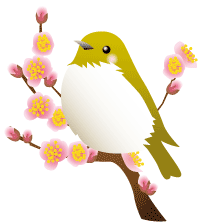
In Japanese
勅なれば いともかしこし
鶯の
宿はと問わば
いかが答へむ chokunareba itomokashikoshi uguhisuno
yadohatotowaba ikagakotahemu Ōkagami, Ki no NaishiIn English
Since it is the emperor's order, I humbly offer this tree. But if the warbler that comes to the plum tree asks, "Where is my lodging?", how should I answer?
- The Kana Preface (Kanajo)
- The preface to the Kokin Wakashū written in kana (the Japanese syllabary), as opposed to the preface written in Chinese.
- Changing Tastes in Flowers
- Until the Nara period, plum blossoms were the most popular, but from the Heian period on, cherry blossoms became more popular.