


Front of the Card
Back of the Card
Japanese
English
Audio: NHK Creative Library
Read by LibriVox volunteer Larry Wilson.
Audio courtesy of LibriVox
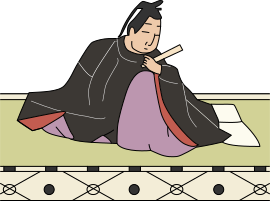
凡河内躬恒
心当てに
折らばや折らむ
初霜の
おきまどはせる
白菊の花
おきまとは
せるしらき
くのはな

こころあ


- Poem 29
- 心当てに
折らばや折らむ
初霜の
おきまどはせる 白菊の花
Author: Ōshikōchi no Mitsune (c. 859–c. 925)
Source: Kokin Wakashū, Autumn
- English Verse Translation
- It was a white chrysanthemum I came to take away; But, which are coloured, which are white,
I'm half afraid to say, So thick the frost to-day!
— William N. Porter, 1909
- Modern Translation
- Shall I pick it or not? The white chrysanthemum lies hidden beneath the first frost, and I cannot tell them apart.
- Commentary
- The meaning depends on "kokoro ate ni." Read as "by guessing," the poem says the white chrysanthemums are hard to tell from the first frost. Read as "with care," it says: how could I pick such a beautiful white chrysanthemum?
- About the Poet
- Ōshikōchi no Mitsune held only a low rank but was known for his great skill at nature poems. He was ranked with Ki no Tsurayuki as one of the best poets of his time and was chosen as a compiler of the Kokin Wakashū.
- Poem Illustration
-
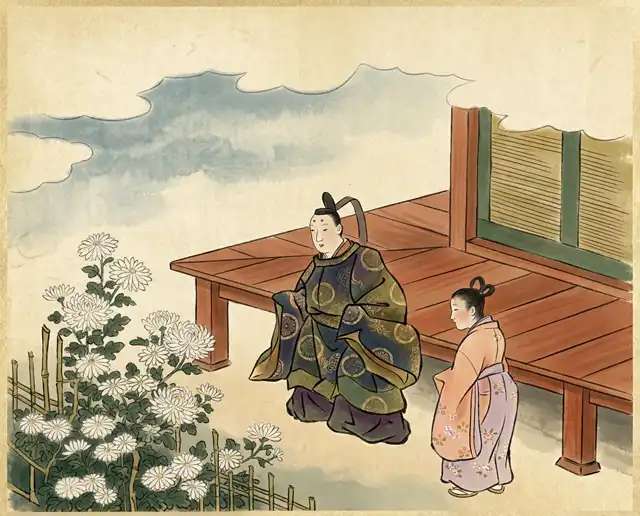
This image is based on an illustration from William N. Porter's A Hundred Verses from Old Japan, his 1909 English translation of the Hyakunin Isshu published in England, colorized and reworked using Adobe Firefly (generative AI).
- Ōshikōchi no Mitsune: A Short Timeline
-
- c. 859
- Born
- 894
- Becomes a junior official of Kai Province
- 905
- Chosen with Ki no Tsurayuki and others to compile the Kokin Wakashū
- 907
- Becomes an official of Tanba Province
- 916
- Writes poems while traveling with Retired Emperor Uda to Ishiyama-dera Temple
- 921
- Becomes an official of Awaji Province
- c. 925
- Dies
- Notes
-
- Counted as one of the Thirty-Six Immortal Poets
- Ōshikōchi no Mitsune's Family Tree
-
Ōshikōchi no Mitsune was one of the compilers of the Kokin Wakashū, together with Ki no Tomonori, Ki no Tsurayuki, and Mibu no Tadamine.
His rank was not high, and he served in a series of provincial posts in Kai, Tanba, Izumi, Awaji, and elsewhere.
He is said to have been a close friend of Ki no Tsurayuki and to have visited the house of Fujiwara no Kanesuke, who supported him.
- Appendix
-
- The Chrysanthemum Festival
- Chrysanthemums are said to have come to Japan from China in the Nara period. They first arrived as medicinal plants, but later became popular at court as flowers to enjoy. At the Heian court, the custom of the Chōyō no Sekku (the Chrysanthemum Festival on the ninth day of the ninth month) came from China, and chrysanthemums often appeared in waka.
- The Compilers of the Kokin Wakashū
-
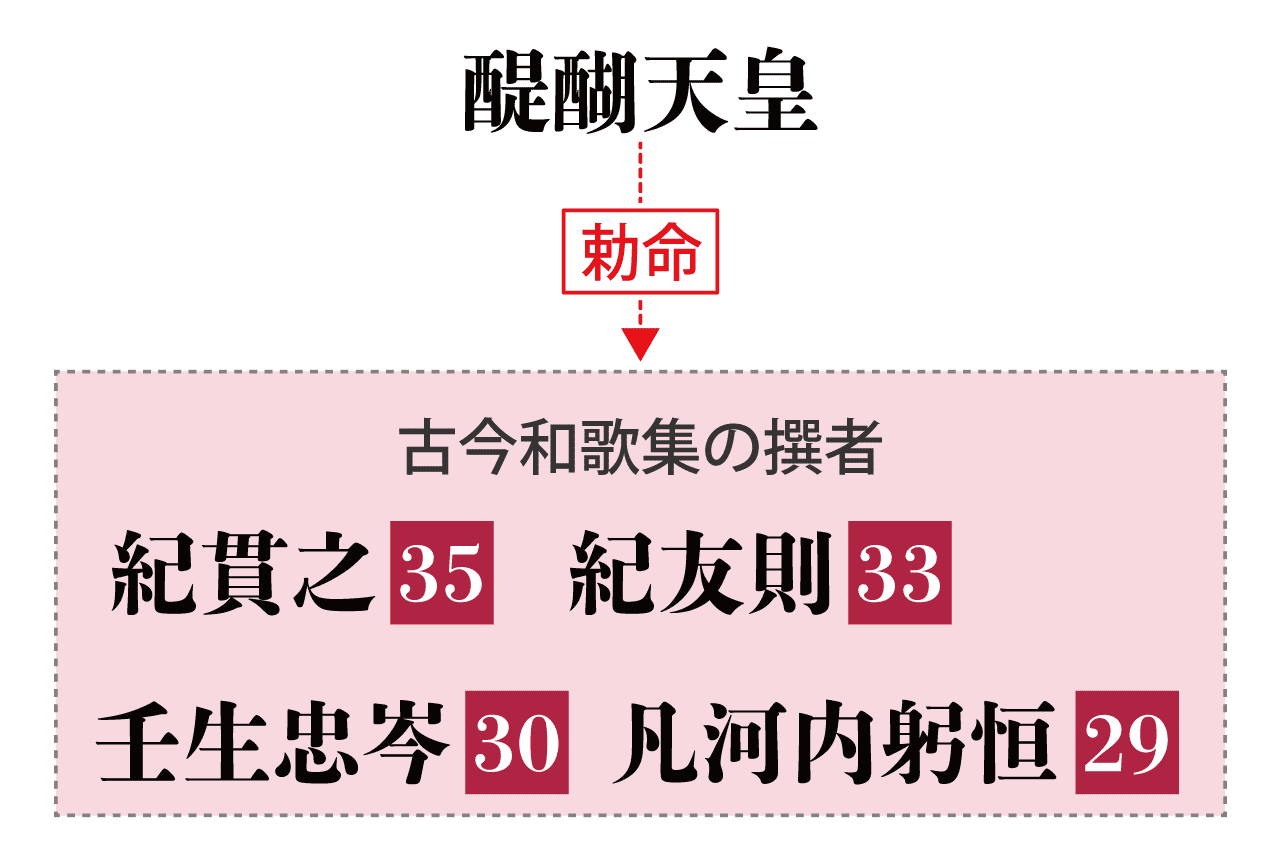
Click a poet marked with a ■number to go to that poet's page.
The Kokin Wakashū was the first imperial anthology of waka, compiled at the order of Emperor Daigo. Four poets, Ki no Tsurayuki, Ki no Tomonori, Mibu no Tadamine, and Ōshikōchi no Mitsune, served as its compilers and gathered about 1,100 poems, including poems not in the Man'yōshū and poems of their own time. It was completed around 913, but Ki no Tomonori died before it was finished.
- A Poem Worrying About a Small Child Growing Up
-
Mitsune wrote the next poem when he saw a small child while he was troubled by something.
In Japanese
今更に なに生ひいづらむ 竹の子の
憂き節しげき 世とは知らずや imasarani naniohiizuramu takenokono
ukifushishigeki yotohashirazuya Kokin Wakashū, Ōshikōchi no MitsuneIn English
Why, now of all times, should you grow up in this sad world, shooting up like a bamboo shoot, little one? Don't you know this world is full of painful times, as a bamboo is full of joints (fushi)?
- Poems About the Scent of Plum Blossoms
-
The next two poems by Ōshikōchi no Mitsune are both in the Kokin Wakashū.
They describe the scent of plum blossoms on spring nights.In Japanese
春の夜の 闇はあやなし 梅の花
色こそ見えね 香やはかくるる harunoyono yamihaayanashi umenohana
irokosomiene kayahakakururu Kokin Wakashū, Ōshikōchi no MitsuneIn English
The darkness of a spring night makes no sense.
It hides the color of the plum blossoms, but can it hide their scent?In Japanese
月夜には それとも見えず 梅の花
香をたづねてぞ 知るべかりける tsukiyoniha soretomomiezu umenohana
kaotazunetezo shirubekarikeru Kokin Wakashū, Ōshikōchi no MitsuneIn English
On a moonlit night, the plum blossoms can hardly be seen,
but if you follow their scent, you can find where they bloom. - A Poem in The Tale of Genji That Begins "Kokoroate ni"
-
The next poem appears in "Yūgao," the fourth chapter of The Tale of Genji.
On his way to visit his sickly old nurse, Hikaru Genji notices yūgao (moonflowers) blooming at the house next door and tells his attendant to go and pick one. A little girl comes out of that house, holds out a fan scented with incense, and says that since the flowers are so delicate, he should place one on the fan to present it. This poem was written on the fan. The word kokoroate ("guessing") is used in a scene about picking a flower, so it feels as if Murasaki Shikibu had Ōshikōchi no Mitsune's poem in mind.In Japanese
心あてに それかとぞ見る 白露の
光そへたる 夕顔の花 kokoroateni sorekatozomiru shiratsuyuno
hikarisohetaru yuugaonohana The Tale of Genji, "Yūgao"In English
It is only a guess, but I look and wonder if it is you,
this moonflower to which the white dew adds its light. - A Poem of White Flowers Lost in the Snow
-
The next poem, by Ki no Tomonori, is in the Kokin Wakashū.
It describes plum blossoms that cannot be told apart from the snow. It is similar to Ōshikōchi no Mitsune's poem, and the idea of white flowers mixing with snow seems to have been a popular way of writing poems at the time.In Japanese
雪降れば 木毎に花ぞ 咲きにける
いづれを梅と わきて折らまし yukifureba kigotonihanazo sakinikeru
izureoumeto wakiteoramashi Kokin Wakashū, Ki no TomonoriIn English
When snow falls, every tree seems to bloom with white flowers.
Since the snow and blossoms look alike, how can I tell which tree is the plum, to break off a branch? - Masaoka Shiki's Opinion
- In Letters to a Waka Poet (Utayomi ni Atauru Sho), Masaoka Shiki criticized Ōshikōchi no Mitsune's poem: "Because this poem by Mitsune is in the Hyakunin Isshu, everyone recites it, but it is a worthless poem, not worth a penny. Its idea is a lie: there is no danger of white chrysanthemums becoming invisible just because the first frost has fallen." This judgment is typical of Masaoka Shiki, who aimed for realism in waka. But mitate, the technique of seeing one thing as something else, developed in the age of the Kokin Wakashū.
- Priest Shun'e's Opinion
- In Mumyōshō, Priest Shun'e, the poet of Poem 85 in the Hyakunin Isshu, praised Mitsune highly as a poet without equal in the way he thought deeply about his subject before writing: "In truly thinking deeply into his words, Mitsune has no match." While Masaoka Shiki judged the wording of the poem itself, Shun'e focused on the poet's attitude toward his poems and the depth of his thought.