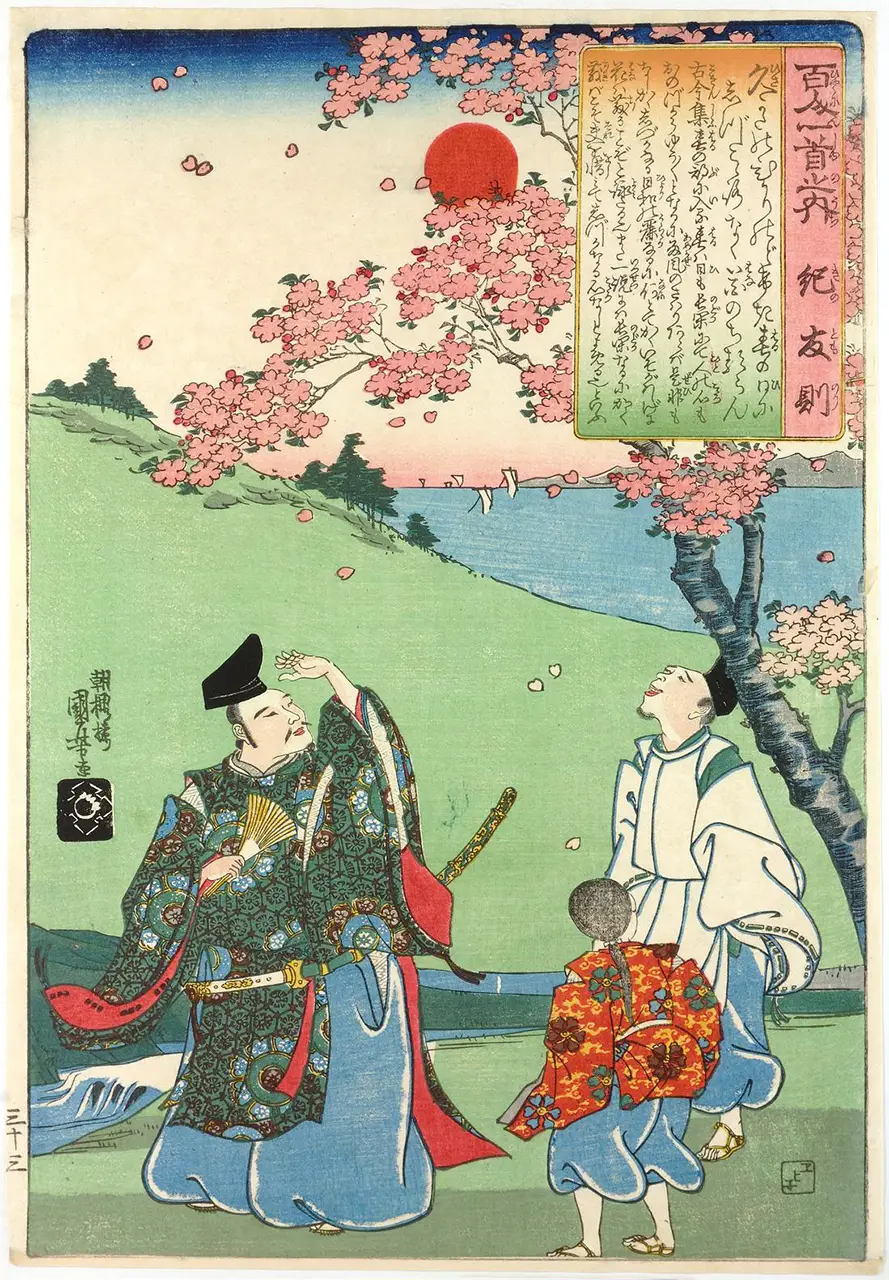
Front of the Card
Back of the Card
Japanese
English
Audio: NHK Creative Library
Read by LibriVox volunteer Larry Wilson.
Audio courtesy of LibriVox
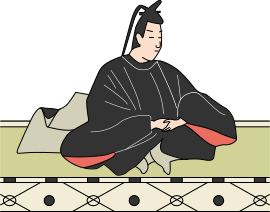
紀友則
久方の
光のどけき
春の日に
しづ心なく
花の散るらむ
しつこころ
なくはなの
ちるらむ

ひさ


- Poem 33
- 久方の
光のどけき
春の日に
しづ心なく 花の散るらむ
Author: Ki no Tomonori (c. 845–907)
Source: Kokin Wakashū, Spring
- English Verse Translation
- The spring has come, and once again The sun shines in the sky; So gently smile the heavens, that
It almost makes me cry, When blossoms droop and die.
— William N. Porter, 1909
- Modern Translation
- In the peaceful light of a spring day, why do the cherry blossoms scatter so restlessly?
- Commentary
- This was likely written for a contest on the theme "falling blossoms." On a calm, windless spring day the cherry blossoms still fall, and the poet asks why they hurry so, as if they had no peace of heart. It shows how quickly blossoms fade and the poet's gentle feeling as he watches.
- About the Poet
- Ki no Tomonori was a cousin of Ki no Tsurayuki. He was one of the compilers of the Kokin Wakashū but died before it was finished. His poems were highly praised, many appear in imperial anthologies, and he is one of the Thirty-Six Immortal Poets.
- Poem Illustration
-
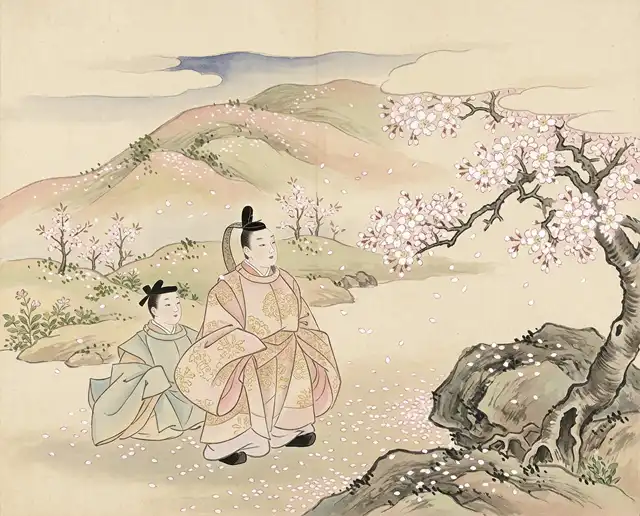
This image is based on an illustration from William N. Porter's A Hundred Verses from Old Japan, his 1909 English translation of the Hyakunin Isshu published in England, colorized and reworked using Adobe Firefly (generative AI).
- Ki no Tomonori: A Short Timeline
-
- c. 845
- Born
- 897
- Becomes an official of Tosa Province
- 898
- Becomes a junior palace secretary
- 904
- Becomes a senior palace secretary
- 905
- Chosen to compile the Kokin Wakashū
- 907
- Dies
- Notes
-
- Counted as one of the Thirty-Six Immortal Poets
- Ki no Tomonori's Family Tree
-
Ki no Tomonori was a cousin of Ki no Tsurayuki.
At the order of Emperor Daigo, Ki no Tomonori, Ki no Tsurayuki, Mibu no Tadamine, and Ōshikōchi no Mitsune served as the compilers of the Kokin Wakashū, but Tomonori died while it was still being compiled.
- Appendix
-
- A Poem About Plum Blossoms
-
Ki no Tomonori is famous for his Hyakunin Isshu poem about cherry blossoms, but he also wrote about plum blossoms.
The headnote in the Kokin Wakashū says, "Written when he broke off a branch of plum blossoms and sent it to someone."In Japanese
君ならで 誰に見せむ 梅の花
色をも香をも 知る人ぞ知る kiminarade tarenimisemu umenohana
iroomokaomo shiruhitozoshiru Kokin Wakashū, Ki no TomonoriIn English
Who else but you should I show these plum blossoms to?
Only you truly know the beauty of both their color and their scent. - A Poem About the Coming of Autumn
-
Ki no Tomonori wrote this poem based on the following Chinese story. Su Wu, an envoy of the Han dynasty, was held captive for a long time by the Xiongnu. The Xiongnu insisted that Su Wu was dead, but he tied a letter to the leg of a wild goose and let it fly, and the goose carried the letter to the capital, so he was able to return home safely.

In Japanese
秋風に 初雁が音ぞ 聞こゆなる
誰がたまづさを かけて来つらむ akikazeni hatsukariganezo kikoyunaru
tagatamazusao kaketekitsuramu Kokin Wakashū, Ki no TomonoriIn English
On the autumn wind I hear the cries of the first wild geese.
Whose letter have they brought with them? - Ki no Tsurayuki's Poem Mourning
Tomonori's Early Death -
Ki no Tomonori died while the Kokin Wakashū was still being compiled. His cousin Ki no Tsurayuki, grieving his death that came far too soon, wrote the next poem.
In Japanese
明日知らぬ 我が身と思へど
asushiranu wagamitoomohedo kurenumano
暮れぬ間の
今日は人こそ
かなしかりけれ
kyouhahitokoso kanashikarikere Kokin Wakashū, Ki no TsurayukiIn English
I do not know if I myself will live to see tomorrow, but today, while I am still alive, I cannot stop grieving for him.
- Utagawa Kuniyoshi's Hyakunin Isshu no Uchi
-
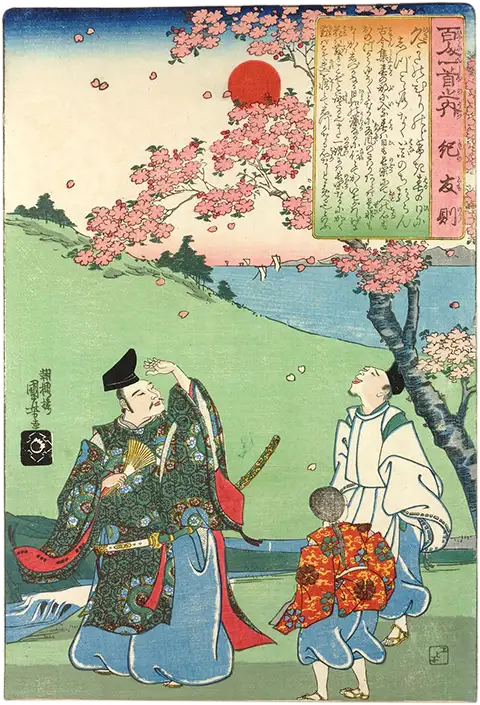
British Museum, Public domain, via Wikimedia Commons This ukiyo-e is by Utagawa Kuniyoshi, an artist of the Edo period.
It shows a scene that matches the poem in the Hyakunin Isshu. - The Kana Preface (Kanajo)
- The preface to the Kokin Wakashū written in kana (the Japanese syllabary), as opposed to the preface written in Chinese.
- Changing Tastes in Flowers
- Until the Nara period, plum blossoms were the most popular, but from the Heian period on, cherry blossoms became more popular.