Front of the Card
Back of the Card
Japanese
English
Audio: NHK Creative Library
Read by LibriVox volunteer Larry Wilson.
Audio courtesy of LibriVox
藤原敏行朝臣
住の江の
岸による波
よるさへや
夢のかよひ路
人目よくらむ
ゆめのかよ
ひちひとめ
よくらむ

す


- Poem 18
- 住の江の
岸による波
よるさへや
夢のかよひ路 人目よくらむ
Author: Fujiwara no Toshiyuki Ason (dates unknown–901)
Source: Kokin Wakashū, Love
- English Verse Translation
- To-night on Sumi-no-ye beach The waves alone draw near; And, as we wander by the cliffs,
No prying eyes shall peer, No one shall dream we're here.
— William N. Porter, 1909
- Modern Translation
- Even in my dreams, I find myself longing to go to you along the path of dreams — but do I hide from others' eyes even in the night?
- Commentary
- A woman waits for a lover who no longer visits. People then believed that if someone appeared in your dream, they were thinking of you. Not seeing him even in her dreams makes her feel unloved, a loneliness deeper than simply not meeting.
- About the Poet
- Fujiwara no Toshiyuki was a famous calligrapher. A tale in the Uji Shūi Monogatari says he copied the Lotus Sutra for many people but did so while "impure," after eating fish and being with women, and so fell into hell.
- Poem Illustration
-
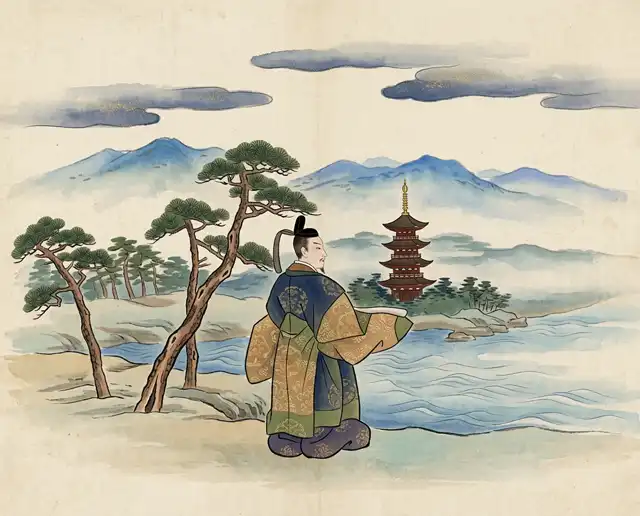
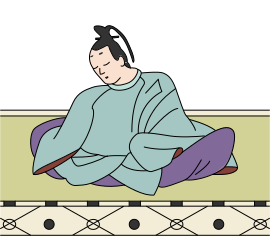
This image is based on an illustration from William N. Porter's A Hundred Verses from Old Japan, his 1909 English translation of the Hyakunin Isshu published in England, colorized and reworked using Adobe Firefly (generative AI).
- Fujiwara no Toshiyuki: A Short Timeline
-
- 866
- Becomes a junior palace secretary
- 873
- Given Junior Fifth Rank, Lower Grade
- 886
- Becomes Minor Captain of the Right Palace Guards
- 888
- Becomes a Chamberlain (Kurōdo) of the Fifth Rank
- 894
- Becomes Acting Middle Captain of the Right Palace Guards
- 897
- Given Junior Fourth Rank, Upper Grade, and becomes Commander of the Right Military Guards
- 901
- Dies
- Notes
-
- Counted as one of the Thirty-Six Immortal Poets
- Fujiwara no Toshiyuki's Family Tree
-
Fujiwara no Toshiyuki was born into a distinguished family descended from Fujiwara no Muchimaro, the founder of the Southern House of the Fujiwara. His mother's side came from the Ki clan, so he was also a distant relative of Ki no Tsurayuki and Ki no Tomonori, who later played a leading part in compiling the Kokin Wakashū.
He was also a close friend of Ariwara no Narihira, one of the greatest poets of the Heian period, and the two were related by marriage: each of them married one of Ki no Aritsune's daughters. The Tales of Ise also tells a story in which Toshiyuki sent love poems to a young woman in Narihira's house, and Narihira wrote her replies for her.
- Appendix
-
- A Poem Written on the First Day of Autumn
- The next poem is Fujiwara no Toshiyuki's best-known poem. It is placed first in the autumn section of the Kokin Wakashū.
Odoroku here means "to notice."In Japanese
秋来ぬと 目にはさやかに 見えねども
風の音にぞ おどろかれぬる akikinuto menihasayakani mienedomo
kazenootonizo odorokarenuru Kokin Wakashū, Fujiwara no ToshiyukiIn English
My eyes cannot clearly see that autumn has come,
but the sound of the wind suddenly made me notice. - An Exchange of Poems Between Narihira
and Toshiyuki in The Tales of Ise - The Tales of Ise tells how Toshiyuki sent love poems to a young woman who served in Narihira's house, and Narihira wrote her replies for her.
Here is one of the poems they exchanged. - Toshiyuki's Poem
-
In Japanese
つれづれの ながめにまさる 涙川
袖のみ濡れて 逢ふよしもなし tsurezureno nagamenimasaru namidagawa
sodenominurete afuyoshimonashi Kokin Wakashū, Fujiwara no ToshiyukiIn English
Like a river swollen by long rains, my longing for you grows, and my tears flow like a river. Only my sleeves get wet with tears, and I have no way to meet you.
- The Reply Narihira Wrote for Her
-
In Japanese
浅みこそ 袖はひつらめ 涙川
身さへ流ると 聞かばたのまむ asamikoso sodehahitsurame namidagawa
misahenagaruto kikabatanomamu Kokin Wakashū, Ariwara no NarihiraIn English
Your river of tears must be shallow, since only your sleeves get wet. If your love were true, you yourself would be swept away. When I hear that you have been, I will trust your feelings.
- Ukiyo-e by Katsushika Hokusai
-
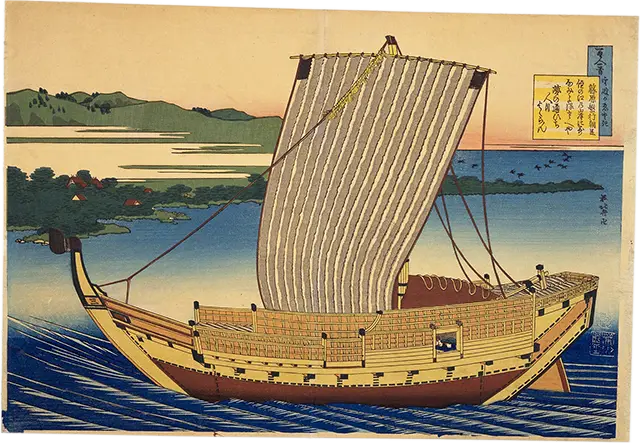
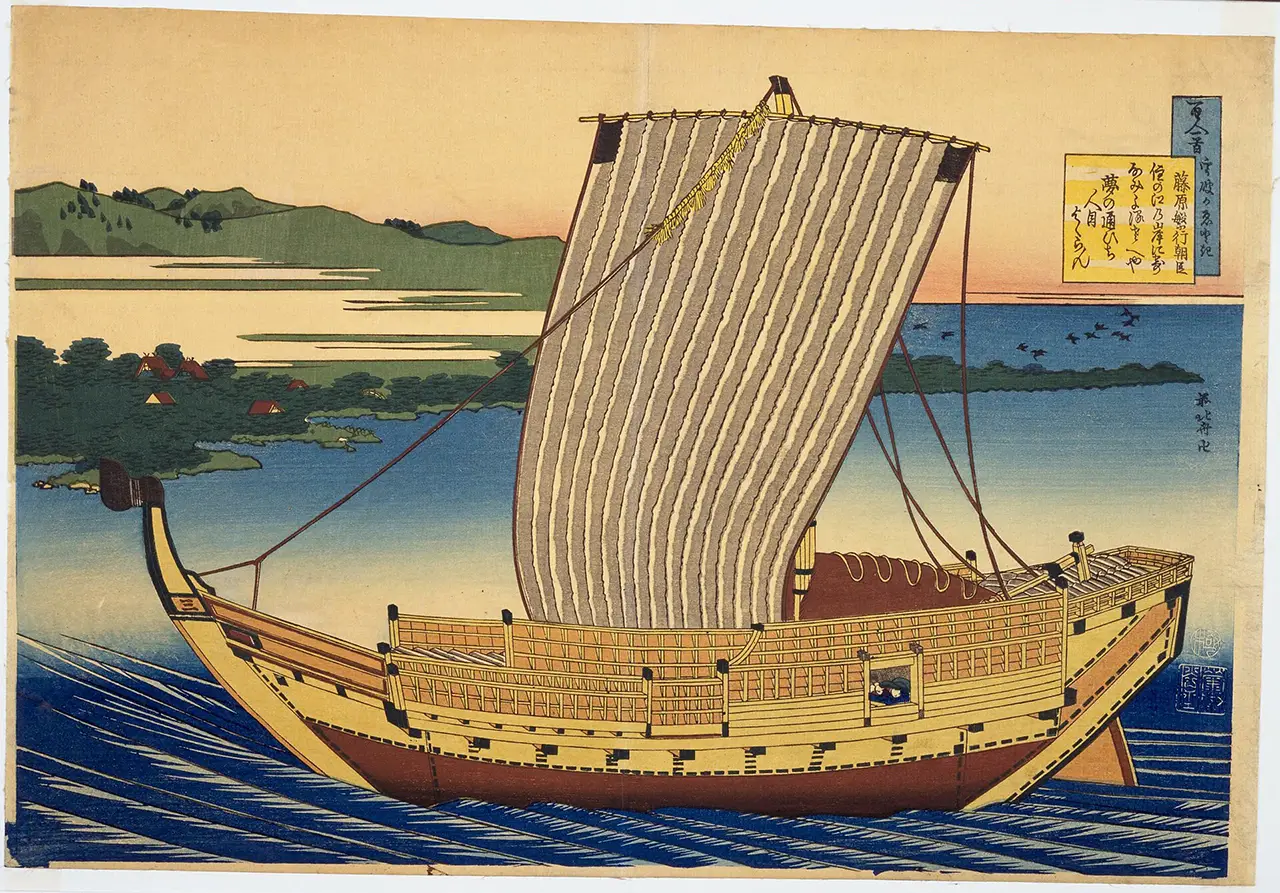
National Diet Library, Public domain, via Wikimedia Commons This print is from One Hundred Poems Explained by the Nurse (Hyakunin Isshu Uba ga Etoki) by Katsushika Hokusai, an ukiyo-e artist of the Edo period.
Suminoe is reclaimed land today, but it was once a port. The shrine seen on the far shore is probably Sumiyoshi Taisha. Its gods are said to have appeared from the sea, so they are worshipped as gods of safety at sea. Hokusai may have thought of Sumiyoshi Taisha, the symbol of Suminoe, and drawn the large ships sailing in the port.
By the way, Sumiyoshi Taisha is also worshipped as a god of poetry. Priest Dōin is said to have walked there from Kyoto every month to pray that he might write good poems.
- Utagawa Kuniyoshi's Hyakunin Isshu no Uchi
-
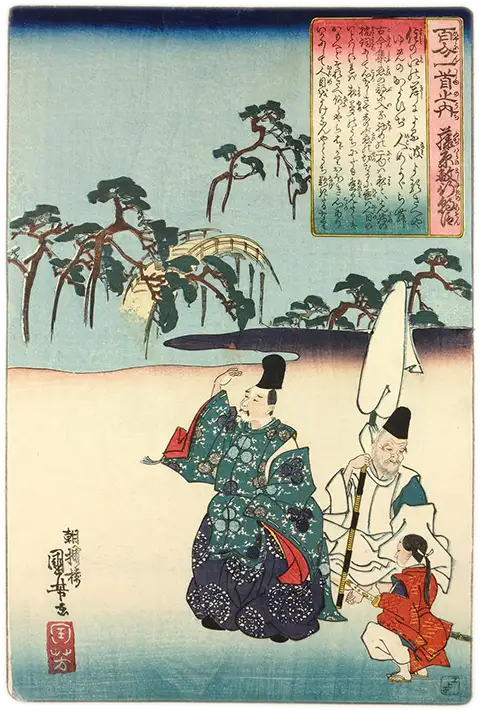
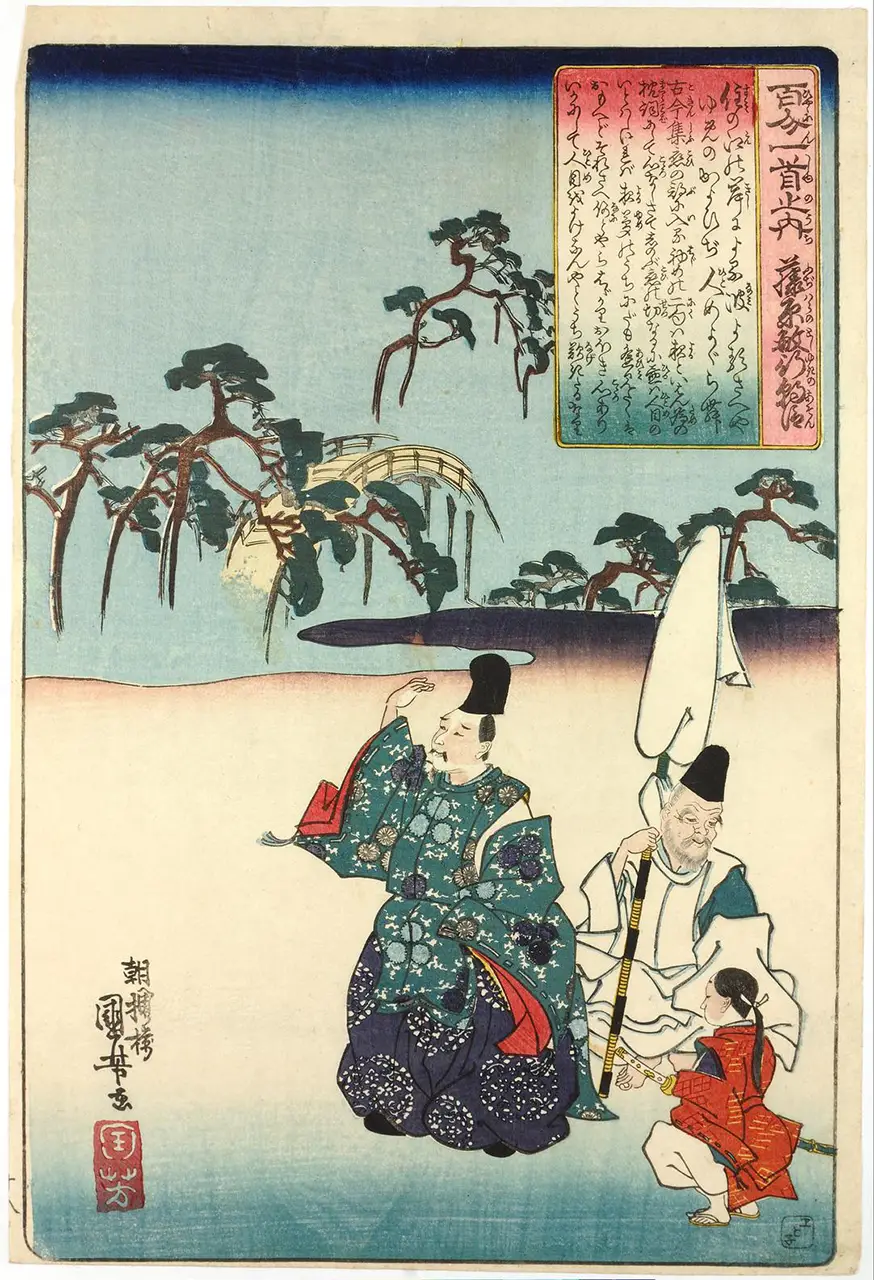
British Museum, Public domain, via Wikimedia Commons Suminoe (Sumiyoshi Ward, Osaka) has been largely reclaimed from the sea, and little of its old look remains. But Suminoe was once one of the most beautiful places in Japan, with white sand stretching on and on and green pines shining against it.
This print by Utagawa Kuniyoshi shows the Taiko-bashi (Sori-bashi) arched bridge, the symbol of Sumiyoshi Taisha, and suggests that the shoreline once came very close to it.
However, the arched bridge is thought to have been built in the late 16th century or later, so it probably did not yet exist in the Heian period.
- Sadanobu's Sumiyoshi Takadōrō
-
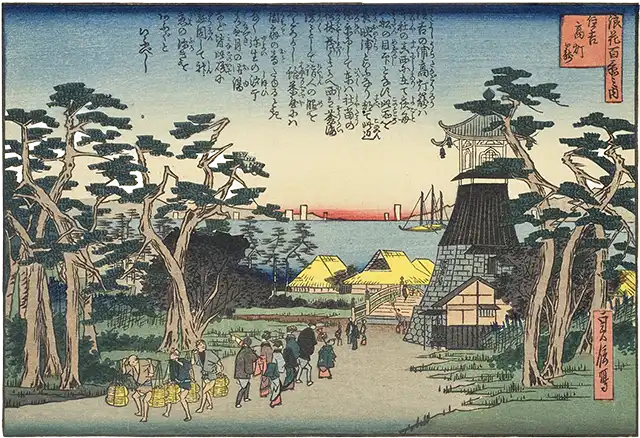
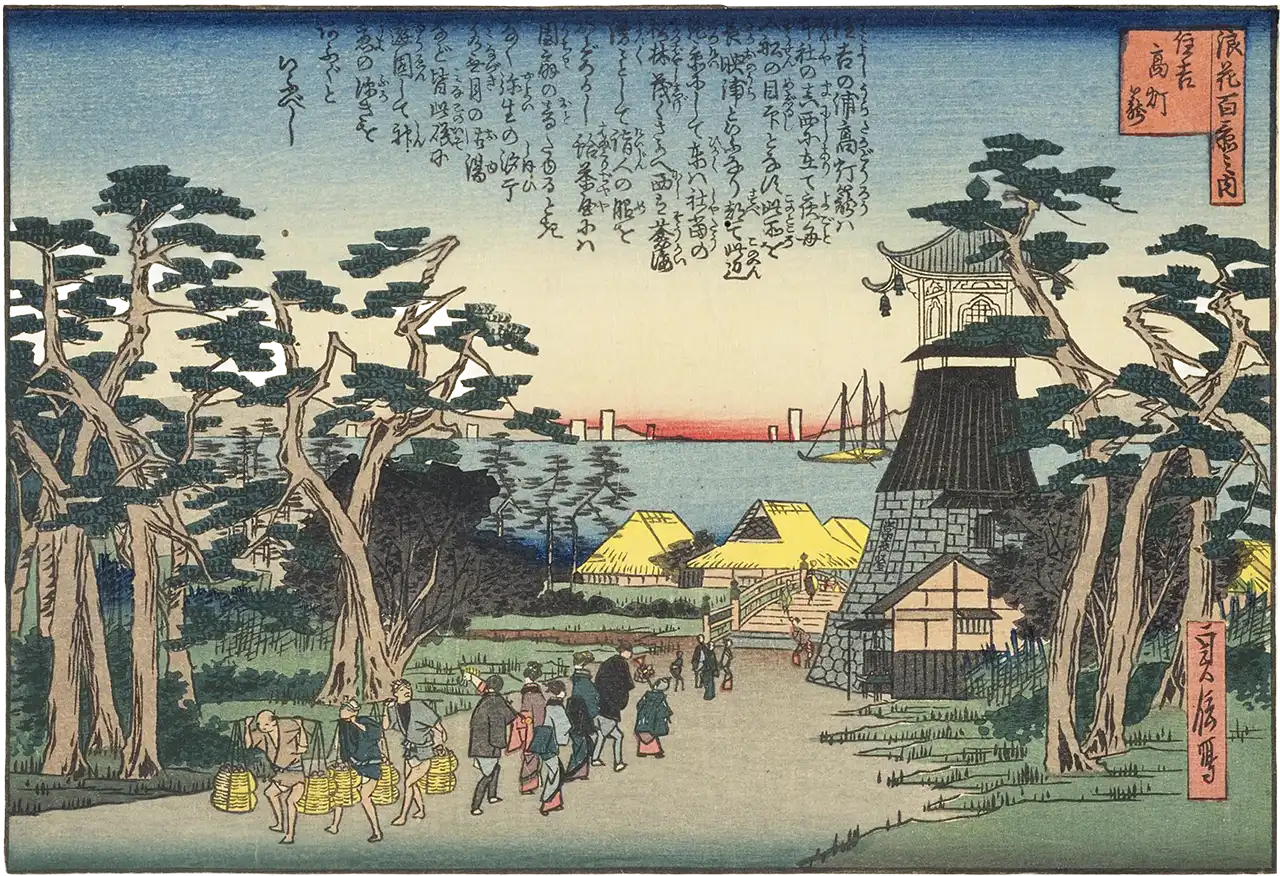
National Diet Library, Public domain, via Wikimedia Commons This ukiyo-e is a fine work by Hasegawa Sadanobu I that still conveys the feel of Osaka as it changed from the Edo period to the Meiji period. It is one of the prints in his series One Hundred Views of Naniwa (Naniwa Hyakkei no Uchi).
It shows the Sumiyoshi Takadōrō, a tall stone lantern that quietly kept watch over the safety of ships.
More than just a lighthouse, it was a famous sight that crowds of people came to visit, and the print shows that lively charm with delicate, atmospheric lines.