


Front of the Card
Back of the Card
Japanese
English
Audio: NHK Creative Library
Read by LibriVox volunteer Larry Wilson.
Audio courtesy of LibriVox
俊恵法師
夜もすがら
物思ふころは
明けやらで
閨のひまさへ
つれなかりけり
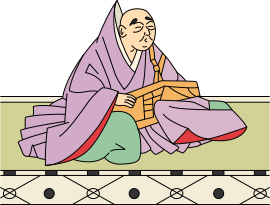
ねやのひま
さへつれな
かりけり

よも


- Poem 85
- 夜もすがら
物思ふころは
明けやらで
閨のひまさへ つれなかりけり
Author: Priest Shun'e (1113–c. 1191)
Source: Senzai Wakashū, Love
- English Verse Translation
- All through the never-ending night I lie awake and think; In vain I look to try and see The
daybreak's feeble blink Peep through the shutter's chink.
— William N. Porter, 1909
- Modern Translation
- All through the night, lost in thought, the dawn will not come. Even the crack of light through the bedroom door seems cold and distant.
- Commentary
- Written on the theme "love." Shun'e speaks as a woman waiting, worn out, through an endless dark night, troubled by thoughts of her cold lover.
- About the Poet
- Shun'e lost his father, Minamoto no Toshiyori, at 17 and became a monk at Tōdai-ji. He later moved to Shirakawa in Kyoto, called his lodging Karin'en (Poetry Grove), and held many gatherings there, joined by many Hyakunin Isshu poets. His student Kamo no Chōmei, author of the Hōjōki, wrote down many of his teachings.
- Poem Illustration
-
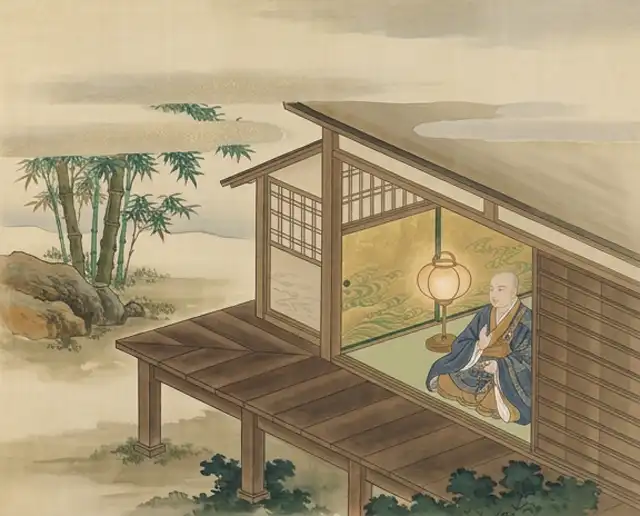
This image is based on an illustration from William N. Porter's A Hundred Verses from Old Japan, his 1909 English translation of the Hyakunin Isshu published in England, colorized and reworked using Adobe Firefly (generative AI).
- Priest Shun'e: A Short Timeline
-
- 1113
- Born as a son of Minamoto no Toshiyori
- c. 1130
- His father Toshiyori dies
- c. 1150
- Names his temple lodging in Shirakawa "Karin'en" (Garden of Poetry), where poets gather
- c. 1191
- Dies
- Priest Shun'e's Family Tree
-
Priest Shun'e was a descendant of the Uda Genji, the Minamoto line founded by Emperor Uda.
His grandfather was Minamoto no Tsunenobu, and his father was Minamoto no Toshiyori.
Three generations were chosen for the Hyakunin Isshu.Shun'e lost his father at 17 and became a monk at Tōdai-ji, a temple famous for its Great Buddha.
- Appendix
-
- Poets Who Joined the Karin'en
- Priest Shun'e held a poetry gathering every month at the Karin'en, his lodging, and many poets took part.
- Minamoto no Yorimasa
- Kojijū
- Kamo no Chōmei
- Later Tokudaiji Minister of the Left
- Priest Dōin
- Fujiwara no Kiyosuke Ason
- Priest Jakuren
- Attendant to Empress Inpu
- Sanuki, attendant to retired Emperor Nijō