Front of the Card
Back of the Card
Japanese
English
Audio: NHK Creative Library
Read by LibriVox volunteer Larry Wilson.
Audio courtesy of LibriVox
大納言経信
夕されば
門田の稲葉
おとづれて
蘆のまろやに
秋風ぞ吹く
あしのまろ
やにあきか
せそふく

ゆう


- Poem 71
- 夕されば
門田の稲葉
おとづれて
蘆のまろやに 秋風ぞ吹く
Author: Upper Counselor Tsunenobu (1016–1097)
Source: Kin'yō Wakashū, Autumn
- English Verse Translation
- This autumn night the wind blows shrill, And would that I could catch Its message, as it
whistles through The rushes in the thatch And leaves of my rice-patch.
— William N. Porter, 1909
- Modern Translation
- As evening falls, the breeze comes rustling through the rice stalks by the gate, and the autumn wind blows through the reed-thatched hut.
- Commentary
- The Kin'yō Wakashū says this was written on the theme "autumn wind at a farmhouse" at a gathering at the Umezu villa of Tsunenobu's relative Minamoto no Morokata. Country life was in fashion, and many nobles built villas outside the capital.
- About the Poet
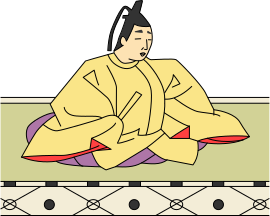
- Minamoto no Tsunenobu, a great-grandson of Prince Atsumi (a son of Emperor Uda), excelled at Chinese poetry, waka, and music. When boats for each art were raced on the Ōi River, he arrived late and said any boat would do. Like Fujiwara no Kintō, he was praised for "the talent of three boats."
- Poem Illustration
-
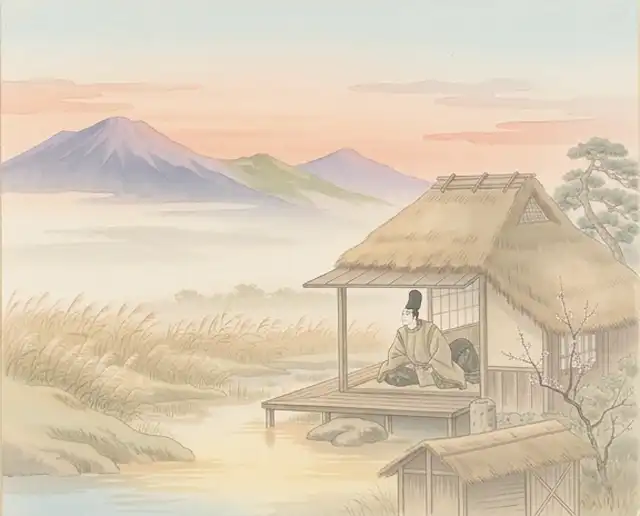
This image is based on an illustration from William N. Porter's A Hundred Verses from Old Japan, his 1909 English translation of the Hyakunin Isshu published in England, colorized and reworked using Adobe Firefly (generative AI).
- Minamoto no Tsunenobu: A Short Timeline
-
- 1016
- Born as a son of Minamoto no Michikata
- 1030
- Given Junior Fifth Rank, Lower Grade
- 1067
- Becomes Councillor (Sangi)
- 1075
- Becomes Acting Middle Counselor
- 1091
- Becomes Upper Counselor
- 1094
- Becomes Acting Governor-General of Dazaifu
- 1095
- Goes to Dazaifu to take up the post
- 1097
- Dies at Dazaifu
- Minamoto no Tsunenobu's Family Tree
-
Minamoto no Tsunenobu was a descendant of the Uda Genji, the Minamoto line founded by Emperor Uda.
A poetry gathering (utakai) was held at the villa of his relative Minamoto no Morokata in Umezu (Umezu, Ukyō Ward, Kyoto, south of Uzumasa on the east bank of the Katsura River). His Hyakunin Isshu poem was written at that gathering.
His son was Minamoto no Toshiyori and his grandson was Priest Shun'e,
so three generations were chosen for the Hyakunin Isshu.
- Appendix
-
- A Poem About the Hio of the Uji River
-
The next poem by Minamoto no Tsunenobu is in the Kin'yō Wakashū.
Hio are young sweetfish, and ajiro were fish traps for catching them, a winter sight on the Uji River.In Japanese
月清み 瀬々の網代に よるひをは
玉藻に冴ゆる 氷なりけり tsukikiyomi sezenoajironi yoruhioha
tamamonisayuru koorinarikeri Kin'yō Wakashū, Minamoto no TsunenobuIn English
In the clear moonlight, the hio gathering at the fish traps in the shallows sparkle like ice frozen on the water plants.
- A Landscape Poem Written at Sumiyoshi
-
The next poem by Minamoto no Tsunenobu is in the Go Shūi Wakashū. Sumiyoshi (today's Sumiyoshi Ward, Osaka) was once a beautiful place of white sand and green pines. The poem was written when Retired Emperor Go-Sanjō visited Sumiyoshi.
In Japanese
沖つ風 吹きにけらしな 住吉の
松のしづ枝を あらふ白波 okitsukaze fukinikerashina sumiyoshino
matsunoshizueo arafushiranami Go Shūi Wakashū, Minamoto no TsunenobuIn English
The wind must have blown out at sea. White waves rise high enough to reach the lower branches of the pines on the shore of Sumiyoshi.
- Ukiyo-e by Katsushika Hokusai
-
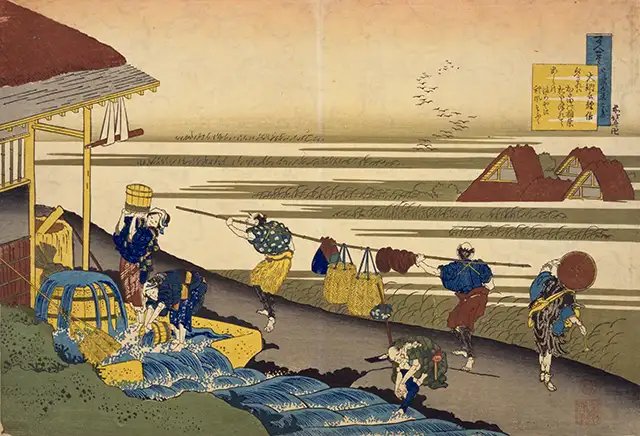
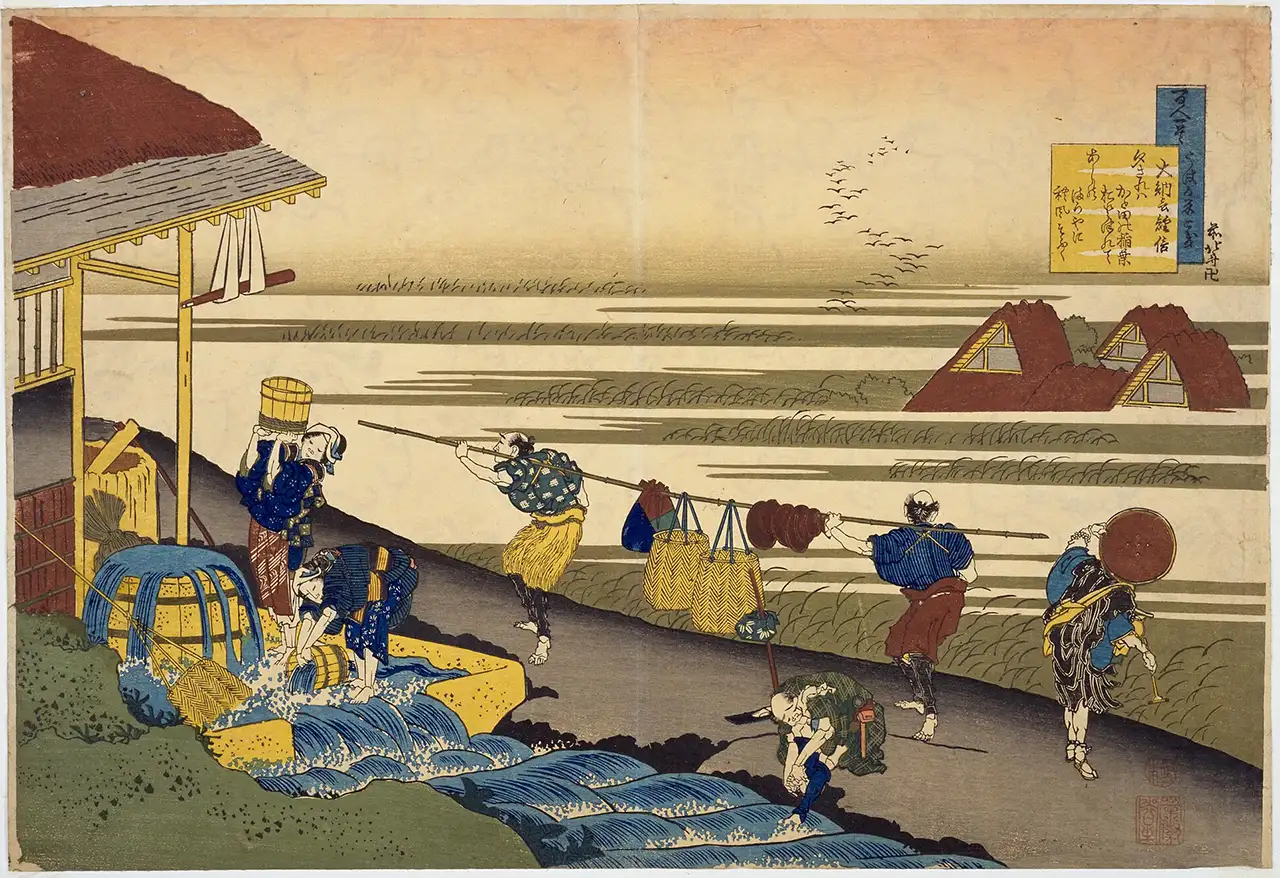
National Diet Library, Public domain, via Wikimedia Commons This print is from One Hundred Poems Explained by the Nurse (Hyakunin Isshu Uba ga Etoki) by Katsushika Hokusai, an ukiyo-e artist of the Edo period. The idea of the series is a nurse explaining the Hyakunin Isshu poems with easy-to-understand pictures.
People look up at a flock of wild geese far in the distance. It shows a farming village where autumn will soon arrive.
- Utagawa Kuniyoshi's Hyakunin Isshu no Uchi
-
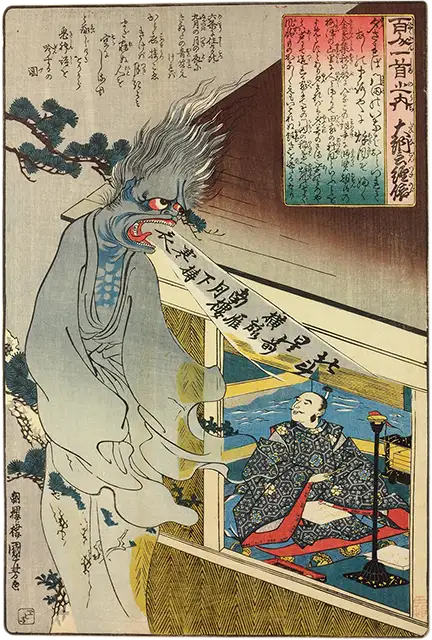
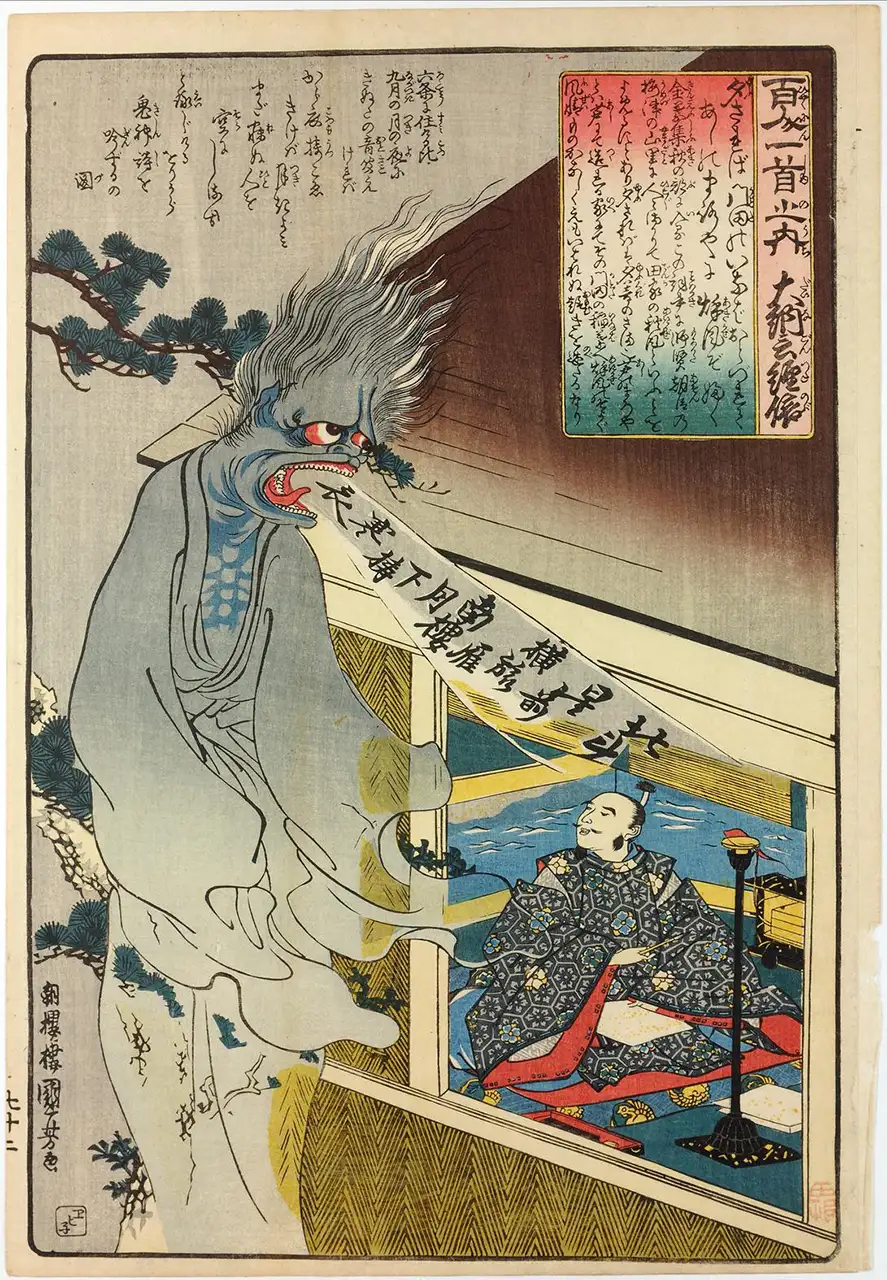
British Museum, Public domain, via Wikimedia Commons This ukiyo-e print is by Utagawa Kuniyoshi, an artist of the Edo period. It is based on the following story.
Tsunenobu murmured Ki no Tsurayuki's poem "Karakoromo utsu koe kikeba tsuki kiyomi mada nenu hito wo sora ni shiru kana" ("I hear the sound of cloth being beaten. Under the clear autumn moon, someone is still awake. Will that person, too, look up at this moon?").
Then the ogre of the Suzakumon-in, who loved elegant things, appeared and recited a Chinese poem: "North of the Dipper, wild geese fly across; under the moon by the south tower, winter clothes are beaten" ("I see wild geese flying past the Northern Dipper. By the south tower, late at night under the moon, I hear the sound of fulling blocks softening clothes for winter.").
- The Ōi River
-
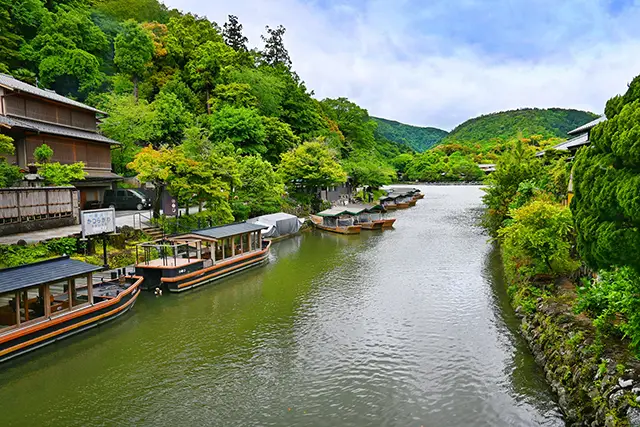
The Ōi River flows through the beautiful Arashiyama area of Kyoto and is also called the Katsura River. Heian nobles went boating on this river.
Sightseeing on roofed pleasure boats (yakatabune) to enjoy the Arashiyama scenery in every season is still popular today.