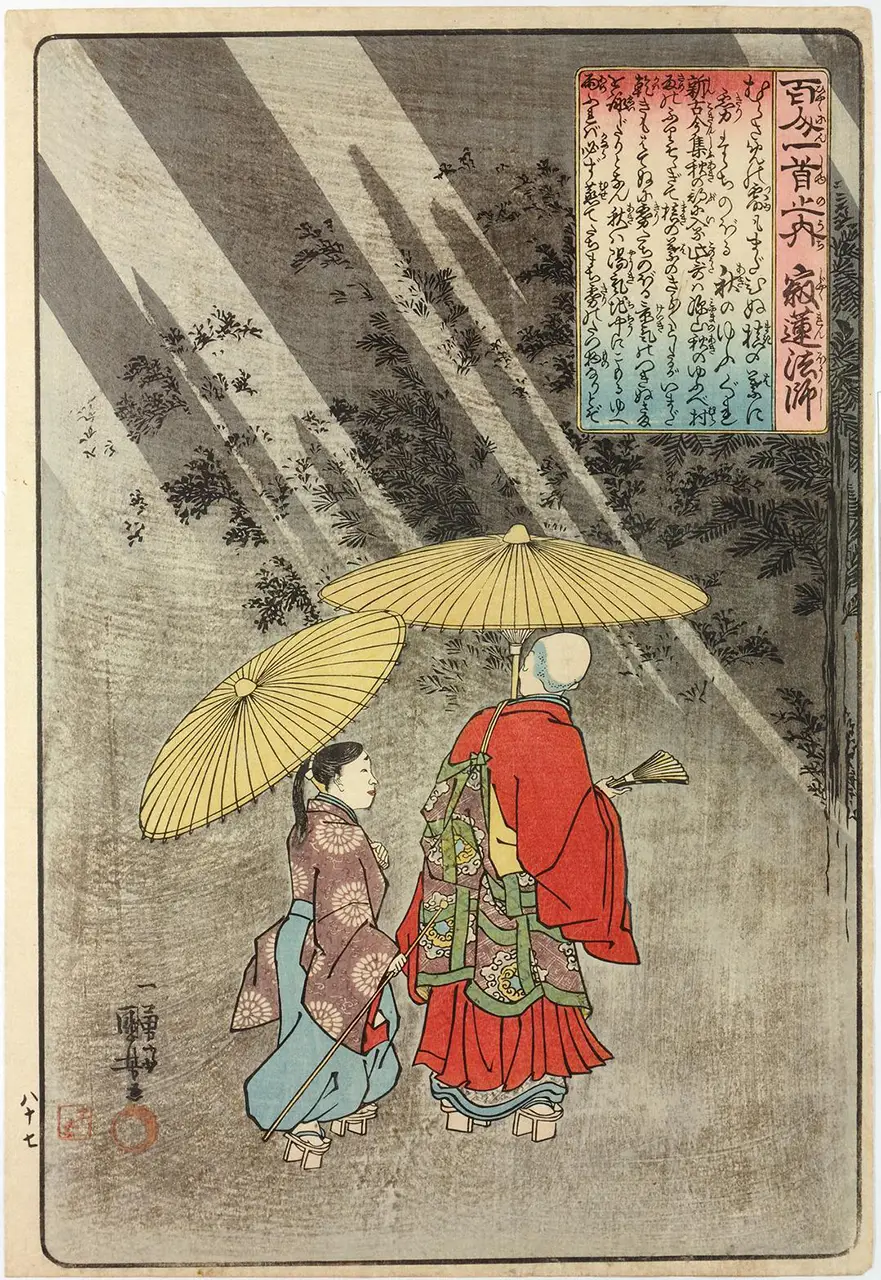
Front of the Card
Back of the Card
Japanese
English
Audio: NHK Creative Library
Read by LibriVox volunteer Larry Wilson.
Audio courtesy of LibriVox
寂蓮法師
村雨の
露もまだひぬ
まきの葉に
霧たちのぼる
秋の夕暮
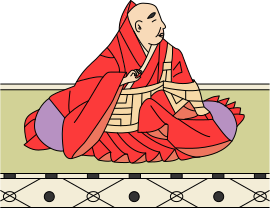
きりたちの
ほるあきの
ゆふくれ

む


- Poem 87
- 村雨の
露もまだひぬ
まきの葉に
霧たちのぼる 秋の夕暮
Author: Priest Jakuren (c. 1139–1202)
Source: Shin Kokin Wakashū, Autumn
- English Verse Translation
- The rain, which fell from passing showers, Like drops of dew, still lies Upon the fir-tree
needles, and The mists of evening rise Up to the autumn skies.
— William N. Porter, 1909
- Modern Translation
- After the passing shower, the mist rises slowly through the rain-drenched leaves of the cedar. An autumn evening.
- Commentary
- Written for the "Fifty Poems of Old and Young" contest held by Retired Emperor Go-Toba. An autumn scene without the colors of autumn leaves, it shows evergreen trees in a stillness like an ink painting. "Murasame" is a passing autumn shower.
- About the Poet
- Jakuren was adopted by Fujiwara no Toshinari, but is said to have become a monk so that Toshinari's own son Sadaie could be heir. After traveling the country he settled in Saga. Go-Toba chose him with Sadaie to compile the Shin Kokin Wakashū, but he died the next year.
- Poem Illustration
-
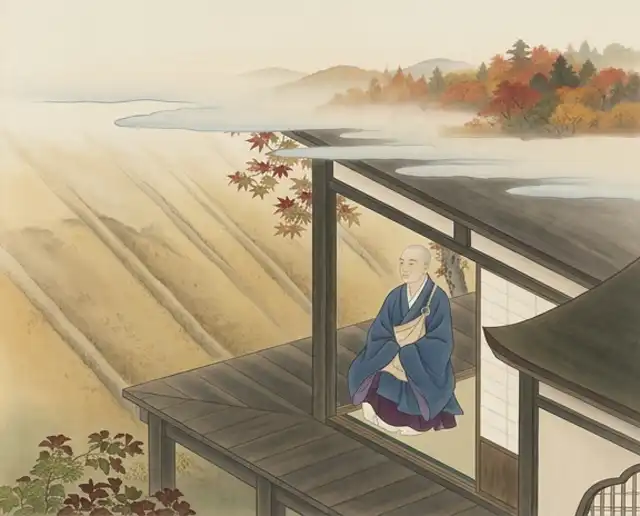
This image is based on an illustration from William N. Porter's A Hundred Verses from Old Japan, his 1909 English translation of the Hyakunin Isshu published in England, colorized and reworked using Adobe Firefly (generative AI).
- Priest Jakuren: A Short Timeline
-
- c. 1139
- Born as a son of Fujiwara no Shunkai
- c. 1150
- Adopted by his uncle, Fujiwara no Toshinari
- 1170s
- Becomes a monk in his 30s
- 1201
- Joins the Office of Poetry and is chosen to compile the Shin Kokin Wakashū
- 1202
- Dies
- Priest Jakuren's Family Tree
-
Priest Jakuren was the son of Shunkai, Fujiwara no Toshinari's elder or younger brother. His father Shunkai became a monk at Daigo-ji, and Jakuren is thought to have been adopted by his uncle Toshinari at around age 12.
He rose to Junior Fifth Rank, Upper Grade, and Junior Assistant Minister of Central Affairs (Nakatsukasa no shō), but became a monk in his 30s.
Even after becoming a monk, he was active at poetry gatherings in the capital. Retired Emperor Go-Toba thought highly of him as a poet and chose him, together with Fujiwara no Sadaie, to compile the Shin Kokin Wakashū. But he died before it was finished.
- Appendix
-
- The Sanseki no Uta ("Three Evening Poems")
- The following three poems in the Shin Kokin Wakashū, all ending with "aki no yūgure" (an autumn evening), are praised as the Sanseki no Uta.
Jakuren
In Japanese
さびしさは その色としも なかりけり
まき立つ山の 秋の夕暮れ sabishisaha sonoirotoshimo nakarikeri
makitatsuyamano akinoyuugure Shin Kokin Wakashū, JakurenIn English
Loneliness does not come only from a color (the color of autumn leaves). It is there in an autumn evening in the mountains, where cedars and cypresses stand (without color).
Saigyō
In Japanese
心なき 身にもあはれは 知られけり
鴫立つ沢の 秋の夕暮れ kokoronaki minimoahareha shirarekeri
shigitatsusawano akinoyuugure Shin Kokin Wakashū, SaigyōIn English
Though I became a monk and gave up my feelings, I feel the sadness of an autumn evening at the marsh where snipes fly up.
Fujiwara no Sadaie
In Japanese
見渡せば 花も紅葉も なかりけり
浦の苫屋の 秋の夕暮れ miwataseba hanamomomijimo nakarikeri
uranotomayano akinoyuugure Shin Kokin Wakashū, Fujiwara no SadaieIn English
Looking around, I see neither cherry blossoms nor autumn leaves. Only an autumn evening by the shore, with a poor hut thatched with rush mats, meets my eyes.
- A Poem Regretting the End of Spring
-
The next poem was written for the "Fifty Poems of Old and Young" contest in 1201 (Kennin 1), the year before Priest Jakuren died.
"Haru no minato" (the harbor of spring) is a coined phrase, used to mean the place where spring finally ends up.In Japanese
暮れてゆく 春の湊は 知らねども
霞に落つる 宇治の柴舟 kureteyuku harunominatoha shiranedomo
kasuminiotsuru ujinoshibabune Shin Kokin Wakashū, Priest JakurenIn English
I do not know where the harbor is where the passing spring will end up, but the brushwood boats of the Uji River drift down as if falling into the haze that hangs over the river below.
- A Poem About a Snail
-
The next poem looks kindly on a small creature, and shows Priest Jakuren's gentle nature.

In Japanese
牛の子に ふまるな庭の かたつぶり
角ありとても 身をなたのみそ ushinokoni fumarunaniwano katatsuburi
tsunoaritotemo mionatanomiso Jakuren Hōshi-shū, Priest JakurenIn English
Don't get stepped on by the calf, little snail in the garden. Just because you have horns, don't trust yourself too much.
- Utagawa Kuniyoshi's Hyakunin Isshu no Uchi
-
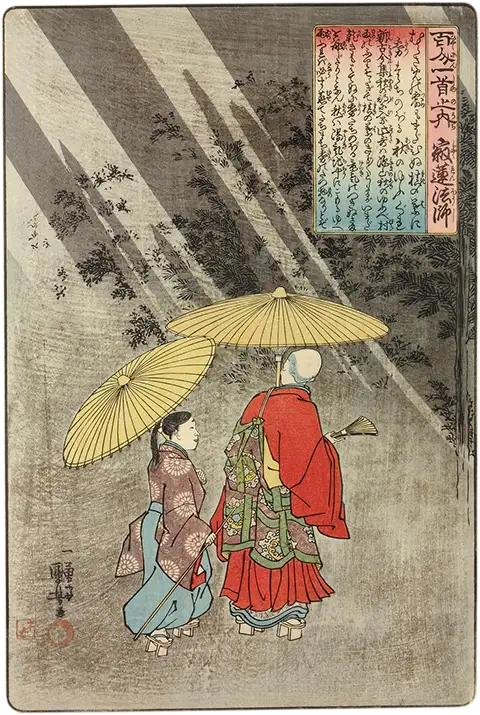
British Museum, Public domain, via Wikimedia Commons An ukiyo-e print by Utagawa Kuniyoshi, an ukiyo-e artist of the Edo period.
It shows a scene that matches the Hyakunin Isshu poem.