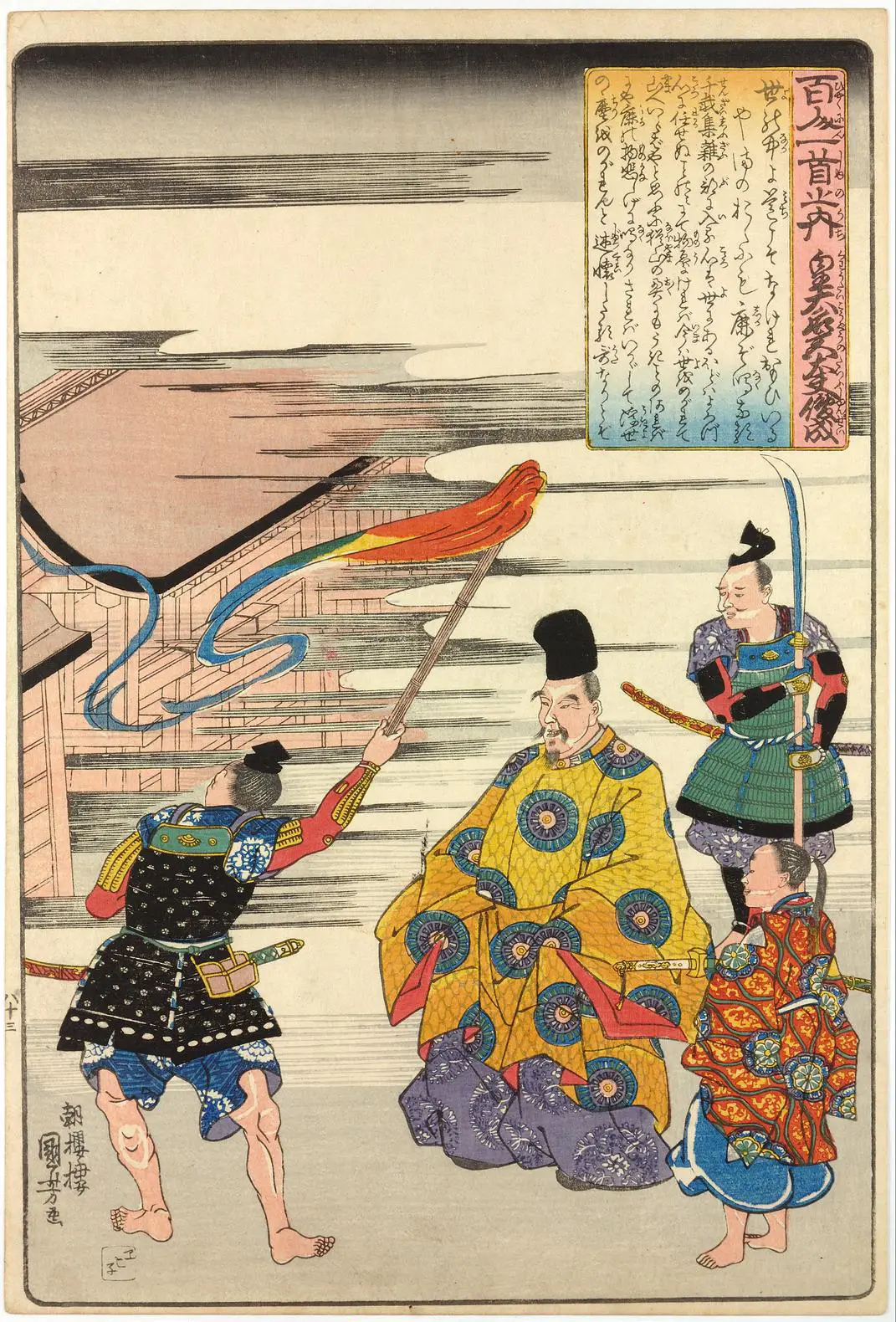
Front of the Card
Back of the Card
Japanese
English
Audio: NHK Creative Library
Read by LibriVox volunteer Larry Wilson.
Audio courtesy of LibriVox
皇太后宮大夫俊成
世の中よ
道こそなけれ
思ひ入る
山の奥にも
鹿ぞ鳴くなる
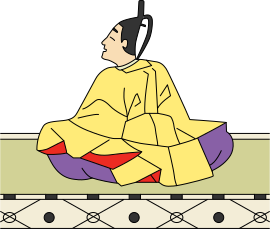
やまのおく
にもしかそ
なくなる

よのなかよ


- Poem 83
- 世の中よ
道こそなけれ
思ひ入る
山の奥にも 鹿ぞ鳴くなる
Author: Fujiwara no Toshinari (1114–1204)
Source: Senzai Wakashū, Miscellaneous
- English Verse Translation
- From pain and sorrow all around There's no escape, I fear; To mountain wilds should I
retreat, There also I should hear The cry of hunted deer.
— William N. Porter, 1909
- Modern Translation
- There is no escape from this world. Even deep in the mountains, the deer cry out.
- Commentary
- Toshinari wrote this around age 27, as the Heian period was nearing its end. Many people his age were becoming monks, and he may have gone into the mountains thinking of doing the same. But hearing a stag's sad cry deep in the mountains, he seems to have realized there was no escape from life's troubles.
- About the Poet
- Fujiwara no Toshinari was the father of Fujiwara no Sadaie, compiler of the Hyakunin Isshu, and compiled the Senzai Wakashū. As a judge at many contests, he often praised "yūgen" (deep, mysterious beauty) and "en" (elegance). His sense of beauty later shaped the tea ceremony and Noh as well.
- Poem Illustration
-
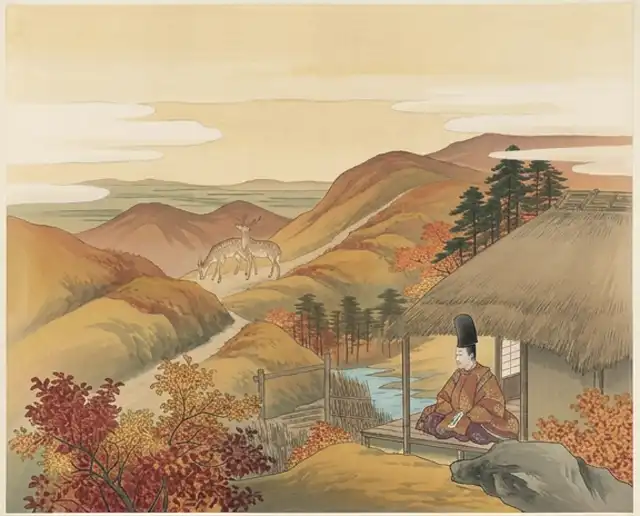
This image is based on an illustration from William N. Porter's A Hundred Verses from Old Japan, his 1909 English translation of the Hyakunin Isshu published in England, colorized and reworked using Adobe Firefly (generative AI).
- Fujiwara no Toshinari: A Short Timeline
-
- 1114
- Born as a son of Fujiwara no Toshitada
- Unknown
- Adopted as a child by Hamuro no Akiyori and called Akihiro
- 1167
- Changes his name to Fujiwara no Toshinari at age 54
- 1176
- Becomes a monk because of illness and takes the name Shakua
- 1188
- Presents the Senzai Wakashū, compiled at Retired Emperor Go-Shirakawa's order
- 1189
- Offers the Five Shrines Hundred-Poem Sequence
- 1203
- Retired Emperor Go-Toba holds a party to celebrate his 90th birthday
- 1204
- Dies
- Fujiwara no Toshinari's Family Tree
-
- Appendix
-
- A Poem About Mono no Aware
- This poem was written at a poetry gathering on the theme of "love." Toshinari praised The Tale of Genji as a work that embodies mono no aware (a deep feeling for the sadness and beauty of things), and left the words "A poet who has not read Genji is a regrettable thing." The poem says that through love, not only through its joys but also its sorrows and pain, people's hearts grow rich, and they come to understand mono no aware, the fleeting, painful beauty of life.
In Japanese
恋せずは 人も心も なからまし
もののあはれも これよりぞ知る koisezuha hitomokokoromo nakaramashi
mononoaharemo koreyorizoshiru Chōshū Eisō, Fujiwara no ToshinariIn English
Without love, people would never grow a heart.
It is through love that we come to understand mono no aware.Chōshū Eisō is Toshinari's personal poetry collection.
- A Love Poem
- Toshinari sent this poem to a woman he was really in love with. We know this from its headnote: "Sent to a woman on a rainy day." The "haze" in the poem is thought to stand for his clouded feelings of love, and the "spring rain" for the tears he shed, sad that he could not meet her.
In Japanese
思ひあまり そなたの空を ながむれば
霞を分けて 春雨ぞ降る omohiamari sonatanosorao nagamureba
kasumiowakete harusamezofuru Shin Kokin Wakashū, Fujiwara no ToshinariIn English
Longing for you too much, I gaze at the sky where you live,
and spring rain falls, parting the haze. - How to Read the Name 俊成
- The name 俊成 is read both "Toshinari" and "Shunzei."
Reading a name in the Chinese-style way, like "Shunzei," is called yūsoku-yomi. - Utagawa Kuniyoshi's Hyakunin Isshu no Uchi
-
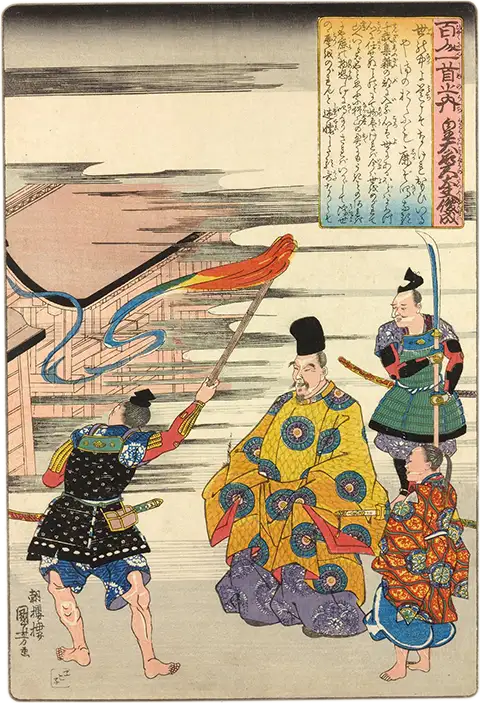
British Museum, Public domain, via Wikimedia Commons An ukiyo-e print by Utagawa Kuniyoshi, an ukiyo-e artist of the Edo period. It shows a scene that matches the Hyakunin Isshu poem.