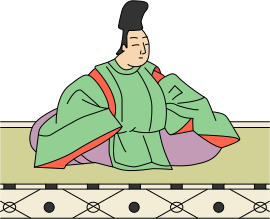
Front of the Card
Back of the Card
Japanese
English
Audio: NHK Creative Library
Read by LibriVox volunteer Larry Wilson.
Audio courtesy of LibriVox
従二位家隆
風そよぐ
ならの小川の
夕暮は
みそぎぞ夏の
しるしなりける
みそきそな
つのしるし
なりける

かぜそ


- Poem 98
- 風そよぐ
ならの小川の
夕暮は
みそぎぞ夏の しるしなりける
Author: Junior Second Rank Ietaka (1158–1237)
Source: Shin Chokusen Wakashū, Summer
- English Verse Translation
- The twilight dim, the gentle breeze By Nara's little stream, The splash of worshippers who
wash Before the shrine, all seem A perfect summer's dream.
— William N. Porter, 1909
- Modern Translation
- The breeze rustles through the leaves of the sacred oak trees by the river at dusk. The purification rite is the only sign that summer is here.
- Commentary
- Written for a folding screen in 1229, when Kujō Shunshi became a consort of Emperor Go-Horikawa. It went with a painting of the Minazuki purification rite on one of the screens she brought to court.
- About the Poet
- Fujiwara no Ietaka studied waka under Fujiwara no Toshinari and, with Fujiwara no Sadaie, was a leading poet of his time. Go-Toba chose him as a compiler of the Shin Kokin Wakashū. After Go-Toba lost the Jōkyū War and was exiled to Oki, Ietaka stayed loyal and supported him through letters.
- Poem Illustration
-
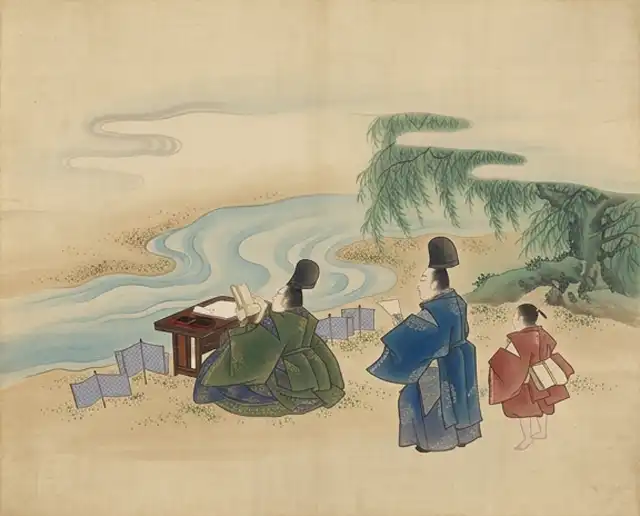
This image is based on an illustration from William N. Porter's A Hundred Verses from Old Japan, his 1909 English translation of the Hyakunin Isshu published in England, colorized and reworked using Adobe Firefly (generative AI).
- Fujiwara no Ietaka: A Short Timeline
-
- 1158
- Born as a son of Fujiwara no Mitsutaka
- 1175
- Given Junior Fifth Rank, Lower Grade
- 1201
- Chosen to compile the Shin Kokin Wakashū
- 1206
- Becomes Minister of the Imperial Household
- 1235
- Given Junior Second Rank
- 1236
- Becomes a monk
- 1237
- Dies
- Fujiwara no Ietaka's Family Tree
-
According to one theory, Fujiwara no Ietaka was the son-in-law of Jakuren, Fujiwara no Toshinari's adopted son. Ietaka studied waka under Toshinari and polished his skill until he was ranked alongside Fujiwara no Sadaie, the compiler of the Hyakunin Isshu, as a good rival. Both were chosen as compilers of the Shin Kokin Wakashū.
Ietaka served Retired Emperor Go-Toba. Even after Go-Toba started the Jōkyū War, lost, and was exiled to Oki, Ietaka stayed loyal and kept in touch with him, for example by receiving topics from him and sending him poems.
Ietaka's daughter, Tsuchimikado-in no Kosaishō, first served Retired Emperor Tsuchimikado, and after the Jōkyū War she served Minamoto no Ariko (Shōmeimon-in), Emperor Tsuchimikado's mother.
- Appendix
-
- A Poem About Sue no Matsuyama
- Fujiwara no Ietaka wrote about "Sue no Matsuyama," the place in Kiyohara no Motosuke's poem, like this.
He seems to have imagined a dreamlike scene in which trailing clouds at dawn hang over Sue no Matsuyama as if waves were coming over it.In Japanese
霞立つ 末の松山 ほのぼのと
波に離るる 横雲の空 kasumitatsu suenomatsuyama honobonoto
naminihanaruru yokogumonosora Shin Kokin Wakashū, Fujiwara no IetakaIn English
Haze rises over Sue no Matsuyama, which the waves are said never to cross. In the sky as dawn slowly breaks, trailing clouds part faintly from the waves, as if about to pass over Sue no Matsuyama.
- A Poem About Lake Biwa
- On the shore of Lake Biwa, in a winter so harsh that the water freezes and the waves draw back toward the open lake.
The poem describes the dawn moon (ariake no tsuki) in the sky on such a bitterly cold morning.In Japanese
志賀の浦や 遠ざかりゆく 波間より
凍りていづる 有明の月 shiganouraya toozakariyuku namimayori
kooriteizuru ariakenotsuki Shin Kokin Wakashū, Fujiwara no IetakaIn English
Shiga Bay. From between the waves drawing farther away, the dawn moon appears, frozen in the icy daybreak.
- A Poem About Tachibana Flowers
- In the Kokin Wakashū there is a famous anonymous poem: "五月待つ 花橘の 香をかげば 昔の人の 袖の香ぞする" (When I smell the tachibana flowers that wait for the fifth month, I smell the sleeves of someone I once loved). Since then, the scent of tachibana (a kind of citrus) flowers has been thought of as something that brings back the past. Building on this tradition, Ietaka asks a playful question in the next poem.
In Japanese
今年より 花さきそむる 橘の
いかで昔の 香に匂ふらむ kotoshiyori hanasakisomuru tachibanano
ikademukashino kaniniofuramu Shin Kokin Wakashū, Fujiwara no IetakaIn English
This tachibana tree only began to bloom this year,
so how can it give off the scent of the past? - A Poem from Ietaka's Last Years
- In his last years, Fujiwara no Ietaka became a monk after an illness, moved near Shitennō-ji in what is now Osaka City, and built a hermitage he named Sekiyō-an (the Evening Sun Hermitage). From there he prayed to the sun setting into the western sea, wishing to journey to the Pure Land in the west. The next poem was written at that time. Today the sunset can no longer be seen from this spot, but the area keeps the name "Yūhigaoka-chō" (Evening Sun Hill) in memory of Sekiyō-an.
In Japanese
契りあれば 難波の里に やどりきて
波の入日を 拝みけるかな chigiriareba naniwanosatoni yadorikite
naminoiribio ogamikerukana Kokon Chomonjū, Fujiwara no IetakaIn English
Because of a bond from a past life, I came to live in the village of Naniwa, and so I pray to the sun setting among the waves.
- Karyū-zuka (Ietaka's Grave)
-
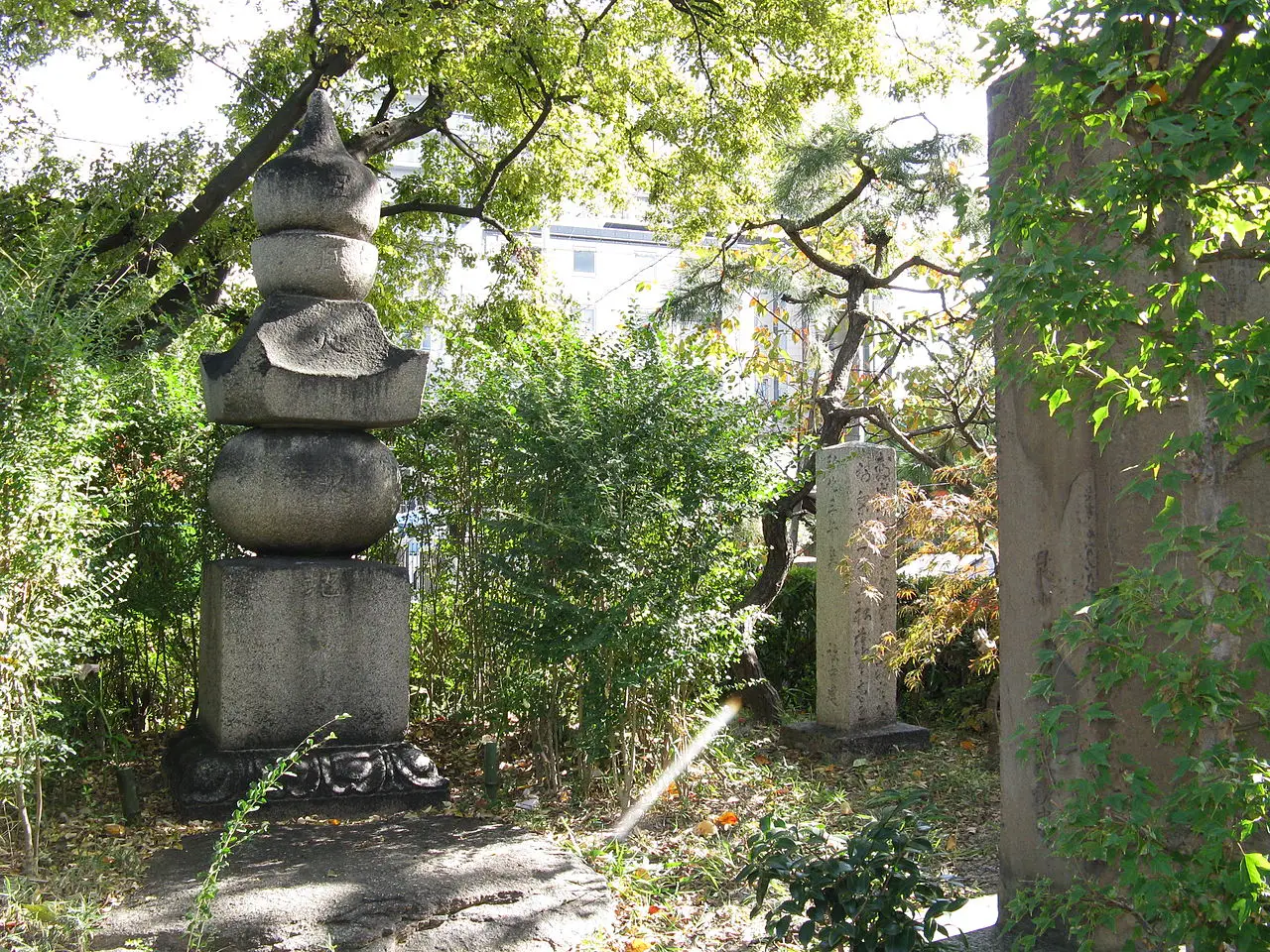
I, KENPEI, CC BY-SA 3.0 <http://creativecommons.org/licenses/by-sa/3.0/>, via Wikimedia Commons In Yūhigaoka-chō, Tennōji Ward, Osaka City, is the grave of Fujiwara no Ietaka, known affectionately as Karyū-zuka ("Karyū" is the Chinese-style reading of Ietaka). It is said to have been built on the site of Sekiyō-an, where Ietaka spent his last years.