Front of the Card
Back of the Card
Japanese
English
Audio: NHK Creative Library
Read by LibriVox volunteer Larry Wilson.
Audio courtesy of LibriVox
後鳥羽院
人もをし
人もうらめし
あぢきなく
世を思ふゆゑに
物思ふ身は
よをおもふ
ゆゑにもの
おもふみは

ひとも


- Poem 99
- 人もをし
人もうらめし
あぢきなく
世を思ふゆゑに 物思ふ身は
Author: Retired Emperor Go-Toba (1180–1239)
Source: Zoku Gosen Wakashū, Miscellaneous
- English Verse Translation
- How I regret my fallen friends How I despise my foes! And, tired of life, I only seek To
reach my long day's close, And gain at last repose.
— William N. Porter, 1909
- Modern Translation
- I find people both dear and hateful. It is because I care so deeply about this troubled world that I am always lost in thought.
- Commentary
- Retired Emperor Go-Toba pours out his feelings, troubled by conflict with the rising Kamakura shogunate and the weakening court. He wrote it at 33, nine years before he started the Jōkyū War.
- About the Poet
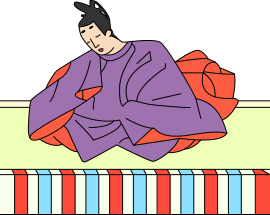
- Go-Toba became emperor without the full set of the Three Sacred Treasures. As if to make up for this, he trained hard and mastered waka, go, swimming, riding, and hunting. But he was overconfident: in 1221 he ordered war on Hōjō Yoshitoki, failed to win the eastern warriors' support, lost, and was exiled to Oki.
- Poem Illustration
-
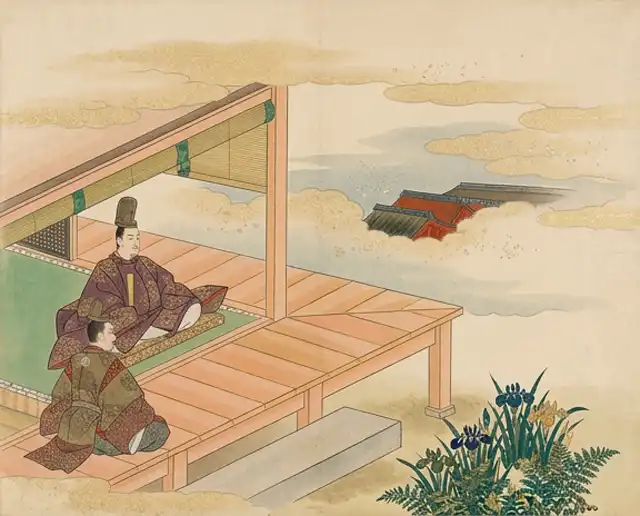
This image is based on an illustration from William N. Porter's A Hundred Verses from Old Japan, his 1909 English translation of the Hyakunin Isshu published in England, colorized and reworked using Adobe Firefly (generative AI).
- Retired Emperor Go-Toba: A Short Timeline
-
- 1180
- Born as a son of Emperor Takakura
- 1183
- Becomes emperor without the Three Sacred Treasures
- 1198
- Hands the throne to Emperor Tsuchimikado and begins ruling as retired emperor
- 1201
- Revives the Office of Poetry and orders the Shin Kokin Wakashū to be compiled
- 1221
- Loses the Jōkyū War and is exiled to Oki Province
- 1239
- Dies in Oki Province
- Retired Emperor Go-Toba's Family Tree and Relationship Chart
-
Retired Emperor Go-Toba was a grandson of Emperor Go-Shirakawa and a younger half-brother of Emperor Antoku. He had two sons, Emperor Tsuchimikado and Retired Emperor Juntoku. Tsuchimikado became emperor at 3, but at 15 Go-Toba made him give up the throne, and Juntoku became the new emperor. Tsuchimikado seems to have been gentle, while Juntoku had a fierce temper. At the time of the Jōkyū War, Tsuchimikado tried to talk his father Go-Toba out of it, while Juntoku is said to have actively supported his father in trying to overthrow the shogunate.
- Appendix
-
- The Jōkyū War
-
In 1185, the shogunate placed land stewards (jitō) throughout the country, which reduced the income the court received from its estates, and the conflict with the shogunate deepened. Retired Emperor Go-Toba added the Western Guards (saimen no bushi) to the Northern Guards (hokumen no bushi) to strengthen his military power against the shogunate.
In 1219, Minamoto no Sanetomo was assassinated by his nephew Kugyō, and Kugyō in turn was killed by the shogunate's men. After this, there was a growing move at court to rethink its policy of getting along with the shogunate. Judging that a succession struggle was going on inside the shogunate, Go-Toba issued an order in 1221 to strike down Hōjō Yoshitoki, starting the Jōkyū War.
The shogunate, however, had already learned of Go-Toba's plans to raise an army from household officials of Saionji Kintsune and others. Hōjō Masako appealed to the shogun's vassals, telling them that the court was trying to destroy the shogunate, and the conflict grew into a war between the court's army and the shogunate's army. The shogunate's army marched on Kyoto along three routes, the Tōkaidō, the Tōsandō, and the Hokurikudō, and defeated the court's army only a month after the order was issued. Go-Toba was exiled to Oki and Juntoku to Sado, Tsuchimikado moved to Tosa of his own will, and Emperor Chūkyō was removed from the throne.
- Oki
-
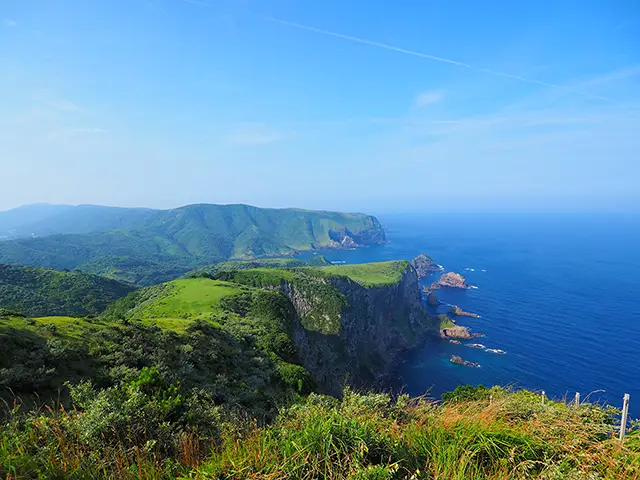
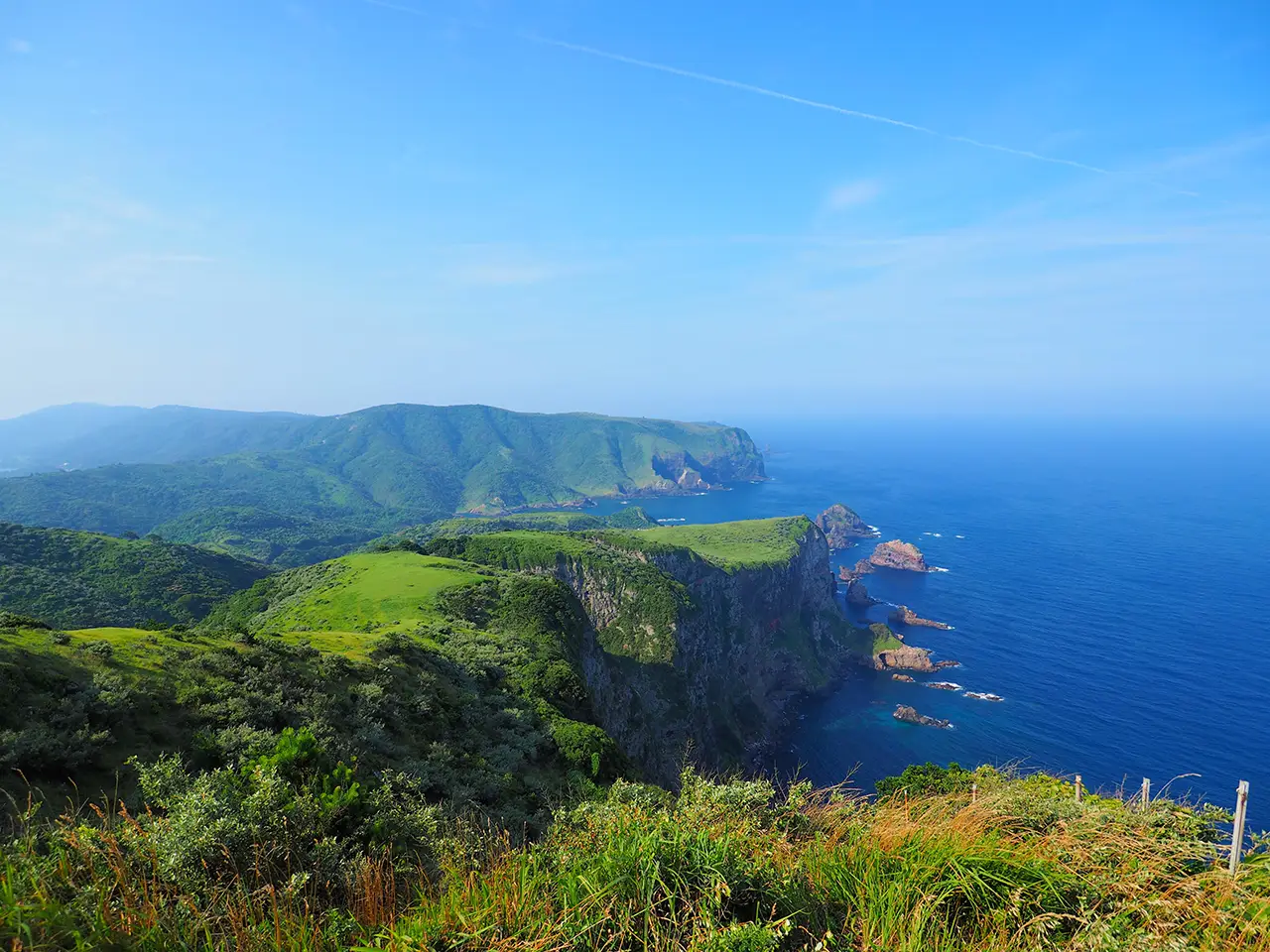
Photo: Adobe Stock Oki District, Shimane Prefecture. After losing the Jōkyū War, Retired Emperor Go-Toba was exiled to Oki, and he died there at 58. See it on the map
- A Poem Showing a Ruler's Spirit
-
This poem was written before the Jōkyū War. So it is sometimes read as expressing a wish to correct the politics that the Kamakura shogunate had bent out of shape. It is also sometimes read as expressing a ruler's wish to govern rightly.
In Japanese
奥山の おどろが下も 踏み分けて
道ある世ぞと 人に知らせむ okuyamano odorogashitamo fumiwakete
michiaruyozoto hitonishirasemu Shin Kokin Wakashū, Retired Emperor Go-TobaIn English
Even through the thorny brush deep in the mountains, where there is no path, I will push my way through, and let people know that this is a world with a right path.
- The Best-Known Poem of the Entō Hyakushu
-
The next poem is said to have been written on the ship taking Retired Emperor Go-Toba into exile on Oki. The sea was wild and a storm was raging, but the moment Go-Toba wrote this poem, it is said, the storm died down and the sea became calm. Go-Toba's passion for waka did not fade even after his exile to Oki, and he compiled a hundred-poem sequence called the Entō Hyakushu (Hundred Poems from a Distant Island).
In Japanese
我こそは 新島守よ 隠岐の海の
荒き波風 心して吹け warekosoha niijimamoriyo okinoumino
arakinamikaze kokoroshitefuke Masukagami, Retired Emperor Go-TobaIn English
I am the new guardian of this island.
Rough waves and winds of the sea of Oki, from now on blow gently.Masukagami is a historical tale of the Kamakura period.
The next poem was placed at the very end of the Entō Hyakushu. It shows Go-Toba's sense of the impermanence of all things (mujōkan).
In Japanese
かぎりあれば 萱が軒端の 月も見つ
知らぬは人の 行く末の空 kagiriareba kayaganokibano tsukimomitsu
shiranuhahitono yukusuenosora Entō Hyakushu, Retired Emperor Go-TobaIn English
Life has its limits. Gazing at the moon over the eaves of my poor thatched hut, I think that no one knows what lies ahead.
- A Folding-Screen Poem for Fujiwara no Toshinari's 90th Birthday
-
Retired Emperor Go-Toba wrote this poem for a folding screen to celebrate Fujiwara no Toshinari's 90th birthday (kujū no ga). It borrows (honkadori) from Kakinomoto no Hitomaro's poem "Ashibiki no yamadori no o no...." In the late Heian period, Fujiwara no Akisue started the Hitomaro eigu ceremony, and Kakinomoto no Hitomaro was treated as a god of poetry. The poem is thought to have been written with respect, wishing a long life to Toshinari, whom Go-Toba looked up to as his teacher of waka.
In Japanese
桜咲く 遠山鳥の
しだり尾の
ながながし日も
あかぬ色かな sakurasaku tooyamadorino shidariono
naganagashihimo akanuirokana Shin Kokin Wakashū, Retired Emperor Go-TobaIn English
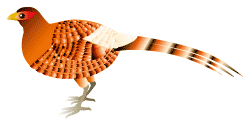
Cherry blossoms on the distant mountains. Even if I gaze at them all through a day as long as the trailing tail of a mountain pheasant,
I never tire of their color. - Go-Toba's Best-Known Poem
-
This is the best-known of Retired Emperor Go-Toba's poems. In waka, autumn was usually linked with autumn leaves, evenings, and wild geese, while haze was a symbol of spring, so this poem is thought to have broken the rules.
In Japanese
見渡せば 山もとかすむ 水無瀬川
夕べは秋と なに思ひけむ miwataseba yamamotokasumu minasegawa
yuubehaakito naniomohikemu Shin Kokin Wakashū, Retired Emperor Go-TobaIn English
Looking out, I see the foot of the mountains hazy and the Minase River flowing. Why did I ever think that evenings are best in autumn? Spring evenings are wonderful too.
- Utagawa Kuniyoshi's Hyakunin Isshu no Uchi
-
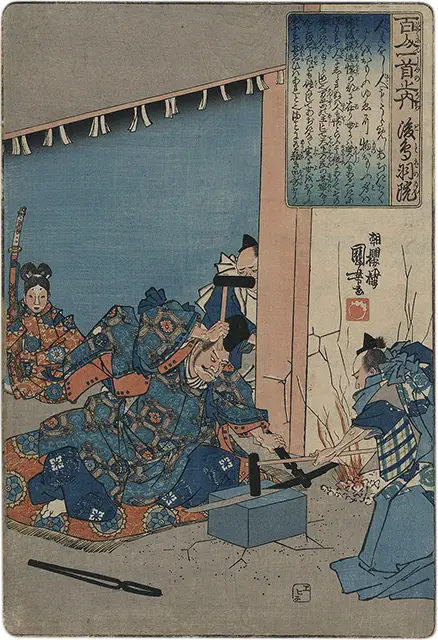
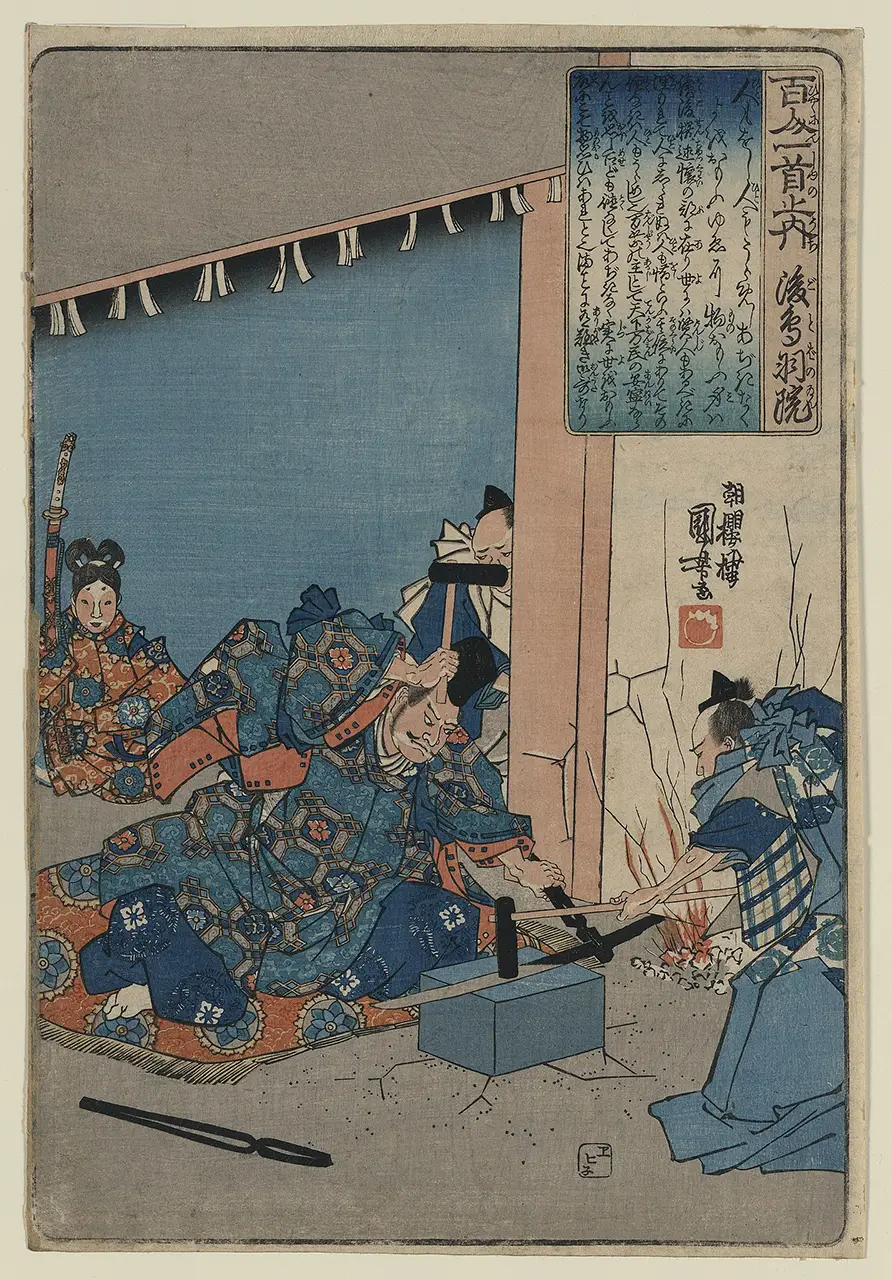
Utagawa, Kuniyoshi, 1798-1861, artist, Public domain, via Wikimedia Commons An ukiyo-e print by Utagawa Kuniyoshi, an ukiyo-e artist of the Edo period.
Retired Emperor Go-Toba became emperor in the middle of the Genpei War without the Three Sacred Treasures.Perhaps because of this, Go-Toba was so passionate about swords that he even forged them himself.
- The Chrysanthemum Go-Toba Loved
- The chrysanthemum is the crest of the imperial family, and it is said that this began because Go-Toba loved chrysanthemums and put a chrysanthemum crest on his swords and other things.