


Front of the Card
Back of the Card
Japanese
English
Audio: NHK Creative Library
Read by LibriVox volunteer Larry Wilson.
Audio courtesy of LibriVox
後京極摂政前太政大臣
きりぎりす
鳴くや霜夜の
さむしろに
衣かたしき
ひとりかも寝む
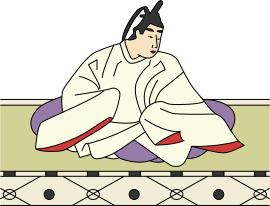
ころもかた
しきひとり
かもねむ

きり


- Poem 91
- きりぎりす
鳴くや霜夜の
さむしろに
衣かたしき ひとりかも寝む
Author: Gokyōgoku Regent and former Chancellor of the Realm (1169–1206)
Source: Shin Kokin Wakashū, Autumn
- English Verse Translation
- I'm sleeping all alone, and hear The crickets round my head; So cold and frosty is the
night, That I across the bed My koromo have spread.
— William N. Porter, 1909
- Modern Translation
- On a cold, frosty night, the cricket cries. Lying alone with one sleeve folded beneath me — how lonely it is.
- Commentary
- Kujō Yoshitsune wrote this about sleeping alone on an autumn night after his wife died. Lovers then used each other's robes as pillows, so "spreading only my own robe" meant sleeping alone.
- About the Poet
- Kujō Yoshitsune was the second son of Kujō Kanezane and grandson of Fujiwara no Tadamichi. He became head of the family after his elder brother died young. He rose to regent and Chancellor, but died two years later at 38, before his father. One rumor says he was killed in his sleep by a spear thrust through the ceiling.
- Poem Illustration
-
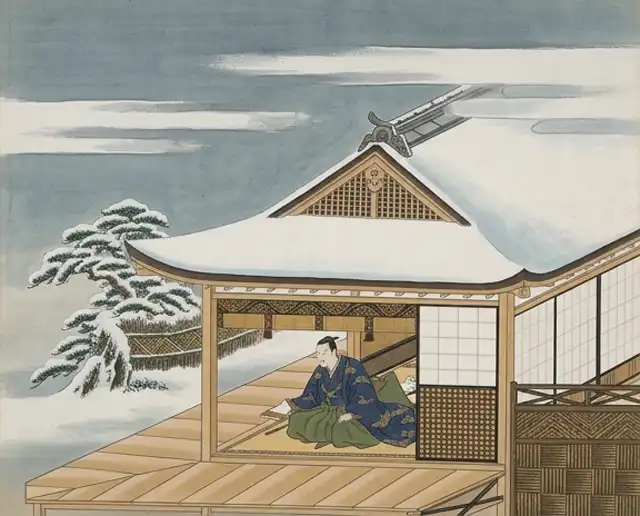
This image is based on an illustration from William N. Porter's A Hundred Verses from Old Japan, his 1909 English translation of the Hyakunin Isshu published in England, colorized and reworked using Adobe Firefly (generative AI).
- Kujō Yoshitsune: A Short Timeline
-
- 1169
- Born as a son of Kujō Kanezane
- 1195
- Becomes Palace Minister
- 1202
- Becomes Regent (Sesshō) for Emperor Tsuchimikado
- 1204
- Becomes Chancellor of the Realm
- 1206
- Dies
- Kujō Yoshitsune's Family Tree
-
Kujō Yoshitsune was a grandson of Fujiwara no Tadamichi and the second son of Kujō Kanezane, founder of the Kujō family. Because his elder brother, Kujō Yoshimichi, died young, he became the family's heir. He was active in politics from a young age and became Palace Minister in his mid-20s. But when his father Kanezane was removed as Kampaku in the "Political Change of 1196" (Kenkyū shichinen no seihen), Yoshitsune too was kept away from the court for a time.
Later, he returned as Minister of the Left at 30. Trusted by Retired Emperor Go-Toba, he became regent for Emperor Tsuchimikado at 33 and rose to Chancellor of the Realm at 35. But he died suddenly at only 38. Because his death was so sudden, there is a theory that he was stabbed to death in his bedroom.
Yoshitsune's father Kanezane supported Fujiwara no Toshinari and his son Sadaie. Yoshitsune learned waka from Toshinari, led his own poetry circle, and supported Sadaie and other poets of the new style. Sadaie also served as Yoshitsune's keishi (a household official who managed the family's affairs). Yoshitsune was also a gifted calligrapher, founded the Gokyōgoku style of calligraphy, and wrote the kana preface of the Shin Kokin Wakashū.
- Appendix
-
- The Chirp of a Cricket
-
Click the play button to hear the chirp of a cricket (kōrogi).
Audio: Sound Effect Lab - The Poem He Borrowed From
-
Yoshitsune borrowed (honkadori) from the following poem. His aim in borrowing was to layer images on top of each other. In the time of the original poem, the Kokin Wakashū, the Lady of Uji Bridge (Uji no Hashihime) was a symbol of "a beloved woman." Later, however, under the influence of The Tale of Genji, she took on the darker image of "a fragile figure wasting away alone."
Yoshitsune blended these two opposite images: the classic elegance that came from the original poem, and the loneliness brought by The Tale of Genji.
In Japanese
さむしろに 衣かたしき 今宵もや
我を待つらむ 宇治の橋姫 samushironi koromokatashiki koyoimoya
wareomatsuramu ujinohashihime Kokin Wakashū, AnonymousIn English
Spreading only her own robe on a straw mat, is she waiting for me tonight too, lonely and alone,
the Lady of Uji Bridge? - The Influence of the Shijing
-
The Shijing (Shikyō, the Classic of Poetry), the oldest collection of poems in China, contains the following lines.
Yoshitsune is thought to have written his poem with these Chinese lines in mind.In Chinese
十月蟋蟀
入我牀下 ShijingIn English
In the tenth month, the crickets
come in under my bed.