Front of the Card
Back of the Card
Japanese
English
Audio: NHK Creative Library
Read by LibriVox volunteer Larry Wilson.
Audio courtesy of LibriVox
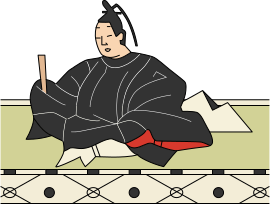
権中納言匡房
高砂の
尾の上の桜
咲きにけり
外山の霞
立たずもあらなむ
とやまのか
すみたたす
もあらなむ

たか


- Poem 73
- 高砂の
尾の上の桜
咲きにけり
外山の霞 立たずもあらなむ
Author: Acting Middle Counselor Masafusa (1041–1111)
Source: Go Shūi Wakashū, Spring
- English Verse Translation
- The cherry trees are blossoming On Takasago's height; Oh may no mountain mist arise, No
clouds so soft and white, To hide them from our sight.
— William N. Porter, 1909
- Modern Translation
- The cherry blossoms on the high peaks of Takasago have already bloomed. Let the mist not rise over the foothills and hide them from view.
- Commentary
- The Go Shūi Wakashū says this was written at a drinking party at the home of Palace Minister Fujiwara no Moromichi, on the theme "looking at mountain cherry blossoms far away."
- About the Poet
- Ōe no Masafusa was a great-grandson of Akazome Emon. His family produced scholars, and he became an advanced student of literature at 16. An expert on court customs, he taught Emperors Go-Sanjō, Shirakawa, and Horikawa, advised them on policy, and rose to Acting Middle Counselor.
- Poem Illustration
-
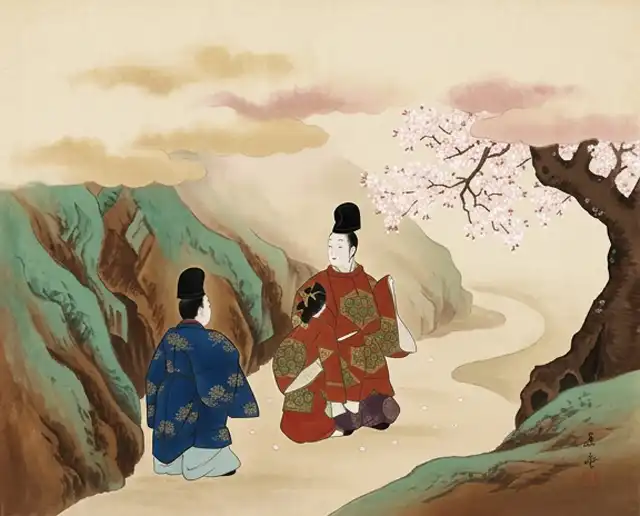
This image is based on an illustration from William N. Porter's A Hundred Verses from Old Japan, his 1909 English translation of the Hyakunin Isshu published in England, colorized and reworked using Adobe Firefly (generative AI).
- Ōe no Masafusa: A Short Timeline
-
- 1041
- Born
- 1056
- Becomes an advanced student of literature at the court university
- 1068
- Becomes a Chamberlain (Kurōdo) to Emperor Go-Sanjō
- 1088
- Becomes Councillor (Sangi)
- 1094
- Becomes Acting Middle Counselor
- 1097
- Also becomes Acting Governor-General of Dazaifu
- 1102
- Given Senior Second Rank
- 1111
- Becomes Minister of the Treasury; dies the same year
- Ōe no Masafusa's Family Tree
-
According to the Sonpi Bunmyaku and the Ōe-shi Keizu (Ōe family tree), the founder of the Ōe clan was Emperor Heizei. But this is said to have been the Ōe family's attempt to make its line look nobler, and it has been pointed out that it may be wrong.
In the time of Ōe no Otondo, the family name was changed from Ōe written as "大枝" (great branch) to "大江" (great river). It is said to carry the wish that the family would prosper for a long time, like a great river (e).
Like the Sugawara clan, the Ōe clan produced many scholars, and the two are mentioned together as the Kanke (the Sugawara family) and the Gōke (the Ōe family).
- Appendix
-
- Akazome Emon's Poem
Celebrating Masafusa's Birth - The next poem by Akazome Emon is in the Go Shūi Wakashū.
She sent it with baby clothes to celebrate Masafusa's birth.In Japanese
雲の上に のぼらむまでも 見てしがな
鶴の毛衣 年ふとならば kumonoueni noboramumademo miteshigana
tsurunokegoromo toshifutonaraba Go Shūi Wakashū, Akazome EmonIn English
I want to watch you grow until you rise "above the clouds" (to the ranks allowed in the emperor's presence). Wearing white baby clothes like a crane's feathers, you surely will, as the years go by.
- A Poem About the Cherry Blossoms on the Peak
in The Tale of Genji - This poem appears in "Wakamurasaki," the 5th chapter of The Tale of Genji. Hikaru Genji wishes to take in the young Murasaki, and her grandmother, who firmly refuses to give her to him, wrote this poem. Just as one's heart is caught by cherry blossoms before the storm scatters them, she fears Genji's love will last only the short time until the blossoms fall.
In Japanese
嵐吹く 尾上の桜 散らぬ間を
心とめける ほどのはかなさ arashifuku onoenosakura chiranumao
kokorotomekeru hodonohakanasa The Tale of Genji, the nun of KitayamaIn English
Your heart was caught only for the short time before the storm scatters the cherry blossoms on the peak. How fleeting that is!
- Ukiyo-e by Katsushika Hokusai
-
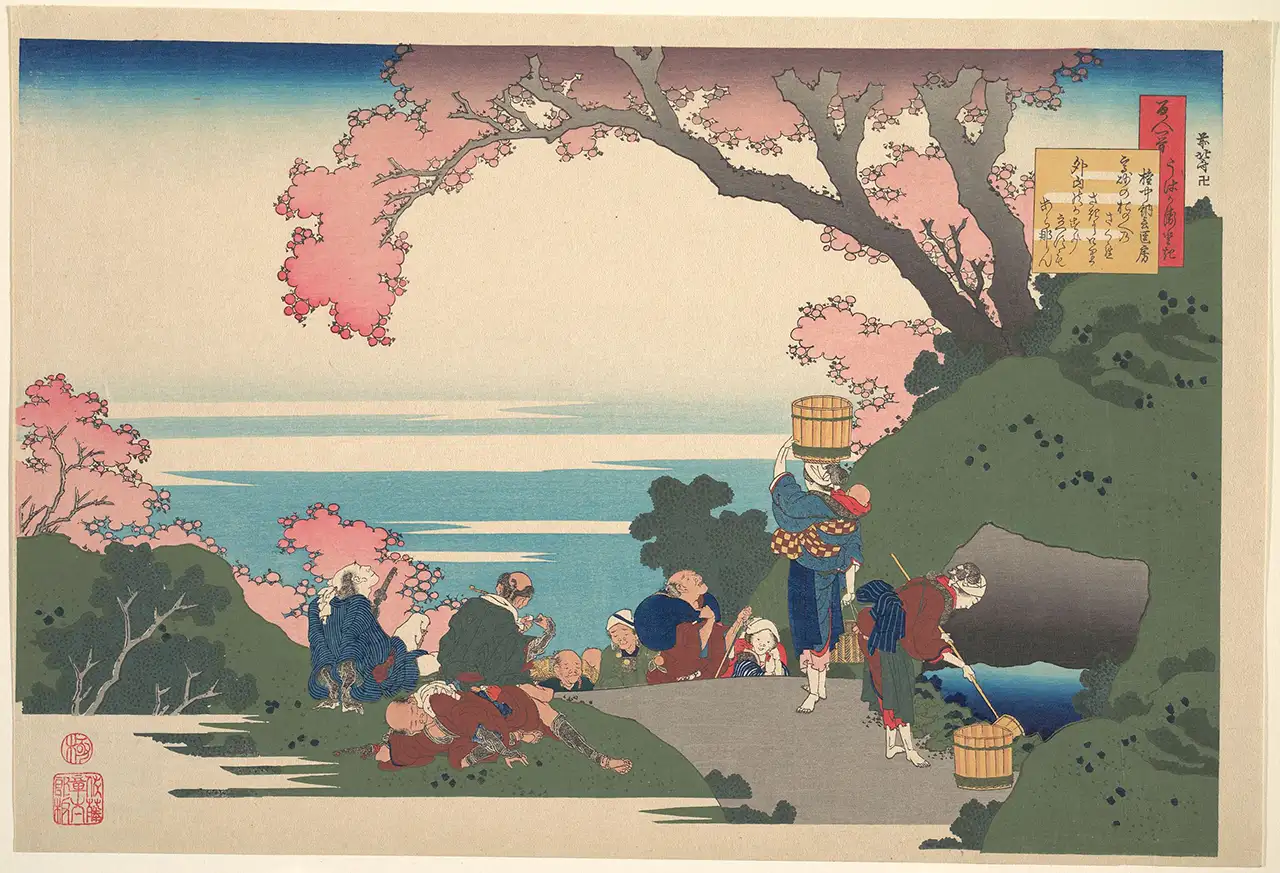
Katsushika Hokusai, CC0, via Wikimedia Commons This print is from One Hundred Poems Explained by the Nurse (Hyakunin Isshu Uba ga Etoki) by Katsushika Hokusai, an ukiyo-e artist of the Edo period. The idea of the series is a nurse explaining the Hyakunin Isshu poems with easy-to-understand pictures.
It shows people enjoying the cherry blossoms on a mountain. But unlike the wish in the poem, haze has risen, and it seems the mountain cherries cannot be seen from far away.
- Akazome Emon's Poem