


Front of the Card
Back of the Card
Japanese
English
Audio: NHK Creative Library
Read by LibriVox volunteer Larry Wilson.
Audio courtesy of LibriVox
待賢門院堀川
長からむ
心もしらず
黒髪の
みだれてけさは
物をこそ思へ
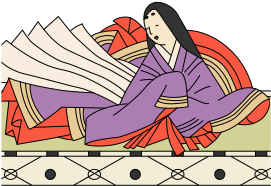
みたれてけ
さはものを
こそおもへ

ながか


- Poem 80
- 長からむ
心もしらず
黒髪の
みだれてけさは 物をこそ思へ
Author: Horikawa, attendant to Empress Taiken (dates unknown)
Source: Senzai Wakashū, Love
- English Verse Translation
- My doubt about his constancy Is difficult to bear; Tangled this morning are my thoughts, As
is my long black hair. I wonder—Does he care?
— William N. Porter, 1909
- Modern Translation
- Not knowing whether your heart will last — I woke this morning with my long black hair in tangles, lost in thought.
- Commentary
- Written on the theme "love" for the Kyūan Hyakushu held by Retired Emperor Sutoku. The worry of a woman waiting for her lover is compared to tangled black hair. Long hair was a sign of beauty in the Heian period, so its tangles stand for the turmoil in her heart.
- About the Poet
- Horikawa served Taikenmon-in, Sutoku's mother, and was active as a poet in his time. In 1142 she became a nun with Taikenmon-in, and she spent her last years at Ninna-ji.
- Poem Illustration
-
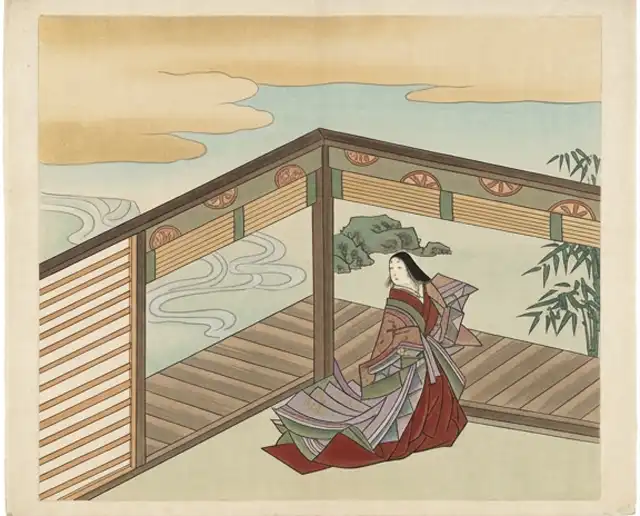
This image is based on an illustration from William N. Porter's A Hundred Verses from Old Japan, his 1909 English translation of the Hyakunin Isshu published in England, colorized and reworked using Adobe Firefly (generative AI).
- Horikawa of Taikenmon-in: A Short Timeline
-
- 1126
- Takes part in the poetry contest at the home of Regent and Minister of the Left Tadamichi
- 1142
- Becomes a nun along with her mistress, Taikenmon-in
- 1145
- Taikenmon-in dies
- 1150
- Presents 100 poems for the Kyūan Hundred-Poem Sequence
- Horikawa's Relationship Chart
-
Horikawa served Taikenmon-in (Fujiwara no Shōshi), the empress of Emperor Toba.
- Appendix
-
- How Poems About "Tangled Hair" Changed over Time
- Since ancient times, "black hair" (kurokami) has often appeared in Japanese literature as a way to show love, sorrow, and a woman's beauty. "Tangled hair" (midaregami) in particular has expressed different feelings of love in each age. In the Man'yōshū, it stands for a heart thrown into confusion by love itself; in the Heian period, tangled hair became a scene that brings back memories of a lover; and in modern times, Yosano Akiko gave it a new meaning, as a way to express passion and her own self.
- The Man'yōshū Age
— A Heart Thrown into Confusion by Love — - In the Man'yōshū age, tangled hair was not a carefully planned mood. The poems simply express a heart in turmoil, unable to bear the pain of love.
In Japanese
ぬばたまの 我が黒髪を 引きぬらし
乱れてさらに 恋ひわたるかも nubatamano wagakurokamio hikinurashi
midaretesarani kohiwatarukamo Man'yōshū, AnonymousIn English
I let down my black hair, and with my heart in turmoil too, I go on longing for you.
"Nubatama no" is a pillow word (makurakotoba) that leads into "black."
- The Mid-Heian Period
— Memories of a Lover's Touch — - In Izumi Shikibu's poem, tangled black hair brings back the memory of a lover who once stroked her hair aside. The hair is shown as a symbol that holds the warmth and touch of a beloved person.
In Japanese
黒髪の 乱れも知らず うち伏せば
まづかきやりし 人ぞ恋しき kurokamino midaremoshirazu uchifuseba
mazukakiyarishi hitozokoishiki Goshūi Wakashū, Izumi ShikibuIn English
As I lie down, lost in thought, not caring that my black hair is tangled, I long for the one who used to stroke my hair aside.
- The Late Heian Period
— Lingering Love, Worry About the Future, and Memories of a Face — -
In the late Heian period, "black hair" grew into a theme that reflected the lingering feelings of love and worry about the future. Horikawa, attendant to Empress Taiken, linked her tangled hair on the morning after a night together with her worry about where the love would lead. Fujiwara no Sadaie, on the other hand, described how the face of a lover comes back to him with every strand of black hair.
In Japanese
長からむ 心もしらず 黒髪の
みだれてけさは 物をこそ思へ nagakaran kokoromoshirazu kurogamino
midaretekesaha monookosoomoe Senzai Wakashū, Horikawa, attendant to Empress TaikenIn English
I cannot tell whether your heart, which promised to love me forever, will last. This morning after we parted, my heart is as tangled as my black hair, and I am lost in thought.
In Japanese
かきやりし その黒髪の すぢごとに
うち臥すほどは 面影ぞ立つ kakiyarishi sonokurokamino sujigotoni
uchifusuhodoha omokagezotatsu Shin Kokin Wakashū, Fujiwara no SadaieIn English
In every strand of the black hair I stroked aside, your face appears before me.
- Modern Times
— Self-Expression and Passion — - Midaregami (Tangled Hair) is a poetry collection born from the love between Yosano Akiko and Yosano Tekkan, who had a wife and child.
At a time when society's rules were strict, it became known as a work that openly expressed her own love and passion.In Japanese
黒髪の 千すぢの髪の みだれ髪
かつおもひみだれ おもひみだるる kurokamino chisujinokamino midaregami
katsuomohimidare omohimidaruru Midaregami, Yosano AkikoIn English
Just as my black hair is tangled in a thousand strands, my heart too is tangled, and I worry over this and that.