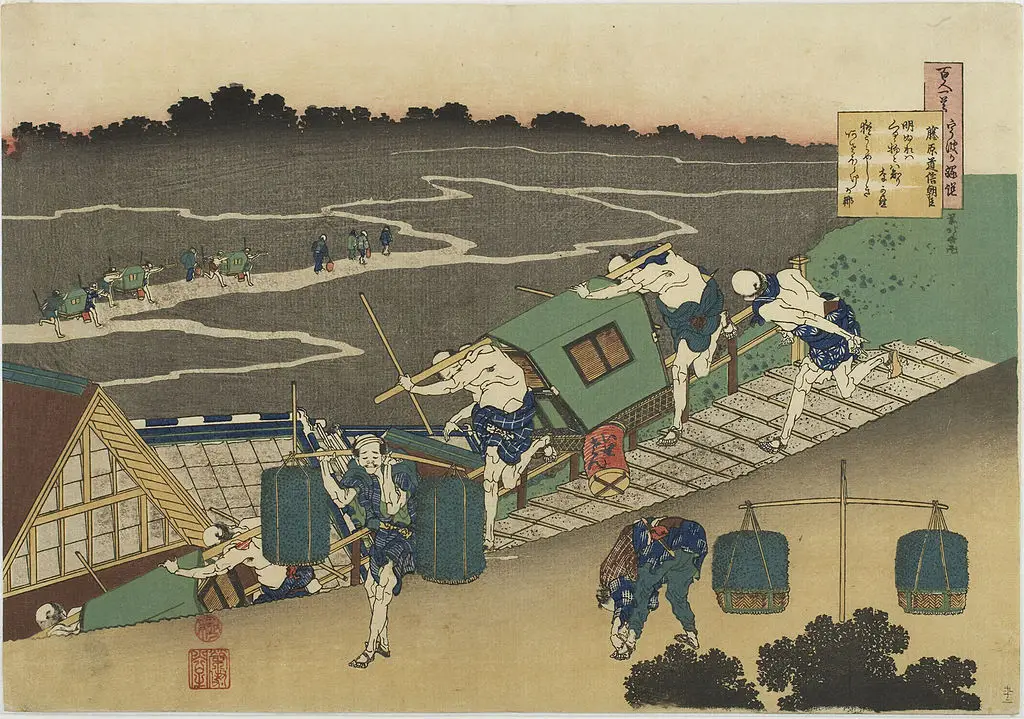
Front of the Card
Back of the Card
Japanese
English
Audio: NHK Creative Library
Read by LibriVox volunteer Larry Wilson.
Audio courtesy of LibriVox
藤原道信朝臣
明けぬれば
暮るるものとは
知りながら
なほうらめしき
朝ぼらけかな
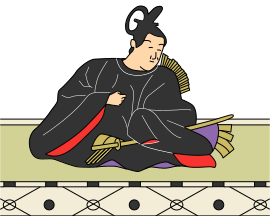
なほうらめ
しきあさほ
らけかな

あけ


- Poem 52
- 明けぬれば
暮るるものとは
知りながら
なほうらめしき 朝ぼらけかな
Author: Fujiwara no Michinobu Ason (972–994)
Source: Go Shūi Wakashū, Love
- English Verse Translation
- Although I know the gentle night Will surely follow morn, Yet, when I'm wakened by the sun,
Turn over, stretch and yawn— How I detest the dawn!
— William N. Porter, 1909
- Modern Translation
- I know that after dawn comes dusk — and yet how I resent this pale morning sky.
- Commentary
- Even knowing they will meet again when night falls, he still finds the dawn parting painful and hateful. In the Heian period lovers met only at night and had to part in the morning. The poem shows his wish not to leave his love even for a moment.
- About the Poet
- Fujiwara no Michinobu was raised as the adopted son of his uncle, Fujiwara no Kaneie, the Regent. The Ōkagami calls him a fine poet of quiet, gentle character. Much was expected of him, but he died of smallpox at only 23.
- Poem Illustration
-
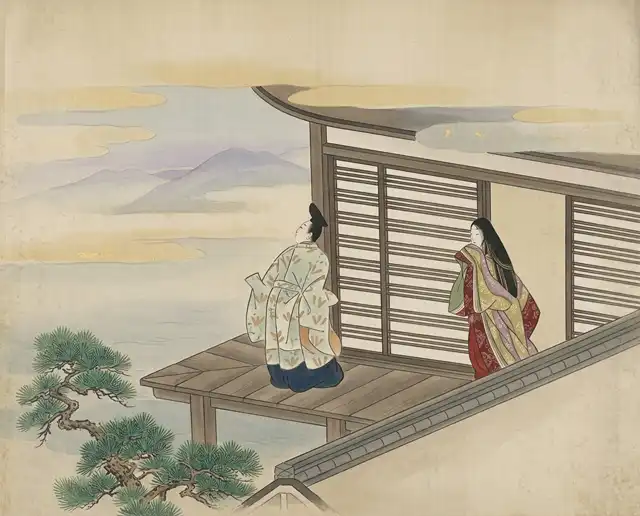
This image is based on an illustration from William N. Porter's A Hundred Verses from Old Japan, his 1909 English translation of the Hyakunin Isshu published in England, colorized and reworked using Adobe Firefly (generative AI).
- Fujiwara no Michinobu: A Short Timeline
-
- 972
- Born as a son of Fujiwara no Tamemitsu
- 986
- Adopted by Fujiwara no Kaneie and holds his coming-of-age ceremony
- 988
- Becomes Minor Captain of the Left Palace Guards
- 991
- Becomes Middle Captain of the Left Palace Guards
- 994
- Dies
- Fujiwara no Michinobu's Family Tree
-
Fujiwara no Michinobu was the third son of Fujiwara no Tamemitsu. He came of age as the adopted son of his uncle, Fujiwara no Kaneie, who had just become Regent (sesshō) for Emperor Ichijō, and was given Junior Fifth Rank, Upper Grade. His real father, Tamemitsu, died when Michinobu was 21. He served as a provincial official in Bingo, Echizen, Tango, and other places, and his final post and rank were Middle Captain of the Left Palace Guards and Junior Fourth Rank, Upper Grade.
- Appendix
-
- A Poem of Lost Love Sent to an Emperor's Consort
-
Michinobu sent this poem to Princess Enshi. She was a granddaughter of Emperor Murakami and a consort (nyōgo) of Emperor Kazan. Perhaps because of the difference in their rank, his love could not come true, and he is said to have put his sad feelings into this poem.

In Japanese
嬉しきは いかばかりかは 思ふらむ
憂きは身にしむ 心地こそすれ ureshikiha ikabakarikaha omofuramu
ukihaminishimu kokochikososure Shika Wakashū, Fujiwara no MichinobuIn English
How happy you must be, now that your love has come true.
As for me, who lost my love, the sorrow soaks deep into my heart. - Linked Verse with Ise no Taifu
- The next poem is a linked verse (renga) by Fujiwara no Michinobu and Ise no Taifu.
When Michinobu was passing the rooms of Akiko, Emperor Ichijō's empress, holding yamabuki (kerria) flowers, the ladies-in-waiting begged him to compose a poem. So Michinobu wrote the upper verse, and Ise no Taifu wrote the lower verse.
In Japanese
くちなしに ちしほやちしほ
染めてけり
こはえも言はぬ
花の色かな kuchinashini chishihoyachishiho sometekeri
kohaemoihanu hananoirokana Toshiyori ZuinōIn English
I, who hold feelings I cannot speak, like the kuchinashi (gardenia, "no mouth"),
carry these yamabuki flowers, dyed again and again in gardenia yellow.
What a color, too lovely for words!Yamabuki has yellow flowers. The fruit of the kuchinashi (gardenia) is used as a dye and gives a yellow color. "Kuchinashi" also means "no mouth," that is, unable to speak. In the lower verse, "e mo iwanu" (beyond words) answers that "no mouth."
- His Death Poem
- Here is one more gardenia poem: Michinobu's death poem.
Just before he died of illness, Michinobu sent this poem, together with a robe the color of yamabuki, to the woman he loved.
In Japanese
くちなしの 園にやわが身
入りにけむ
思ふことをも
言はでやみぬる kuchinashino sononiyawagami irinikemu
omofukotoomo ihadeyaminuru Senzai Wakashū, Fujiwara no MichinobuIn English
Have I wandered into a garden of gardenias ("no mouth")?
My life is ending without my being able to say what I feel. - Ukiyo-e by Katsushika Hokusai
-
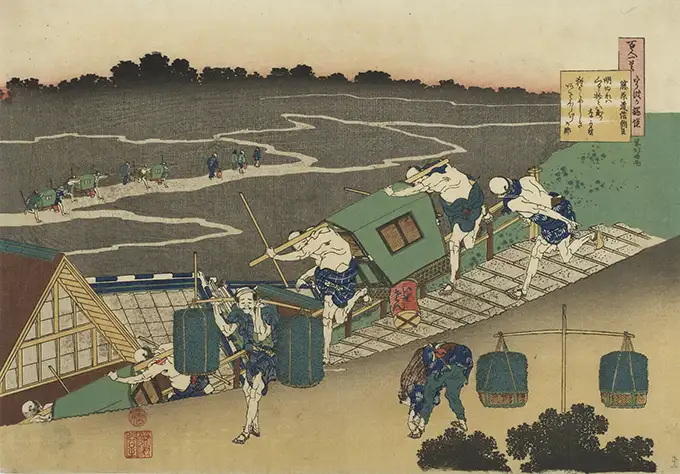
Katsushika Hokusai, Public domain, via Wikimedia Commons This print is from One Hundred Poems Explained by the Nurse (Hyakunin Isshu Uba ga Etoki) by Katsushika Hokusai, an ukiyo-e artist of the Edo period. The idea of the series is a nurse explaining the Hyakunin Isshu poems with easy-to-understand pictures. It shows palanquin bearers carrying customers who have spent the night in the Yoshiwara pleasure quarter. Hokusai seems to have seen, in the customers inside the palanquins, the feeling of resenting the dawn.