


Front of the Card
Back of the Card
Japanese
English
Audio: NHK Creative Library
Read by LibriVox volunteer Larry Wilson.
Audio courtesy of LibriVox
謙徳公
あはれとも
いふべき人は
思ほえで
身のいたづらに
なりぬべきかな
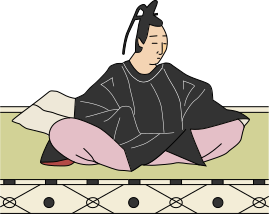
みのいたつ
らになりぬ
へきかな

あわれ


- Poem 45
- あはれとも
いふべき人は
思ほえで
身のいたづらに なりぬべきかな
Author: Kentoku-kō (924–972)
Source: Shūi Wakashū, Love
- English Verse Translation
- I dare not hope my lady-love Will smile on me again; She knows no Pity, and my life I care
not to retain, Since all my prayers are vain.
— William N. Porter, 1909
- Modern Translation
- There is no one who might show even a little compassion. I feel as though my life will simply fade away, just like that.
- Commentary
- The Shūi Wakashū says this poem is about the pain of lost love. That a man known for reaching the height of power pours out his broken heart and begs only for pity shows that even the most powerful cannot control love.
- About the Poet
- Kentoku-kō is the name given after death to Fujiwara no Koretada, grandson of Teishin-kō and son of Minister of the Right Fujiwara no Morosuke. His father told him to live simply, but he lived in luxury. Late in life, his daughter bore the future Emperor Kazan, and he rose to regent and Chancellor, but he died the next year at 49.
- Poem Illustration
-
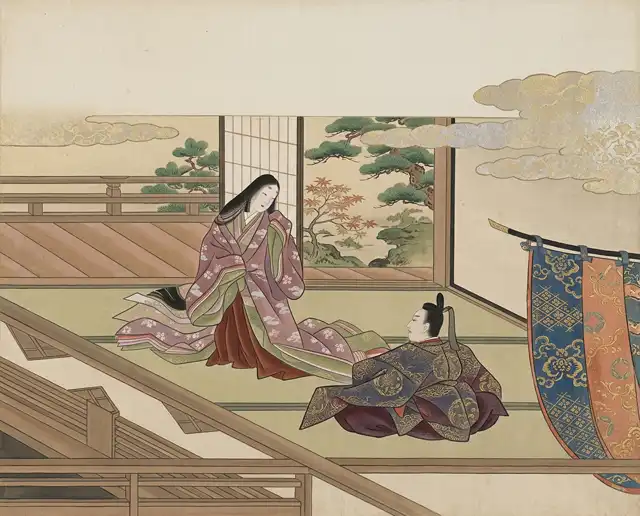
This image is based on an illustration from William N. Porter's A Hundred Verses from Old Japan, his 1909 English translation of the Hyakunin Isshu published in England, colorized and reworked using Adobe Firefly (generative AI).
- Fujiwara no Koretada (Kentoku-kō): A Short Timeline
-
- 924
- Born as a son of Fujiwara no Morosuke
- 951
- Becomes head of the Office of Poetry and leads the Five Men of the Pear Pavilion
- 967
- Becomes Acting Middle Counselor
- 970
- Becomes Minister of the Right and Regent (Sesshō)
- 971
- Becomes Chancellor of the Realm
- 972
- Dies; later given Senior First Rank and the name Kentoku-kō after death
- Kentoku-kō (Fujiwara no Koretada)'s Family Tree
-
Kentoku-kō was the eldest son of Minister of the Right Fujiwara no Morosuke, and a grandson of Teishin-kō, who served as Regent, Kampaku (chief adviser), and Chancellor of the Realm.
His daughter, Fujiwara no Kaishi, became a consort (nyōgo) of Emperor Reizei and gave birth to Emperor Kazan. But Koretada died in 972, before Kazan took the throne. After his death, Kaneie and others in the Fujiwara clan gradually gained power and in time took control of the government. Emperor Kazan came to the throne in 984, but he reigned only about two years and gave up the throne in 986.
Kentoku-kō's third son, Fujiwara no Yoshitaka, was also chosen for the Hyakunin Isshu. Yoshitaka's son was Fujiwara no Yukinari, a master calligrapher and one of the Three Great Calligraphers (Sanseki).
- Appendix
-
- Head of the Office of Poetry
- On the orders of Emperor Murakami, Fujiwara no Koretada was made head (bettō) of the Office of Poetry (Wakadokoro), set up to compile the Gosen Wakashū. Because the office was in the Nashitsubo (Pear Pavilion), the compilers of the Gosen Wakashū (Kiyohara no Motosuke, Ōnakatomi no Yoshinobu, Minamoto no Shitagō, Sakanoue no Mochiki, and Ki no Tokibumi) are called the "Five Men of the Pear Pavilion."
- Ichijō Sesshō Gyoshū
- Fujiwara no Koretada's personal poetry collection. Writing as if he were Kurahashi no Toyokage, a low-ranking clerk of the Ministry of the Treasury, Koretada tells of his own love affairs in the style of a poem-tale (uta monogatari). His Hyakunin Isshu poem, "Aware tomo...," is placed at the very beginning of this collection.