Front of the Card
Back of the Card
Japanese
English
Audio: NHK Creative Library
Read by LibriVox volunteer Larry Wilson.
Audio courtesy of LibriVox
中納言敦忠
逢ひ見ての
のちの心に
くらぶれば
昔は物を
思はざりけり
むかしはも
のをおもは
さりけり

あい


- Poem 43
- 逢ひ見ての
のちの心に
くらぶれば
昔は物を 思はざりけり
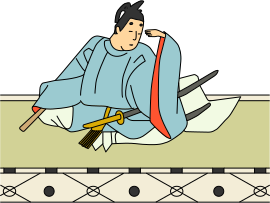
Author: Middle Counselor Atsutada (906–943)
Source: Shūi Wakashū, Love
- English Verse Translation
- How desolate my former life, Those dismal years, ere yet I chanced to see thee face to face
'Twere better to forget Those days before we met.
— William N. Porter, 1909
- Modern Translation
- Compared to this feeling after meeting you, the longing I felt before seems like nothing at all.
- Commentary
- The Shūishō says this was sent the morning after the poet first spent the night with a woman, a so-called morning-after poem. Atsutada is known to have loved Ukon (Poem 38), but he had affairs with many women, so we cannot be sure whom it was for.
- About the Poet
- Fujiwara no Atsutada was the third son of Minister of the Left Fujiwara no Tokihira. Gifted at poetry and the biwa, he died of illness at only 38. Because his father had brought down Sugawara no Michizane, rumors spread that Michizane's angry spirit had cursed him.
- Poem Illustration
-
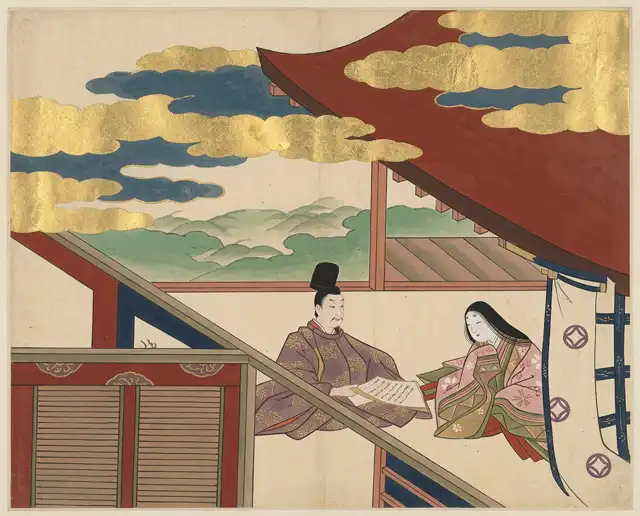
This image is based on an illustration from William N. Porter's A Hundred Verses from Old Japan, his 1909 English translation of the Hyakunin Isshu published in England, colorized and reworked using Adobe Firefly (generative AI).
- Fujiwara no Atsutada: A Short Timeline
-
- 906
- Born as a son of Fujiwara no Tokihira
- 934
- Becomes Head Chamberlain (Kurōdo no Tō)
- 939
- Becomes Councillor (Sangi)
- 942
- Given Junior Third Rank and becomes Acting Middle Counselor
- 943
- Dies
- Notes
-
- Counted as one of the Thirty-Six Immortal Poets
- Middle Counselor Atsutada's Family Tree
-
Fujiwara no Atsutada was the son of Minister of the Left Fujiwara no Tokihira. In the Shōtai Incident of 901, Tokihira played the central role in having Sugawara no Michizane sent away to Dazaifu. People believed that Michizane became an angry spirit after his death. In 908, Fujiwara no Sugane, who had taken part in Tokihira's plot, was struck by lightning and died suddenly, and Tokihira himself died suddenly in 909 at the age of 39. Then, in 930, lightning struck the Seiryōden hall of the palace, and Fujiwara no Kiyotsura, another who had taken part in Tokihira's plot, also died suddenly.
Because the men of his family died young, Atsutada is said to have expected a short life himself. He died in 943, at only 38.
- Appendix
-
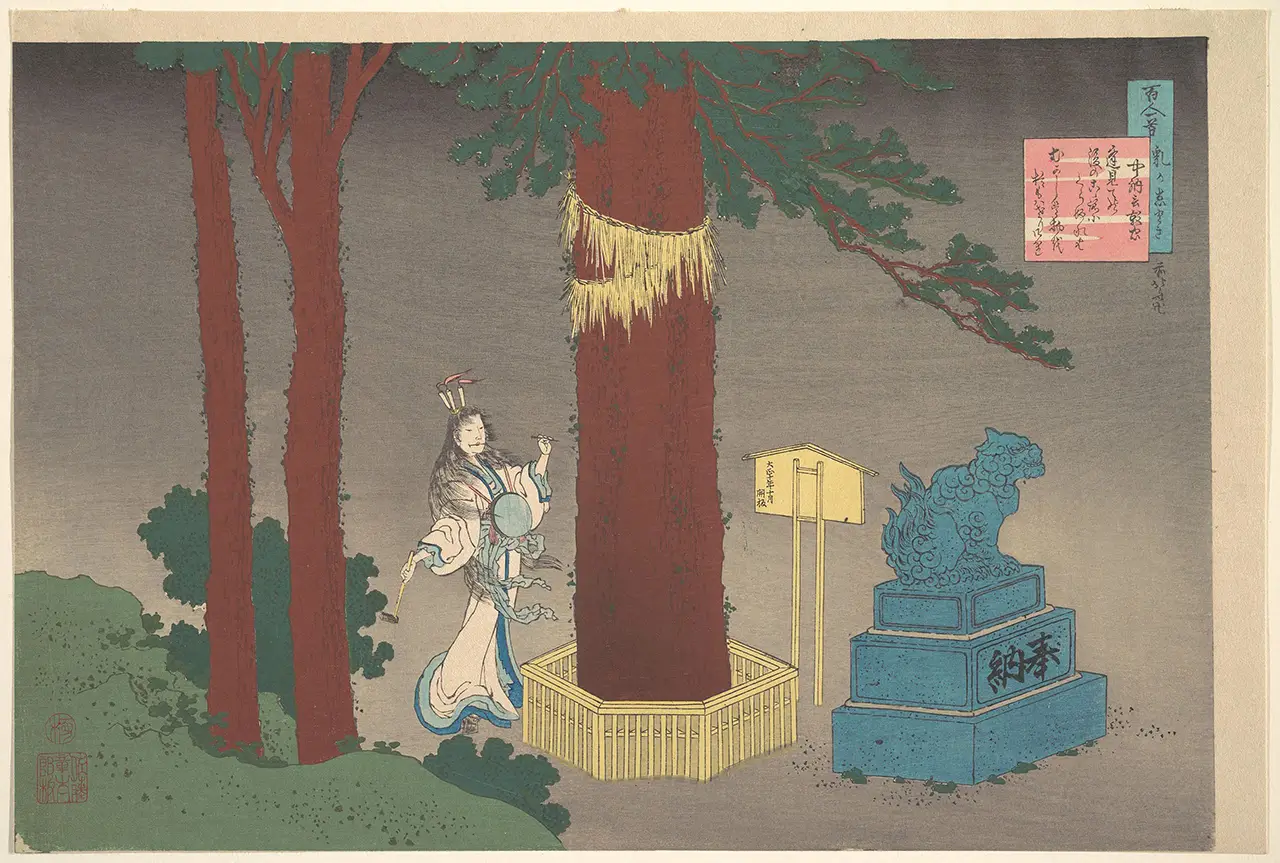
- Ukiyo-e by Katsushika Hokusai
-
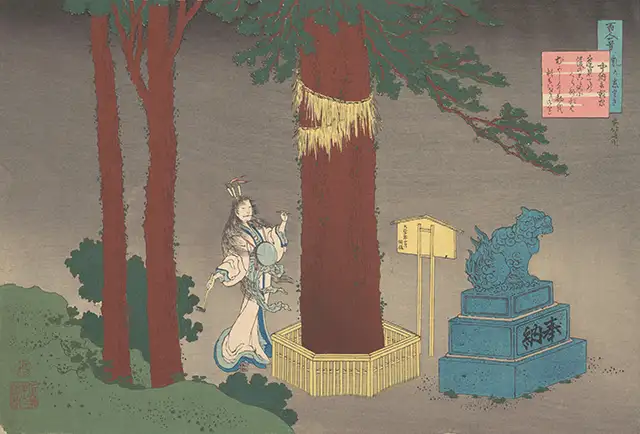
Katsushika Hokusai, CC0, via Wikimedia Commons This print is from One Hundred Poems Explained by the Nurse (Hyakunin Isshu Uba ga Etoki) by Katsushika Hokusai, an ukiyo-e artist of the Edo period. The idea of the series is a nurse explaining the Hyakunin Isshu poems with easy-to-understand pictures.
For some reason, this picture shows ushi no koku mairi, a kind of curse in which a person goes to a shrine at around 1 to 3 a.m. and nails a straw doll, standing for the hated person, to the shrine's sacred tree. Ukon wrote a poem worrying that Atsutada would be punished by the gods. If the woman in this picture is Ukon, her poem may really have been an ironic jab at the man who left her.
In the Heian period, a woman who was not a man's principal wife, even if they were married, faced an unfair situation: the relationship simply ended when he stopped visiting her. By the way, ushi no koku mairi seems to have been done only by women.
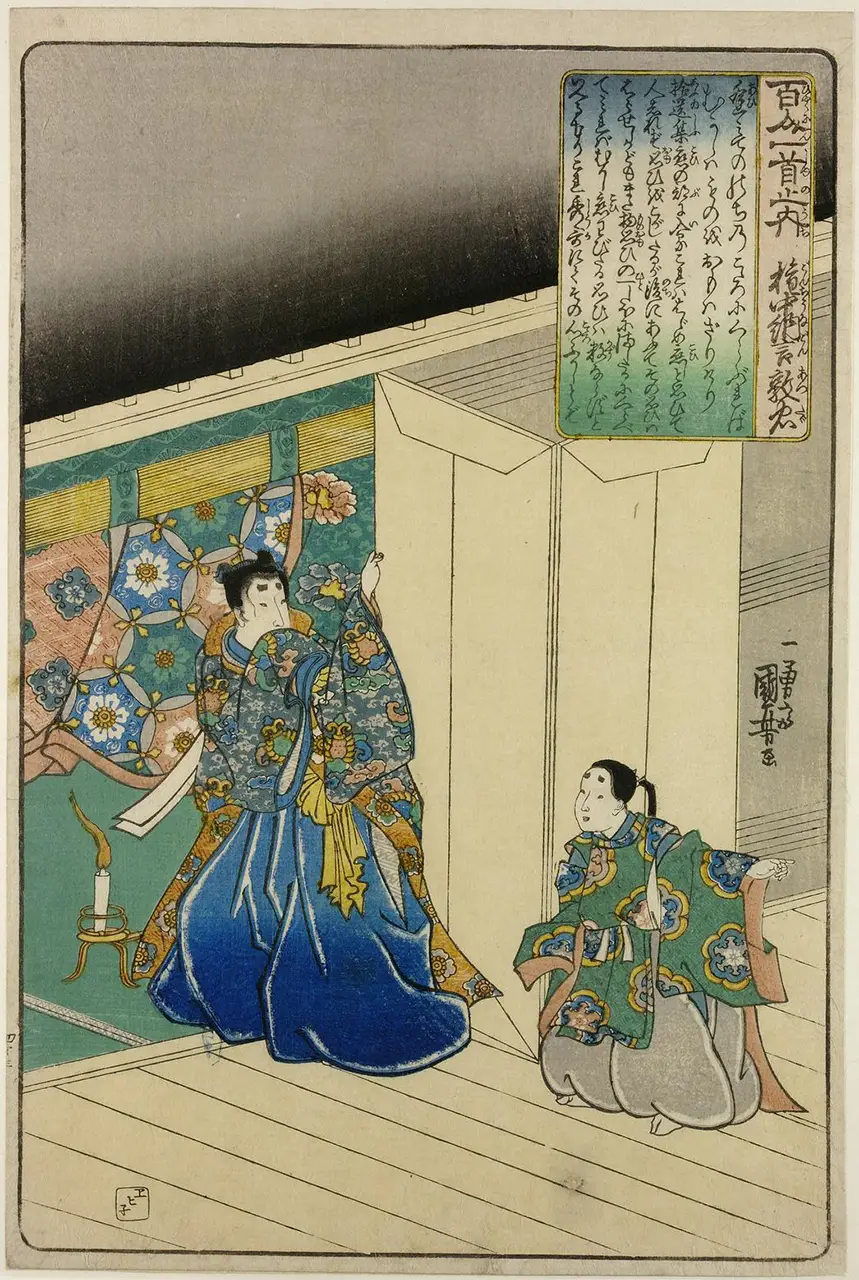
- Utagawa Kuniyoshi's Hyakunin Isshu no Uchi
-
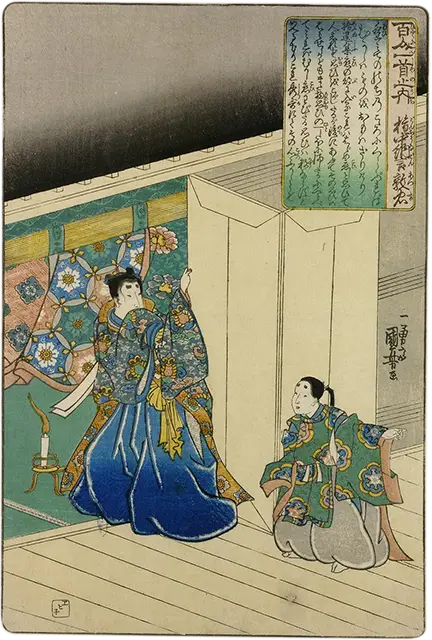
British Museum, Public domain, via Wikimedia Commons This ukiyo-e print is by Utagawa Kuniyoshi, an artist of the Edo period.
It shows a scene to go with the Hyakunin Isshu poem.