Front of the Card
Back of the Card
Japanese
English
Audio: NHK Creative Library
Read by LibriVox volunteer Larry Wilson.
Audio courtesy of LibriVox
右近
忘らるる
身をば思はず
誓ひてし
人の命の
惜しくもあるかな
ひとのいの
ちのをしく
もあるかな

わすら


- Poem 38
- 忘らるる
身をば思はず
誓ひてし
人の命の 惜しくもあるかな
Author: Ukon (dates unknown)
Source: Shūi Wakashū, Love
- English Verse Translation
- My broken heart I don't lament, To destiny I bow; But thou hast broken solemn oaths,— I pray
the Gods may now Absolve thee from thy vow.
— William N. Porter, 1909
- Modern Translation
- I do not grieve for myself, though I am forgotten. But I worry for you — you who swore an oath. What will become of you?
- Commentary
- A lover who swore by the gods to love her has left her, and she worries the gods will punish him. Some read it as deep love, but he may have been frightened. The Yamato Monogatari says he was Middle Counselor Atsutada, who died young at 38. Divine punishment?
- About the Poet
- Ukon was a lady-in-waiting to Empress Onshi, wife of Emperor Daigo. Her name comes from her father's post in the Right Palace Guards (Ukon'e). The Yamato Monogatari tells of her loves with many men.
- Poem Illustration
-
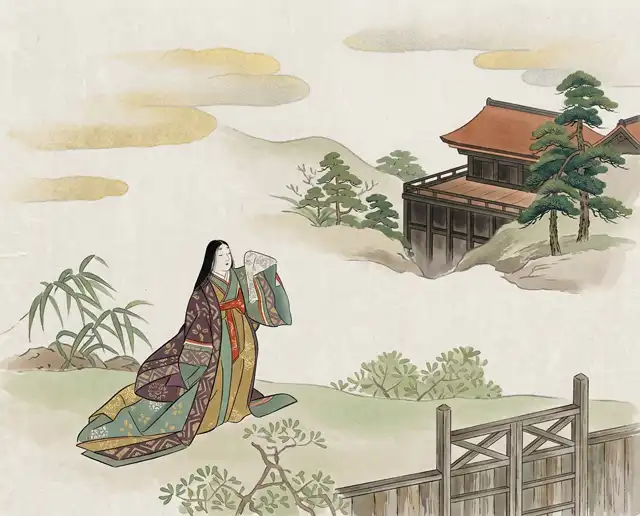
This image is based on an illustration from William N. Porter's A Hundred Verses from Old Japan, his 1909 English translation of the Hyakunin Isshu published in England, colorized and reworked using Adobe Firefly (generative AI).
- Ukon: A Short Timeline
-
- 960
- Takes part in the Palace Poetry Contest of the Tentoku Era
- 962
- Takes part in the Palace Poetry Contest of the 2nd year of Ōwa
- 966
- Takes part in the Palace Garden Plant Contest
- Notes
-
- Served Onshi, empress of Emperor Daigo
- Ukon's Family Tree
-
Ukon's name comes from the post of her father, Fujiwara no Suenawa, who was a Minor Captain of the Right Palace Guards (Ukon'e no Shōshō).
She served Empress Onshi, the consort of Emperor Daigo, as a lady-in-waiting, and was known as a poet who had many loves.
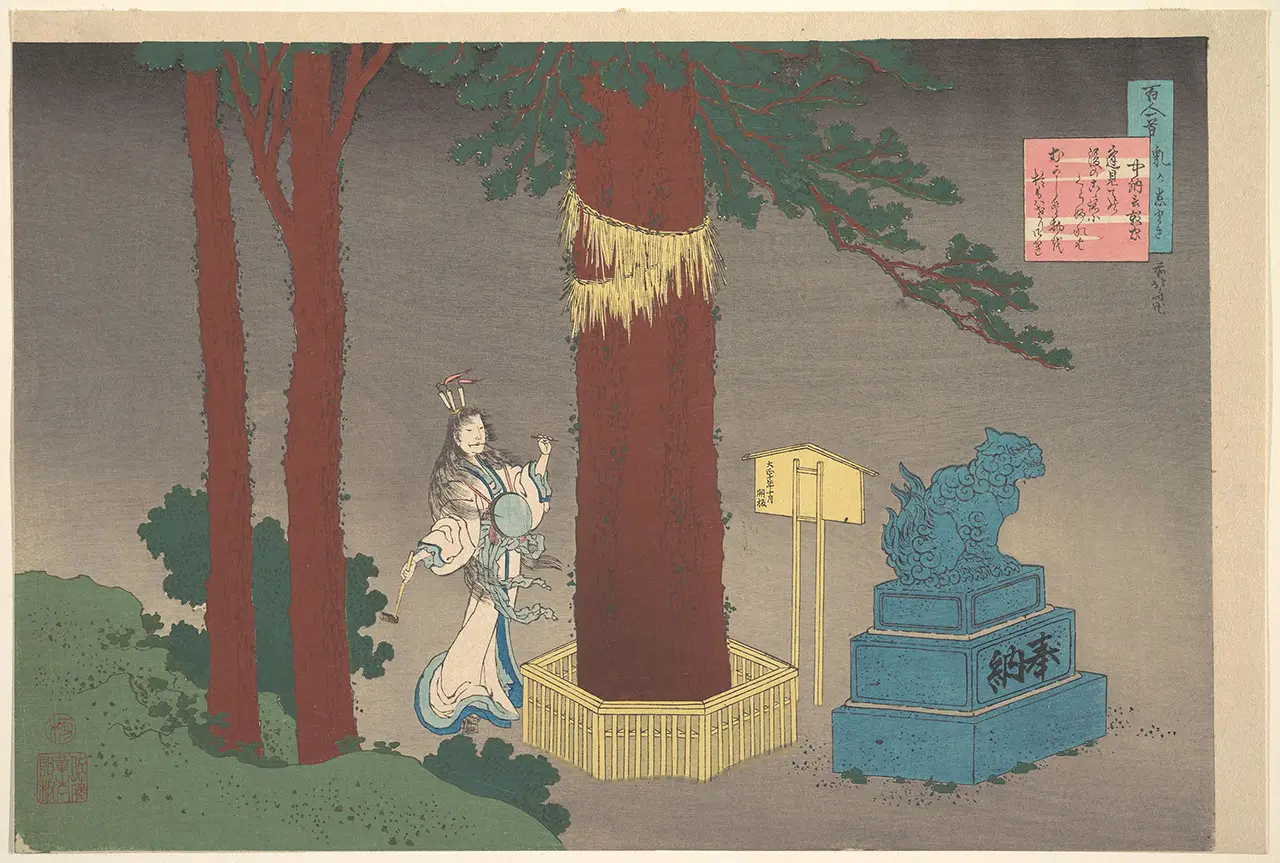
Her poem "Wasuraruru..." is said to have been sent to Fujiwara no Atsutada (Middle Counselor Atsutada). It is not clear whether she truly meant to worry about him or to curse him for leaving her. Katsushika Hokusai made an interesting ukiyo-e print for Atsutada's Hyakunin Isshu poem. Please take a look.
- Appendix
-
- Sei Shōnagon's "Wasuraruru" Poem
- Sei Shōnagon also wrote a poem that begins with "Wasuraruru." Its headnote says it was sent "to a man whose heart had changed," so it too was written to a man who had lost interest in her. Its feelings are easy for people today to understand.
In Japanese
忘らるる 身のことわりと 知りながら
思ひあへぬは 涙なりけり wasuraruru minokotowarito shirinagara
omohiahenuha namidanarikeri Shika Wakashū, Sei ShōnagonIn English
I understand why you have forgotten me,
and yet my tears will not stop. - Ukon's Poem in The Tale of Genji
- Ukon's Hyakunin Isshu poem is used to great effect in The Tale of Genji, in a scene that shows how a man and a woman can fail to understand each other. Murasaki no Ue waited in the capital, trusting Hikaru Genji's promise, made as he left for Suma, that he would stay with her as long as he lived. But Genji had an affair with the Akashi Lady, who became pregnant, and then came back to the capital. Murasaki no Ue was deeply hurt. At that moment she murmured to Genji, "mi wo ba omowazu" ("I do not think of myself"), part of Ukon's poem. Behind these words was probably her sadness at being betrayed, but Genji took them as jealousy and found her charming. The quotation of Ukon's poem makes the gap between their hearts stand out strongly.
- Ukiyo-e by Katsushika Hokusai
-
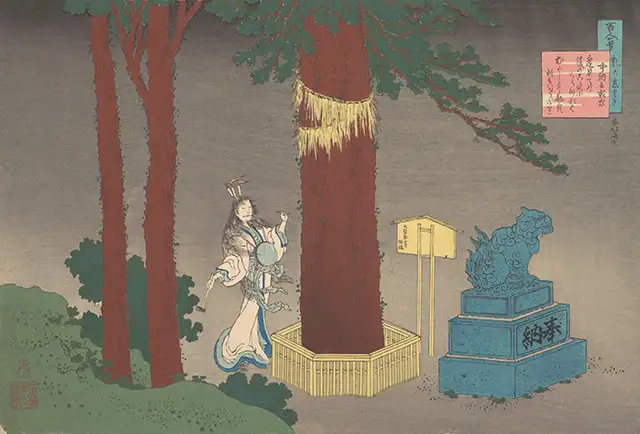
Katsushika Hokusai, CC0, via Wikimedia Commons This print is from Hokusai's One Hundred Poems Explained by the Nurse, made for the poem by Fujiwara no Atsutada, who is said to have been Ukon's lover.
The woman here is doing ushi no koku mairi, a kind of curse in which a person goes to a shrine at around 1 to 3 a.m. and nails a straw doll, standing for the hated person, to the shrine's sacred tree. She may be meant as Ukon, who wrote a poem worrying that the lover who swore eternal love might lose his life as punishment from the gods. Of course, this is not a confirmed historical fact.
In the Heian period, a woman who was not a man's principal wife, even if they were married, faced an unfair situation: the relationship simply ended when he stopped visiting her. By the way, ushi no koku mairi seems to have been done only by women.
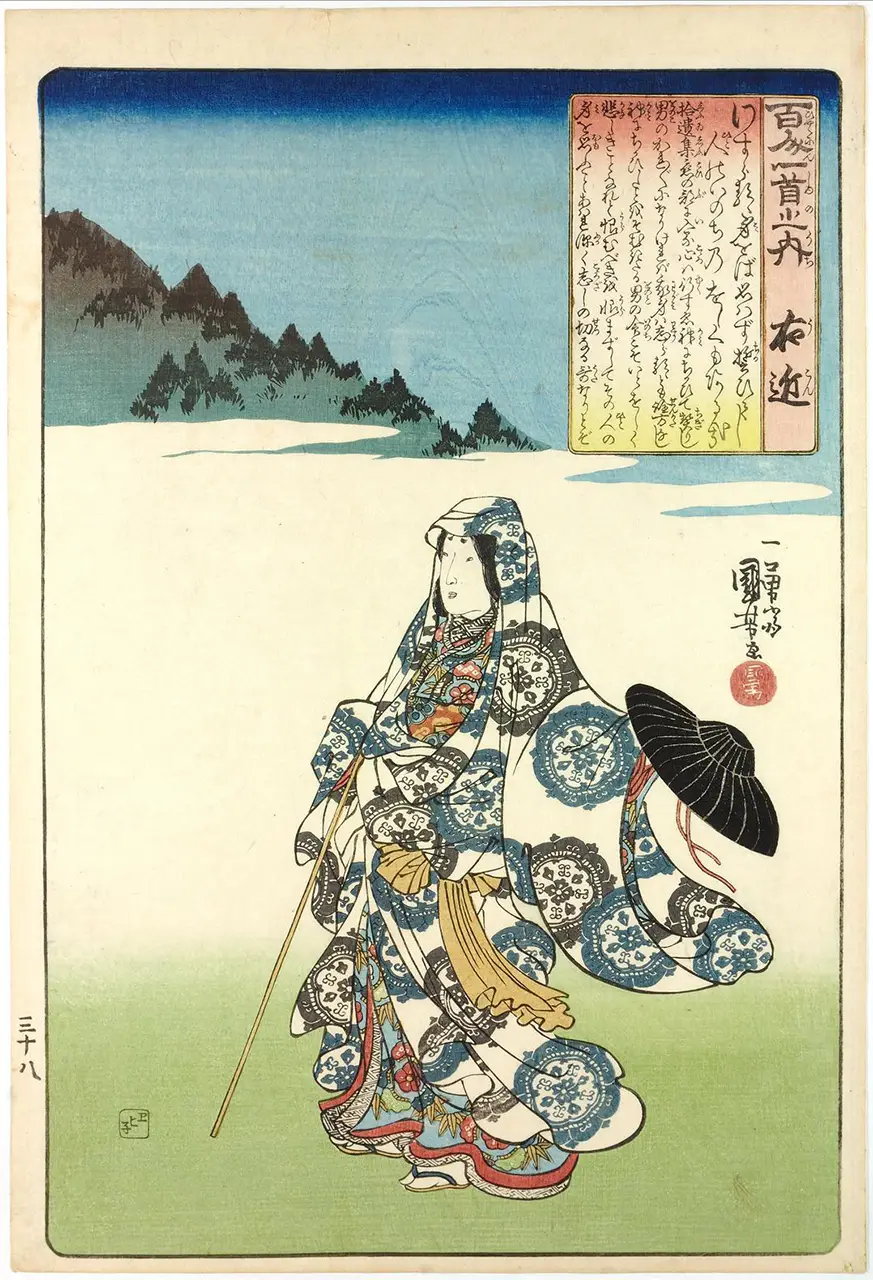
- Utagawa Kuniyoshi's Hyakunin Isshu no Uchi
-
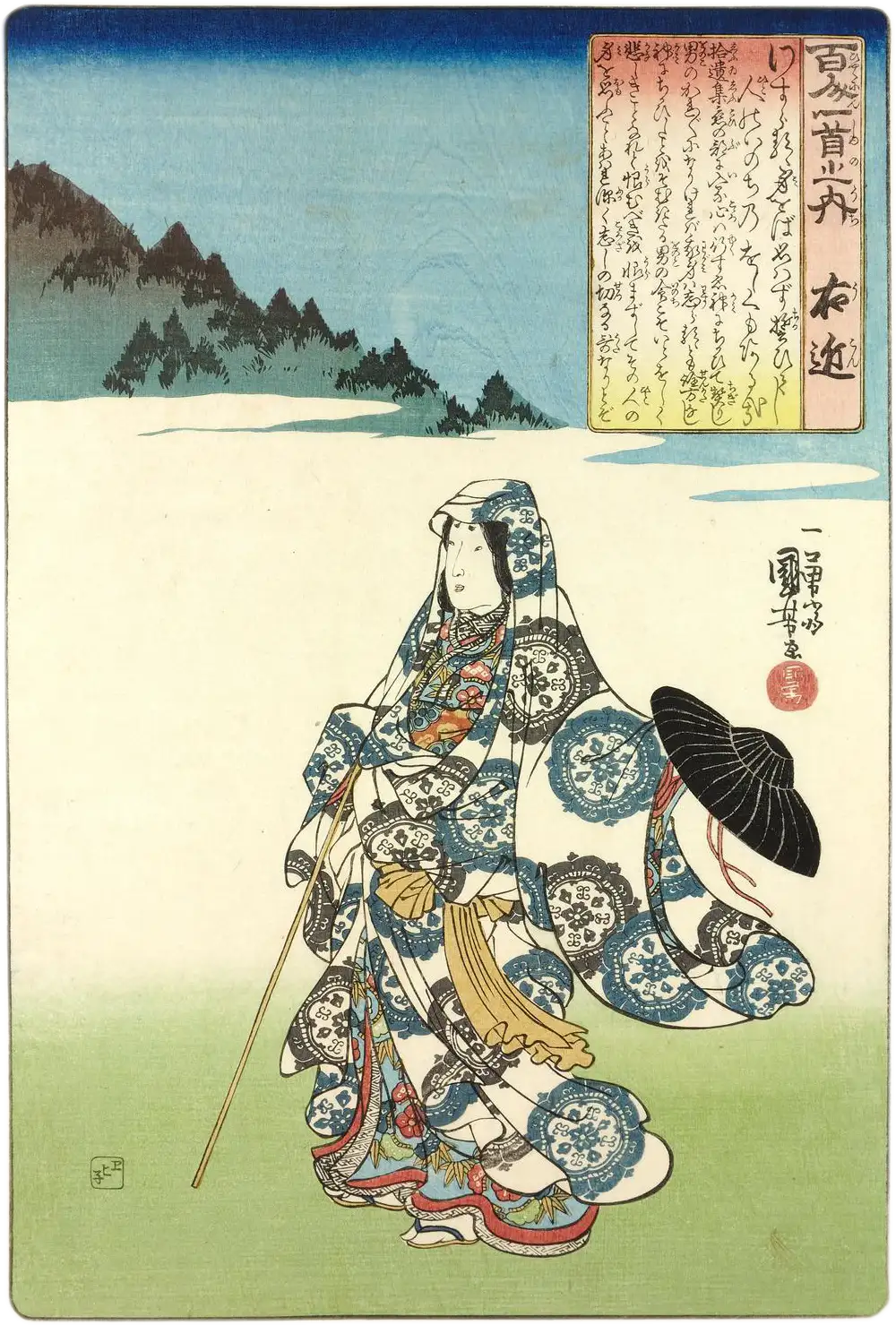
British Museum, Public domain, via Wikimedia Commons This print is by Utagawa Kuniyoshi, an ukiyo-e artist of the Edo period. It is one of a series that pictures the Hyakunin Isshu poems in his own way, and it shows Ukon, who shone in the court salons of the Heian period.
Ukon is called a gifted woman not just because she wrote good poems. As a lady-in-waiting to Empress Onshi, consort of Emperor Daigo, she had deep learning and a witty way with words that let her hold her own with leading cultural figures such as Ki no Tsurayuki.
Her intelligence shows best in her Hyakunin Isshu poem "Wasuraruru...." Rather than simply grieving over a betrayed love, she seems to have added a deliberate, ironic twist: "I am worried that you, who swore to the gods that you loved me, will be punished by them for breaking that promise."