Front of the Card
Back of the Card
Japanese
English
Audio: NHK Creative Library
Read by LibriVox volunteer Larry Wilson.
Audio courtesy of LibriVox
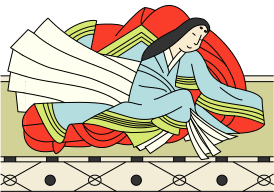
清少納言
夜をこめて
鳥のそらねは
はかるとも
よに逢坂の
関は許さじ
よにあふさ
かのせきは
ゆるさし

よを


- Poem 62
- 夜をこめて
鳥のそらねは
はかるとも
よに逢坂の 関は許さじ
Author: Sei Shōnagon (c. 966–c. 1025)
Source: Go Shūi Wakashū, Miscellaneous
- English Verse Translation
- Too long to-night you've lingered here, And, though you imitate The crowing of a cock, 'twill
not Unlock the tollbar gate; Till daylight must you wait.
— William N. Porter, 1909
- Modern Translation
- Even if you try to fool me with a crowing rooster in the night — I will not open the Barrier of Ōsaka for you.
- Commentary
- One night Sei Shōnagon talked late with Fujiwara no Yukinari, but he left before dawn, writing next morning that a rooster's crow had made him hurry. She asked if he meant the rooster of Hangu Pass, a Chinese tale in which a fake cock's crow opened a gate at night. When he said he meant the Ōsaka Barrier, she wrote this poem: "You won't fool me."
- About the Poet
- Sei Shōnagon was the great-granddaughter of Kiyohara no Fukayabu and the daughter of Kiyohara no Motosuke. She served Empress Teishi and wrote The Pillow Book, Japan's oldest book of essays.
- Poem Illustration
-
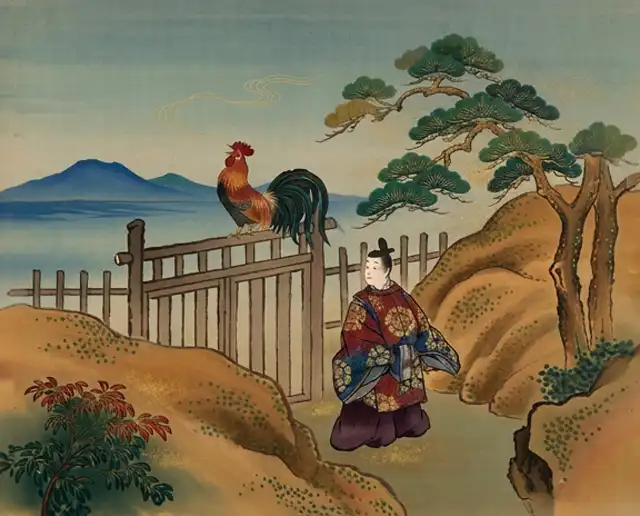
This image is based on an illustration from William N. Porter's A Hundred Verses from Old Japan, his 1909 English translation of the Hyakunin Isshu published in England, colorized and reworked using Adobe Firefly (generative AI).
- Sei Shōnagon: A Short Timeline
-
- c. 966
- Born as a daughter of Kiyohara no Motosuke
- 974
- Goes with her father when he becomes governor of Suō Province
- c. 981
- Marries Tachibana no Norimitsu
- 993
- Serves Empress Teishi as a lady-in-waiting
- 1000
- Empress Teishi dies, and later Sei Shōnagon leaves court service
- After 1000
- Finishes The Pillow Book
- c. 1025
- Dies
- Sei Shōnagon's Family Tree
-
Sei Shōnagon's name comes from her family name, Kiyohara (the "Sei" is another reading of the first character). The Kiyohara clan includes many descendants of Prince Toneri, a son of Emperor Tenmu.
Her great-grandfather was Kiyohara no Fukayabu, and her father was Kiyohara no Motosuke. From about age 9 to 12, Sei Shōnagon lived in Suō Province with her father, Motosuke, who was its governor.
At about 16 she married Tachibana no Norimitsu and had a son, Tachibana no Norinaga. Norinaga is said to have later married an elder or younger sister of Priest Nōin.
At about 27, Sei Shōnagon began serving Teishi, empress (chūgū) of Emperor Ichijō, and she is said to have written The Pillow Book around age 30. At about 33 she drifted apart from Tachibana no Norimitsu and later married Fujiwara no Muneyo. Their daughter, Koma no Myōbu, served Akiko, empress (chūgū) of Emperor Ichijō.
- Sei Shōnagon, Who Served Empress Teishi
-
- Appendix
-
- Fujiwara no Yukinari's Answer
- Fujiwara no Yukinari, to whom Sei Shōnagon sent the poem "Yo wo komete...," answered as follows.
His poem says he hopes she will be waiting for him.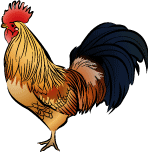
In Japanese
逢坂は 人越えやすき 関なれば
鳥鳴かぬにも 開けて待つとか ousakaha hitokoeyasuki sekinareba
torinakanunimo aketematsutoka The Pillow Book, Fujiwara no YukinariIn English
The Ōsaka Barrier is easy for people to cross,
so I hear it opens and waits even before the rooster crows. - A Rooster's Crow
- Click the play button to hear a rooster's crow.
(Audio: NHK Creative Library) - Hangu Pass
-
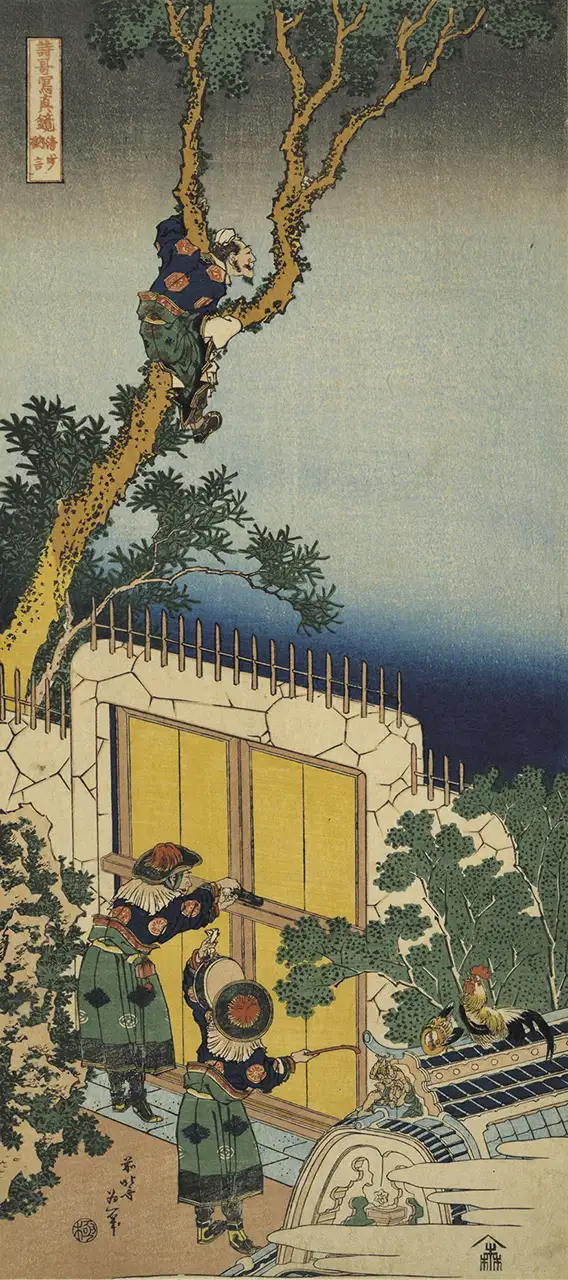
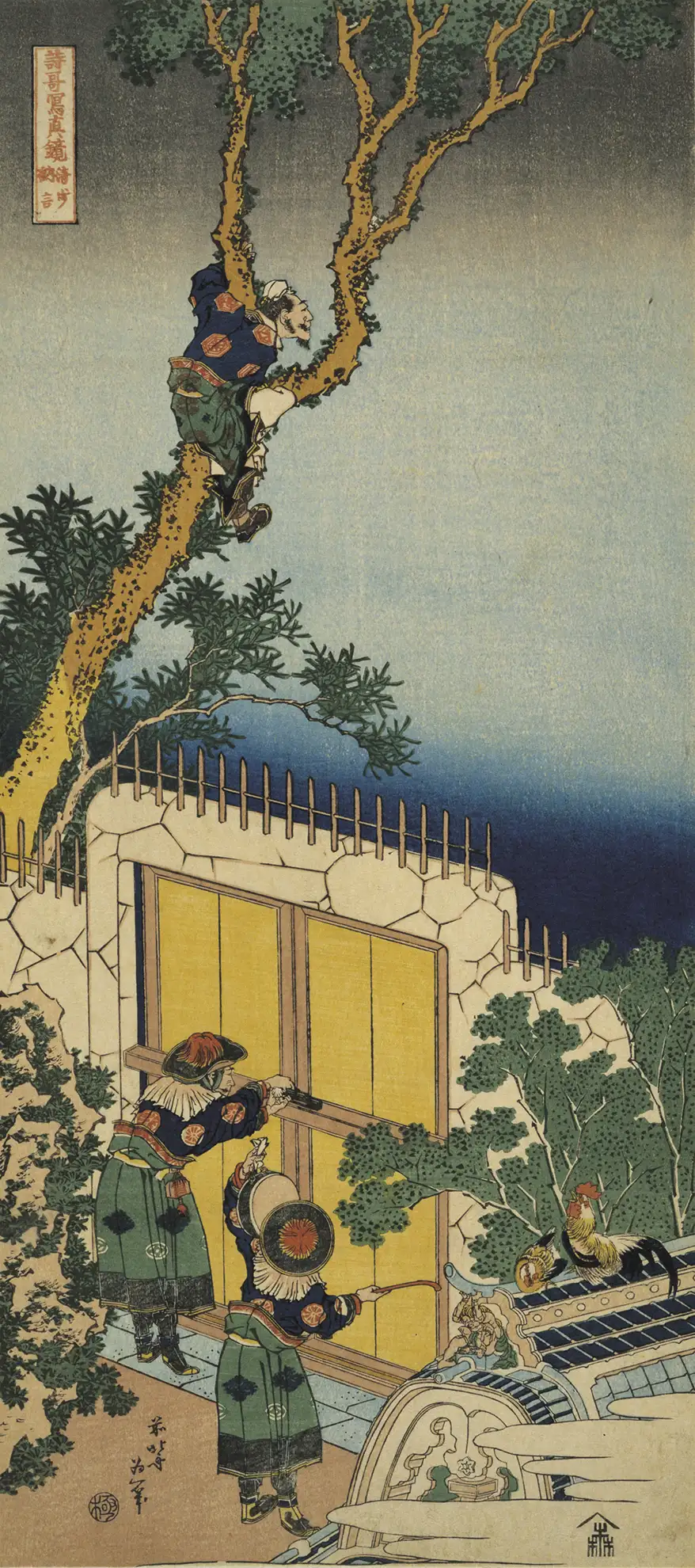
Source: ColBase (Integrated Collections Database of the National Museums, Japan) This ukiyo-e print by Katsushika Hokusai shows the old Chinese story of Hangu Pass (Kankokukan).
The Story of Hangu Pass
The story of Hangu Pass is known as a legendary escape made possible by cleverness and quick wits. Lord Mengchang of the state of Qi was being chased by King Zhaoxiang of Qin, and with the gate of Hangu Pass shut, he had nowhere to run. But one of his men was very good at imitating a rooster's crow. The gatekeepers of Hangu Pass opened the gate when they heard the rooster announce dawn, so, fooled by the man's crowing, they opened the gate in the middle of the night. With this trick, Lord Mengchang escaped safely.
The well-known four-character phrase keimei kutō ("crowing like a rooster and stealing like a dog") comes from this story. Among Lord Mengchang's men were one who was light-footed like a dog and good at stealing, and one who could imitate a rooster to fake the dawn. Lord Mengchang used their skills to escape danger. So keimei kutō is used to mean that even people who seem useless can be useful at the right moment, and also, on the other hand, to describe people who can only do petty things.
- The Snow of Xianglu Peak (Kōrohō no Yuki)
-
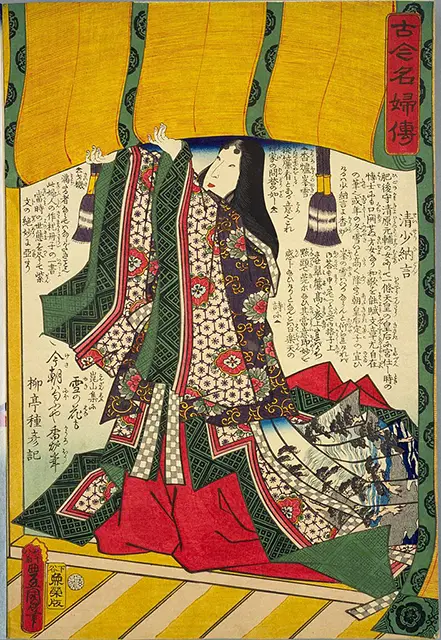
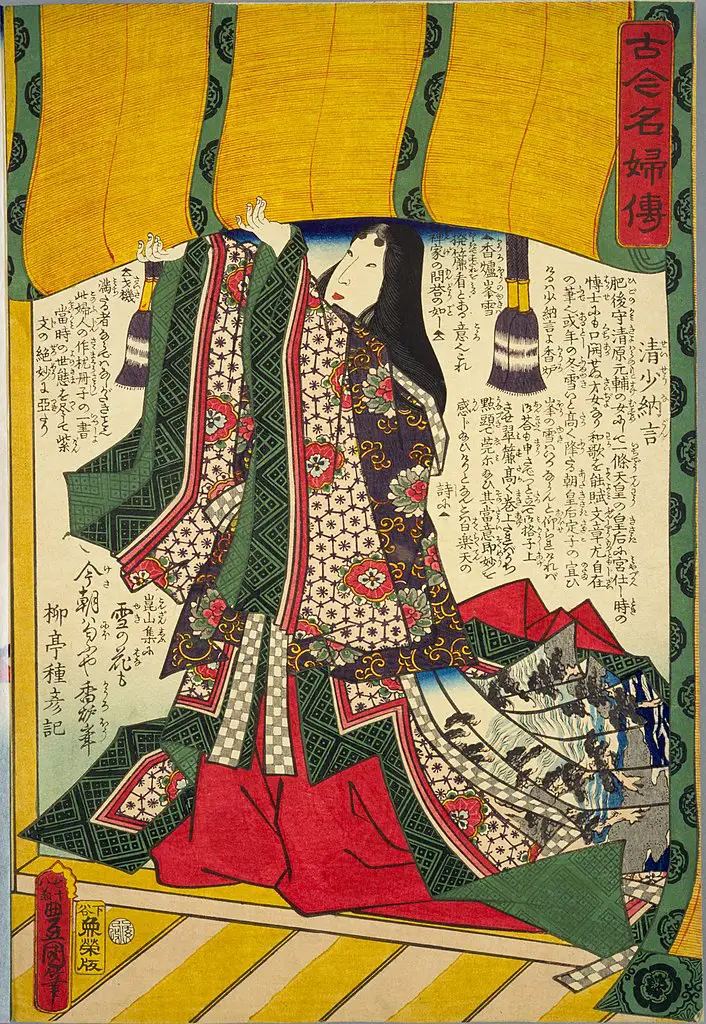
Utagawa Kunisada, Public domain, via Wikimedia Commons This ukiyo-e print is by Utagawa Kunisada, an artist of the Edo period. It shows the moment when Teishi, whom Sei Shōnagon served, asked, "Shōnagon, how is the snow on Xianglu Peak?" and Sei Shōnagon quickly rolled up the blind to show her the snowy view.
Teishi's question was based on a line by the Chinese poet Bai Juyi: "The snow on Xianglu Peak, I view by raising the blind." Thinking quickly, Sei Shōnagon met her expectations perfectly.
This episode is told in The Pillow Book and shows how well Teishi and Sei Shōnagon understood each other.
- Teishi's Letter
Urging Her to Return to Court -
When Teishi's elder brother Korechika and younger brother Takaie shot arrows at Retired Emperor Kazan, mistaking him for a rival in love, Fujiwara no Tadanobu reported the incident to Fujiwara no Michinaga. Because Sei Shōnagon was friendly with Tadanobu, the other ladies-in-waiting suspected her of being Michinaga's spy. Hurt by this, Sei Shōnagon left the palace and shut herself up at home.
Then a letter came to her from Teishi. When she opened it, she found a note that said "iwade omou zo" (I think of you without saying so) and a single petal of yamabuki (kerria).
The words were quoted from the following poem. When she saw them, Sei Shōnagon decided to go back to Teishi.
This anonymous poem is in the Kokin Waka Rokujō.In Japanese
心には 下ゆく水の わきかへり
言はで思ふぞ 言ふにまされる kokoroniha shitayukumizuno wakikaheri
ihadeomofuzo ifunimasareru Kokin Waka Rokujō, AnonymousIn English
In my heart, like water welling up underground, I think of you without saying a word.
Such feelings run far deeper than words.Teishi is thought to have wrapped the yamabuki petal in the letter with the next poem, by the priest Sosei, in mind.
This poem is in the Kokin Wakashū.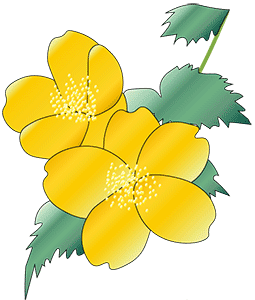
In Japanese
山吹の 花色衣 ぬしや誰
問へど答へず くちなしにして yamabukino hanairogoromo nushiyatare
tohedokotahezu kuchinashinishite Kokin Wakashū, Priest SoseiIn English
O robe the yellow of yamabuki flowers, who is your owner? I ask, but there is no answer, for you were dyed with kuchinashi (gardenia, "no mouth").
- A Poem Teishi Gave to Sei Shōnagon
-
After Fujiwara no Michinaga's daughter Akiko became Emperor Ichijō's empress (chūgū) and everyone's attention turned to her, Teishi was suffering from morning sickness.
To cheer up Teishi, who could hardly eat during her pregnancy, Sei Shōnagon gave her a sweet called aozashi.
Touched by her kindness, Teishi wrote the next poem to thank her.In Japanese
みな人の 花や蝶やと いそぐ日も
わが心をば 君ぞ知りける minahitono hanayachouyato isoguhimo
wagakokorooba kimizoshirikeru The Pillow Book, Fujiwara no TeishiIn English
Even on days when everyone rushes after flowers and butterflies (the latest fashion),
you alone understand my heart. - Linked Verse with Fujiwara no Kintō
- The next poem appears in the section of The Pillow Book that begins "Around the end of the second month."
Fujiwara no Kintō gave Sei Shōnagon a lower verse, and she added the upper verse.
Seeing falling snow as scattering blossoms is something it shares with a poem by her great-grandfather, Kiyohara no Fukayabu.In Japanese
空寒み 花にまがへて 散る雪に
少し春ある 心地こそすれ sorasamumi hananimagahete chiruyukini
sukoshiharuaru kokochikososure The Pillow BookIn English
The sky is so cold that the falling snow looks like blossoms,
and I feel a little touch of spring.Sei Shōnagon understood that Kintō had based his lower verse on a passage of Bai Juyi's poem "Snow in Nanqin," and she added the upper verse at once. The following lines are from that poem.
In Chinese
三時雲冷多飛雪
二月山寒少有春 Bai's Collected Works, vol. 14, "Snow in Nanqin," Bai JuyiIn English
For three seasons the clouds are cold and much snow flies;
in the second month the mountains are cold, and there is little of spring.Kintō gave the same challenge to other people as well. The Dainagon Kintō-shū includes a linked verse with another poet, as follows. The author of the upper verse is unknown.
In Japanese
吹きそむる 風もぬるまぬ 山里は
少し春ある 心地こそすれ fukisomuru kazemonurumanu yamazatoha
sukoshiharuaru kokochikososure Dainagon Kintō-shū, AnonymousIn English
In this mountain village, where even the first breezes of spring are not yet warm,
I feel only a little of spring. - The Pillow Book
- The Pillow Book (Makura no Sōshi) is Japan's oldest collection of essays, written by Sei Shōnagon. It has about 300 sections, which fall into three broad groups: list sections such as "Insects" and "Flowering trees"; essay sections, such as the famous "In spring, the dawn"; and memoir sections that look back on and praise her days with Teishi. The word okashi (charming, delightful) is used so often that it is called the literature of okashi.