Front of the Card
Back of the Card
Japanese
English
Audio: NHK Creative Library
Read by LibriVox volunteer Larry Wilson.
Audio courtesy of LibriVox
清原深養父
夏の夜は
まだ宵ながら
あけぬるを
雲のいづこに
月やどるらむ
くものいつ
こにつきや
とるらむ

なつ


- Poem 36
- 夏の夜は
まだ宵ながら
あけぬるを
雲のいづこに 月やどるらむ
Author: Kiyohara no Fukayabu (dates unknown)
Source: Kokin Wakashū, Summer
- English Verse Translation
- Too short the lovely summer night, Too soon 'tis passed away; I watched to see behind which cloud
The moon would chance to stay, And here's the dawn of day!
— William N. Porter, 1909
- Modern Translation
- On a summer night, the day has already dawned while it still feels like early evening. Where in the clouds is the moon hiding?
- Commentary
- The poet is sad to see the moon set on a short summer night. Asking behind which cloud the moon is hiding has a charm almost like a fantasy. It is a lovely poem full of fondness for the moon as it sinks toward the west.
- About the Poet
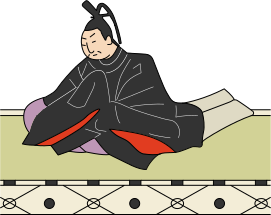
- Kiyohara no Fukayabu was a descendant of Emperor Tenmu but never rose high. He was Sei Shōnagon's great-grandfather; she, too, wrote in The Pillow Book that summer nights, especially moonlit ones, are best. He was friends with Fujiwara no Kanesuke, Ki no Tsurayuki, and Ōshikōchi no Mitsune.
- Poem Illustration
-
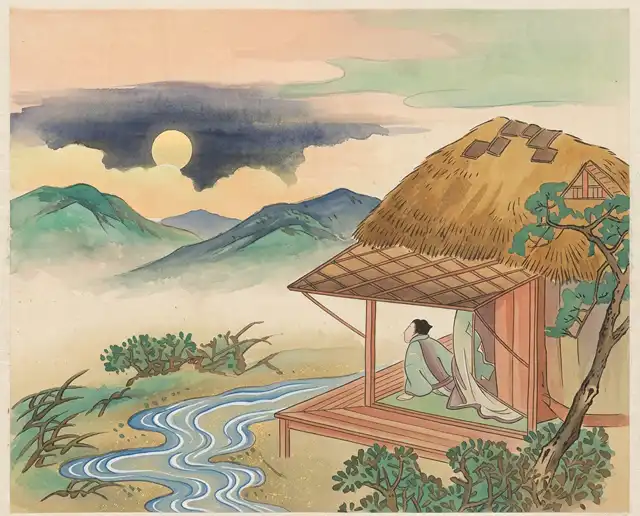
This image is based on an illustration from William N. Porter's A Hundred Verses from Old Japan, his 1909 English translation of the Hyakunin Isshu published in England, colorized and reworked using Adobe Firefly (generative AI).
- Kiyohara no Fukayabu: A Short Timeline
-
- 908
- Becomes a junior official of the Palace Craft Office
- 923
- Becomes a senior official of the Palace Storehouse
- 930
- Given Junior Fifth Rank, Lower Grade
- Notes
-
- Was a master of the koto (a stringed instrument)
- Said to have built Fudaraku-ji Temple in Iwakura in his later years and lived there quietly
- Kiyohara no Fukayabu's Family Tree
-
The Kiyohara clan includes many descendants of Prince Toneri, a son of Emperor Tenmu. Kiyohara no Fukayabu's grandson was Kiyohara no Motosuke, and Motosuke's daughter was Sei Shōnagon.
Kiyohara no Fukayabu was a friend of Middle Counselor Kanesuke (Fujiwara no Kanesuke), Ki no Tsurayuki, Ōshikōchi no Mitsune, and others. A poem Fujiwara no Kanesuke wrote on hearing the koto played by Fukayabu, a master of the instrument, was chosen for the Sanjūrokuninsen (Selection of Thirty-Six Poets).
- Appendix
-
- A Poem That Sees Falling Snow as Flower Petals
-
The next poem expresses Fukayabu's longing for the spring soon to come as he watches the snow.
Like his Hyakunin Isshu poem, it is full of fantasy.In Japanese
冬ながら 空より花の 散りくるは
雲のあなたは 春にやあるらむ fuyunagara sorayorihanano chirikuruha
kumonoanataha haruniyaaruramu Kokin Wakashū, Kiyohara no FukayabuIn English
Though it is still winter, flower petals are falling from the sky.
Could it be spring beyond the clouds? - A Poem of Longing to the Point of Death
-
In the next poem, the poet has not been able to see the lover who promised to meet again for a long time, and pleads that he is longing for her to the point of death.
In Japanese
今ははや 恋ひ死なましを 逢ひ見むと
頼めしことぞ 命なりける imahahaya kohishinamashio ahimimuto
tanomeshikotozo inochinarikeru Kokin Wakashū, Kiyohara no FukayabuIn English
By now I would have died of longing long ago, but your promise, "Let's meet," which gave me hope, is the only thing keeping me alive.
- The Koto
-
The koto is a stringed instrument that came from China in the Nara period. You press the strings with your left hand and pluck them with your right to make sounds. There are several kinds: the 琴 (kin) with 7 strings, the 和琴 (wagon) with 6 strings, and the 筝 (sō) with 13 strings.

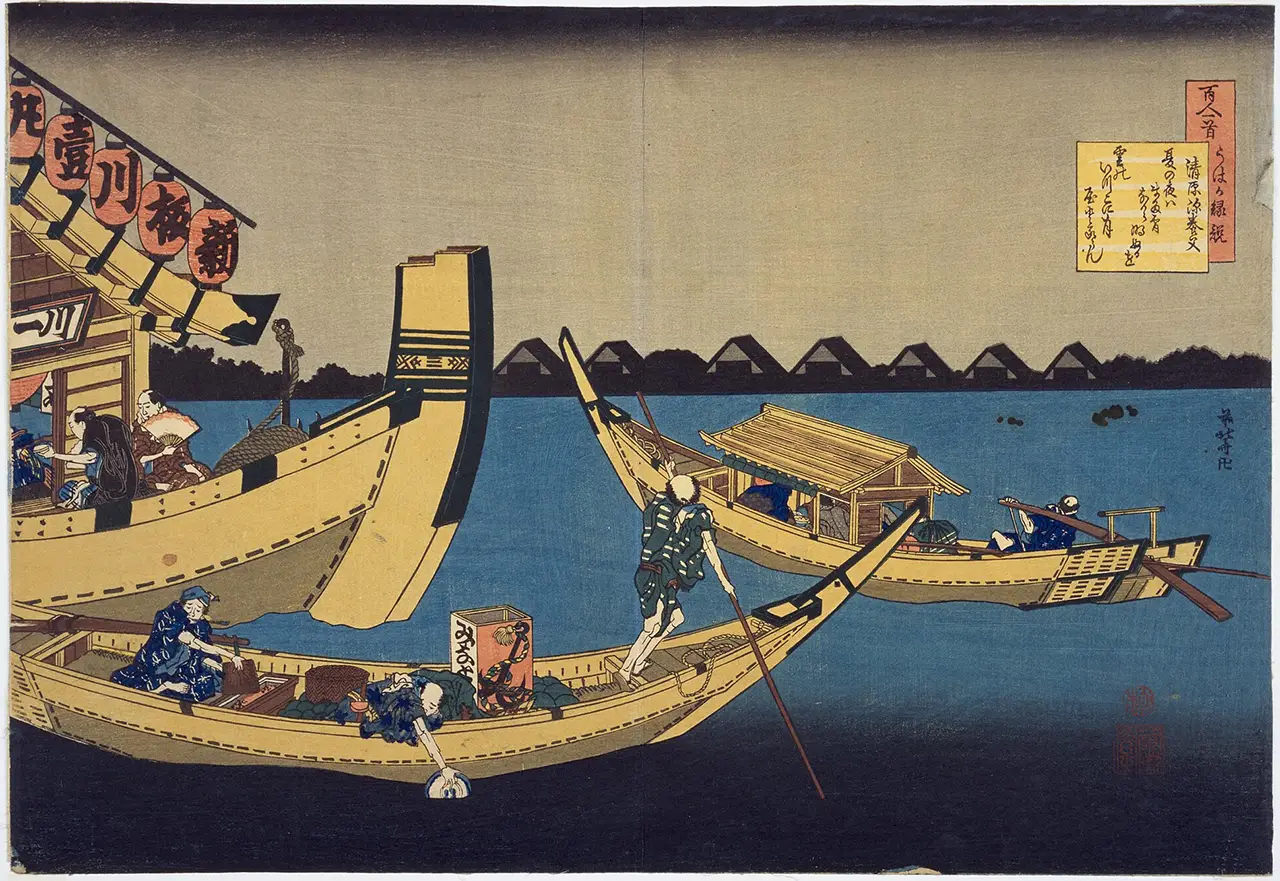
Metropolitan Museum of Art, Public domain - Ukiyo-e by Katsushika Hokusai
-
National Diet Library, Public domain, via Wikimedia Commons This print is from One Hundred Poems Explained by the Nurse (Hyakunin Isshu Uba ga Etoki) by Katsushika Hokusai, an ukiyo-e artist of the Edo period. The idea of the series is a nurse explaining the Hyakunin Isshu poems with easy-to-understand pictures. This picture shows a pleasure boat on the Sumida River. For the people of Edo, spending a summer night on a pleasure boat must have been a refined way to enjoy themselves. Did Hokusai, too, feel on a pleasure boat that good times pass in no time?