Front of the Card
Back of the Card
Japanese
English
Audio: NHK Creative Library
Read by LibriVox volunteer Larry Wilson.
Audio courtesy of LibriVox
中納言定頼
朝ぼらけ
宇治の川霧
絶え絶えに
あらはれわたる
瀬々の網代木
あらはれわ
たるせせの
あしろき

あさぼらけう


- Poem 64
- 朝ぼらけ
宇治の川霧
絶え絶えに
あらはれわたる 瀬々の網代木
Author: Middle Counselor Sadayori (995–1045)
Source: Senzai Wakashū, Winter
- English Verse Translation
- So thickly lies the morning mist, That I can scarcely see The fish-nets on the river bank,
The River of Uji, Past daybreak though it be.
— William N. Porter, 1909
- Modern Translation
- In the early dawn mist over the Uji River, here and there the wooden stakes of fish weirs begin to appear through the haze.
- Commentary
- The Senzai Wakashū says this was written on a visit to Uji. Light shines into the mist rising from the cold river, and through gaps in the mist the stakes of fish traps (ajirogi) appear, a typical winter sight on the Uji River. Ajirogi held bamboo traps for catching young sweetfish.
- About the Poet
- Fujiwara no Sadayori was the son of Fujiwara no Kintō. Like his father he was skilled at poetry and music, and he was also a fine calligrapher. But the famous story of being outwitted by Koshikibu no Naishi's poem shows he could be careless.
- Poem Illustration
-
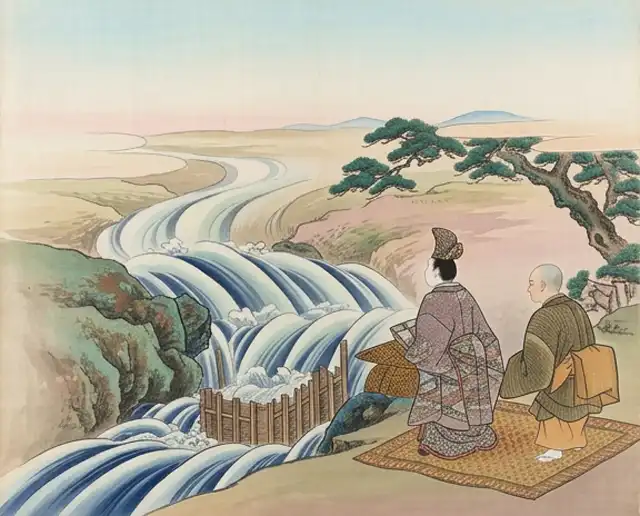
This image is based on an illustration from William N. Porter's A Hundred Verses from Old Japan, his 1909 English translation of the Hyakunin Isshu published in England, colorized and reworked using Adobe Firefly (generative AI).
- Fujiwara no Sadayori: A Short Timeline
-
- 995
- Born as a son of Fujiwara no Kintō
- 1007
- Holds his coming-of-age ceremony and is given Junior Fifth Rank, Lower Grade
- 1017
- Given Senior Fourth Rank, Lower Grade, and becomes Head Chamberlain (Kurōdo no Tō)
- 1020
- Becomes Councillor (Sangi)
- 1022
- Given Junior Third Rank
- 1029
- Becomes Acting Middle Counselor
- 1044
- Becomes a monk because of illness
- 1045
- Dies
- Fujiwara no Sadayori's Family Tree
-
Fujiwara no Sadayori was born into the Ononomiya line. His father was Fujiwara no Kintō, who excelled at waka, Chinese poetry, and music and was praised for "the talent of three boats."
- Appendix
-
- Kakinomoto no Hitomaro's Poem About the Fish-Trap Stakes of Uji
- This poem is said to have been written by Kakinomoto no Hitomaro on the bank of the Uji River on his way from the ruined province of Ōmi to the Fujiwara capital.
"Mononofu no" is a pillow word (makurakotoba) that leads into "yaso" (many). "Uji" is a pun (kakekotoba) on uji (clans) and the place name Uji.
Having seen the abandoned capital of Ōtsu with his own eyes, Hitomaro is thought to have expressed the impermanence (mujōkan) of a changing world.In Japanese
もののふの 八十宇治川の 網代木に
いさよふ波の 行く方知らずも mononofuno yasoujigawano ajirogini
isayofunamino yukueshirazumo Man'yōshū, Kakinomoto no HitomaroIn English
Like the waves lingering at the fish-trap stakes of the Uji River, no one knows where all the many officials serving the court will end up.
- The Uji River
-
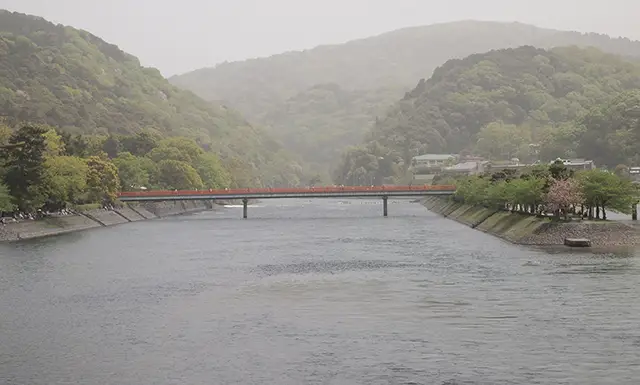
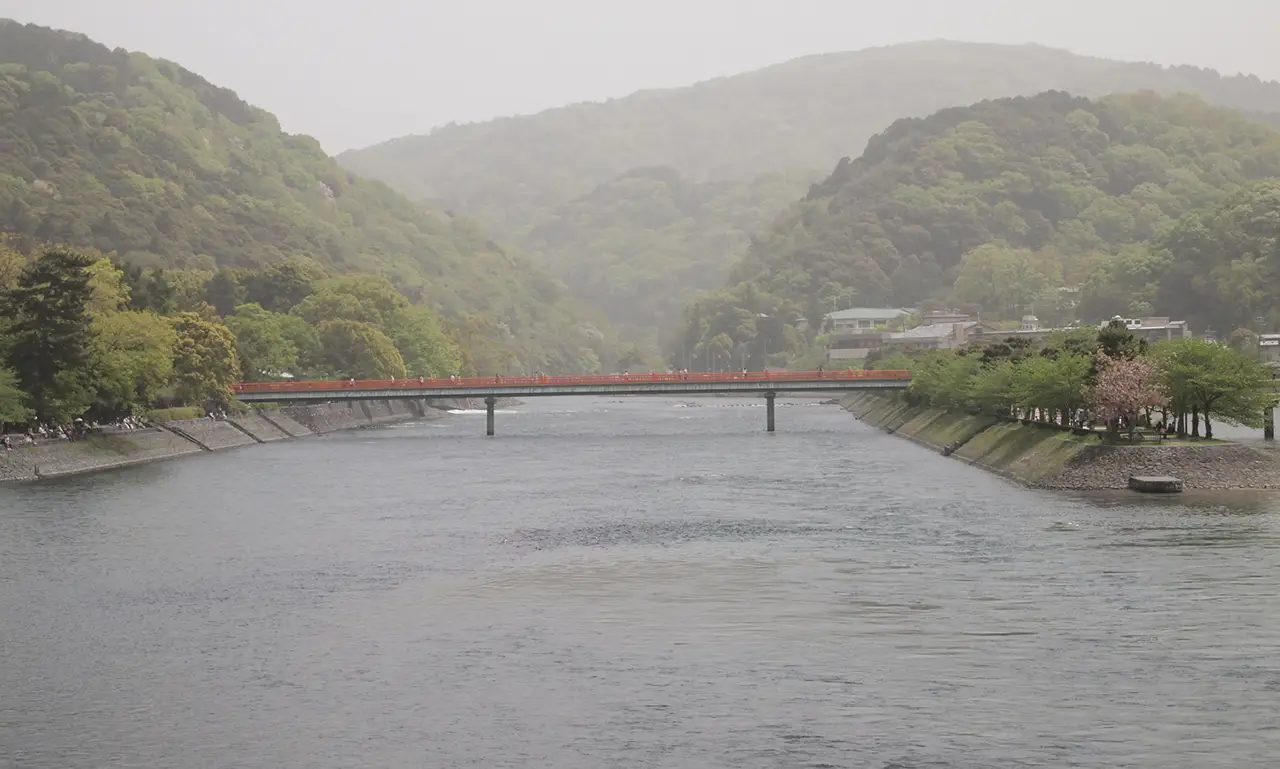
A river that flows from Uji City, Kyoto Prefecture, out into the Kyoto Basin.
Upstream, the Uji River runs through a deep gorge, and the river mist that forms there flows down the valley to Uji. So river mist often rises at Uji, and the scene of "Asaborake Uji no kawagiri" (the river mist of Uji at dawn) has been a much-loved view of Uji from the Heian period to the present day.
- Utagawa Kuniyoshi's Hyakunin Isshu no Uchi
-
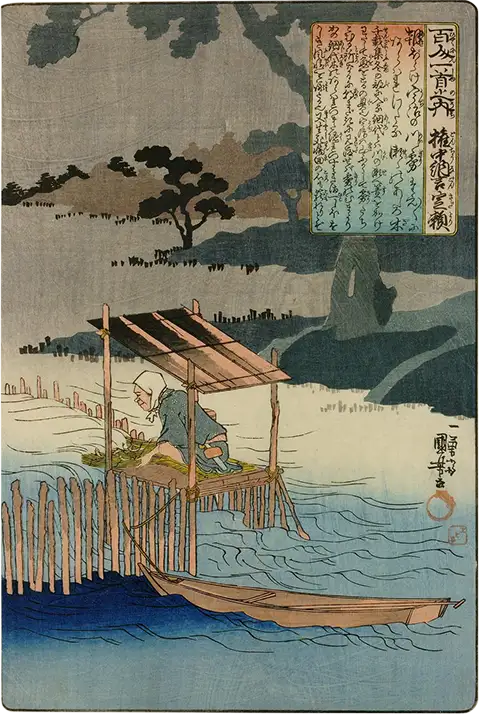
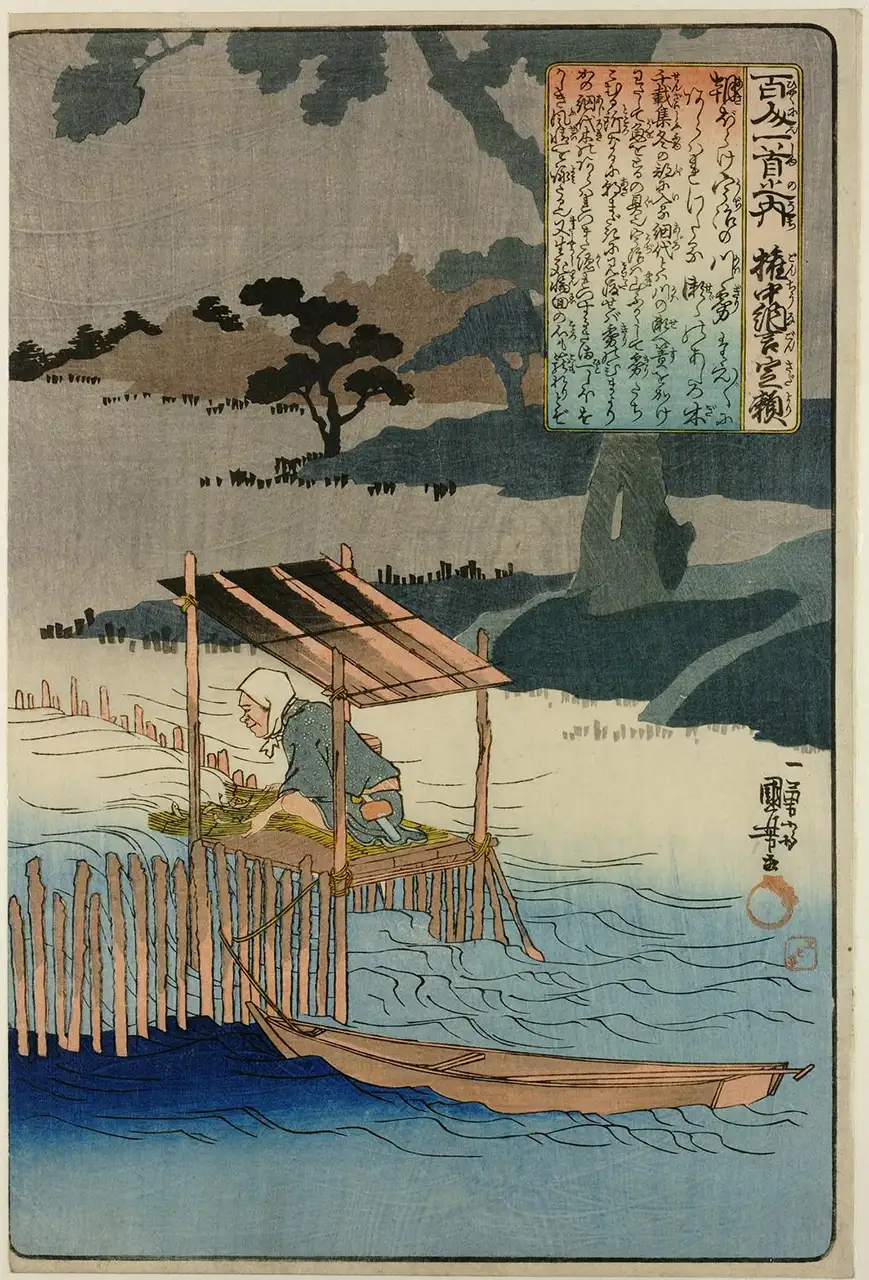
British Museum, Public domain, via Wikimedia Commons This ukiyo-e print is by Utagawa Kuniyoshi, an artist of the Edo period.
It shows a scene to go with the Hyakunin Isshu poem.In those days, every winter, fish traps (ajiro) were set up at the shallows of the Uji River to catch hio (young sweetfish). As the morning mist cleared, the stakes driven into the river appeared one after another, a typical winter scene on the Uji River.
Ajiro fishing has disappeared today, but in summer cormorant fishing (ukai) is held on the Uji River, and you can still see a traditional style of fishing. Cormorant fishing was already done in the Heian period, and it is recorded in the Kagerō Diary.