Front of the Card
Back of the Card
Japanese
English
Audio: NHK Creative Library
Read by LibriVox volunteer Larry Wilson.
Audio courtesy of LibriVox
文屋朝康
白露に
風の吹きしく
秋の野は
つらぬきとめぬ
玉ぞ散りける
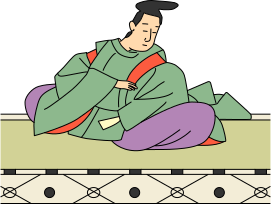
つらぬきと
めぬたまそ
ちりける

しら


- Poem 37
- 白露に
風の吹きしく
秋の野は
つらぬきとめぬ 玉ぞ散りける
Author: Fun'ya no Asayasu (dates unknown)
Source: Gosen Wakashū, Autumn
- English Verse Translation
- This lovely morn the dewdrops flash Like diamonds on the grass— A blaze of sparkling jewels! But
The autumn wind, alas! Scatters them as I pass.
— William N. Porter, 1909
- Modern Translation
- In the autumn fields, where the wind keeps blowing on the white dew, the drops look like pearls with no string to hold them, scattering everywhere.
- Commentary
- The Gosen Wakashū says this was written for Emperor Daigo in the Engi era. But it already appears in a poetry contest held earlier, in Emperor Uda's Kanpyō era, before the Kokin Wakashū. That contest record, made at the time, is thought to be more reliable.
- About the Poet
- Fun'ya no Asayasu was the son of Fun'ya no Yasuhide (Poem 22). He never rose to high rank, but he was well known as a poet.
- Poem Illustration
-
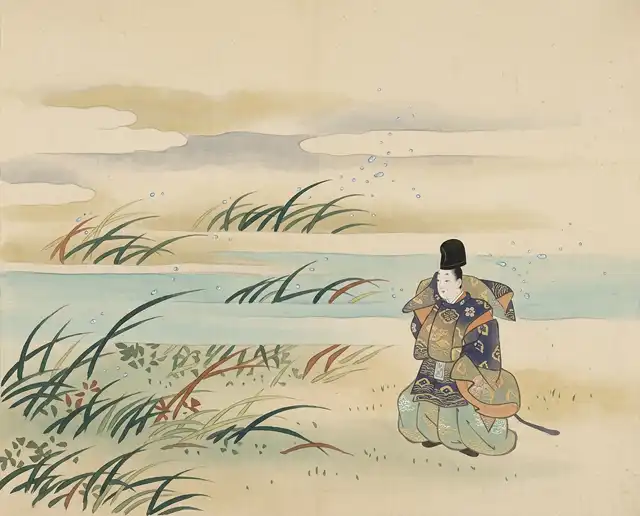
This image is based on an illustration from William N. Porter's A Hundred Verses from Old Japan, his 1909 English translation of the Hyakunin Isshu published in England, colorized and reworked using Adobe Firefly (generative AI).
- Fun'ya no Asayasu: A Short Timeline
-
- 892
- Becomes an official of Suruga Province
- 902
- Becomes a senior official of the Palace Attendants' Office
- Notes
-
- Took part in the Poetry Contest at the Palace of the Empress in the Kanpyō Era
- Took part in the Poetry Contest at the Home of Prince Koresada
- 3 of his poems appear in imperial anthologies
- Fun'ya no Asayasu's Family Tree
-
Fun'ya no Asayasu is thought to have been a descendant of Emperor Tenmu. In 752, in the Nara period, the Fun'ya family was given the family name Fun'ya together with the title Mahito. This was the highest of the "Eight Titles" (Yakusa no Kabane) that Emperor Tenmu had set up.
Asayasu himself, however, rose no higher than Junior Sixth Rank, Lower Grade, as a junior official of the Office of the Palace Kitchens (Daizen no Shōjō), a low-ranking noble. Behind this lay the politics of the time, as the Fujiwara took over the central government and reshaped the court.
As a poet, though, he was well regarded. His father, Fun'ya no Yasuhide, was one of the Six Poetic Sages, and Asayasu is thought to have inherited his rare talent.
Records show that he took part in famous poetry contests, such as the Poetry Contest at the Palace of the Empress in the Kanpyō Era and the Poetry Contest at the Home of Prince Koresada. This is thought to show that, despite his low rank, he was recognized both through the poets' circle his family had built since his father's time and through his own skill.
In some old manuscripts of the Kokin Wakashū, Yasuhide's Hyakunin Isshu poem is credited to Asayasu. So although father and son both have poems in the Hyakunin Isshu, one theory says both poems are really Asayasu's.
- Appendix
-
- A Poem About White Dew
-
In his Hyakunin Isshu poem, Asayasu wrote about white dew blown across a field. The next poem is about white dew sparkling on a spider's thread.
Because white dew is pure and fleeting, many poets loved to write about it.In Japanese
秋の野に 置く白露は 玉なれや
つらぬきかくる くもの糸すぢ akinononi okushiratsuyuha tamanareya
tsuranukikakuru kumonoitosuji Kokin Wakashū, Fun'ya no AsayasuIn English
Is the white dew lying on the autumn fields a string of pearls?
The threads of a spider run through the drops and hold them. - Ukiyo-e by Katsushika Hokusai
-
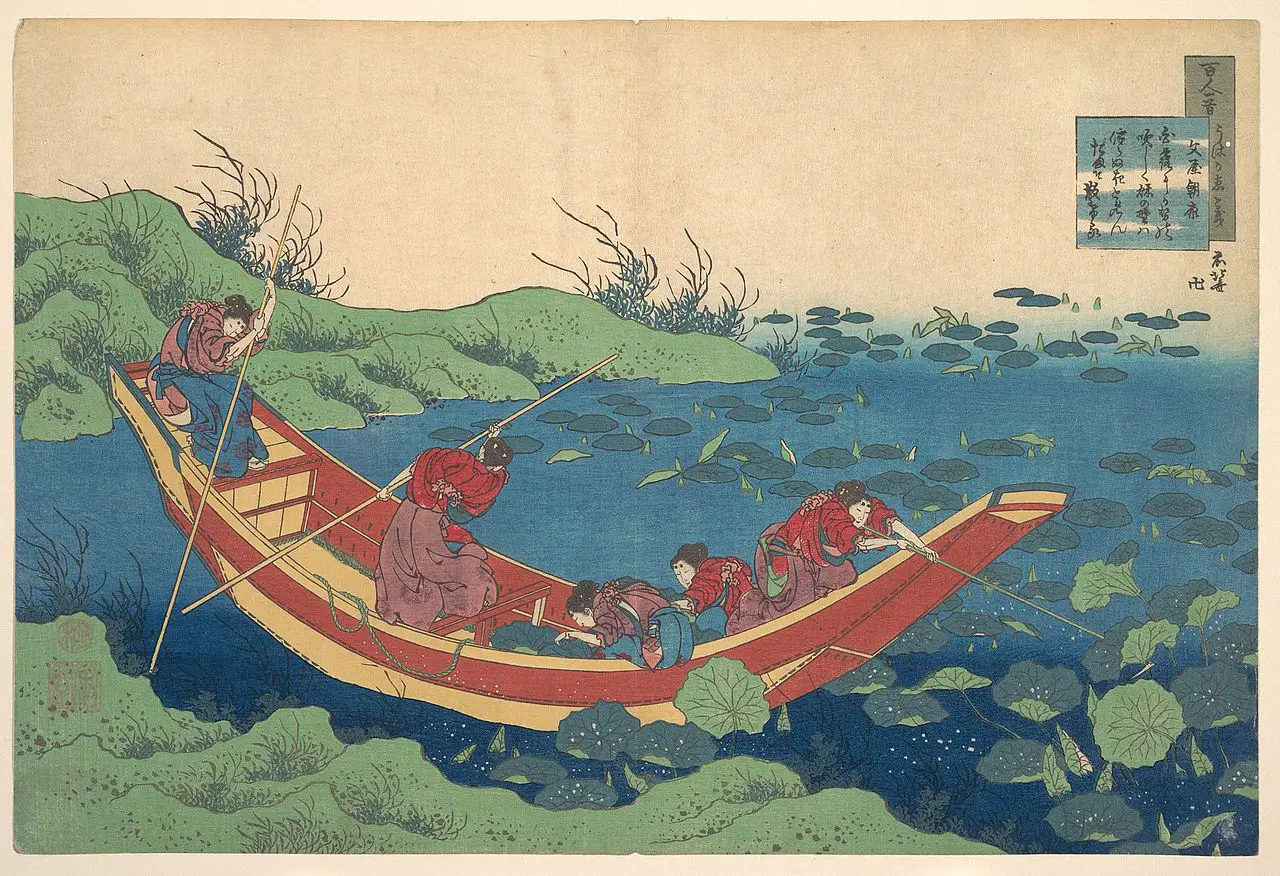
Katsushika Hokusai, CC0, via Wikimedia Commons This print is from One Hundred Poems Explained by the Nurse (Hyakunin Isshu Uba ga Etoki) by Katsushika Hokusai, an ukiyo-e artist of the Edo period. The idea of the series is a nurse explaining the Hyakunin Isshu poems with easy-to-understand pictures.
The picture is based on Asayasu's autumn poem, in which he praised the beauty of white dew blown by the wind across an autumn field, comparing the drops to pearls (tama) that are not held on a string.
To show these "scattering beads of dew," Hokusai drew a pond crowded with lotus leaves, where people seem to be gathering the dew that has collected on them. Look closely and you can see sparkling drops of dew finely drawn on the large leaves. Because of its beauty, the lotus is also called tsuyutamagusa, the "dew-bead plant." Hokusai turned the noble world of Asayasu's poem into a fresh, clear landscape.