Front of the Card
Back of the Card
Japanese
English
Audio: NHK Creative Library
Read by LibriVox volunteer Larry Wilson.
Audio courtesy of LibriVox
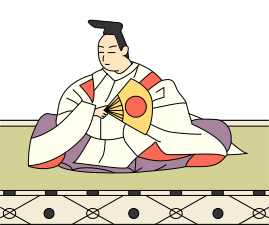
文屋康秀
吹くからに
秋の草木の
しをるれば
むべ山風を
嵐といふらむ
むへやまか
せをあらし
といふらむ

ふ


- Poem 22
- 吹くからに
秋の草木の
しをるれば
むべ山風を 嵐といふらむ
Author: Fun'ya no Yasuhide (dates unknown–c. 885)
Source: Kokin Wakashū, Autumn
- English Verse Translation
- The mountain wind in autumn time Is well called "hurricane"; It hurries canes and twigs along,
And whirls them o'er the plain To scatter them again.
— William N. Porter, 1909
- Modern Translation
- The moment the autumn wind blows, the grasses and trees wither. Now I understand why the mountain wind is called "arashi" — storm.
- Commentary
- The poem uses a Chinese word game of splitting and joining characters: 山 (mountain) and 風 (wind) make 嵐 (arashi, storm). Today "arashi" means a violent storm, but then it meant wind blowing down from the mountains.
- About the Poet
- Fun'ya no Yasuhide was a leading Heian poet, one of the Six Poetic Sages, and the father of Fun'ya no Asayasu. His friendship with Ono no Komachi is famous: when he was posted to Mikawa he invited her along, and she answered with a poem saying she might drift along like floating weed. Whether she went is unknown.
- Poem Illustration
-
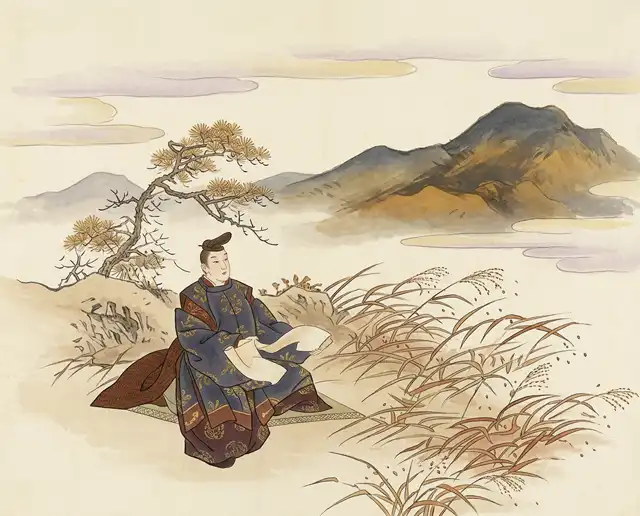
This image is based on an illustration from William N. Porter's A Hundred Verses from Old Japan, his 1909 English translation of the Hyakunin Isshu published in England, colorized and reworked using Adobe Firefly (generative AI).
- Fun'ya no Yasuhide: A Short Timeline
-
- 860
- Becomes a middle judge in the Ministry of Justice
- Unknown
- Becomes a junior official of Mikawa Province; said to have invited Ono no Komachi to come along
- 877
- Becomes a senior secretary of Yamashiro Province
- 880
- Becomes Assistant Head of the Palace Sewing Office
- c. 885
- Dies
- Notes
-
- Counted as one of the Six Immortal Poets
- Fun'ya no Yasuhide's Family Tree
-
Fun'ya no Yasuhide is thought to have been a descendant of Emperor Tenmu. In 752, in the Nara period, the Fun'ya family was given the family name Fun'ya together with the title Mahito. This was the highest of the "Eight Titles" (Yakusa no Kabane) that Emperor Tenmu had set up.
In the Heian period, however, as the Fujiwara took over the central government and reshaped politics, the Fun'ya family lost standing. Yasuhide himself rose no higher than Assistant Director of the Bureau of Sewing (Nuidono no Suke). Despite his noble bloodline, he had to struggle at court as a low-ranking noble.
As a poet, though, he was highly praised. Ki no Tsurayuki chose him as one of the Six Poetic Sages, and he is remembered as a master of clever wording. There is also a charming story: when he was going to take up a post in the province of Mikawa, he invited his friend Ono no Komachi, another of the Six Poetic Sages, to come with him, and Komachi answered with a witty poem, "Wabinureba..." ("I have fallen so low that I will go anywhere I am invited"). See Ono no Komachi's page for more.
In some old manuscripts of the Kokin Wakashū, Yasuhide's Hyakunin Isshu poem is credited to his son Asayasu. So although father and son both have poems in the Hyakunin Isshu, one theory says both poems are really Asayasu's.
- Appendix
-
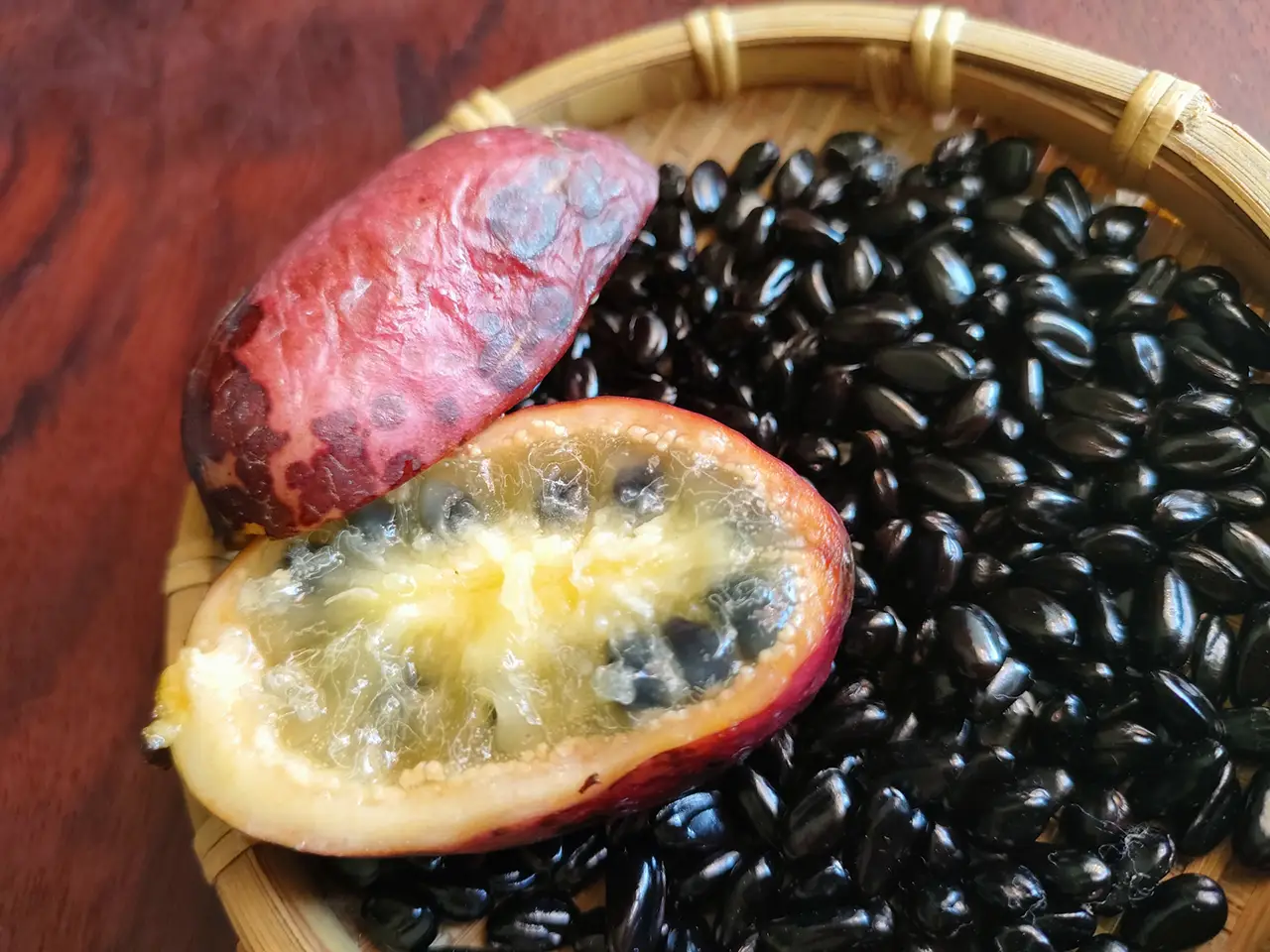
- The Mube Fruit
-
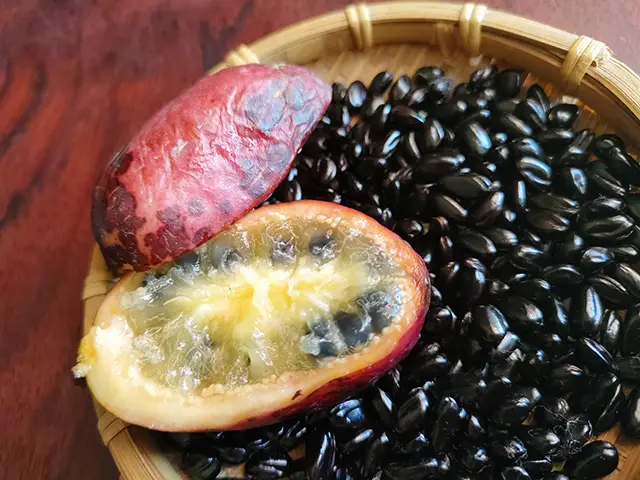
Do you know mube, a plant of the akebia family? Its name is said to come from an old legend about Emperor Tenji, who had his capital in Ōmi (Shiga Prefecture).
According to the legend, when Emperor Tenji was traveling through the province of Ōmi, he met an old couple living in the mountains. Though old, they were amazingly healthy and had many children. When the emperor asked the secret of their long life, the couple offered him a fruit that grew in the mountains and said, "We eat this every day."
When the emperor tasted the fruit, he was deeply impressed by its goodness and flavor and said, "Mube naru kana" ("No wonder!"). Mube is an old word used when you are fully convinced of something.
The emperor's words left such an impression that people came to call the fruit mube.
Fun'ya no Yasuhide wrote "mube yamakaze o arashi to iuramu." His choice of the word mube may have carried respect for a beautiful word linked to the imperial family, his own ancestors.
- "Mube Yamakaze o" in The Pillow Book
- In the section "The Day After a Typhoon" (Nowaki no mata no hi koso) of The Pillow Book by Sei Shōnagon, she describes the scene on the day after a typhoon has passed. Sei Shōnagon watches with interest the plants of the garden scattered by the wind and a beautiful woman with her hair tousled, just out of bed. She also writes about gazing thoughtfully at the scene outside, murmuring "mube yamakaze o," a phrase from Fun'ya no Yasuhide's poem, and feeling how elegant it is.
- Poems That Play with Kanji
-
Fujiwara no Suemichi wrote a poem that splits the kanji 愁 ("sorrow") into 秋 ("autumn") and 心 ("heart").
In Japanese
事毎に 悲しかりけり むべしこそ
秋の 心を 愁と 言ひけれ kotogotoni kanashikarikeri mubeshikoso
akino kokoroo urehito ihikere Senzai Wakashū, Fujiwara no SuemichiIn English
Everything feels sad. No wonder people write "autumn" and "heart" together and call it "sorrow."
Ki no Tomonori wrote a poem that splits 梅 ("plum") into 木 ("tree") and 毎 ("every").
In Japanese
雪降れば 木 毎に 花ぞ 咲きにける
いづれを梅と わきて折らまし yukifureba ki gotoni hanazo sakinikeru
izureoumeto wakiteoramashi Kokin Wakashū, Ki no TomonoriIn English
When snow falls, every tree seems to bloom with white flowers.
Since the snow and blossoms look alike, how can I tell which tree is the plum, to break off a branch? - The Six Poetic Sages (Rokkasen)
-
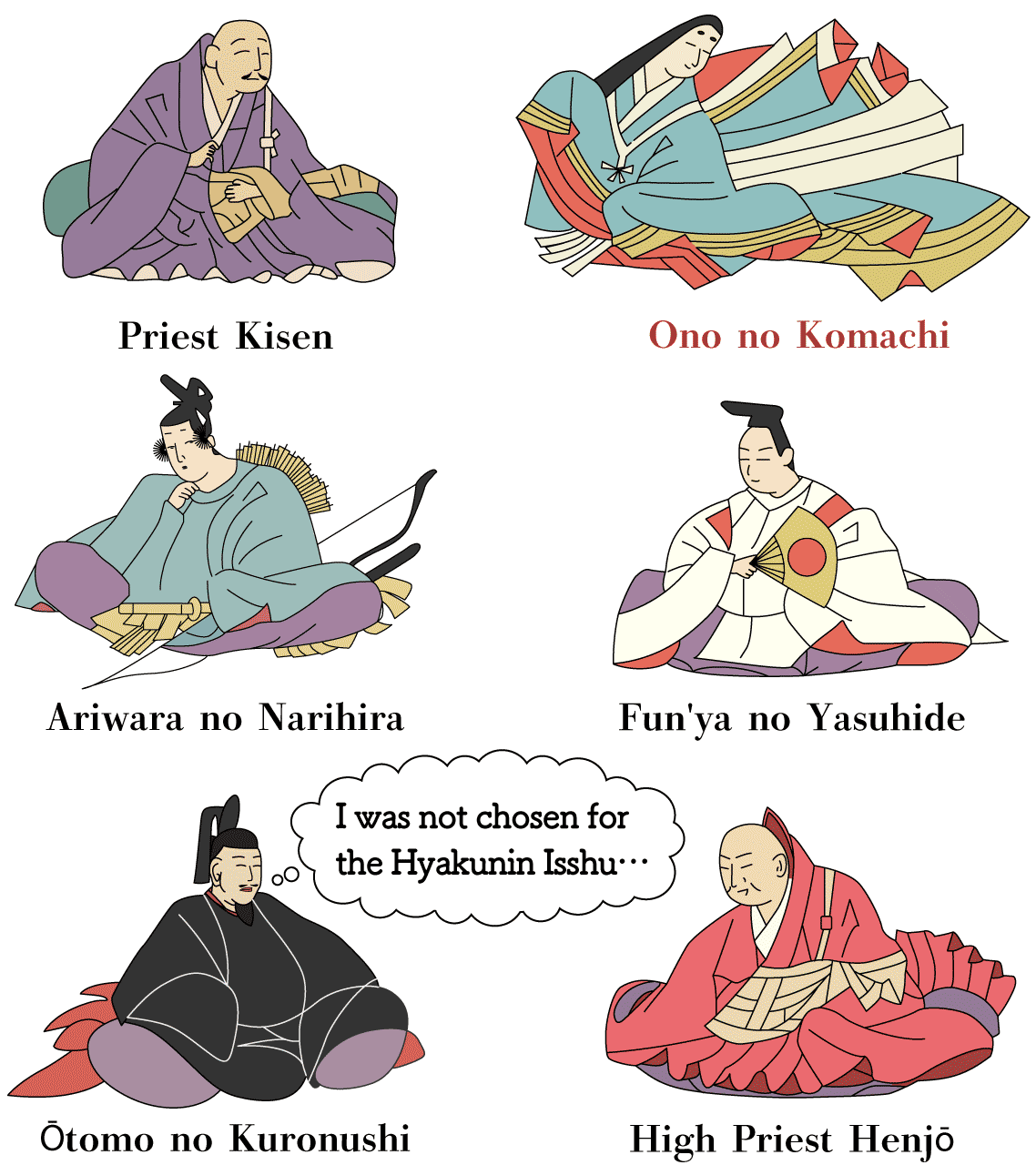
Click a poet to go to their poem page. When the Kokin Wakashū was compiled, these six poets, including Fun'ya no Yasuhide, were very famous poets of the generation before. In the Japanese preface to the Kokin Wakashū, Ki no Tsurayuki picked them out as "people whose names were known in recent times" and judged their poetry. His judgments were quite harsh, but the six later came to be called the Rokkasen, the Six Poetic Sages, and were highly praised as great poets.
See Ki no Tsurayuki's judgments of the six poets.
One of the Six Poetic Sages, Ōtomo no Kuronushi, has no poem in the Hyakunin Isshu, while the other five were all chosen.
- The Mube-yama Sugoroku
-
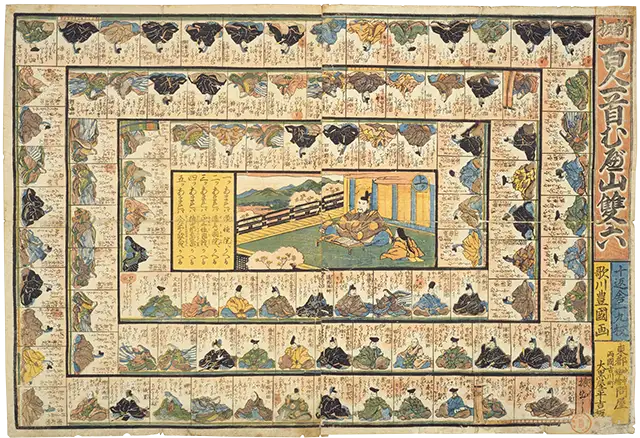
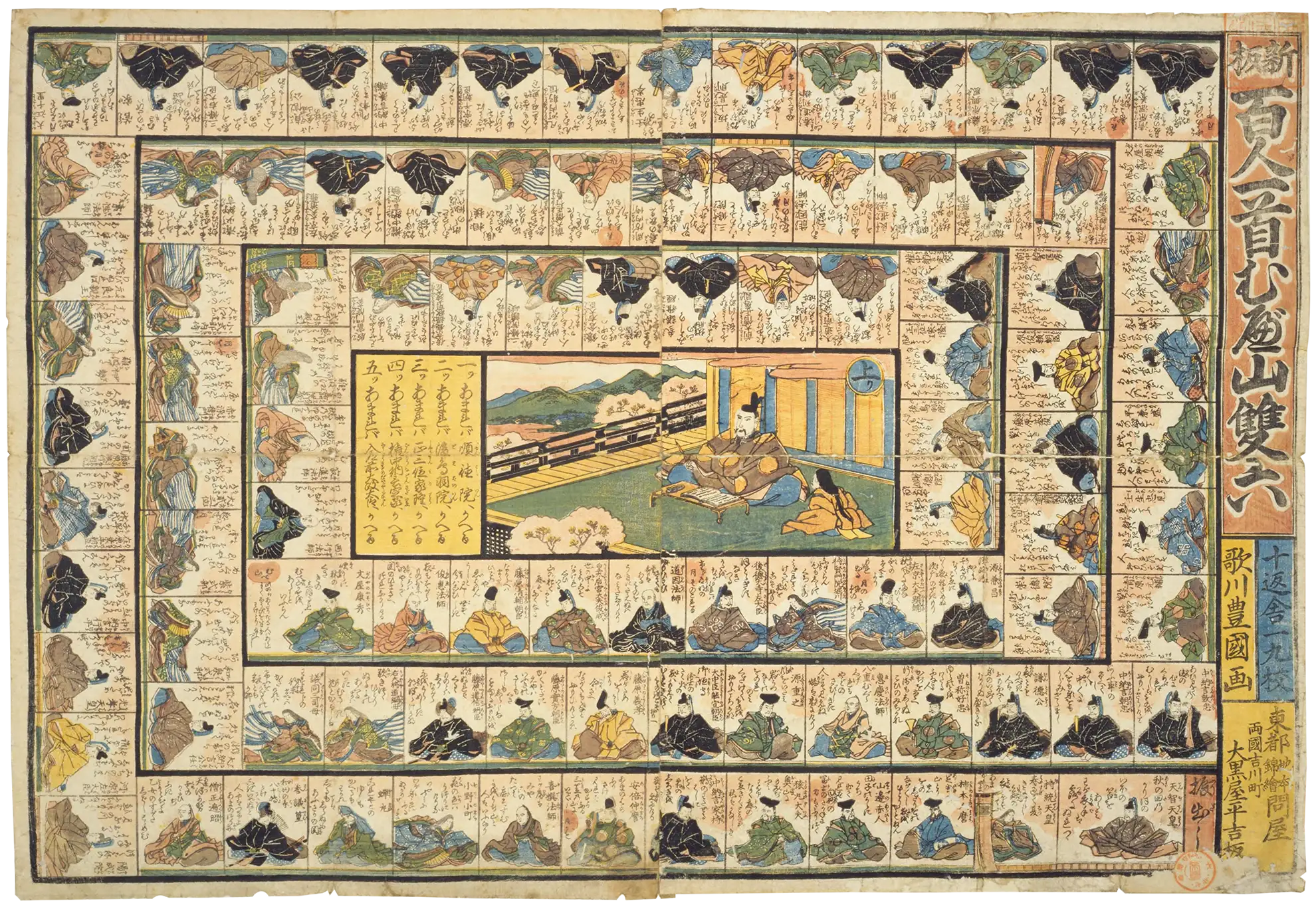
National Diet Library Digital Collections This is a Hyakunin Isshu sugoroku (a board game like snakes and ladders) made in the Edo period, called Shinpan Hyakunin Isshu Mube-yama Sugoroku. Poem 1, by Emperor Tenji, is at the lower right, and the cards are lined up counterclockwise, almost in order. It is said that a player who landed on Poem 22, Fun'ya no Yasuhide's "Fuku kara ni aki no kusaki no shiorureba mube yamakaze o arashi to iuramu," won a prize.
It is about 52 cm tall and 75 cm wide. - Utagawa Kuniyoshi's Hyakunin Isshu no Uchi
-
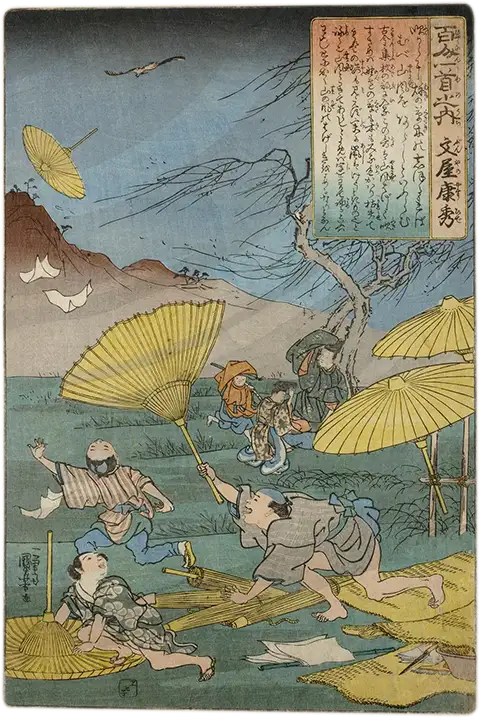
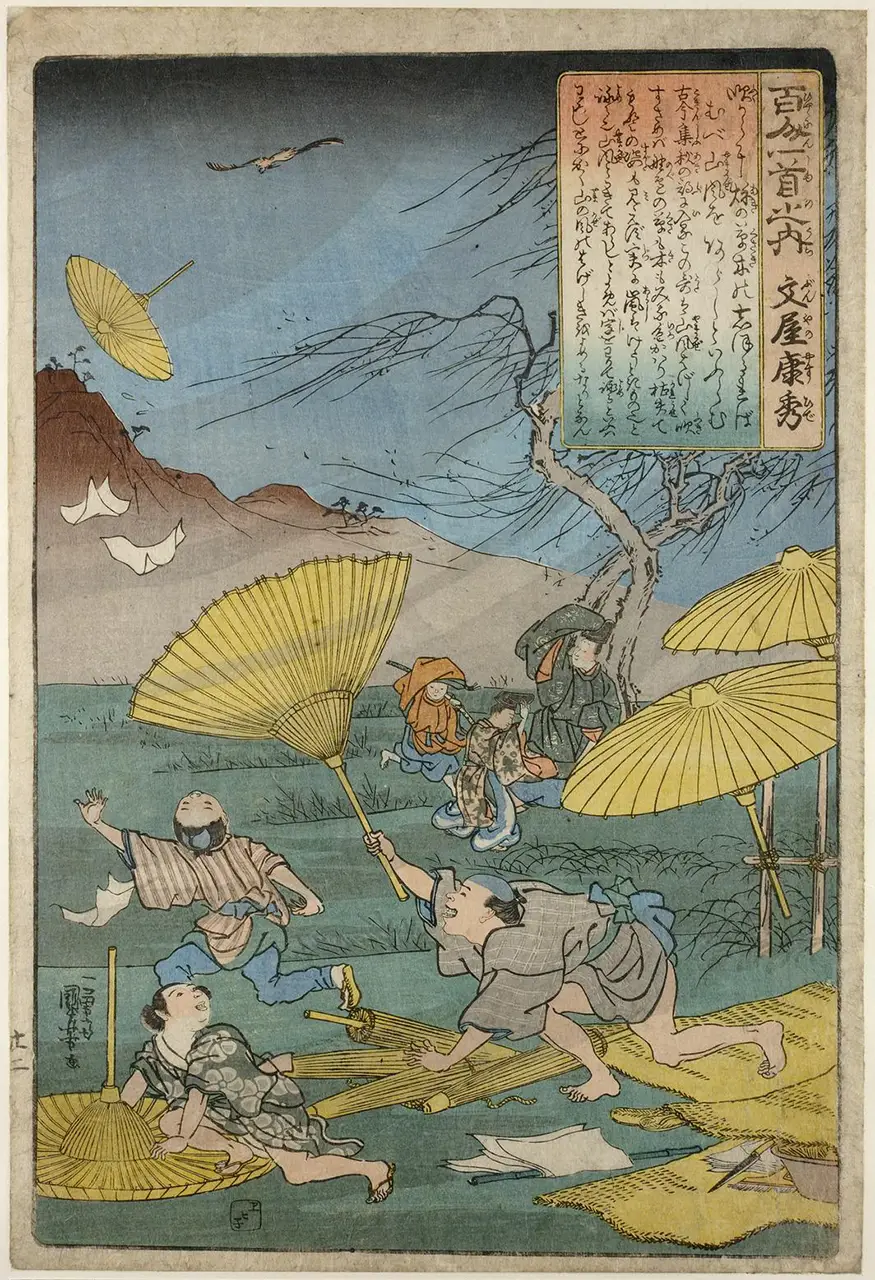
British Museum, Public domain, via Wikimedia Commons This ukiyo-e is by Utagawa Kuniyoshi, an artist of the Edo period.
It shows a scene that matches the poem in the Hyakunin Isshu.Yasuhide used the word play "mountain + wind = storm" (山 + 風 = 嵐) to explain, with reasoning, why the storm is so strong: "No wonder (mube)." Kuniyoshi turned that power into a dynamic picture of people tossed about by a fierce wind.
A man desperately chasing his blown-away umbrella, a woman holding down her kimono as it flaps up: Kuniyoshi deliberately turns Yasuhide's clever poem into a playful scene of Edo townspeople in a panic. It is a very interesting picture that, with Kuniyoshi's typical humor, brings the poem of Yasuhide, a descendant of the noble Mahito, into the everyday life of ordinary people.