Front of the Card
Back of the Card
Japanese
English
Audio: NHK Creative Library
Read by LibriVox volunteer Larry Wilson.
Audio courtesy of LibriVox
小野小町
花の色は
うつりにけりな
いたづらに
わが身よにふる
ながめせしまに
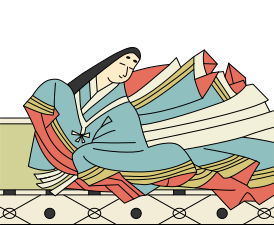
わかみよに
ふるなかめ
せしまに

はなの


- Poem 9
- 花の色は
うつりにけりな
いたづらに
わが身よにふる ながめせしまに
Author: Ono no Komachi (dates unknown)
Source: Kokin Wakashū, Spring
- English Verse Translation
- The blossom's tint is washed away By heavy showers of rain; My charms, which once I prized so much,
Are also on the wane, Both bloomed, alas! in vain.
— William N. Porter, 1909
- Modern Translation
- How the beauty of the cherry blossoms faded away, soaked by the long spring rains. And just like them, my own looks have faded too, lost in a haze of endless longing.
- Commentary
- A beautiful woman who spent her days looking for true love realizes that time has passed and she has grown old and lonely. How this poem is read, however, has changed from age to age.
- About the Poet
- Little is known for sure about Ono no Komachi. She is said to have been the daughter of Ono no Yoshizane, an official in Dewa Province. In Japan she is counted with Cleopatra and Yang Guifei as one of the "three great beauties of the world," and many legends surround her. She is also said to have served at the courts of Emperors Ninmyō and Montoku.
- Poem Illustration
-
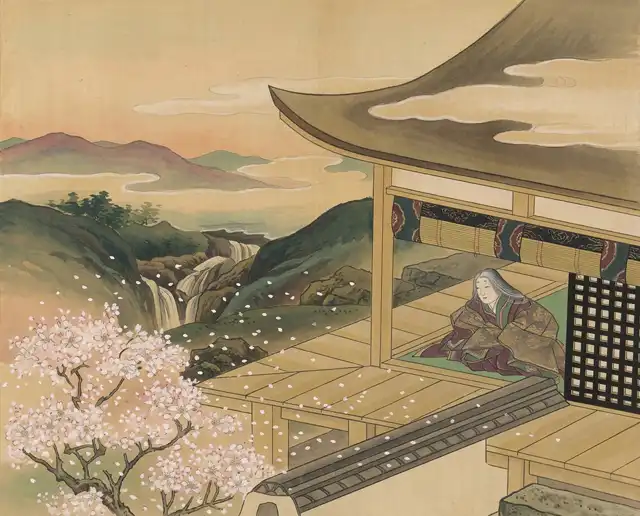
This image is based on an illustration from William N. Porter's A Hundred Verses from Old Japan, his 1909 English translation of the Hyakunin Isshu published in England, colorized and reworked using Adobe Firefly (generative AI).
- Ono no Komachi: A Short Timeline
-
- Notes
-
Little is known for sure about Ono no Komachi's life, including when she was born and died.
- Counted as one of the Six Immortal Poets
- Counted as one of the Thirty-Six Immortal Poets
- Ono no Komachi's Family Tree
-
The Ono clan played an important part in both politics and culture from the Asuka period to the Heian period.
In the Asuka period, Ono no Imoko went to Sui China as head of a Japanese mission. He is famous for carrying a letter for Prince Shōtoku to the Sui emperor that began, "The Son of Heaven in the land where the sun rises..."
In the Heian period, Ono no Takamura became known as a learned and gifted official and writer, and Ono no Michikaze, one of the Three Great Calligraphers, had a great influence on Japanese calligraphy.
And Ono no Komachi, one of the Six Poetic Sages, is remembered for her elegant poems and her legendary beauty.
The poet Fujiwara no Toshiyuki married a daughter of Ono no Minemori, who was Ono no Takamura's elder or younger sister, so the Ono and Fujiwara clans were also linked by marriage.
- Appendix
-
- What Komachi Meant by the Cherry Blossoms
-
Ono no Komachi's Hyakunin Isshu poem, "Hana no iro wa...," has two main readings. In the Middle Ages, it was read as a poem that links the cherry blossoms to love between a man and a woman, and to fading beauty: the fading color of the blossoms stands for her own youth and for love that changes.
But in the Edo period, scholars of Japanese classics such as Keichū, Kamo no Mabuchi, and Motoori Norinaga offered a different reading. Focusing on what the words originally meant, they argued that the poem need not be a metaphor for love; it can also be read simply as a poem about cherry blossoms losing their color. In other words, Komachi may have just been describing a spring scene: "While I gazed at the long spring rain, the color of the cherry blossoms faded."
In Japanese schools today, the poem is usually taught as one about love and growing old. Perhaps being read in so many ways over the ages is part of what makes it a great poem.
- The Six Poetic Sages (Rokkasen)
-
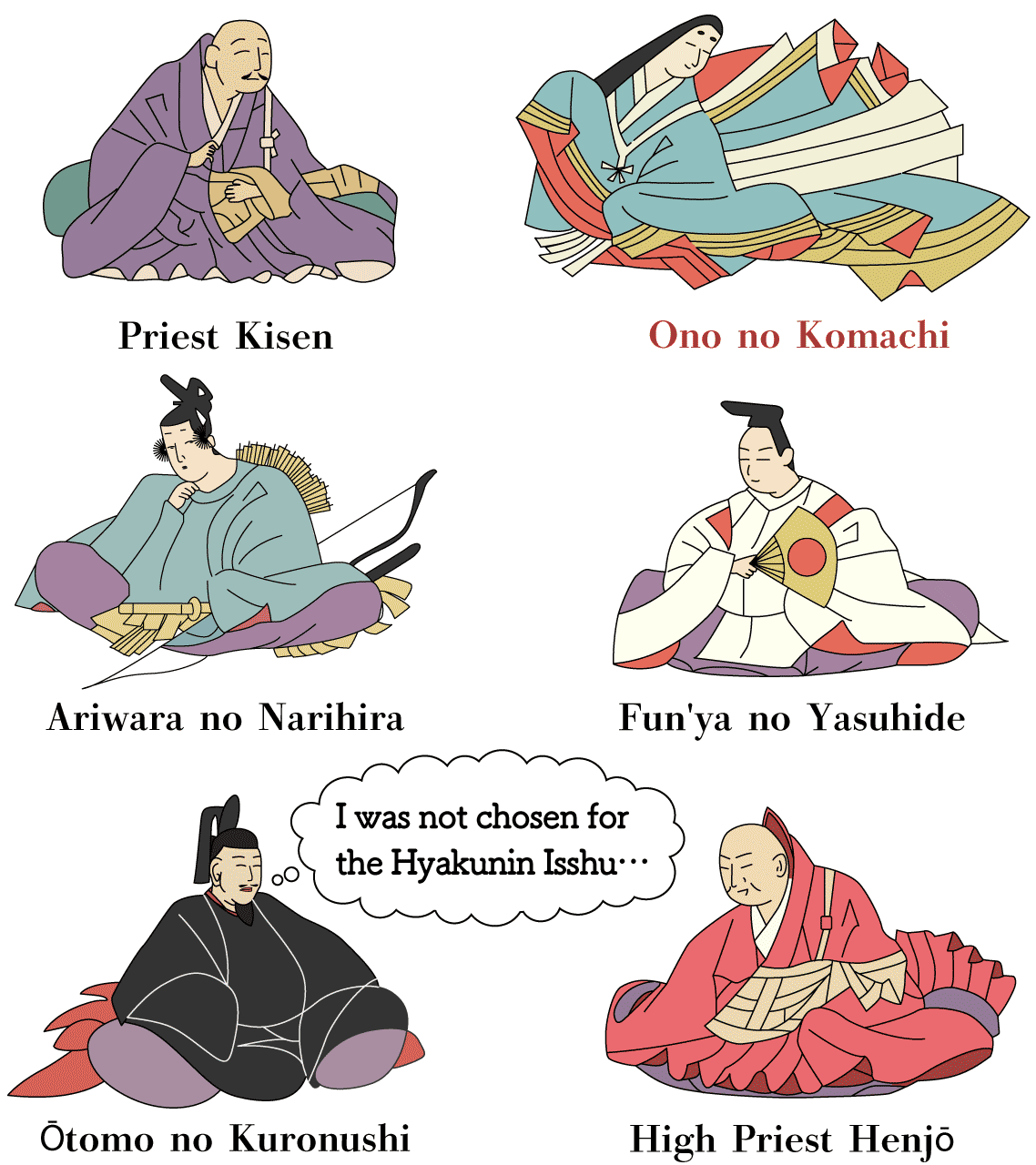
Click a poet to go to their poem page. When the Kokin Wakashū was compiled, these six poets, including Ono no Komachi, were very famous poets of the generation before. In the Japanese preface to the Kokin Wakashū, Ki no Tsurayuki picked them out as "people whose names were known in recent times" and judged their poetry. His judgments were quite harsh, but the six later came to be called the Rokkasen, the Six Poetic Sages, and were highly praised as great poets.
See Ki no Tsurayuki's judgments of the six poets.
One of the Six Poetic Sages, Ōtomo no Kuronushi, has no poem in the Hyakunin Isshu, while the other five were all chosen.
- A Poem About the Heart in Love
-
After throwing herself into many loves, Ono no Komachi seems to have reached a calm understanding of how easily people's hearts change. "Yo no naka" in this poem can mean "the world" but also "the relationship between a man and a woman," and here it is thought to mean the second. Her quiet gaze, seeing a change of heart as part of nature, has the depth of someone who has known both the sweet and the bitter.
In Japanese
色見えで 移ろふものは 世の中の
人の心の 花にぞありける iromiede utsurofumonoha yononakano
hitonokokorono hananizoarikeru Kokin Wakashū, Ono no KomachiIn English
What fades without showing its color
is the flower of the heart between lovers. - A Poem on Life, Death, and Impermanence
- Komachi wrote of how nothing in life lasts. Thinking of what she would become after death, she also wrote about the impermanence of life and death.
In Japanese
あはれなり わが身の果てや 浅緑
つひには野辺の 霞と思へば aharenari wagaminohateya asamidori
tsuhinihanobeno kasumitoomoheba Shin Kokin Wakashū, Ono no KomachiIn English
How sad it is that life and death never stay the same,
when I think that my body will become pale green smoke
and at last a haze drifting over the fields. - A Poem by Ise, in Contrast to Komachi
-
Ono no Komachi wrote with sadness that she could never get back the youth and beauty she was losing. Ise, on the other hand, wrote that even if she withered like winter fields, she would wait for spring to come again, as the seasons turn. The two poems are opposites, but perhaps everyone has both feelings: missing the past and finding hope in the future.
In Japanese
冬枯れの 野辺とわが身を 思ひせば
もえても春を 待たましものを fuyugareno nobetowagamio omohiseba
moetemoharuo matamashimonoo Kokin Wakashū, IseIn English
If I thought of myself as a withered winter field,
then even if I were burned, I would wait for spring, when new shoots come up. - A Poem Hoping to Meet in a Dream
-
Ono no Komachi wrote that she wanted to meet her lover, even if only in a fleeting dream. At the time, people believed that if someone you loved appeared in your dream, it was because they were thinking of you strongly. The wish to love and be loved in return seems the same in every age.
In Japanese
うたた寝に 恋しき人を 見てしより
夢てふものは 頼み初めてき utataneni koishikihitoo miteshiyori
yumetefumonoha tanomisometeki Kokin Wakashū, Ono no KomachiIn English
Ever since I saw the one I love while dozing,
I have begun to put my trust in dreams. - A Poem About a Dream She Did Not Want to Wake From
-
The next poem expresses deep regret at waking from a dream in which she met the one she loved. In another poem she calmly watches people's hearts change, yet here she is driven by a love she cannot control and cannot help wishing to meet him, even in a dream. Her honesty in putting even such contradictory feelings into her poems, just as they are, is part of what makes them true and appealing.
In Japanese
思ひつつ 寝ればや人の 見えつらむ
夢と知りせば 覚めざらましを omohitsutsu nerebayahitono mietsuramu
yumetoshiriseba samezaramashio Kokin Wakashū, Ono no KomachiIn English
Did he appear because I fell asleep thinking of him again and again? Had I known it was a dream, I would never have woken up.
- A Poem Using "Nagame"
- The next poem is by Ariwara no Narihira.
Ono no Komachi and Ariwara no Narihira, two great poets of the Heian period, each used the same pun, nagame ("long rain" and "gazing in thought"), to show the depths of their love.In Japanese
起きもせず 寝もせで夜を 明かしては
春のものとて ながめくらしつ okimosezu nemosedeyoruo akashiteha
harunomonotote nagamekurashitsu Kokin Wakashū, Ariwara no NarihiraIn English
Thinking of you, I spent the night neither getting up nor sleeping, and now I spend the day lost in thought, gazing at the long rain that comes with spring.
- A Poem to Fun'ya no Yasuhide
- When Fun'ya no Yasuhide was posted to Mikawa Province, he asked Ono no Komachi to come with him.
The next poem is her answer.In Japanese
わびぬれば 身を浮草の 根を絶えて
誘ふ水あらば いなむとぞ思ふ wabinureba mioukikusano neotaete
sasofumizuaraba inamutozoomofu Kokin Wakashū, Ono no KomachiIn English
I am so unhappy that, like a floating weed cut from its roots,
I think I would go wherever the water invites me. - How the Legend of Her Beauty Began
- Ono no Komachi is the only woman among the Six Poetic Sages. In the Japanese preface to the Kokin Wakashū, Ki no Tsurayuki judged her poems as follows. He says that Komachi follows the style of Princess Sotoori, a legendary beauty. This remark is thought to be how so many legends about Komachi's beauty began.
In Japanese
小野小町は、いにしへの衣通姫の流なり。あはれなるやうにて強からず。いはば、よき女のなやめるところあるに似たり。In English
Ono no Komachi follows the style of Princess Sotoori of long ago. Her poems are deeply moving, but they lack strength. It is like a beautiful woman who is unwell. - The Legend of the "Hundred Nights' Visits"
-
Momoyo-gayoi (the Hundred Nights' Visits) is a love story, also famous from Zeami's Noh plays. Ono no Komachi made a harsh promise: "If you visit me for a hundred nights in a row, I will accept your love." Believing her, Captain Fukakusa visited her for ninety-nine nights, but just before his wish came true, he died in a heavy snowstorm. It is a tale of his devotion and his tragic end.
One theory says the model for Captain Fukakusa was High Priest Henjō. - Ukiyo-e by Katsushika Hokusai
-
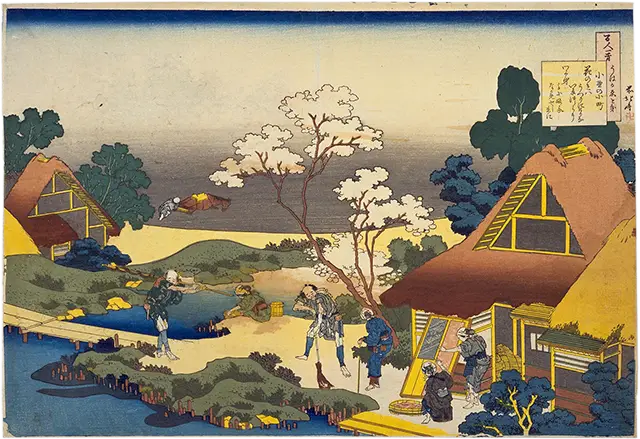
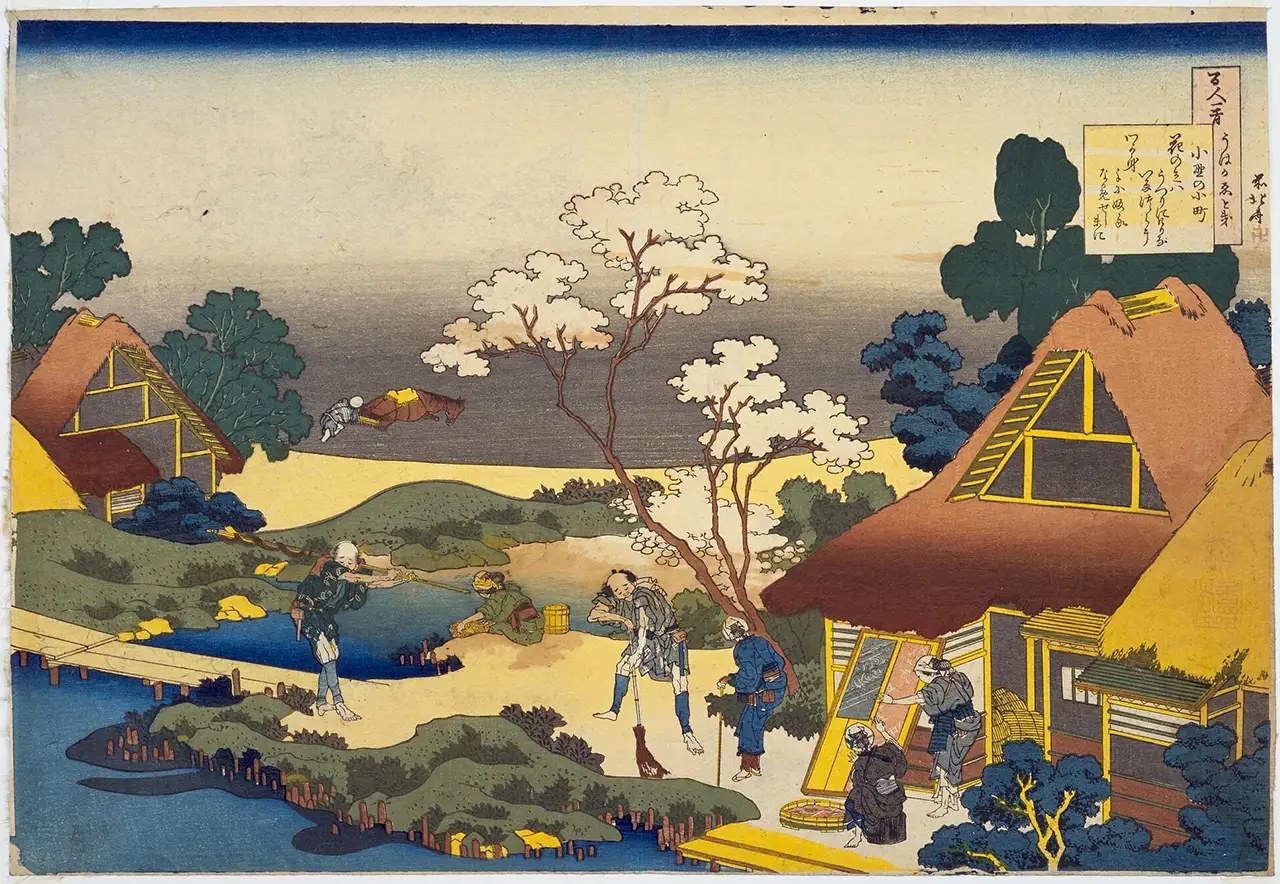
National Diet Library, Public domain, via Wikimedia Commons This print is from One Hundred Poems Explained by the Nurse (Hyakunin Isshu Uba ga Etoki) by Katsushika Hokusai, an ukiyo-e artist of the Edo period. The idea of the series is a nurse explaining the Hyakunin Isshu poems with easy-to-understand pictures. Komachi is said to have wandered on a journey late in life. Could the woman leaning on a cane and looking up at the cherry blossoms be Ono no Komachi?
- Utagawa Kuniyoshi's Hyakunin Isshu no Uchi
-
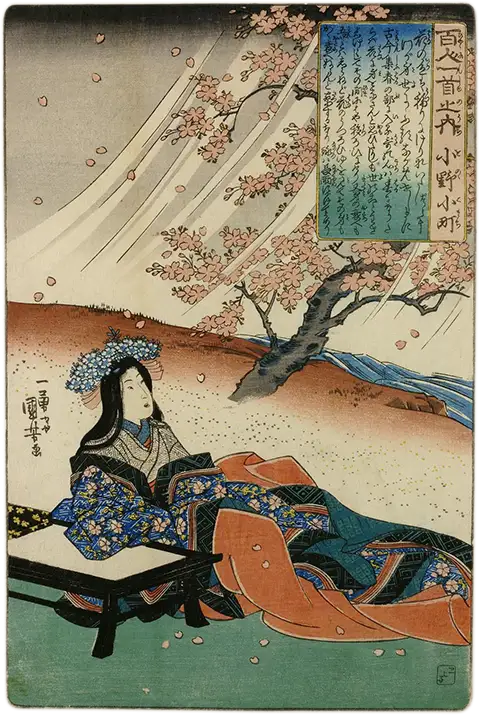
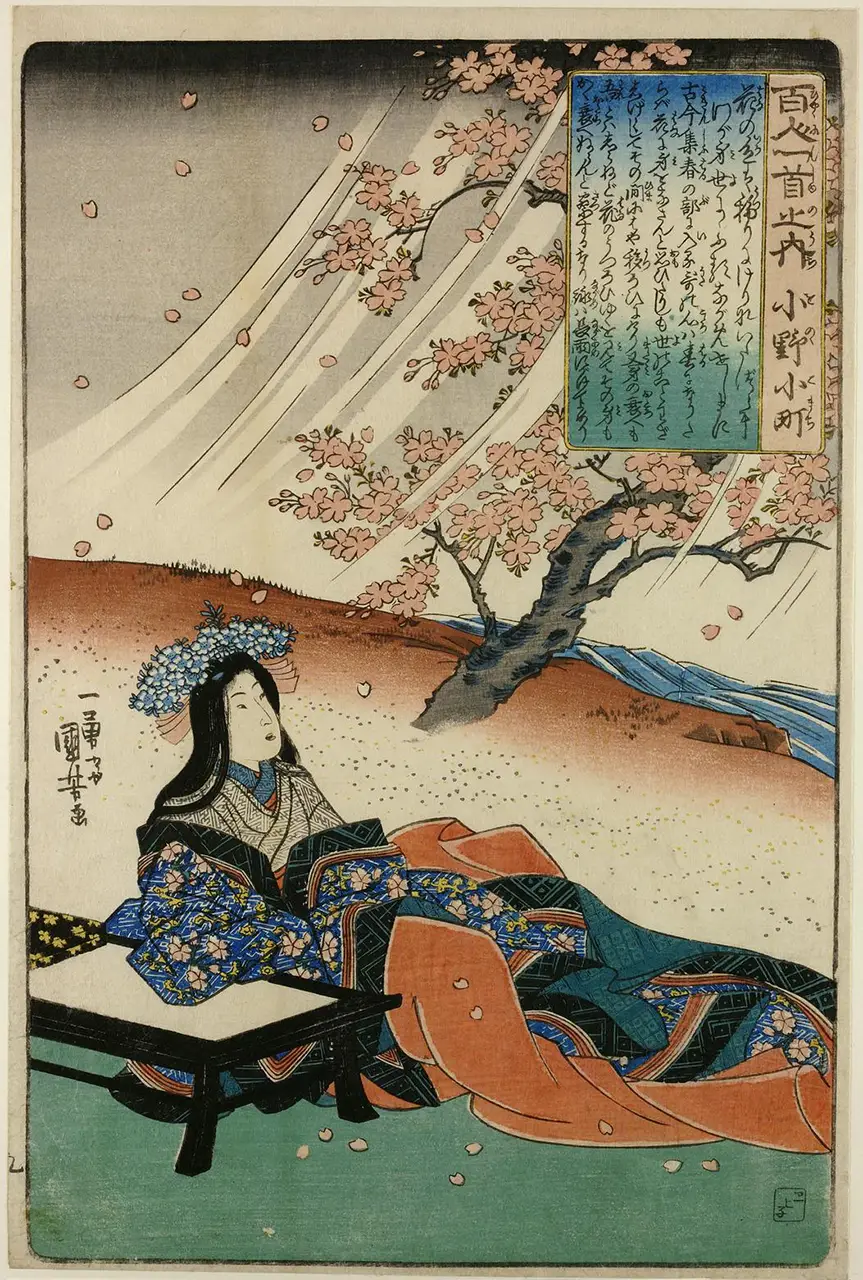
British Museum, Public domain, via Wikimedia Commons This ukiyo-e is by Utagawa Kuniyoshi, an artist of the Edo period.
It shows a scene that matches the poem in the Hyakunin Isshu.The cherry blossoms Komachi looks up at are starting to scatter in the wind. Is she feeling that, like the blossoms, her beauty lasts only a short time?
Perhaps the blue flower ornament in her hair and the colors of her kimono show her thoughtful mood.
- Legends of Ono no Komachi's Old Age
-
There is a famous legend that Ono no Komachi fell into poverty in her old age and wandered the fields, but it is not based on any record of her real later life.
The Tamatsukuri Komachi Sōsuisho, a work in Chinese written in the late Heian period, describes a woman who was proud and prosperous when young but sank into poverty in old age. Its heroine is not Ono no Komachi, but later readers took it as Komachi's story, and it greatly shaped the image of Komachi "fallen in her old age."
These stories of Komachi's decline in old age later found their way into tales and Noh plays. The Noh play Sotoba Komachi is a typical example.
- Tsukioka Yoshitoshi's One Hundred Aspects of the Moon
-
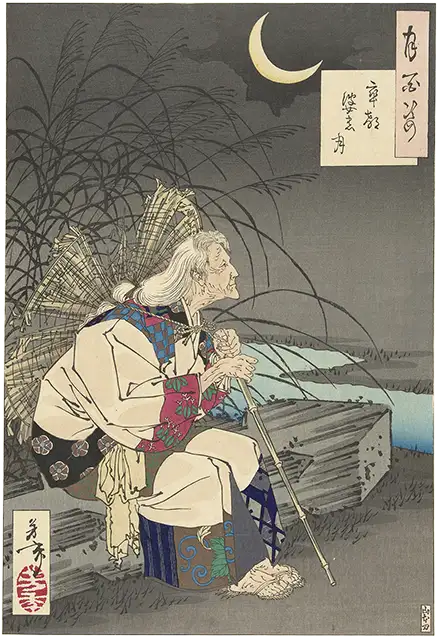
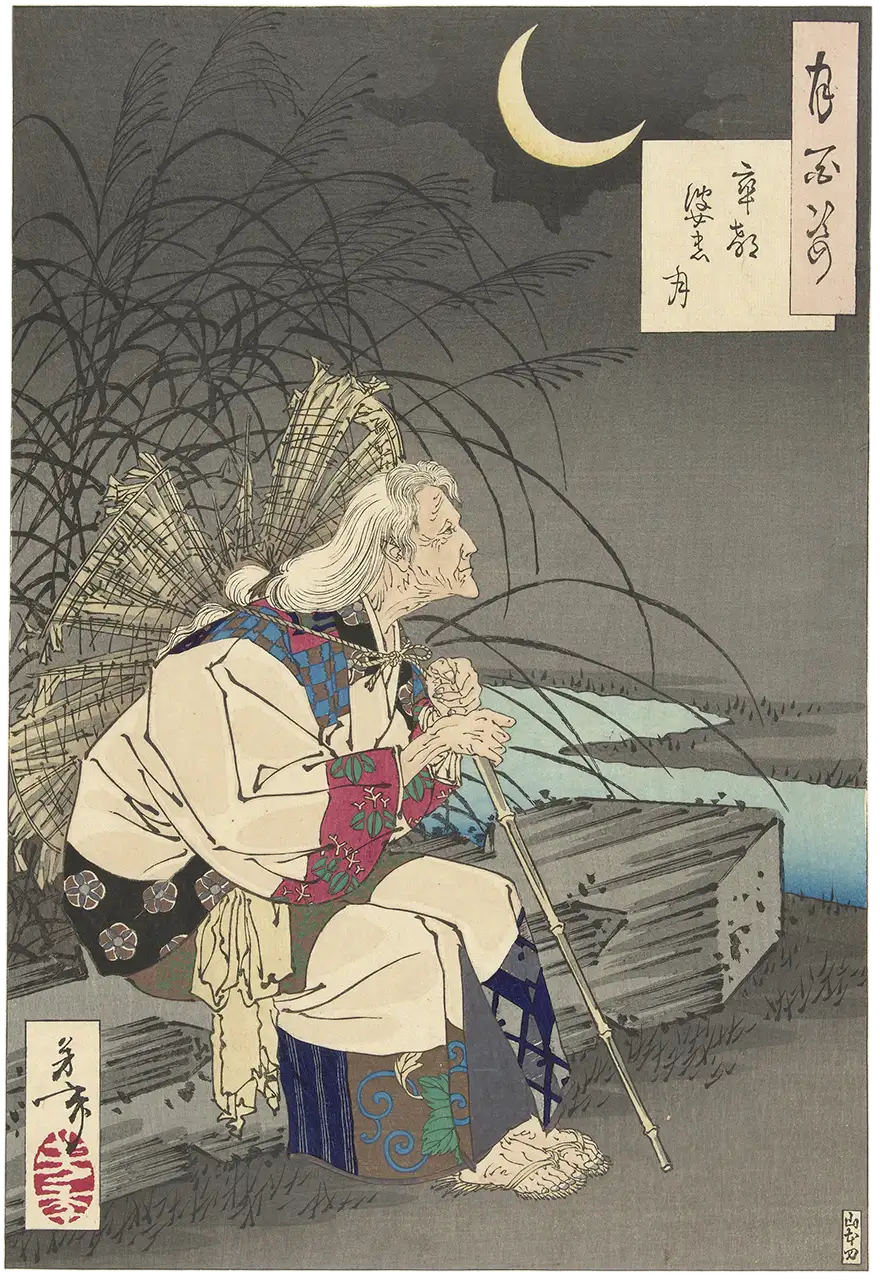
Tsukioka Yoshitoshi; Tsukioka Yoshitoshi died 1892; Yamamoto; Akiyama Buemon, Public domain, via Wikimedia Commons This ukiyo-e is by Tsukioka Yoshitoshi, an artist active from the end of the Edo period into the early Meiji period. Its subject is the Noh play Sotoba Komachi.
Sotoba Komachi tells of an old woman sitting on a sotoba (a wooden grave marker) and a monk from Mount Kōya. When the monk tells her not to sit there, she turns the tables and teaches him that "the mercy of the Buddha is not so shallow." She reveals that she was once the beautiful Ono no Komachi and begins to talk about her past. Then the spirit of Captain Fukakusa appears and possesses her, and she becomes half mad. As she acts out the hundred nights' visits, she comes back to her senses, turns to the way of the Buddha, and prays to be reborn in paradise.
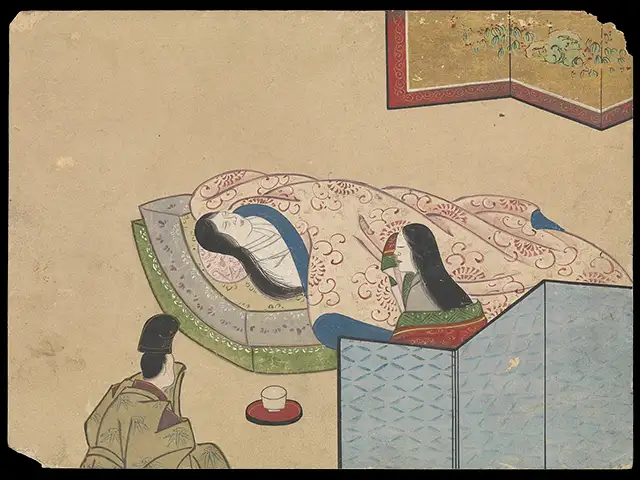
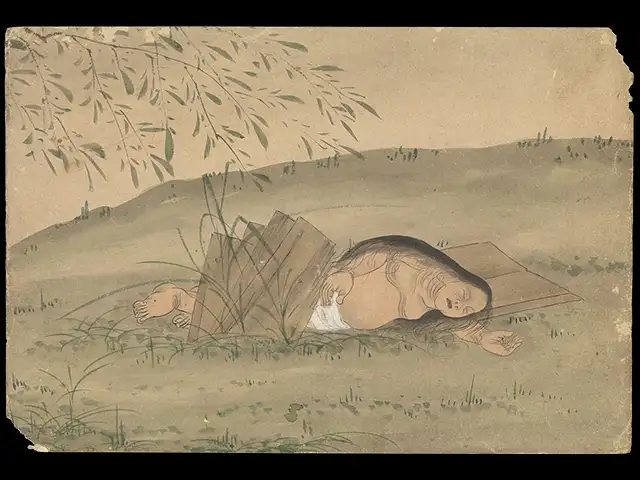
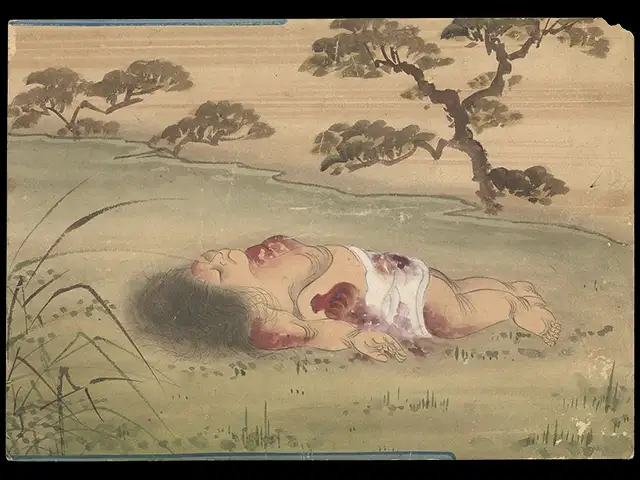
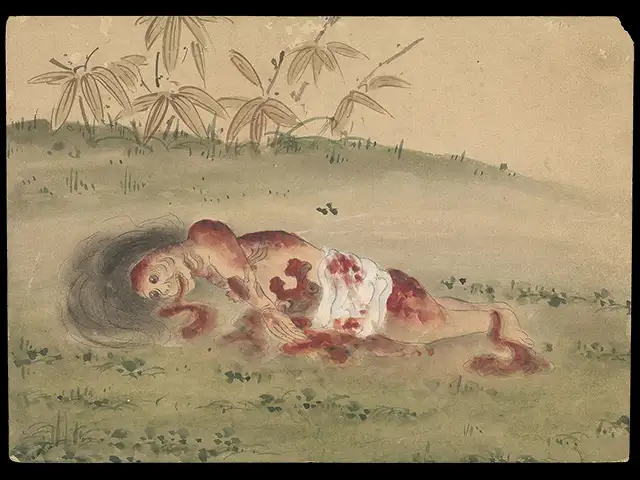
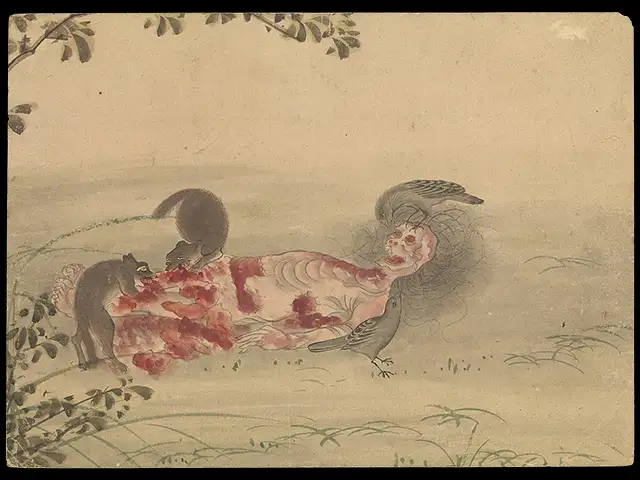
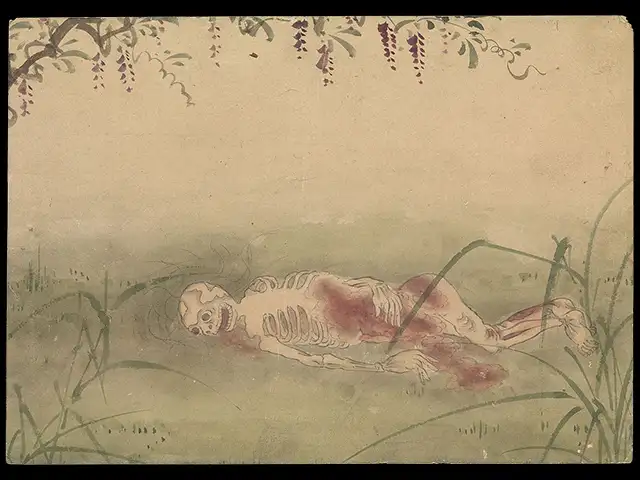
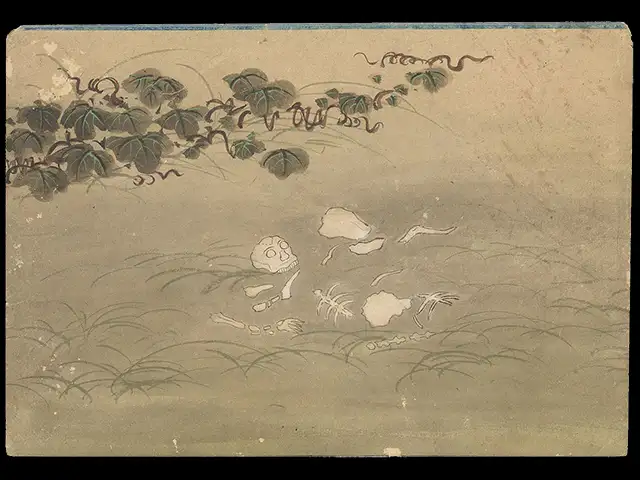
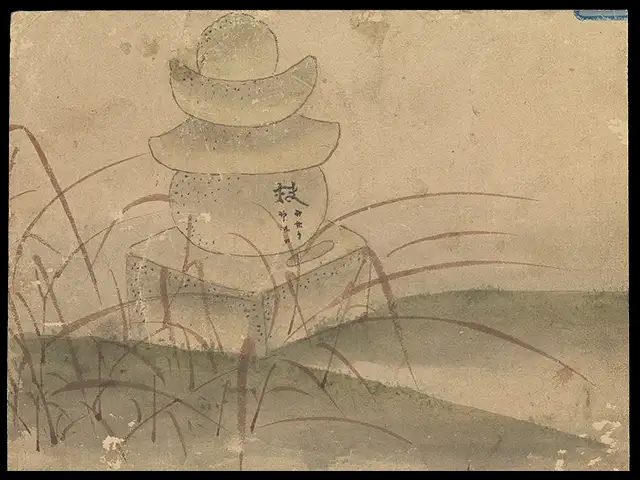
- Kusōzu (Paintings of the Nine Stages of Decay)
-
Kusōzu are Buddhist paintings that show, in nine stages, a dead body left outdoors as it decays. Women who had been beautiful were often chosen as the subject, and the Kusōzu of Ono no Komachi is well known. They are said to have been made to help monks free themselves from worldly desires, by showing that even the most beautiful woman becomes a skeleton after death, and that nothing in this world lasts.
See page for author, CC BY 4.0 <https://creativecommons.org/licenses/by/4.0>, via Wikimedia Commons